
Windows Virtual Angel: what it is and how to remove it
Windows Virtual Angel is a totally harmful computer program that has the same objectives as all the rest of the rogue anti-spywares. It belongs to FakeVimes family of malwares and clearly uses the same features as its earlier versions.
Facts checked October 7, 2026. Removal steps tested on Windows 11 (26H2) and checked against Microsoft's and the browser makers' current documentation. Sections marked as our earlier report are the original text: they describe the threat as it was then and have not been reviewed since. The 2026 status, the removal steps and the questions are current.
Automatic
Get a free scan and check if your PC is infected.
Fortect finds malware, unwanted programs and the Windows damage they leave behind, and repairs it in one pass.
If User32.dll returns after removal, a full scan can find the entry that brings it back.
Do it yourself · free Remove Windows Virtual Angel yourself 5 steps, about 15 minutes, no software needed.
Start the steps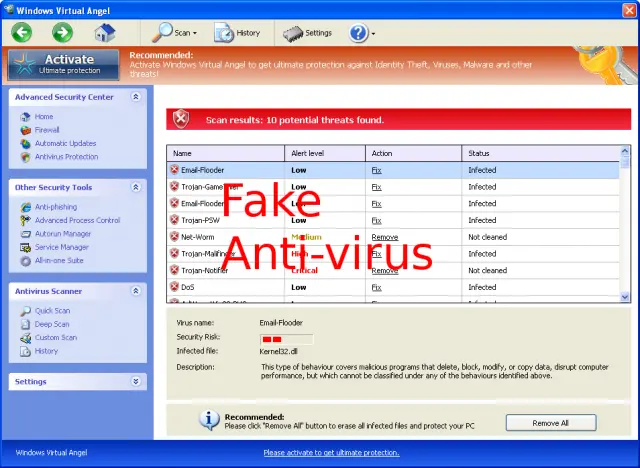
Windows Virtual Angel: summary
| Detection names | No Microsoft detection name is known |
|---|---|
| Distribution | Not recorded in the old report |
| Damage | Not recorded in the old report |
| Name | Windows Virtual Angel |
| Type | Rogue antivirus |
| Symptoms | An unknown process in Task Manager |
| Removal | Scan the PC with security software to find and remove the malware and anything installed with it. Fortect scans Windows for malware and repairs the system files and settings it damaged. Remove it nowTo use the full-featured product, you have to purchase a license for Fortect. The scan is free. |
Show 4 more facts
| Files and processes | User32.dll |
|---|---|
| Evidence | One write-up by a security site; details still limited |
| First seen | 26 April 2021 |
| Facts checked | 7 October 2026 |
From our report of Apr 2021 · not reviewed since
What Windows Virtual Angel is
Windows Virtual Angel is a totally harmful computer program that has the same objectives as all the rest of the rogue anti-spywares.
It belongs to FakeVimes family of malwares and clearly uses the same features as its earlier versions. We highly recommend not to fall for Windows Virtual Angel and remove this threat once you find it on your computer. For that, run a full system scan with anti-malware program to make sure that all infected files are eliminated.
Is Windows Virtual Angel a real security program?
- File:
User32.dll
From our report of Apr 2021 · not reviewed since
More from our earlier report on Windows Virtual Angel
- Error Attempt to modify registry key entries detected.
- Registry entry analysis is recommended.
- Error Potential malware detected It is recommended to activate the protection and perform a thorough system scan to remove the malware.
- Warning Firewall has blocked a program from accessing the Internet Windows XP USER API Clien: DLL User32.dll User32.dll is suspended to have infected your PC.
- This type of virus intercepts entered data and transmits them to a remote server.
How Windows Virtual Angel got on your PC
From our report of Apr 2021 · not reviewed since
Being a fake security solution, Windows Virtual Angel penetrates into PC in a stealthy way, that means it uses security vulnerabilities to come inside and unnoticeably download all its files.
The most interesting part of its infiltration is registry modification which helps for this virus launch as soon as user reboots his PC. In addition, Windows Virtual Angel tends to generate fabricated security scanners that report about invented threats and viruses on the targeted computer.
Of course, we highly recommend to ignore such alerts because most of these 'viruses' are harmless system files. Here are some examples of Windows Virtual Angel alerts:
After reporting about all these invented threats, Windows Virtual Angel offers you install a licensed its version as a tool capable to help you fix your computer. However, paying for it is the same as giving your money for scammers because it is useless just like unregistered Windows Virtual Angel version.
How to remove Windows Virtual Angel
Nothing it reports is real.
These steps remove it and undo a payment if you made one.
Step 1: Do not pay, and undo a payment if you made one
Nothing that Windows Virtual Angel says it found needs fixing by it. Close its windows and do not enter card details.
If you bought it, contact your bank or card issuer about a dispute and cancel any renewal, keeping the receipt e-mail as evidence. Uninstalling it from Windows 11 or Windows 10 removes the program but leaves the subscription running.
Full procedure with screenshots: What to do after paying a scammer
Step 2: Uninstall programs you did not mean to install
Windows Virtual Angel rarely comes alone: it is usually installed by, or together with, a free program. In Windows 11 open Settings > Apps > Installed apps, in Windows 10 Settings > Apps > Apps & features, and sort by install date.
Uninstall every entry from the day the trouble began that you did not install on purpose, for example a download manager, a converter or a browser you never chose.
Keep drivers and entries from Microsoft, Intel, AMD, NVIDIA or your PC's maker unless you are sure.
Full procedure with screenshots: Uninstall a program or app in Windows On uGetFix
Step 3: Remove it from startup
Press Ctrl + Shift + Esc to open Task Manager and select Startup apps (Windows 11) or the Startup tab (Windows 10). Disable entries you do not recognise, especially ones with no publisher or with a name that copies a Windows component.
Right-click an entry and choose Open file location to see where it runs from: programs in
%AppData%or%Temp%deserve a closer look. Some entries are not listed there but in the registry Run keys, which the procedure below shows how to check.Full procedure with screenshots: Stop apps from opening at startup On uGetFix
Step 4: Delete the folders left behind
Uninstalling often leaves the program's folders, and some threats reinstall themselves from them.
Press Windows + R, type
%LocalAppData%and press Enter, then do the same for%AppData%and %ProgramData%, and look for folders named after Windows Virtual Angel, its publisher or created on the day the problem started.Delete those folders, and check
C:\Program FilesandC:\Program Files (x86)too.If Windows says a file is in use, end it in Task Manager or delete the folder after a restart in Safe Mode. The folders are the same in Windows 11 and Windows 10.
Full procedure with screenshots: Remove what malware leaves behind in Windows
Step 5: Scan the PC, then run the offline scan
A scan finds the parts of Windows Virtual Angel that the manual steps cannot see. In Windows Security > Virus & threat protection > Scan options, start a Full scan and quarantine what it reports.
Follow it with Microsoft Defender Antivirus (offline scan) > Scan now, which restarts the PC and checks the disk while Windows and the malware are not running.
It takes about 15 minutes and works the same in Windows 11 and Windows 10. If either scan finds something, run the full scan again after removal until it comes back clean.
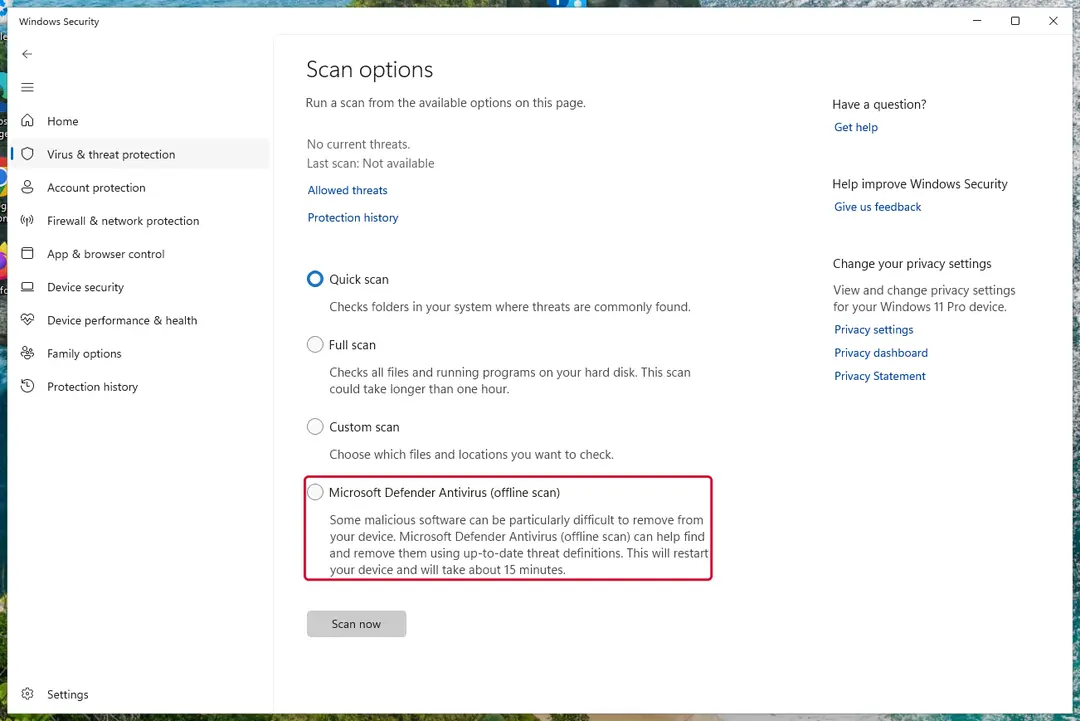
Windows 11: Windows Security > Virus & threat protection > Scan options. Full procedure with screenshots: Run a Microsoft Defender Offline scan
Protect your privacy - employ a VPN
There are several ways how to make your online time more private - you can access an incognito tab.
However, there is no secret that even in this mode, you are tracked for advertising purposes. There is a way to add an extra layer of protection and create a completely anonymous web browsing practice with the help of VPN. This software reroutes traffic through different servers, thus leaving your IP address and geolocation in disguise.
Besides, it is based on a strict no-log policy, meaning that no data will be recorded, leaked, and available for both first and third parties. The combination of a secure web browser and VPN will let you browse the Internet without a feeling of being spied or targeted by criminals.
No backups? No problem. Use a data recovery tool
If you wonder how data loss can occur, you should not look any further for answers - human errors, malware attacks, hardware failures, power cuts, natural disasters, or even simple negligence.
In some cases, lost files are extremely important, and many straight out panic when such an unfortunate course of events happen. Due to this, you should always ensure that you prepare proper data backups on a regular basis.
If you were caught by surprise and did not have any backups to restore your files from, not everything is lost. is one of the leading file recovery solutions you can find on the market - it is likely to restore even lost emails or data located on an external device.
From our report of Apr 2021 · not reviewed since
HOW CAN YOU REMOVE WINDOWS Virtual Angel
In order to stop those multiple obnoxious notifications that usually tell you about the extremely bad security condition on your PC, you should remove Windows Virtual Angel from the PC.
Under no circumstances believe its alerts and scan reports and run a full system scan with reputable anti-spyware program to get rid of this dangerous malware for good. According to our security experts, running or is the easiest way to fix your machine.If you are disabled from launching these programs, enter this this code: 0W000-000B0-00T00-E0020 to 'register' your virus first.
The latest parasite names used by FakeVimes:
Questions about Windows Virtual Angel
Is User32.dll safe?
It depends on where the file is and who signed it, not on the name. Open Task Manager, go to the Details tab, right-click User32.dll and choose Open file location. A file inside Program Files or System32 with a valid digital signature from a known company is usually part of a legitimate program.
A file in AppData, Temp or ProgramData with no signature, especially one that restarts itself after you end it, is suspicious. If you cannot tie the process to anything you installed, uninstall recent unfamiliar programs and run a Microsoft Defender Offline scan.
User32.dll keeps coming back. What should I do?
A process that returns after you end it has a restart mechanism, and that is a reason to treat User32.dll as unwanted. Check Settings > Apps > Startup, Task Scheduler and the Services list for entries pointing to its folder, and disable them.
Look in Installed apps for anything added the same day and uninstall it. Then delete the folder and run a Microsoft Defender Offline scan, which works before Windows starts and can remove files that are locked or hidden while the system is running.
What could the caller do while connected to my PC?
Anything you could do. Callers working with fake alerts like Windows Virtual Angel typically show you Windows logs as "proof", install their own remote tool for later, and steer you to online banking or a gift card purchase. Some add a password to Windows or lock the PC if you refuse to pay.
Remove every remote access program you did not install yourself, check Settings > Accounts > Other users for new accounts, and change important passwords from a clean device. If you cannot be sure what was changed, a reset of Windows is the safe choice.
Do I need to reinstall Windows to get rid of Windows Virtual Angel?
Usually not. A thorough clean-up is enough when the offline scan finds nothing afterwards and you do not see an unfamiliar process called User32.dll in Task Manager again. A reset is the safer choice if an attacker had remote control, if security tools were switched off, or if detections come back after every clean-up.
Windows 11 can reset itself without a USB stick under Settings > System > Recovery > Reset this PC. Copy documents and photos out first and scan the copies. A reset does not change passwords or undo stolen data, so the account steps still apply.
Is my card safe after buying Windows Virtual Angel?
Treat it as exposed. The order page belongs to the seller of Windows Virtual Angel, and you cannot know how the number is stored or shared. Ask your bank for a replacement card, which is usually free, and dispute the original charge as a misrepresented product.
Until the new card arrives, check your account daily for small or foreign transactions. If the bank offers alerts for every card payment, turn them on. Keep the receipt and screenshots, because they support the dispute.
How do I know Windows Virtual Angel is fake?
Three things give it away. It appears as an unfamiliar process called User32.dll in Task Manager, a window from a program rather than from Windows Security. It pushes you to act quickly by calling, paying or downloading.
And the threats it reports never show up when you run a scan in the real Windows Security app. Microsoft does not put phone numbers in warnings or charge for removing threats through pop-ups. Close the window, do not call, and follow the steps to find and uninstall the program behind it.
Someone called offering a refund for Windows Virtual Angel. Is it genuine?
Almost certainly not. Refund calls are a well-known second stage of scareware and tech support scams. The caller says you are owed money, asks you to install a remote access program to "process" it, then opens your online banking, makes it look as if too much was refunded and asks you to send the difference back.
Hang up. Real refunds go back to the card or PayPal account you paid with, through your bank or the payment provider, and never need remote access or a gift card.
Did Windows Virtual Angel steal my information?
Not by itself, as far as reports show. Programs that display an unfamiliar process called User32.dll in Task Manager are built to scare people into paying or calling; they rarely take data on their own.
The risk comes from what you did in response: typing card details into the program, or letting a caller connect to your PC. If you did neither, uninstalling the program is enough. If you did either, treat that information as exposed:
- block the card
- change passwords from another device
- remove any remote-access tool that was installed
Will Fortect remove Windows Virtual Angel?
Fortect scans Windows for malware and unwanted programs and repairs the system files and settings they change, and its free scan shows what it finds on your PC before you decide anything.
For Windows Virtual Angel, follow the plan above as well: the browser steps take back permissions and settings that no scanner treats as a threat, and uninstalling the program that brought it removes the source.
Run Microsoft Defender's full scan and, if anything was found, its offline scan as a second opinion. If the symptoms are gone after the plan and both scans are clean, there is nothing more to do.
Sources
- FTC: How to recognize, remove and avoid malware (read October 7, 2026)
- Microsoft Learn: Microsoft Defender Offline (read October 7, 2026)
- Microsoft Learn: How Microsoft names malware (read October 7, 2026)