

$1000 Amazon Gift Card is a hoax that is used to collect personal data
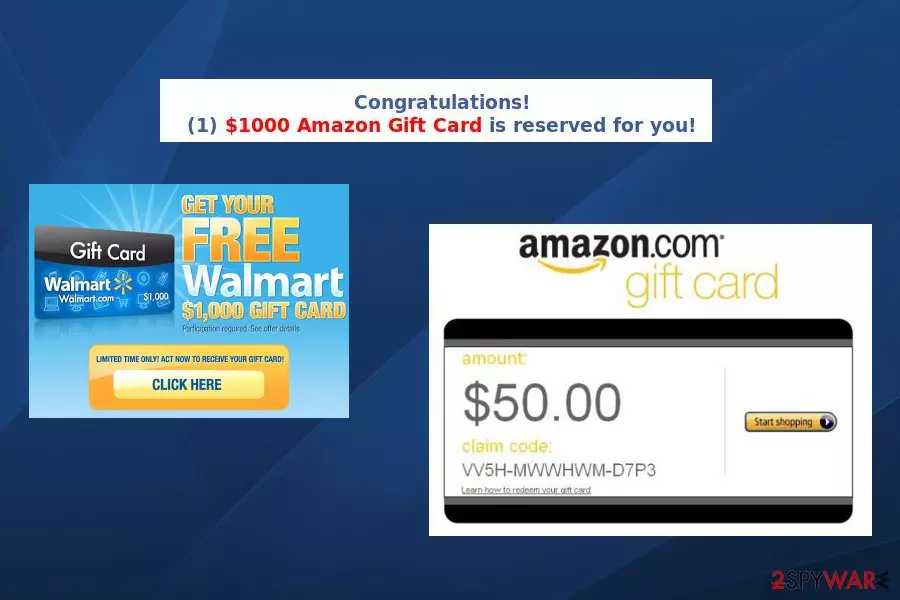
$1000 Amazon Gift Card is a fake alert[1] that emerges on Chrome, Firefox, Edge, and other web browsers when the system is infected with adware-type program. People are informed about a possibility to win Amazon gift card worthy $1000 or even more. Unfortunately, the message is just a catch used to trick unsuspecting PC users. In reality, the $1000 Amazon Gift Card scam seeks to harvest people's personal information, such as telephone number, email address, full name, address, etc. According to the most reputable AV vendors, this message is yet another Survey Scam identical to “Congratulations Amazon User” scam, Amazon Gift card scam or “Amazon Rewards Event.”
| Name | “$1000 Amazon Gift Card is reserved for you” |
|---|---|
| Classification | Adware |
| Sub-category | Survey scam |
| Danger level | Low. If PC's user ignores the pop-up, it can hardly cause any damage. However, if the PC's owner participates in a survey, he or she may unconsciously subscribe useless services and pay for it monthly or start receiving spam calls and messages. |
| Symptoms | Continuous web browser's redirects to fake Amazon websites, pop-ups reporting a $1000 Amazon Gift Card giveaway, an excessive amount of commercial pop-ups. |
| If you encounter such and similar scam alert, do not postpone a full system scan with FortectIntego. That's the quickest way to get rid of malware | |
$1000 Amazon Gift Card virus has mostly been spreading on Mac OS X, but it can occur on Windows on the same frequency. Unfortunately, neither of the web browsers on the market (Google Chrome, Safari, Mozilla Firefox, Internet Explorer, Opera, etc.) is immune to this scam.
Typically, the $1000 Amazon Gift Card scam infiltrates PCs via freeware and injects third-party web browser's extension, which starts displaying fake Amazon prize giveaway pop-ups. As soon as this PUP gets victim's attention, he or she is asked to click the “Continue” button. After doing so, the user is redirected to a “Quick Survey” window, which asks to indicate the phone number, name, home address, email address and other sensitive information.
The potential victim is also informed about the decreasing number of “remaining prizes” and similar information. That's a psychological strategy used by criminals to raise people's interest and involve them in the scam affair. Unfortunately, the “$1000 Amazon Gift Card is reserved for you” virus has nothing in common with Amazon. In fact, this American e-commerce and cloud computing company is not spreading gift cards worth $1000.
In a nutshell, this scam is a result of your PC's infection. Thus, it won't stop from disrupting you during web browsing as long as you won't remove $1000 Amazon Gift Card related adware. For this purpose, we recommend scanning the system with FortectIntego or any other legitimate security software. We also recommend changing passwords and login information you use to connect to social networks.

In addition to the appearance of “$1000 Amazon Gift Card is reserved for you” pop-up, that typically shows up each time you start your browsing on the Internet, the annoying adware program can start causing the following activities:
- Displaying various ads, offers, banners, and pop-ups that all promote questionable content, including installers for various optimization utilities, fake updates, toolbars, tech support scams or similar. These tools are not legitimate. Instead, they can lead you to malware installation and other computer-related issues.
- Trying to install additional components, including browser helper objects and similar components without users’ consent. These objects are typically used to modify system settings, like DNS configuration, system files, security settings, etc., and prevent virus removal from the system.
- Collecting non-personally identifiable information which includes search queries, visited websites, IP addresses, and similar data. This data is used to generate customized ads and gain profit from it.
$1000 Amazon Gift Card scam is a tricky pop-up window, which attract attention of thousands PC users. However, you should be vigilant and stay away from deals that seem to be too good to be true. If you have been attacked by this fake Amazon-themed ad for a while, do not postpone its elimination.
$1000 Amazon Gift Card is reserved for you removal consists of two procedures. First of all, it's a must to eliminate all suspicious and unknown entries from the system. You can do that both manually or automatically. For more information, please heed to the bottom of this article.

You are the one who lets adware into the system. Tips to prevent it
Users are often not aware of the fact that adware-type programs can get into their computers without a clear permission asked. Fortunately, adware cannot affect the machine as seriously as other viruses. However, its ability to redirect users to questionable websites and data tracking cannot be ignored.
The most popular methods used by adware to sneak into users’ systems are:
- Bundling;
- Fake software updates;
- Torrent/P2P websites.
To avoid unwanted programs on your computer, you need to keep away from third-party content and install only legitimate software. If you install free software[2], make sure you follow each installation step carefully and opt for the Advanced installation mode instead of Recommended one. Then, examine the list of optional programs presented to you during installation and uncheck everything you do not recognize.
Besides, you should always Read EULA/Terms of Use before downloading ANY program to your computer. If anything seems shady, abort the installation entirely.
Learn how to eliminate $1000 Amazon Gift Card virus
Adware can show up on your computer unexpectedly. Even if you are encountering this alert for some time, do not worry too much because it does not have a negative effect on your system. However, adding your personal information to its offered forms can be dangerous.
To proceed with $1000 Amazon Gift Card removal, you need to find potentially unwanted programs on your computer. For that, you can either use anti-spyware software or try to find them manually. To help you with this procedure, security experts[3] created a step-by-step guide which is presented below. However, please be careful and follow each step with care. Otherwise, the virus can reappear right after you reboot your computer.
If you want to remove “$1000 Amazon Gift Card is reserved for you” adware without such issues, employ an anti-virus software. Be aware that security software you download from the Internet must be checked twice to avoid using fake applications that cause more trouble than help.
Uninstall from Windows
Uninstall from Windows 10/8:
- Type Control Panel into the Windows search box and open the result.
- Under Programs, select Uninstall a program.


Uninstall from Windows 7/XP:
- Click on Windows Start > Control Panel (Windows XP users should click on Add/Remove Programs).
- In Control Panel, select Programs > Uninstall a program.


Remove the unwanted program:
- In the Programs and Features window, look for any recently installed suspicious entries, select them, and click Uninstall.
- If User Account Control appears, click Yes to confirm, then complete the removal.


Delete from macOS
Remove the unwanted application:
- From the menu bar, select Go > Applications.
- In the Applications folder, look for any suspicious entries, then drag them to Trash (or right-click and pick Move to Trash).


Delete leftover files and folders:
- Select Go > Go to Folder.
- Enter /Library/Application Support and remove any suspicious folders related to the unwanted program.
- Repeat the same check in the /Library/LaunchAgents and /Library/LaunchDaemons folders, deleting any suspicious entries.

- Finally, empty the Trash to permanently remove the leftovers.

Reset Internet Explorer
Remove dangerous add-ons:
- Open Internet Explorer, click on the Gear icon (IE menu) on the top-right corner of the browser
- Pick Manage Add-ons.
- You will see a Manage Add-ons window. Here, look for suspicious plugins. Click on these entries and select Disable.


Change your homepage if it was altered:
- Open IE and click on the Gear icon.
- Select Internet Options.
- In the General tab, delete the Home page address and replace it by your preferred one (for example, Google.com).
- Click Apply and then select OK.


Delete temporary files:
- Press on the Gear icon and select Internet Options.
- Under Browsing history, click Delete...
- Select relevant fields and press Delete.


Reset Internet Explorer:
- Click on Gear icon > Internet options and select Advanced tab.
- Select Reset.
- In the new window, check Delete personal settings and select Reset.


Remove from Microsoft Edge
Delete unwanted extensions from MS Edge:
- Select Menu (three horizontal dots at the top-right of the browser window) and pick Extensions.
- From the list, pick the extension and click on the Gear icon.
- Click Remove.


Clear cookies and other browser data:
- Click on the Menu (three horizontal dots at the top-right of the browser window) and select Settings > Privacy, search, and services..
- Under Clear browsing data, pick Choose what to clear.
- Select Cookies and other site data and Cached images and files. (apart from passwords, although you might want to include Media licenses as well, if applicable) and click on Clear.


Restore new tab and homepage settings:
- Click the menu icon and choose Settings.
- Then find On startup section.
- Click Remove next to any suspicious startup page.
Reset MS Edge if the above steps did not work:
- Press on Ctrl + Shift + Esc to open Task Manager.
- Click on More details arrow at the bottom of the window.
- Select Details tab.
- Now scroll down and locate every entry with Microsoft Edge name in it. Right-click on each of them and select End Task to stop MS Edge from running.


Instructions for Chromium-based Edge
Delete extensions from MS Edge (Chromium):
- Open Edge and click select Settings > Extensions.
- Delete unwanted extensions by clicking Remove.


Clear cache and site data:
- Click on Menu and go to Settings.
- Select Privacy, search and services.
- Under Clear browsing data, pick Choose what to clear.
- Under Time range, pick All time.
- Select Clear now.


Reset Chromium-based MS Edge:
- Click on Menu and select Settings.
- On the left side, pick Reset settings.
- Select Restore settings to their default values.
- Confirm with Reset.
- This will disable extensions and reset startup pages but will not delete bookmarks, saved passwords, or browsing history.


Remove from Mozilla Firefox (FF)
Remove dangerous extensions:
- Open Mozilla Firefox browser and click on the Menu (three horizontal lines at the top-right of the window).
- Select Add-ons.
- In here, select the unwanted extension and click Remove.


Reset the homepage:
- Click three horizontal lines at the top right corner to open the menu.
- Choose Settings.
- Under Home, set your preferred homepage and new tab settings.
Clear cookies and site data:
- Click Menu and pick Settings.
- Go to Privacy & Security section.
- Scroll down to locate Cookies and Site Data.
- Click on Clear Data...
- Select Cookies and Site Data and Temporary cached files and pages, then click Clear.


Reset Mozilla Firefox
If clearing the browser as explained above did not help, reset Mozilla Firefox:
- Open Mozilla Firefox browser and click the Menu.
- Go to Help and then choose Troubleshooting Information.

- Under Give Firefox a tune up section, click on Refresh Firefox...
- Once the pop-up shows up, confirm the action by pressing on Refresh Firefox.



Remove from Google Chrome
Delete malicious extensions from Google Chrome:
- Open Google Chrome, click on the Menu (three vertical dots at the top-right corner) and select More tools > Extensions.
- In the newly opened window, you will see all the installed extensions. Uninstall all suspicious extensions related to the unwanted program by clicking Remove.


Clear cache and web data from Chrome:
- Click on Menu and pick Settings.
- Under Privacy and security, select Clear browsing data.
- Select Browsing history, Cookies and other site data, as well as Cached images and files.
- Click Clear data.


Change your homepage:
- Click menu and choose Settings.
- Look for a suspicious site in the On startup section.
- Click on Open a specific or set of pages and click on three dots to find the Remove option.
Reset Google Chrome:
If the previous methods did not help you, reset Google Chrome to eliminate all the unwanted components:
- Click on Menu and select Settings.
- In the Settings, scroll down and click Advanced.
- Scroll down and locate Reset and clean up section.
- Now click Restore settings to their original defaults.
- Confirm with Reset settings.


Delete from Safari
Remove dangerous extensions:
- Open Safari, click Safari in the menu at the top-left of the screen, and select Preferences.
- Go to the Extensions tab, look for any suspicious entries, and click Uninstall to remove them.


Clear history and website data:
- Click Safari in the menu and pick Clear History.
- Set Clear to all history and confirm with Clear History.


Reset Safari:
- Click Safari in the menu and select Preferences > Advanced.
- Enable Show Develop menu in menu bar.
- From the menu bar, click Develop and select Empty Caches.


Did this guide help?
Be the first to comment