
BazarLoader malware: what it is and how to remove it
BazarLoader is a malicious program categorized as a Trojan and a backdoor - it is designed to infiltrate Windows machines and grant the attackers secret access to them. Once installed, the malware can perform various malicious functions, although the main purpose of the threat is to deliver other malware.
Facts checked October 6, 2026. Removal steps tested on Windows 11 (26H2) and checked against Microsoft's and the browser makers' current documentation. Sections marked as our earlier report are the original text: they describe the threat as it was then and have not been reviewed since. The 2026 status, the removal steps and the questions are current.
Automatic
Get a free scan and check if your PC is infected.
Fortect finds malware, unwanted programs and the Windows damage they leave behind, and repairs it in one pass.
An automatic scan can look at Print_Preview.exe and the other programs installed around the same time.
Do it yourself · free Remove BazarLoader malware yourself 6 steps, about 18 minutes, no software needed.
Start the steps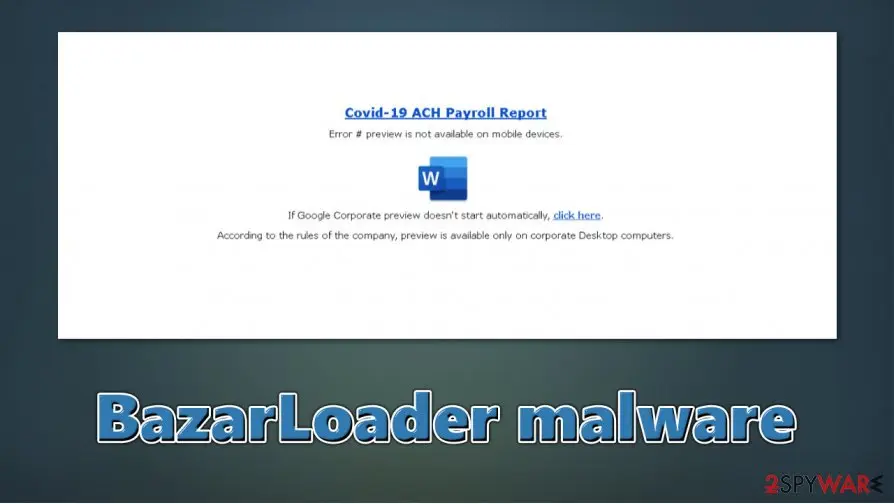
BazarLoader malware: summary
| Distribution | Malware was found |
|---|---|
| Name | BazarLoader malware |
| Type | Trojan, Backdoor |
| Additional payload | Malware delivers Ryuk ransomware as a final payload |
| First spotted | April 2020 |
| Functionality | BazarLoader virus is relatively simple yet effective Trojan and a backdoor that allows malicious actors to deliver other malware on the infected computer |
| Removal | Scan the PC with security software to find and remove the malware and anything installed with it. Fortect scans Windows for malware and repairs the system files and settings it damaged. Remove it nowTo use the full-featured product, you have to purchase a license for Fortect. The scan is free. |
Show 8 more facts
| Detection names | No Microsoft detection name is known |
|---|---|
| Damage | Not recorded in the old report |
| Symptoms | An unknown process in Task Manager and a Windows Security "Threats found" notification |
| Evidence | 5 write-ups by security sites; no sample analysed yet |
| File names | Print_Preview.exe |
| First seen | 15 October 2020 |
| Microsoft Defender name | Backdoor:Win64/Zarab!MSR |
| Facts checked | 6 October 2026 |
What BazarLoader malware does on an infected PC
From our report of Oct 2020 · not reviewed since
More from our earlier report on BazarLoader malware
- To delete malware from your system, you should employ powerful security solutions.
- Access Safe Mode with Networking if the elimination process is unsuccessful in normal mode
- Malware can seriously tamper and change Windows system files, to the point where the OS might become hardly operational after malware elimination.
- Why i can't reach you on the phone?
- I am on my way to XXX.
- Because of customer complaint #7592 on you from last Friday, we will process termination process.
- here is the copy in PDF: Please call me back till i will process additional debit from your acc.
What BazarLoader malware can steal or download
From our report of Oct 2020 · not reviewed since
BazarLoader is a malicious program categorized as a Trojan and a backdoor - it is designed to infiltrate Windows machines and grant the attackers secret access to them.
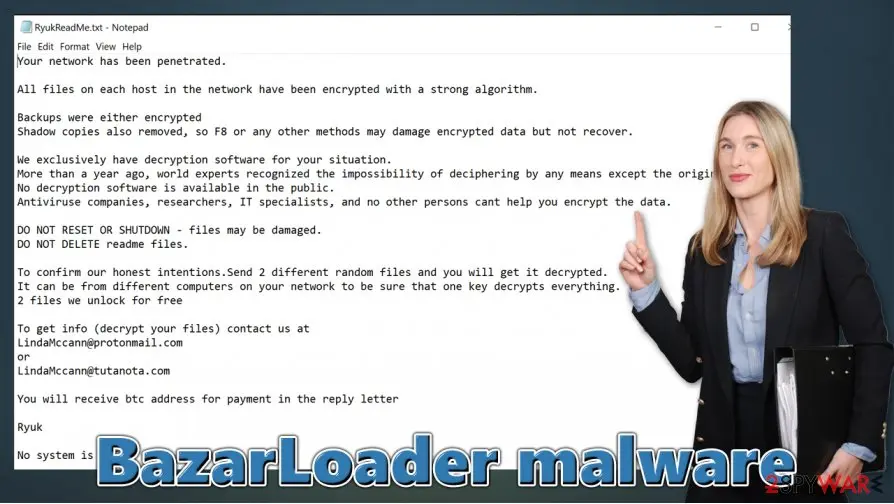
Once installed, the malware can perform various malicious functions, although the main purpose of the threat is to deliver other malware. While the final payload is not defined and can be literally anything, cybersecurity experts observed a deployment of Ryuk ransomware, which encrypts all personal files on all the computers connected to the network and then demands a ransom for the decryption tool.
BazarLoader malware has been used by the same cybercriminals who were actively spreading the infamous Trickbot Trojan, usually delivered via spam email campaigns. Phishing emails might be highly targeted or sent to random users and include various topics, including COVID-19 pandemic, business inquiries, fake customer complaint forms, etc.
The cybercriminal gang behind BazarLoader malware chose this malware due to its simplicity and increased obfuscation. Trickbot, which is considered one of the most prevalent Trojans in the world, has been analyzed by many leading security research groups, hence became much easier to detect and stop.
Despite this, many security solutions can detect and remove BazarLoader virus before it manages to cause any harm. One of the observed malicious email attachment samples (Print_Preview.exe) is detected as follows on Virus Total:
The initial attack of BazarLoader malware starts with a phishing email that is often highly targeted. Many security researchers that analyzed the campaign uncovered that most of the emails are presented as customer complaints. Here is one of the examples:
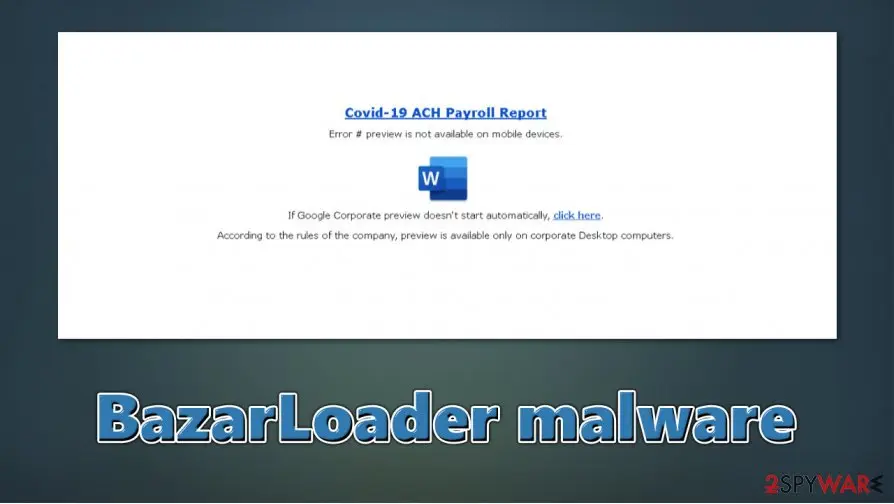
Since the link is directing to Google Docs, victims are more likely to proceed. Once the link is clicked, they are redirected to a web-based PDF document, which includes another link. This time, by clicking on it, users would begin the installation of the BazarLoader malware.
As soon as the infection process is complete, the virus will install the BazarBackdoor part of the payload, which would inject malicious components into legitimate Windows processes, such as cmd.exe, explorer.exe, and svchost.exe. During this time, a scheduled task is also established on the system for the malware to start with each Windows boot. After performing some more downloads, BazarLoader malware will finally deploy Ryuk ransomware.
Once that is complete, malicious actors can ask victims for high sums as ransoms (typically, 10 to 50 bitcoin - approx. $114k - $570k at the time of the writing) for data recovery. Thus, BazarLoader seems like a great choice for cybercriminals due to low detection rates, which also guarantees high profits due to the ransomware component within the campaign.
BazarLoader malware removal is not the hardest process as long as adequate security software (such as or ) is used, although the encrypted files or a data leak can be the most devastating side-effects of the infection. Below you will also find alternative ways for data recovery.
- Trojan.GenericKD.43838874
- Backdoor:Win64/Zarab!MSR
- Trojan.Trickster.Gen
- Win64:CrypterX-gen
- Win/malicious_confidence_100% (W)
- Trojan.Bazar
- A Variant Of Win64/Kryptik.CAK, etc.
How to check the PC for BazarLoader malware
BazarLoader malware detection names
If Windows Security shows Backdoor:Win64/Zarab!MSR, it has found BazarLoader malware or a file that belongs to it.
Write the name down before you click Remove: it is the most useful search term later, and you will need it if you report the incident.
A family name in the label is more informative than a heuristic one. Our page on why one threat has many antivirus names lists the common formats and what each part means.
- File:
Print_Preview.exe
How to remove BazarLoader malware
How to remove BazarLoader malware and lock the attacker out
Someone may have had remote control of the PC.
Cut the connection first, then remove the trojan and secure your accounts.
Step 1: Remove remote access tools and lock the attacker out
Attackers keep access through remote control tools and extra user accounts. Disconnect the PC from the internet, then remove every remote access program you did not install yourself from the installed apps list in Windows 11 or Windows 10.
Look for a user account you do not know and delete it, and switch off Remote Desktop in Settings > System. Reconnect only for the scan.
Full procedure with screenshots: Uninstall a program or app in Windows On uGetFix
Step 2: Check where Print_Preview.exe runs from and stop it
In Task Manager (Ctrl + Shift + Esc) find
Print_Preview.exeon Processes, right-click it and choose Open file location before ending anything.Windows' own files live in
C:\Windows\System32; the same name in%AppData%, %Temp% or C:\Users\Public is an impostor. If the folder is wrong, right-click the process again, choose End task and delete the file.If it starts again within seconds, a task or another process restarts it, so run the scan step in Safe Mode. Task Manager works the same in Windows 11 and Windows 10.
Full procedure with screenshots: Close a frozen app (Task Manager, Force Quit) On uGetFix
Step 3: Delete scheduled tasks that bring it back
Programs like BazarLoader malware add a scheduled task so they return after an uninstall or reopen a page at every sign-in. Start Task Scheduler, open Task Scheduler Library and sort by Last Run Time to see what ran recently.
On the Actions tab, a program in a user folder, a script or a web address is a warning sign; right-click such a task and choose Delete.
Tasks with names copying Google, Edge or Windows updaters but pointing to an odd folder are typical. The tool looks the same in Windows 11 and Windows 10.

Windows 11: Task Scheduler Library, the task selected, the Actions tab shows the file it runs. Full procedure with screenshots: Remove what malware leaves behind in Windows
Step 4: Remove it from startup
Press Ctrl + Shift + Esc to open Task Manager and select Startup apps (Windows 11) or the Startup tab (Windows 10). Disable entries you do not recognise, especially ones with no publisher or with a name that copies a Windows component.
Right-click an entry and choose Open file location to see where it runs from: programs in
%AppData%or%Temp%deserve a closer look. Some entries are not listed there but in the registry Run keys, which the procedure below shows how to check.Full procedure with screenshots: Stop apps from opening at startup On uGetFix
Step 5: Scan the PC, then run the offline scan
A scan finds the parts of BazarLoader malware that the manual steps cannot see. In Windows Security > Virus & threat protection > Scan options, start a Full scan and quarantine what it reports.
Follow it with Microsoft Defender Antivirus (offline scan) > Scan now, which restarts the PC and checks the disk while Windows and the malware are not running.
It takes about 15 minutes and works the same in Windows 11 and Windows 10. If either scan finds something, run the full scan again after removal until it comes back clean.

Windows 11: Windows Security > Virus & threat protection > Scan options. Full procedure with screenshots: Run a Microsoft Defender Offline scan
Step 6: Change passwords from another device and sign out other sessions
BazarLoader malware can copy saved passwords, cookies and session tokens and send them out in seconds, so cleaning the PC does not undo the theft.
Change your passwords on a device that was never infected, starting with the e-mail account, since every other reset goes through it. On each account, end all other sessions and check the recovery e-mail, phone number and forwarding rules.
Then turn on two-step verification. Sign in on the Windows 11 or Windows 10 PC again only after the offline scan is clean.
Full procedure with screenshots: Turn on two-step verification / secure a hacked account
Instructions for each browser and system
The detailed steps for every browser and system this guide covers. Open the one you use.
Manual removal using Safe Mode
Important! →
Manual removal guide might be too complicated for regular computer users. It requires advanced IT knowledge to be performed correctly (if vital system files are removed or damaged, it might result in full Windows compromise), and it also might take hours to complete. Therefore, we highly advise using the automatic method provided above instead.
Step 1. Access Safe Mode with Networking
Manual malware removal should be best performed in the Safe Mode environment.
Windows 7 / Vista / XP
- Click Start > Shutdown > Restart > OK.
- When your computer becomes active, start pressing F8 button (if that does not work, try F2, F12, Del, etc. - it all depends on your motherboard model) multiple times until you see the Advanced Boot Options window.
- Select Safe Mode with Networking from the list.

Windows 10 / Windows 8
- Right-click on Start button and select Settings.

- Scroll down to pick Update & Security.

- On the left side of the window, pick Recovery.
- Now scroll down to find Advanced Startup section.
- Click Restart now.

- Select Troubleshoot.

- Go to Advanced options.

- Select Startup Settings.

- Press Restart.
- Now press 5 or click 5) Enable Safe Mode with Networking.

Step 2. Shut down suspicious processes
Windows Task Manager is a useful tool that shows all the processes running in the background. If malware is running a process, you need to shut it down:
- Press Ctrl + Shift + Esc on your keyboard to open Windows Task Manager.
- Click on More details.

- Scroll down to Background processes section, and look for anything suspicious.
- Right-click and select Open file location.

- Go back to the process, right-click and pick End Task.

- Delete the contents of the malicious folder.
Step 3. Check program Startup
- Press Ctrl + Shift + Esc on your keyboard to open Windows Task Manager.
- Go to Startup tab.
- Right-click on the suspicious program and pick Disable.

Step 4. Delete virus files
Malware-related files can be found in various places within your computer. Here are instructions that could help you find them:
- Type in Disk Cleanup in Windows search and press Enter.

- Select the drive you want to clean (C: is your main drive by default and is likely to be the one that has malicious files in).
- Scroll through the Files to delete list and select the following:
Temporary Internet Files
Downloads
Recycle Bin
Temporary files - Pick Clean up system files.

- You can also look for other malicious files hidden in the following folders (type these entries in Windows Search and press Enter):
%AppData%
%LocalAppData%
%ProgramData%
%WinDir%
After you are finished, reboot the PC in normal mode.
From our report of Oct 2020 · not reviewed since
How to spot phishing emails and prevent malware infection
Email spam is among the most prominent methods for malware delivery.
While the principle remains the same from many years ago, cybercriminals employ new techniques to make fake emails more believable and can obfuscate them from automatic scanners.
For example, Gmail and other reputable email providers scan each of the received emails, put the suspicious ones in the Junk folder, and mark it as "Dangerous." Despite these efforts, many users still believe that the warning is a false-positive and proceed with clicking on attachments or the embedded links.
As previously mentioned, BazarLoader virus authors exploit the most relevant topics, such as coronavirus pandemic or the typical scare tactics. Besides, since they often include a link to Google Docs, many users are more inclined to click on it.
Nonetheless, it is also known that cybercriminals employ malicious documents. In such a case, by enabling content within an attachment (DOC, PDF, and similar formats), victims would immediately begin the infection process.
There are several experts' tips that could prevent the devastating infection from occurring:
Keep in mind that the sender's address, buttons, links, and other attributes can be faked by skilled criminals, so the most important criteria here is not to rush things and practice extreme caution when dealing with unexpected emails.
- Never allow documents attached to emails to run macro function ("Allow Content");
- Employ additional email protection solutions;
- Upload attachments to Virus Total or similar analysis tools;
- Watch out for suspicious sender address;
- Do not give into fear and click on links/files without examining them.
From our report of Oct 2020 · not reviewed since
BazarLoader malware removal steps
It is important to note that BazarLoader malware removal is not the only payload that you have to eliminate from the system.
As previously mentioned, the virus would also deliver ransomware as a secondary payload. And while the elimination process for it does not differ much than the other malware's, its consequences are much more sinister. All the pictures, music, videos, documents, and other personal files will be locked even after you fully remove BazarLoader and Ryuk from the computer.
If your files were encrypted and you have no backups, make a copy of the data for the possible solution in the future. Then, download and install , , or another reputable anti-malware and perform a full system scan - accesses Safe Mode if required. Finally, follow the data recovery instructions we provide below, although keep in mind that the success rate of retrieving data fully is relatively low.
[GI=method-1]Access Safe Mode with Networking if malware is tampering with your security tools:
[GI=method-2]System Restore can also be effective when trying to remove malicious programs:
Windows Previous Versions feature might be useful
In case malware failed to delete Shadow Copies, you can attempt to recover files one-by-one.
Take control of your files with ShadowExplorer
This tool can automate data recovery if Shadow Copies are still present on the PC.
After removal: passwords, accounts and prevention
Accounts come next
Because the PC showed an unfamiliar process called Print_Preview.exe in Task Manager, a sign of a program that could read browser data, the clean-up is only half of the work.
The other half happens in your online accounts.
Change passwords from a clean device, beginning with e-mail; sign out of all sessions; check forwarding rules and recovery phone numbers; and turn on two-step verification with an authenticator app or a passkey. Ask your bank to replace cards saved in the browser.
Why the order matters and what to check in each account: secure your accounts after malware.
Do not let government spy on you
The government has many issues in regards to tracking users' data and spying on citizens, so you should take this into consideration and learn more about shady information gathering practices.
Avoid any unwanted government tracking or spying by going totally anonymous on the internet.
You can choose a different location when you go online and access any material you want without particular content restrictions. You can easily enjoy internet connection without any risks of being hacked by using VPN.
Control the information that can be accessed by government any other unwanted party and surf online without being spied on. Even if you are not involved in illegal activities or trust your selection of services, platforms, be suspicious for your own security and take precautionary measures by using the VPN service.
Backup files for the later use, in case of the malware attack
Computer users can suffer from data losses due to cyber infections or their own faulty doings.
Ransomware can encrypt and hold files hostage, while unforeseen power cuts might cause a loss of important documents. If you have proper up-to-date backups, you can easily recover after such an incident and get back to work. It is also equally important to update backups on a regular basis so that the newest information remains intact - you can set this process to be performed automatically.
When you have the previous version of every important document or project you can avoid frustration and breakdowns. It comes in handy when malware strikes out of nowhere. Use for the data restoration process.
Questions about BazarLoader malware
Is Print_Preview.exe safe?
It depends on where the file is and who signed it, not on the name. Open Task Manager, go to the Details tab, right-click Print_Preview.exe and choose Open file location. A file inside Program Files or System32 with a valid digital signature from a known company is usually part of a legitimate program.
A file in AppData, Temp or ProgramData with no signature, especially one that restarts itself after you end it, is suspicious. If you cannot tie the process to anything you installed, uninstall recent unfamiliar programs and run a Microsoft Defender Offline scan.
What does the name Backdoor:Win64/Zarab!MSR tell me?
Microsoft builds names in a fixed order:
- category
- then platform
- then family
- sometimes followed by a variant letter
- a suffix
The category is the most useful part for you. Trojan, Backdoor and PWS mean real malware that can download more, give remote access or steal passwords. PUA means unwanted software.
Ransom means ransomware. Suffixes such as !ml or !MTB mean the detection came from machine learning or behaviour analysis. Search for the family part of Backdoor:Win64/Zarab!MSR together with the word Microsoft to find its entry in Microsoft's security encyclopedia.
Can I end Print_Preview.exe in Task Manager?
Ending an unknown process is safe in the sense that Windows will warn you before you close anything critical, and a restart brings back whatever Windows needs. Ending Print_Preview.exe will not remove it, though: if a task or startup entry launches it, it returns at the next sign-in.
Use ending the process as a test. If something important stops working, it belonged to a program you use. If nothing changes and it comes back by itself, find and disable its starter, delete the file and scan the PC.
Should I change my passwords after Backdoor:Win64/Zarab!MSR?
It depends on the category and on whether the file ran. If the name begins with PWS, Spy, Backdoor or Trojan and the file sat in AppData, ProgramData or Temp, assume it ran and change your important passwords from a different device, starting with e-mail, then banking.
Sign out of all sessions too. If Backdoor:Win64/Zarab!MSR is a PUA or was caught in Downloads before you opened anything, a password change is a precaution rather than a must. When in doubt, change the e-mail password and turn on two-step verification; it is quick and protects everything else.
Is Print_Preview.exe a virus?
If it sits outside the Windows and Program Files folders and your antivirus links it to BazarLoader malware, yes. Print_Preview.exe is the file name used by this trojan. Some trojans borrow the names of real Windows components, so the name alone does not decide it:
- right-click the process in Task Manager
- choose Open file location
- look at the folder and the publisher under Properties > Details
A file in a user folder with no publisher is the trojan. Do not delete it by hand while it runs; use the offline scan in the plan above.
Is Microsoft Defender enough to remove BazarLoader malware?
For most home PCs it is a solid first step. Defender detects this threat as Backdoor:Win64/Zarab!MSR, and a full scan followed by an offline scan covers the places where BazarLoader malware usually hides. The offline scan runs before Windows starts, so malware that hides while Windows is running cannot interfere: Run a Microsoft Defender Offline scan.
Defender does not undo everything, though. It does not restore browser settings, decrypt files or change passwords that may have been copied, which is why this guide has separate steps for those. If Defender finds the same item again after removal, something else keeps reinstalling it.
Should I report BazarLoader malware?
Report it if you lost money, if accounts were taken over, if you are a business, or if the trojan came through a scam call. A police or national cybercrime report gives you a reference number for your bank and insurer and helps link cases.
You do not need to report a trojan that antivirus blocked before it ran. Before reporting, write down the dates, the detection name, file names and any messages or transactions linked to the attack; screenshots of antivirus alerts are useful evidence. The country list is in the report section above.
Why can't I find BazarLoader malware in antivirus databases?
Because it is new or because it is listed under a different name. Antivirus companies name threats after the family they belong to, and a program that appears as BazarLoader malware on your PC may carry a generic or unrelated label in their databases.
Many new samples are first detected only by behaviour, without a family name. What you saw, an unfamiliar process called Print_Preview.exe in Task Manager, is enough to act on:
- end the program
- remove its startup entry
- run a Microsoft Defender offline scan
- secure your accounts
A detection name from a scan is worth noting for later.
Should I check my other computers too?
Yes, it takes little time and removes doubt. BazarLoader malware itself usually stays on one PC, but the download that carried it may have been copied to other computers, shared drives may hold the same installer, and an attacker who had access could have tried saved passwords on other devices.
Run a full scan on every Windows PC in the home or office, check shared folders for the original download, and change Wi-Fi and router passwords if they were stored on the infected machine.
Will Fortect remove BazarLoader malware?
Fortect scans Windows for malware and unwanted programs and repairs the system files and settings they change, and its free scan shows what it finds on your PC before you decide anything.
For BazarLoader malware, follow the plan above as well: the browser steps take back permissions and settings that no scanner treats as a threat, and uninstalling the program that brought it removes the source.
Run Microsoft Defender's full scan and, if anything was found, its offline scan as a second opinion. If the symptoms are gone after the plan and both scans are clean, there is nothing more to do.
Sources
- Virus Total: 34cc67888cd38da7aeb52508b48ad71287c402aecb72bccca7cbd3a0cd8fe985 (read October 6, 2026)
- Hornet Security: BazarLoader Campaign with Fake Termination Emails (read October 6, 2026)
- Senzavirus advice and malware insights: Senzavirus (read October 6, 2026)
- FTC: How to recognize, remove and avoid malware (read October 6, 2026)
- Microsoft Learn: Microsoft Defender Offline (read October 6, 2026)