
BitRAT malware: what it is and how to remove it
BitRAT malware is the cyber infection that is set to provide remote access to various devices. The RAT can have various functionalities and infect the machine to perform different activities.
Facts checked October 6, 2026. Removal steps tested on Windows 11 (26H2) and checked against Microsoft's and the browser makers' current documentation. Sections marked as our earlier report are the original text: they describe the threat as it was then and have not been reviewed since. The 2026 status, the removal steps and the questions are current.
Automatic
Get a free scan and check if your PC is infected.
Fortect finds malware, unwanted programs and the Windows damage they leave behind, and repairs it in one pass.
Programs like BitRAT malware usually arrive in groups; a free scan lists the companions that are easy to miss.
Do it yourself · free Remove BitRAT malware yourself 3 steps, about 9 minutes, no software needed.
Start the steps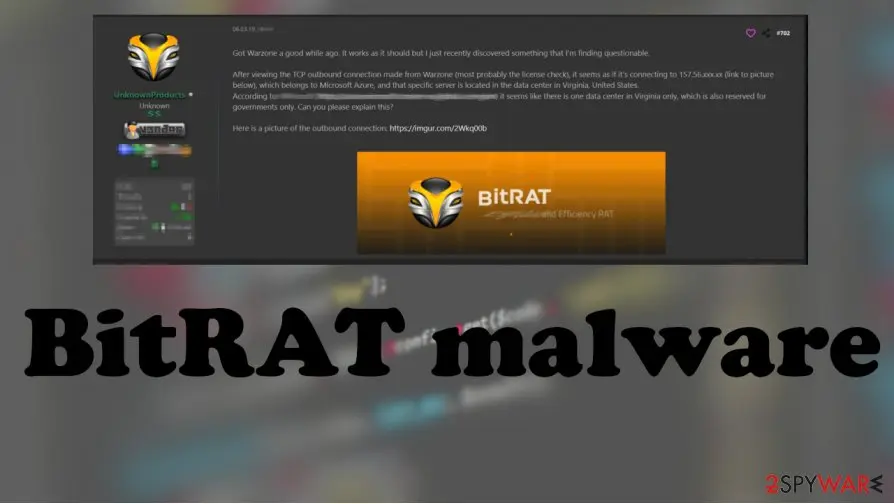
BitRAT malware: summary
| Distribution | Files with malicious code can be spread around using malicious macro filled email attachments, links to malware sites |
|---|---|
| Damage | Silent infiltration allows the malware to run for a longer time, so users' passwords, login credentials, other personal details get recorded |
| Name | BitRAT malware |
| Type | Trojan/ Info-stealer malware/ RAT |
| Issues | The program can be set to gather information, record keystrokes, videos, took screenshots. The virus may infect the machine with other viruses |
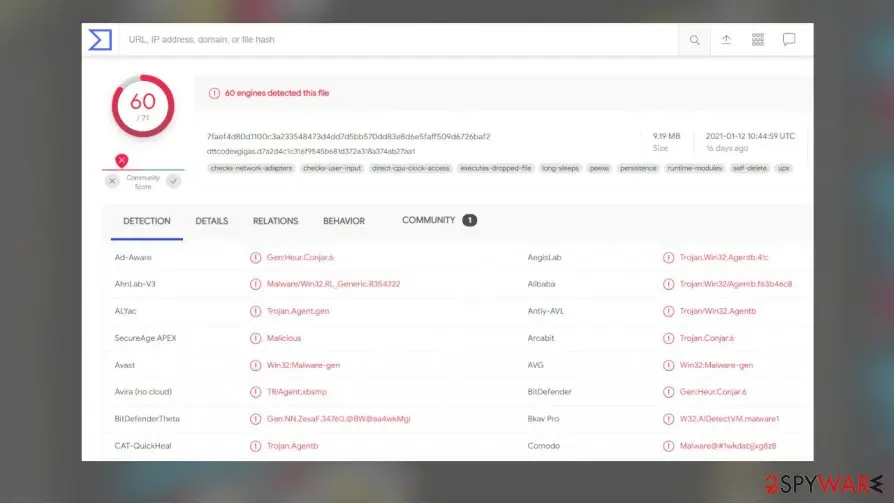
| Possible detection names | Win32:MalwareX-gen, Variant Of Win32/Agent.ACBZ HEUR:Backdoor.Win32.Agent.gen; no Microsoft detection name is known for this name |
| Removal | Scan the PC with security software to find and remove the malware and anything installed with it. Fortect scans Windows for malware and repairs the system files and settings it damaged. Remove it nowTo use the full-featured product, you have to purchase a license for Fortect. The scan is free. |
Show 4 more facts
| Symptoms | An unknown program in Installed apps |
|---|---|
| Evidence | 4 write-ups by security sites; details still limited |
| First seen | 28 January 2021 |
| Facts checked | 6 October 2026 |
What BitRAT malware does
From our report of Jan 2021 · not reviewed since
Make sure to terminate the BitRAT virus from the system once and for all
BitRAT malware virus is a threat that can be added to various spam email messages presented via malicious links in those notifications or attached as files to the message itself.
You cannot be sure when or how the threat appeared on the machine, but time is crucial in this case. The longer this malware has on the PC, the more permanent damage can be done.
Make sure to run a tool like or , rely on your anti-malware application, and fully check the system so the BitRAT malware removal can be performed. You can't find the threat manually because it is not a program that waits on the desktop. You might find other programs or suspicious processes, but those are only pieces of the infection, not the main RAT.
When you remove BitRAT malware yourself, you might have a difficult time when AV tools get blocked by the trojan. Enter the Safe Mode before you launch the security tool. This way, your anti-malware program checks all the parts of the system uninterrupted. Then you can run a tool like - system repair app that fixes the damage of the virus and ensures that you can use the machine afterward.
[GI=method-1]You might benefit from Safe mode with networking when the AV tool gets blocked by BitRAT malware virus
From our report of Jan 2021 · not reviewed since
BitRAT malware is the RAT-type intruder that can be designed to collect keystrokes and audio or video on the targeted computer
BitRAT malware is the cyber infection that is set to provide remote access to various devices.
The RAT can have various functionalities and infect the machine to perform different activities. Hackers distribute the threat to access, view, and modify various files, execute commands, and download other programs or data from the internet. The virus can also initiate remote access to the desktop, so malicious attacker directly controls the machine.
This BitRAT virus was spotted promoted and old in various hacker forums and other platforms. It is promoted as a hacking tool, so cybercriminals might take advantage of the silent infiltration techniques and purchase the virus to affect targeted machines. Developers of the trojan copied various open-source projects.
They managed to make a low-effort malware that can cause trouble on the machine without particularly causing any symptoms for the user to see. You need to rely on tools created for malware detection and a few tricks that the guide below explains so the AV tool is working properly.
BitRAT malware can be set to access a web camera, microphone and take screenshots, photos, record you and your background. It can also trigger certain system changes, so the malicious process, file, or program is launched every time the device is launched. Issues with the computer can lead to permanent data loss, damage, or errors like BSOD.
Developers of this threat promote the infection online. They claim that BitRAT malware controls the infected machine and collects various inputs or even streams the microphone material, webcam recordings in real-time. RAT can also use various files and processes to run on resources of the machine so cryptocurrency can be generated or other viruses installed.
If the threat is set to steal information, BitRAT malware removal is crucial and needs to happen as soon as possible. The more time this malware has on the PC, the more information can be exfiltrated, so collected information gets used by criminals. Those personal details that can be obtained are extremely valuable on the internet, especially on the dark web.
BitRAT malware can trigger chain infections and execute downloaded files to spread malware, extract login credentials, passwords, usernames. According to promotions, this threat can steal data from 35 different browsers and 500 additional programs. The virus may record keystrokes, so once it is installed, it becomes extremely dangerous to login to any site or social media platform, banking page.
BitRAT malware and other RATs often are sued to obtain login credentials, passwords, and usernames for particular cryptocurrency wallets, banking sites, online platforms, social media. Malware can access:
If you don't remove BitRAT malware as soon as possible or don't use proper tools like or to terminate the infection fully, you might suffer from the attack directly targeted at you or a more in-depth blackmailing campaign. The infection can be detected with many popular AV tools, so it possible to get rid of the trojan.
It is clear that the virus is new and freshly developed. It can function as cryptomining software and damage the machine nonetheless. Some of the functions are not running smoothly or none at all, but BitRAT virus can lead to various issues with the machine. To avoid further issues, make sure to repair any issues with or similar tools, repair any files or functions and terminate pieces of related malware.
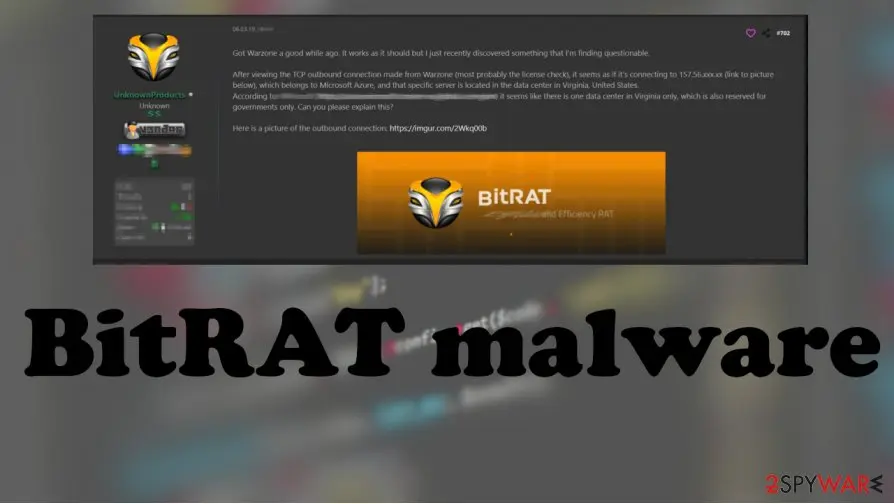
If you suspect that malware is already on your machine, do not hesitate. BitRAT malware should be deleted as soon as possible. It is linked with other RAT named Warzone, so clean the machine thoroughly to avoid repetition of the infection. The code also shows other resemblance, so analysis can confirm that this is a copy-paste threat that is not critical, but it can evolve in the future.
- name;
- address;
- telephone number;
- email;
- banking account credentials;
- credit card numbers.

From our report of Jan 2021 · not reviewed since
More from our earlier report on BitRAT malware
- You need to remove BitRAT malware using proper anti-malware tools
- Make sure to recover the damage that malware made with tools like
How BitRAT malware got on your PC
From our report of Jan 2021 · not reviewed since
Malicious programs like this can be distributed silently, so users do not notice anything until the malware is running its processes.
Illegal activation tools, fake updates, promoted applications, and software license versions downloaded from peer-to-peer services can lead to the installation of such malicious code. It also can happen during insecure installation of freeware, when the additional programs have scripts triggering malware downloads.
Another method includes documents, PDFs, excel sheets that contain malicious macros. Such malicious files can be added to emails directly or attached as additional content to notifications that resemble emails from companies and government officials. There are various companies that malware creators use as bait for victims.
Malware files can be in a variety of formats, so any executables, archives, Microsoft Office, and PDF documents should be suspicious. Especially attached to emails that you were not expected to receive. It is enough to open such infectious files, and macros get triggered by a single press of the button. Be careful when suspicious emails come with files or links.
Particular threats like RATs can be distributed online as products for spying on victims. There are many forums and marketplaces for such software, so malicious actors can target you. Run anti-malware tools more often to avoid any silent infections.
How to remove BitRAT malware
A stealer usually takes what it wants within minutes and may already be gone.
The scan comes first, then the accounts.
Step 1: Scan the PC, then run the offline scan
Open Windows Security > Virus & threat protection > Scan options, run a Full scan and remove everything it finds. Then select Microsoft Defender Antivirus (offline scan) and click Scan now: the PC restarts and scans before Windows loads, which finds files that hide while Windows runs.
Save your work first, because the offline scan takes about 15 minutes. Both scans are built into Windows 11 and Windows 10, and a second scanner from another vendor is a useful extra opinion.

Windows 11: Windows Security > Virus & threat protection > Scan options. Full procedure with screenshots: Run a Microsoft Defender Offline scan
Step 2: Change passwords from another device and sign out other sessions
Assume that the passwords saved in this PC's browsers, and the accounts that were open in them, are known to the attacker. From a phone or a clean computer, change the e-mail password first, then banking, shopping, social and gaming accounts.
Use each service's option to sign out of all other sessions, because stolen cookies keep a session open even after a password change. Turn on two-step verification on each account. Wait with the infected Windows 11 or Windows 10 PC until the scans are clean.
Full procedure with screenshots: Turn on two-step verification / secure a hacked account
Step 3: Delete the folders left behind
What the uninstaller leaves behind is usually in the user folders. Open File Explorer, switch on View > Show > Hidden items (in Windows 10 View > Hidden items), and go through
%LocalAppData%,%AppData%, %ProgramData% and the two Program Files folders.Sort by Date modified and delete folders that appeared together with the problem and belong to no program you use. Folders with random names that hold
.exe,.dll, .js or .ps1 files are the strongest sign.Full procedure with screenshots: Remove what malware leaves behind in Windows
Instructions for each browser and system
The detailed steps for every browser and system this guide covers. Open the one you use.
Manual removal using Safe Mode
Important! →
Manual removal guide might be too complicated for regular computer users. It requires advanced IT knowledge to be performed correctly (if vital system files are removed or damaged, it might result in full Windows compromise), and it also might take hours to complete. Therefore, we highly advise using the automatic method provided above instead.
Step 1. Access Safe Mode with Networking
Manual malware removal should be best performed in the Safe Mode environment.
Windows 7 / Vista / XP
- Click Start > Shutdown > Restart > OK.
- When your computer becomes active, start pressing F8 button (if that does not work, try F2, F12, Del, etc. - it all depends on your motherboard model) multiple times until you see the Advanced Boot Options window.
- Select Safe Mode with Networking from the list.

Windows 10 / Windows 8
- Right-click on Start button and select Settings.

- Scroll down to pick Update & Security.

- On the left side of the window, pick Recovery.
- Now scroll down to find Advanced Startup section.
- Click Restart now.

- Select Troubleshoot.

- Go to Advanced options.

- Select Startup Settings.

- Press Restart.
- Now press 5 or click 5) Enable Safe Mode with Networking.

Step 2. Shut down suspicious processes
Windows Task Manager is a useful tool that shows all the processes running in the background. If malware is running a process, you need to shut it down:
- Press Ctrl + Shift + Esc on your keyboard to open Windows Task Manager.
- Click on More details.

- Scroll down to Background processes section, and look for anything suspicious.
- Right-click and select Open file location.

- Go back to the process, right-click and pick End Task.

- Delete the contents of the malicious folder.
Step 3. Check program Startup
- Press Ctrl + Shift + Esc on your keyboard to open Windows Task Manager.
- Go to Startup tab.
- Right-click on the suspicious program and pick Disable.

Step 4. Delete virus files
Malware-related files can be found in various places within your computer. Here are instructions that could help you find them:
- Type in Disk Cleanup in Windows search and press Enter.

- Select the drive you want to clean (C: is your main drive by default and is likely to be the one that has malicious files in).
- Scroll through the Files to delete list and select the following:
Temporary Internet Files
Downloads
Recycle Bin
Temporary files - Pick Clean up system files.

- You can also look for other malicious files hidden in the following folders (type these entries in Windows Search and press Enter):
%AppData%
%LocalAppData%
%ProgramData%
%WinDir%
After you are finished, reboot the PC in normal mode.
Protect your privacy - employ a VPN
There are several ways how to make your online time more private - you can access an incognito tab.
However, there is no secret that even in this mode, you are tracked for advertising purposes. There is a way to add an extra layer of protection and create a completely anonymous web browsing practice with the help of VPN. This software reroutes traffic through different servers, thus leaving your IP address and geolocation in disguise.
Besides, it is based on a strict no-log policy, meaning that no data will be recorded, leaked, and available for both first and third parties. The combination of a secure web browser and VPN will let you browse the Internet without a feeling of being spied or targeted by criminals.
No backups? No problem. Use a data recovery tool
If you wonder how data loss can occur, you should not look any further for answers - human errors, malware attacks, hardware failures, power cuts, natural disasters, or even simple negligence.
In some cases, lost files are extremely important, and many straight out panic when such an unfortunate course of events happen. Due to this, you should always ensure that you prepare proper data backups on a regular basis.
If you were caught by surprise and did not have any backups to restore your files from, not everything is lost. is one of the leading file recovery solutions you can find on the market - it is likely to restore even lost emails or data located on an external device.
Questions about BitRAT malware
Can I safely uninstall BitRAT malware?
If you did not install BitRAT malware yourself and it is not part of your hardware or a program you rely on, yes. Uninstalling an unwanted program does not harm Windows. Before you do, search the exact name and publisher to be sure it is not a driver tool, a printer utility or a game launcher with an odd name.
Then remove it from Settings, Apps, Installed apps. Ignore any offers or warnings in its uninstaller about losing protection or performance. Afterwards check Startup apps and your browsers for leftovers, and restart once to confirm that it does not reinstall itself.
BitRAT malware came back after I uninstalled it. Why?
Something else is reinstalling it. Common causes are a second program from the same publisher, a scheduled task that downloads it again, or a browser extension that keeps prompting for it. Sort Installed apps by install date and uninstall each entry from the same day that you did not choose.
Then open Task Scheduler and look in the Task Scheduler Library for tasks with updater-style names that you do not recognise. Check Startup apps in Task Manager too. If BitRAT malware still returns, start Windows in Safe Mode, uninstall it there and run a Microsoft Defender offline scan, which looks for loaders that ordinary scans can miss.
Do I need to tell my bank about BitRAT malware?
Yes, if any card was saved in a browser on the affected PC or if you did online banking there while bitRAT malware in the list of installed apps was going on.
Call the number on the back of the card, explain that malware may have copied the card details, and ask for a replacement and a check of recent payments. Banks act faster when you call early. Also change the online banking password from another device and look for new payees, changed contact details or unfamiliar devices in the banking app.
How can someone log in without my two-step code?
By using a session instead of a login. When you sign in, the site gives the browser a cookie that says you already passed both steps. Spyware like BitRAT malware copies that cookie, and the attacker loads it into their own browser, so the site sees a logged-in user and asks for nothing.
The fix is to end all sessions in the account's security settings, which makes the copied cookie worthless, and then change the password. Some services also show active sessions with locations, which helps spot misuse.
The scan found nothing. Am I safe from BitRAT malware?
The PC may well be clean, but your data may not be. Many stealers run for a minute, send what they find and delete themselves, so a clean scan after bitRAT malware in the list of installed apps is common. What matters now is the accounts:
- change passwords from another device
- sign out of all sessions
- turn on two-step verification
Move crypto to a new wallet. Watch for sign-in alerts and password-reset e-mails for a few weeks. If anything suspicious starts with Windows again, scan offline once more or reset the PC.
What happens to the stolen data?
Stolen data is packed into "logs", one per infected PC. The criminal who ran the stealer uses them directly or sells them in online markets, where others search them for bank, crypto, e-mail, gaming and business accounts.
This can happen days or months after the infection. That is why changing passwords and ending sessions matters even if nothing has happened yet. Breach notification services such as Have I Been Pwned can tell you when your e-mail address appears in known leaks.
Should I report a stealer infection?
Report it if money was taken, accounts were used for fraud, or your identity was misused. The report gives you a reference number for your bank and helps police link cases. Also tell the services involved:
- banks
- PayPal
- crypto exchanges and e-mail providers have their own fraud teams that can freeze transfers
- restore accounts
An infection with no misuse yet does not need a police report, but acting on your accounts does. Keep the antivirus log that shows BitRAT malware; it helps explain the case.
Should I reset my PC because of BitRAT malware?
Only if the signs point to deeper access. Reset when you see bitRAT malware in the list of installed apps again after removal, when Windows Security cannot start or update, when remote access tools you did not install keep appearing, or when you simply cannot trust the PC any more.
Otherwise, the plan in this guide plus an offline scan is enough. If you do reset, choose Remove everything and Cloud download for a fresh copy of Windows, restore only documents and photos, and reinstall programs from their official sites. Change important passwords from the clean system afterwards.
Which stealer caused BitRAT malware?
It has not been identified. People who reported BitRAT malware saw bitRAT malware in the list of installed apps, but without the file that caused it, nobody can tell which stealer family was involved. Several families are sold to many criminals at once, and they produce the same result.
If you still have the program or archive you downloaded before this started, keep it unopened; a scan or an upload to a multi-engine scanner can reveal the family. Whatever it was, the steps are the same:
- secure accounts from another device
- scan the PC offline
- remove the download that carried it
Will Fortect remove BitRAT malware?
Fortect scans Windows for malware and unwanted programs and repairs the system files and settings they change, and its free scan shows what it finds on your PC before you decide anything.
For BitRAT malware, follow the plan above as well: the browser steps take back permissions and settings that no scanner treats as a threat, and uninstalling the program that brought it removes the source.
Run Microsoft Defender's full scan and, if anything was found, its offline scan as a second opinion. If the symptoms are gone after the plan and both scans are clean, there is nothing more to do.
Sources
- ZDNet: Malware gangs love open source offensive hacking tools (read October 6, 2026)
- Wikipedia: Blue Screen of Death (read October 6, 2026)
- VirusTotal: Virus detection rate (read October 6, 2026)
- FTC: How to recognize, remove and avoid malware (read October 6, 2026)
- Microsoft Learn: Microsoft Defender Offline (read October 6, 2026)