

Carrerafun.club disguises Tech Support Scam page under inconspicuous-looking website
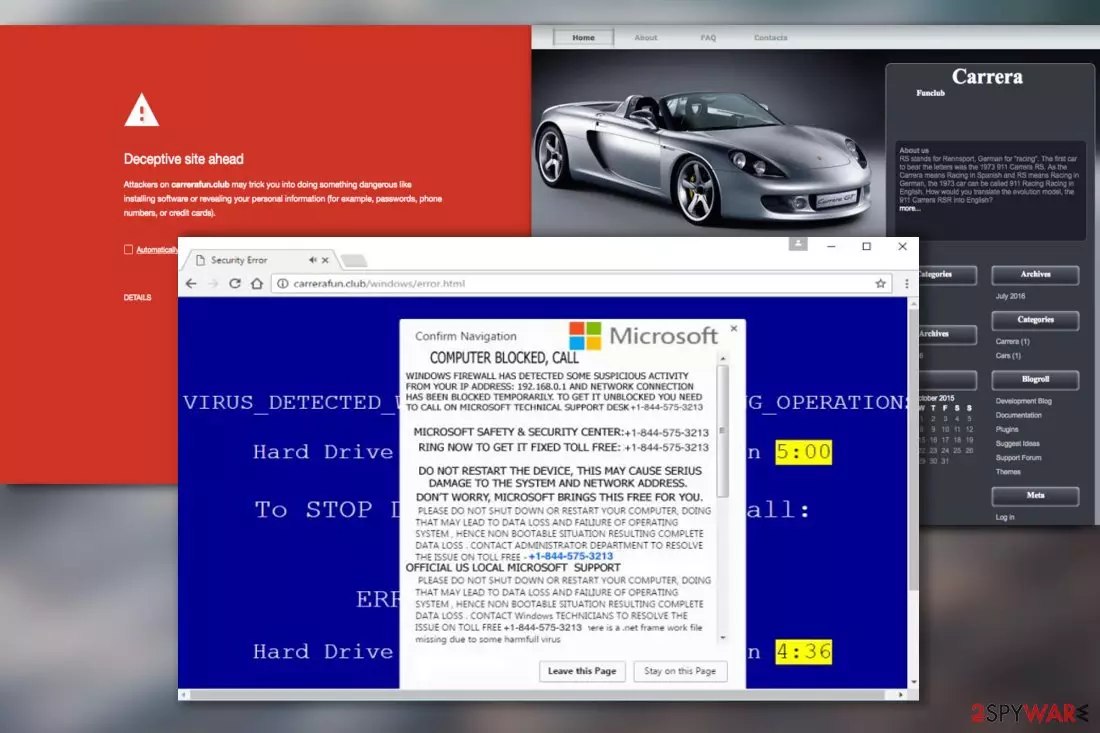
Carrerafun.club virus is a rogue website designed to lure out sensitive information from unsuspecting victims. At first glance, the site looks like any regular fan page where “Porsche” enthusiasts can gather together and share their thoughts and ideas. A closer look at the site reveals that the site has been dead since July 2016 and that none of the links on this site really work.
Nevertheless, according to the statistics [1], this page regularly receives around 166 unique visitors, 322 pageviews a day, and is mainly accessed from countries like Canada and the United States. How come users end up on this useless website though it does not even show up in the regular search results? The truth is that the page is a malicious phishing site that only uses the image of a regular fan page to conceal the malicious Tech Support page to which users get redirected to other potentially unwanted programs, typically adware.
| Name | Carrerafun.club |
|---|---|
| Type | Adware, scam |
| Category | Potentially unwanted program |
| Problems | The program triggers fake messages about technical issues and leads to serious problems when scammers get contacted |
| Distribution | PUP installation is the result of the software bundling method used during the freeware installation process |
| Danger | Users can get tricked into contacting criminals or installing the more dangerous program |
| Elimination | Threats that run in the background can get eliminated with the help of anti-malware tools |
| Repair | The system can get significantly affected when the program controls various processes. Rely on FortectIntego and repair any damage |
Tech support scams [2] are known to imitate system errors or security alerts and persuade users into calling the provided tech support number, in this case, +1-844-575-3213. Unfortunately, this number does not connect victims to Microsoft technicians. Instead, they find themselves in the hands of persistent salespeople who push questionable software, services or try to gain remote access to the victim’s computer.
The scammers are also interested in your sensitive information, so if you accidentally fall for this scam, do not provide users with any of your personal information, banking details, etc. Hang up immediately and remove Carrerafun.club from your computer.
Execute the removal with automatic tools like SpyHunterCombo Cleaner, MalwarebytesMalwarebytes or try tackling the virus manually with our experts’ assistance. You will find the step-by-step malware removal guidelines at the end of the virus description. When infected with a PUP that generates redirects to Carrerafun, you might also notice that your browser is becoming increasingly more cluttered with a variety of different ads as well. Be careful with these ads.
You already know that this virus collaborates with technical support scammers, so it is possible that it may also have business with other shady third parties and shove their ads or links straight to your favorite websites. We do not recommend delaying the termination if you have already noticed its symptoms on your browser. Just launch your antivirus utility and start the full system scan.

Freeware and freeware are the main distributors of PUPs
PUPs that promote the redirect links are sneaky infections that are brought to the computers inside freeware or shareware packages. Malware developers find it easy to disseminate their products this way because it requires little effort since most of the job is carried out by the users themselves.
Malware developers simply have to upload the malware-ridden freeware package to some software-sharing platform and wait for the users to download it. Even the most respectable and acknowledged freeware-sharing websites may be tricked into promoting questionable software packages.
You should be very careful when installing virtually any new content obtained online. Always check whether the downloaded software packages do not contain components you do not wish to see on your computer and opt the undesirable ones out.
Tackle Carrerafun.club removal with the help of automatic software
The PUP removal can be achieved the quickest when using automatic software, such as antivirus or antimalware utilities. The malware detection tools locate the components that are responsible for triggering the virus activity on the computer and remove them automatically.
In the meanwhile, you can enjoy other activities and don’t worry about leaving any unnoticed malware components on your computer. If you are having trouble with your antivirus software and can’t remove Carrerafun.club automatically, you can always take the manual path to the virus removal.
Uninstall from Windows
Uninstall from Windows 10/8:
- Type Control Panel into the Windows search box and open the result.
- Under Programs, select Uninstall a program.


Uninstall from Windows 7/XP:
- Click on Windows Start > Control Panel (Windows XP users should click on Add/Remove Programs).
- In Control Panel, select Programs > Uninstall a program.


Remove the unwanted program:
- In the Programs and Features window, look for any recently installed suspicious entries, select them, and click Uninstall.
- If User Account Control appears, click Yes to confirm, then complete the removal.


Delete from macOS
Remove the unwanted application:
- From the menu bar, select Go > Applications.
- In the Applications folder, look for any suspicious entries, then drag them to Trash (or right-click and pick Move to Trash).


Delete leftover files and folders:
- Select Go > Go to Folder.
- Enter /Library/Application Support and remove any suspicious folders related to the unwanted program.
- Repeat the same check in the /Library/LaunchAgents and /Library/LaunchDaemons folders, deleting any suspicious entries.

- Finally, empty the Trash to permanently remove the leftovers.

Remove from Microsoft Edge
Delete unwanted extensions from MS Edge:
- Select Menu (three horizontal dots at the top-right of the browser window) and pick Extensions.
- From the list, pick the extension and click on the Gear icon.
- Click Remove.


Clear cookies and other browser data:
- Click on the Menu (three horizontal dots at the top-right of the browser window) and select Settings > Privacy, search, and services..
- Under Clear browsing data, pick Choose what to clear.
- Select Cookies and other site data and Cached images and files. (apart from passwords, although you might want to include Media licenses as well, if applicable) and click on Clear.


Restore new tab and homepage settings:
- Click the menu icon and choose Settings.
- Then find On startup section.
- Click Remove next to any suspicious startup page.
Reset MS Edge if the above steps did not work:
- Press on Ctrl + Shift + Esc to open Task Manager.
- Click on More details arrow at the bottom of the window.
- Select Details tab.
- Now scroll down and locate every entry with Microsoft Edge name in it. Right-click on each of them and select End Task to stop MS Edge from running.


Instructions for Chromium-based Edge
Delete extensions from MS Edge (Chromium):
- Open Edge and click select Settings > Extensions.
- Delete unwanted extensions by clicking Remove.


Clear cache and site data:
- Click on Menu and go to Settings.
- Select Privacy, search and services.
- Under Clear browsing data, pick Choose what to clear.
- Under Time range, pick All time.
- Select Clear now.


Reset Chromium-based MS Edge:
- Click on Menu and select Settings.
- On the left side, pick Reset settings.
- Select Restore settings to their default values.
- Confirm with Reset.
- This will disable extensions and reset startup pages but will not delete bookmarks, saved passwords, or browsing history.


Remove from Mozilla Firefox (FF)
Remove dangerous extensions:
- Open Mozilla Firefox browser and click on the Menu (three horizontal lines at the top-right of the window).
- Select Add-ons.
- In here, select the unwanted extension and click Remove.


Reset the homepage:
- Click three horizontal lines at the top right corner to open the menu.
- Choose Settings.
- Under Home, set your preferred homepage and new tab settings.
Clear cookies and site data:
- Click Menu and pick Settings.
- Go to Privacy & Security section.
- Scroll down to locate Cookies and Site Data.
- Click on Clear Data...
- Select Cookies and Site Data and Temporary cached files and pages, then click Clear.


Reset Mozilla Firefox
If clearing the browser as explained above did not help, reset Mozilla Firefox:
- Open Mozilla Firefox browser and click the Menu.
- Go to Help and then choose Troubleshooting Information.

- Under Give Firefox a tune up section, click on Refresh Firefox...
- Once the pop-up shows up, confirm the action by pressing on Refresh Firefox.



Remove from Google Chrome
Delete malicious extensions from Google Chrome:
- Open Google Chrome, click on the Menu (three vertical dots at the top-right corner) and select More tools > Extensions.
- In the newly opened window, you will see all the installed extensions. Uninstall all suspicious extensions related to the unwanted program by clicking Remove.


Clear cache and web data from Chrome:
- Click on Menu and pick Settings.
- Under Privacy and security, select Clear browsing data.
- Select Browsing history, Cookies and other site data, as well as Cached images and files.
- Click Clear data.


Change your homepage:
- Click menu and choose Settings.
- Look for a suspicious site in the On startup section.
- Click on Open a specific or set of pages and click on three dots to find the Remove option.
Reset Google Chrome:
If the previous methods did not help you, reset Google Chrome to eliminate all the unwanted components:
- Click on Menu and select Settings.
- In the Settings, scroll down and click Advanced.
- Scroll down and locate Reset and clean up section.
- Now click Restore settings to their original defaults.
- Confirm with Reset settings.


Delete from Safari
Remove dangerous extensions:
- Open Safari, click Safari in the menu at the top-left of the screen, and select Preferences.
- Go to the Extensions tab, look for any suspicious entries, and click Uninstall to remove them.


Clear history and website data:
- Click Safari in the menu and pick Clear History.
- Set Clear to all history and confirm with Clear History.


Reset Safari:
- Click Safari in the menu and select Preferences > Advanced.
- Enable Show Develop menu in menu bar.
- From the menu bar, click Develop and select Empty Caches.


Did this guide help?
Be the first to comment