

Facebook.com-appple.com is the application that claims to offer various prizes or informs about security issues
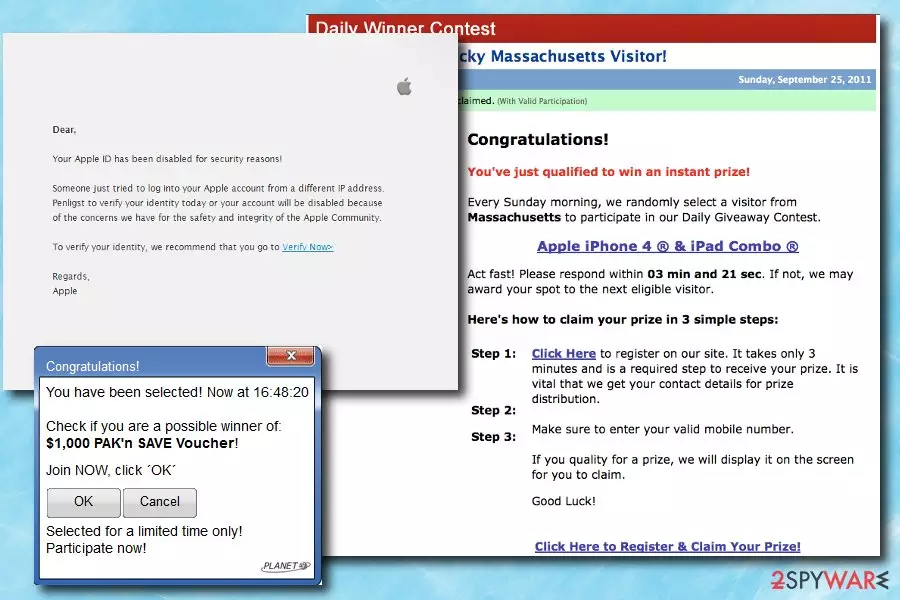
Facebook.com-appple.com is a potentially unwanted application that enters users’ devices without them noticing and spams their Google Chrome, Internet Explorer, Mozilla Firefox, or another browser with intrusive ads. Although the virus has a misspelled “appple” within its name, this pop-up can show up on any device, be it an Android phone or Windows PC.
Users reported that they get these pop-ups regularly when they visit a particular website or an app. Other times, users might encounter it inadvertently – when they get redirected from a suspicious site.
| SUMMARY | |
|---|---|
| Name | Facebook.com-appple.com |
| Type | Adware/ potentially unwanted program/ rdirect |
| Main dangers | Malware infections, stolen credentials, etc. |
| Symptoms | Invasive advertisement, slow browser speed, etc. |
| Distribution | Software bundling |
| Elimination | Uninstall it automatically using an anti-malware tool |
| repair | You can improve the performance of the machine with a tool like FortectIntego |
If ads do not stop, however, it is a high indication of adware infestation. Nevertheless, it is not surprising that users want to remove the Facebook.com-appple.com virus from their devices and go back to normal browsing sessions. Adware is not that dangerous on its own as it does not damage or otherwise directly corrupt system or program files. However, the intruder makes several changes to your registry entries[1] and other settings, allowing it to continue its suspicious activities.
Despite this dubious app not being a piece of malicious software, it can expose users to some high risks and other unpleasant features.
Redirects can lead users to suspicious websites, including phishing, porn, fake software, scam,[2] and other domains. If you get redirected to such a site – do not keep exploring it! Close down your browser and proceed with Facebook.com-appple.com removal instead.
High-risk cyber threats, such as ransomware infections, might enter users’ machines if they are not careful enough. Precisely, clicking on suspicious ads, banners, deals, offers or coupons might infect victims’ machines with just one click. Thus, users should not get tempted to click on those, even if offers seem tempting.
Facebook.com-appple.com virus might gather a variety of information about you and your browsing habits, including, but not limited to:
- IP address;
- Internet service provider;
- Software information;
- Browser information;
- Sites visited;
- Cookie information;
- Links clicked, etc.
This data is collected to create a virtual profile which then generates a targeted advertisement. For example, if an individual enjoys movies, he or she will be prompted to buy or rent them from questionable websites, which can lead to lost money or stolen personal information.
All in all, you should not wait and get rid of Facebook.com-appple.com virus. The safest way to do so is by downloading and installing security software like SpyHunterCombo Cleaner, MalwarebytesMalwarebytes. Alternatively, you can manually uninstall the unwanted program by checking our instructions below.

The system gets affected when the particular freeware is prepacked with PUPs
It goes without saying that the best way to deal with unwanted applications is by avoiding them entirely. For that, you should learn how these programs infiltrate computers. Security experts[3] advise following these simple rules:
- Download applications from legitimate sources only. Avoid peer-to-peer and other file-sharing sites;
- Before installing an unknown application, read up on it online. Reviews can often disclose if the program is legitimate and useful;
- Read through EULA and Privacy Policy;
- Do not click “Next” button quickly and skip steps;
- When prompted, pick Advanced/Custom installation mode instead of Recommended/Quick one;
- When in Advanced settings, remove all the tick marks next to additional components that are offered together with the needed application.
Get rid of the Facebook.com-appple.com virus to stop redirects and other issues
The potentially unwanted program removal can be performed either manually or automatically. Both methods are valid, however, a manual approach might be less convenient. For those who want to remove Facebook.com-appple.com virus automatically, we advise downloading and installing robust security software. Merely bring the program up to date and perform a full system scan. All the unwanted programs should be eliminated automatically.
If you do not want additional software on your device, you can always pick manual Facebook.com-appple.com removal. For that, follow our guide below. Nevertheless, make sure you execute each step carefully as the incorrect procedures might result in the re-infection of the cyber threat.
Uninstall from Windows
Uninstall from Windows 10/8:
- Type Control Panel into the Windows search box and open the result.
- Under Programs, select Uninstall a program.


Uninstall from Windows 7/XP:
- Click on Windows Start > Control Panel (Windows XP users should click on Add/Remove Programs).
- In Control Panel, select Programs > Uninstall a program.


Remove the unwanted program:
- In the Programs and Features window, look for any recently installed suspicious entries, select them, and click Uninstall.
- If User Account Control appears, click Yes to confirm, then complete the removal.


Delete from macOS
Remove the unwanted application:
- From the menu bar, select Go > Applications.
- In the Applications folder, look for any suspicious entries, then drag them to Trash (or right-click and pick Move to Trash).


Delete leftover files and folders:
- Select Go > Go to Folder.
- Enter /Library/Application Support and remove any suspicious folders related to the unwanted program.
- Repeat the same check in the /Library/LaunchAgents and /Library/LaunchDaemons folders, deleting any suspicious entries.

- Finally, empty the Trash to permanently remove the leftovers.

Remove from Microsoft Edge
Delete unwanted extensions from MS Edge:
- Select Menu (three horizontal dots at the top-right of the browser window) and pick Extensions.
- From the list, pick the extension and click on the Gear icon.
- Click Remove.


Clear cookies and other browser data:
- Click on the Menu (three horizontal dots at the top-right of the browser window) and select Settings > Privacy, search, and services..
- Under Clear browsing data, pick Choose what to clear.
- Select Cookies and other site data and Cached images and files. (apart from passwords, although you might want to include Media licenses as well, if applicable) and click on Clear.


Restore new tab and homepage settings:
- Click the menu icon and choose Settings.
- Then find On startup section.
- Click Remove next to any suspicious startup page.
Reset MS Edge if the above steps did not work:
- Press on Ctrl + Shift + Esc to open Task Manager.
- Click on More details arrow at the bottom of the window.
- Select Details tab.
- Now scroll down and locate every entry with Microsoft Edge name in it. Right-click on each of them and select End Task to stop MS Edge from running.


Instructions for Chromium-based Edge
Delete extensions from MS Edge (Chromium):
- Open Edge and click select Settings > Extensions.
- Delete unwanted extensions by clicking Remove.


Clear cache and site data:
- Click on Menu and go to Settings.
- Select Privacy, search and services.
- Under Clear browsing data, pick Choose what to clear.
- Under Time range, pick All time.
- Select Clear now.


Reset Chromium-based MS Edge:
- Click on Menu and select Settings.
- On the left side, pick Reset settings.
- Select Restore settings to their default values.
- Confirm with Reset.
- This will disable extensions and reset startup pages but will not delete bookmarks, saved passwords, or browsing history.


Remove from Mozilla Firefox (FF)
Remove dangerous extensions:
- Open Mozilla Firefox browser and click on the Menu (three horizontal lines at the top-right of the window).
- Select Add-ons.
- In here, select the unwanted extension and click Remove.


Reset the homepage:
- Click three horizontal lines at the top right corner to open the menu.
- Choose Settings.
- Under Home, set your preferred homepage and new tab settings.
Clear cookies and site data:
- Click Menu and pick Settings.
- Go to Privacy & Security section.
- Scroll down to locate Cookies and Site Data.
- Click on Clear Data...
- Select Cookies and Site Data and Temporary cached files and pages, then click Clear.


Reset Mozilla Firefox
If clearing the browser as explained above did not help, reset Mozilla Firefox:
- Open Mozilla Firefox browser and click the Menu.
- Go to Help and then choose Troubleshooting Information.

- Under Give Firefox a tune up section, click on Refresh Firefox...
- Once the pop-up shows up, confirm the action by pressing on Refresh Firefox.



Remove from Google Chrome
Delete malicious extensions from Google Chrome:
- Open Google Chrome, click on the Menu (three vertical dots at the top-right corner) and select More tools > Extensions.
- In the newly opened window, you will see all the installed extensions. Uninstall all suspicious extensions related to the unwanted program by clicking Remove.


Clear cache and web data from Chrome:
- Click on Menu and pick Settings.
- Under Privacy and security, select Clear browsing data.
- Select Browsing history, Cookies and other site data, as well as Cached images and files.
- Click Clear data.


Change your homepage:
- Click menu and choose Settings.
- Look for a suspicious site in the On startup section.
- Click on Open a specific or set of pages and click on three dots to find the Remove option.
Reset Google Chrome:
If the previous methods did not help you, reset Google Chrome to eliminate all the unwanted components:
- Click on Menu and select Settings.
- In the Settings, scroll down and click Advanced.
- Scroll down and locate Reset and clean up section.
- Now click Restore settings to their original defaults.
- Confirm with Reset settings.


Delete from Safari
Remove dangerous extensions:
- Open Safari, click Safari in the menu at the top-left of the screen, and select Preferences.
- Go to the Extensions tab, look for any suspicious entries, and click Uninstall to remove them.


Clear history and website data:
- Click Safari in the menu and pick Clear History.
- Set Clear to all history and confirm with Clear History.


Reset Safari:
- Click Safari in the menu and select Preferences > Advanced.
- Enable Show Develop menu in menu bar.
- From the menu bar, click Develop and select Empty Caches.


Did this guide help?
Be the first to comment