

What should you know before using FullTab app?
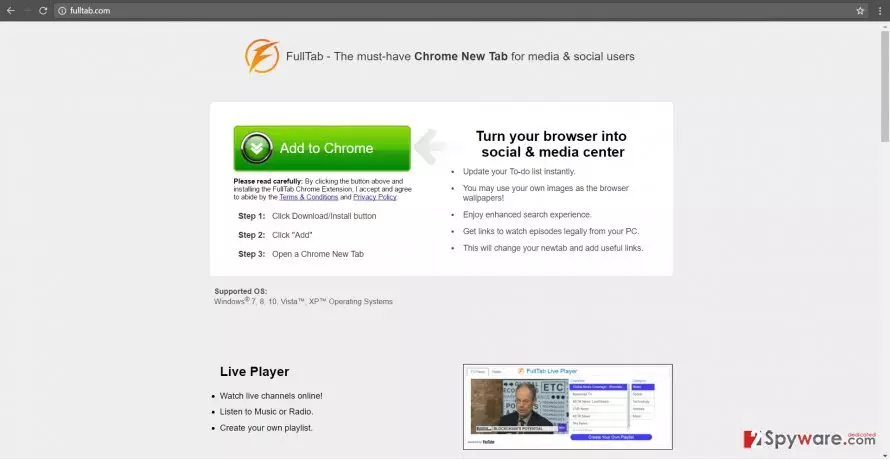
Imali Ltd presents their new product – FullTab virus. They promote it as a search engine which brings your browsing to a completely new level. The new browsing tool should live up your browsing sessions by attaching media features to the browser. Setting your own pictures as the background image, personal to-do list, and the access to legal movie streaming websites are just a few practical features of this tool. However, you need to embrace the reality once again and remember that such privileges and pros are either charged with a fee or there are significant cons of such utilities. Thus, it would be wise to take a look at the privacy policy of this browser hijackers. Let us introduce what effects might follow the usage of this device and how you can remove FullTab from the device. While you are reading the article, entrust the elimination process to FortectIntego.
At first glance, this search engine looks fine and dandy as it offers a bunch of various utilities. Besides already mentioned wallpaper and search engine customization abilities, you will be able to follow the current trends in the stock market and access your social networks right from the homepage. However, such diverse quantity of services has its major flaws. One of them is FullTab redirect. If you take a look at the privacy policy, you will realize that the search engine is supported by third-parties. On their behalf, you can access so many websites with a few clicks. While browsing or searching for a particular topic, you might be redirected to unknown domains which use questionable proxy servers. In other words, due to flaws in them, the mentioned websites might be infected.
Thus, the longer you reside there, the higher is the risk that you might catch a virus or two. Additionally, the hijacker collects information about your browsing peculiarities. Specifically, visited domains, search entries are tracked by this PUP. What is more, this data might include personal data since Full Tab might nag you to complete some surveys or offer various contests and lotteries. Thus, if you are not careful enough and provide too many personal details, not only your browser‘s will be flooded with customized offers, but your Inbox might be targeted as well. Proceed to FullTab removal.
When did the hijacker sneak into the device?
This sort of PUPs prefers using freeware as a disguise. Users facilitate the distribution themselves as they rush through the settings without giving a second look to the installation guide. As a result, by clicking on the “Install” button, they enable FullTab hijack. Likewise, you committed the same mistake, and the hijacker exploited the opportunity to sneak into the computer. Next time you install any application, choose “Custom” settings. They will reveal any optional applications, and you will be able to untick the unnecessary ones.
Quick FullTab elimination
Though Imali Ltd products might be annoying, they are easy to uninstall. You can remove FullTab virus simply by installing an anti-spyware program or opting for the manual guidelines. If you opt for the latter, you should attentively go through each setting not to miss any important detail. Otherwise, the hijacker may assault the computer again. Therefore, automatic FullTab removal is a quicker and more efficient choice. Lastly, you can reduce the risk of any cyber infection if you download software from reliable sources. Reading reviews and taking a look at the privacy policy is a valuable activity as well.
Uninstall from Windows
Uninstall from Windows 10/8:
- Type Control Panel into the Windows search box and open the result.
- Under Programs, select Uninstall a program.


Uninstall from Windows 7/XP:
- Click on Windows Start > Control Panel (Windows XP users should click on Add/Remove Programs).
- In Control Panel, select Programs > Uninstall a program.


Remove the unwanted program:
- In the Programs and Features window, look for any recently installed suspicious entries, select them, and click Uninstall.
- If User Account Control appears, click Yes to confirm, then complete the removal.


Delete from macOS
Remove the unwanted application:
- From the menu bar, select Go > Applications.
- In the Applications folder, look for any suspicious entries, then drag them to Trash (or right-click and pick Move to Trash).


Delete leftover files and folders:
- Select Go > Go to Folder.
- Enter /Library/Application Support and remove any suspicious folders related to the unwanted program.
- Repeat the same check in the /Library/LaunchAgents and /Library/LaunchDaemons folders, deleting any suspicious entries.

- Finally, empty the Trash to permanently remove the leftovers.

Reset Internet Explorer
Remove dangerous add-ons:
- Open Internet Explorer, click on the Gear icon (IE menu) on the top-right corner of the browser
- Pick Manage Add-ons.
- You will see a Manage Add-ons window. Here, look for suspicious plugins. Click on these entries and select Disable.


Change your homepage if it was altered:
- Open IE and click on the Gear icon.
- Select Internet Options.
- In the General tab, delete the Home page address and replace it by your preferred one (for example, Google.com).
- Click Apply and then select OK.


Delete temporary files:
- Press on the Gear icon and select Internet Options.
- Under Browsing history, click Delete...
- Select relevant fields and press Delete.


Reset Internet Explorer:
- Click on Gear icon > Internet options and select Advanced tab.
- Select Reset.
- In the new window, check Delete personal settings and select Reset.


Remove from Microsoft Edge
Delete unwanted extensions from MS Edge:
- Select Menu (three horizontal dots at the top-right of the browser window) and pick Extensions.
- From the list, pick the extension and click on the Gear icon.
- Click Remove.


Clear cookies and other browser data:
- Click on the Menu (three horizontal dots at the top-right of the browser window) and select Settings > Privacy, search, and services..
- Under Clear browsing data, pick Choose what to clear.
- Select Cookies and other site data and Cached images and files. (apart from passwords, although you might want to include Media licenses as well, if applicable) and click on Clear.


Restore new tab and homepage settings:
- Click the menu icon and choose Settings.
- Then find On startup section.
- Click Remove next to any suspicious startup page.
Reset MS Edge if the above steps did not work:
- Press on Ctrl + Shift + Esc to open Task Manager.
- Click on More details arrow at the bottom of the window.
- Select Details tab.
- Now scroll down and locate every entry with Microsoft Edge name in it. Right-click on each of them and select End Task to stop MS Edge from running.


Instructions for Chromium-based Edge
Delete extensions from MS Edge (Chromium):
- Open Edge and click select Settings > Extensions.
- Delete unwanted extensions by clicking Remove.


Clear cache and site data:
- Click on Menu and go to Settings.
- Select Privacy, search and services.
- Under Clear browsing data, pick Choose what to clear.
- Under Time range, pick All time.
- Select Clear now.


Reset Chromium-based MS Edge:
- Click on Menu and select Settings.
- On the left side, pick Reset settings.
- Select Restore settings to their default values.
- Confirm with Reset.
- This will disable extensions and reset startup pages but will not delete bookmarks, saved passwords, or browsing history.


Remove from Mozilla Firefox (FF)
Remove dangerous extensions:
- Open Mozilla Firefox browser and click on the Menu (three horizontal lines at the top-right of the window).
- Select Add-ons.
- In here, select the unwanted extension and click Remove.


Reset the homepage:
- Click three horizontal lines at the top right corner to open the menu.
- Choose Settings.
- Under Home, set your preferred homepage and new tab settings.
Clear cookies and site data:
- Click Menu and pick Settings.
- Go to Privacy & Security section.
- Scroll down to locate Cookies and Site Data.
- Click on Clear Data...
- Select Cookies and Site Data and Temporary cached files and pages, then click Clear.


Reset Mozilla Firefox
If clearing the browser as explained above did not help, reset Mozilla Firefox:
- Open Mozilla Firefox browser and click the Menu.
- Go to Help and then choose Troubleshooting Information.

- Under Give Firefox a tune up section, click on Refresh Firefox...
- Once the pop-up shows up, confirm the action by pressing on Refresh Firefox.



Remove from Google Chrome
Delete malicious extensions from Google Chrome:
- Open Google Chrome, click on the Menu (three vertical dots at the top-right corner) and select More tools > Extensions.
- In the newly opened window, you will see all the installed extensions. Uninstall all suspicious extensions related to the unwanted program by clicking Remove.


Clear cache and web data from Chrome:
- Click on Menu and pick Settings.
- Under Privacy and security, select Clear browsing data.
- Select Browsing history, Cookies and other site data, as well as Cached images and files.
- Click Clear data.


Change your homepage:
- Click menu and choose Settings.
- Look for a suspicious site in the On startup section.
- Click on Open a specific or set of pages and click on three dots to find the Remove option.
Reset Google Chrome:
If the previous methods did not help you, reset Google Chrome to eliminate all the unwanted components:
- Click on Menu and select Settings.
- In the Settings, scroll down and click Advanced.
- Scroll down and locate Reset and clean up section.
- Now click Restore settings to their original defaults.
- Confirm with Reset settings.


Delete from Safari
Remove dangerous extensions:
- Open Safari, click Safari in the menu at the top-left of the screen, and select Preferences.
- Go to the Extensions tab, look for any suspicious entries, and click Uninstall to remove them.


Clear history and website data:
- Click Safari in the menu and pick Clear History.
- Set Clear to all history and confirm with Clear History.


Reset Safari:
- Click Safari in the menu and select Preferences > Advanced.
- Enable Show Develop menu in menu bar.
- From the menu bar, click Develop and select Empty Caches.


Did this guide help?
2 comments
fiercekitty
Those attention-attracting techniques are already well-known.
JerryWhe
The pop-ups were appearing so often that I couldnt browse normally.