
Higher Captcha-Settle pop-ups: what it is and how to remove it
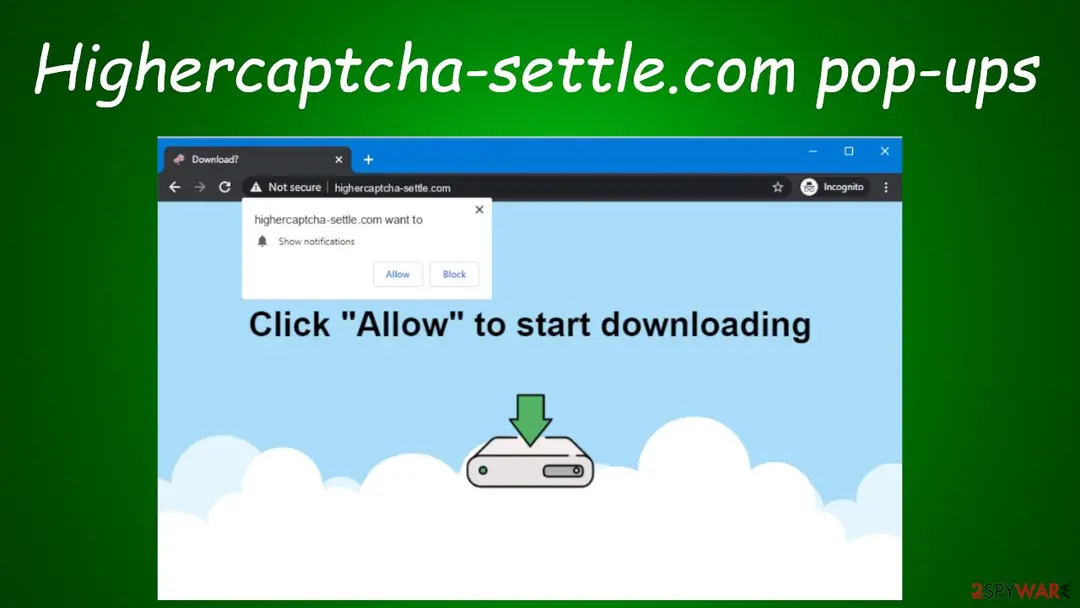
Many users have complained that after clicking a link in Google search (and possibly other search providers), they were redirected to Highercaptcha-settle.com website. This happens because users have a potentially unwanted program installed on their devices.
Facts checked October 6, 2026. Removal steps tested on Windows 11 (26H2) and checked against Microsoft's and the browser makers' current documentation. Sections marked as our earlier report are the original text: they describe the threat as it was then and have not been reviewed since. The 2026 status, the removal steps and the questions are current.
Automatic
Get a free scan and check if your PC is infected.
Fortect finds malware, unwanted programs and the Windows damage they leave behind, and repairs it in one pass.
After a fake CAPTCHA on highercaptcha-settle[.]com, a scan of the PC is a quick first check before you change passwords.
Do it yourself · free Remove Higher Captcha-Settle pop-ups yourself 4 steps, about 12 minutes, no software needed.
Start the steps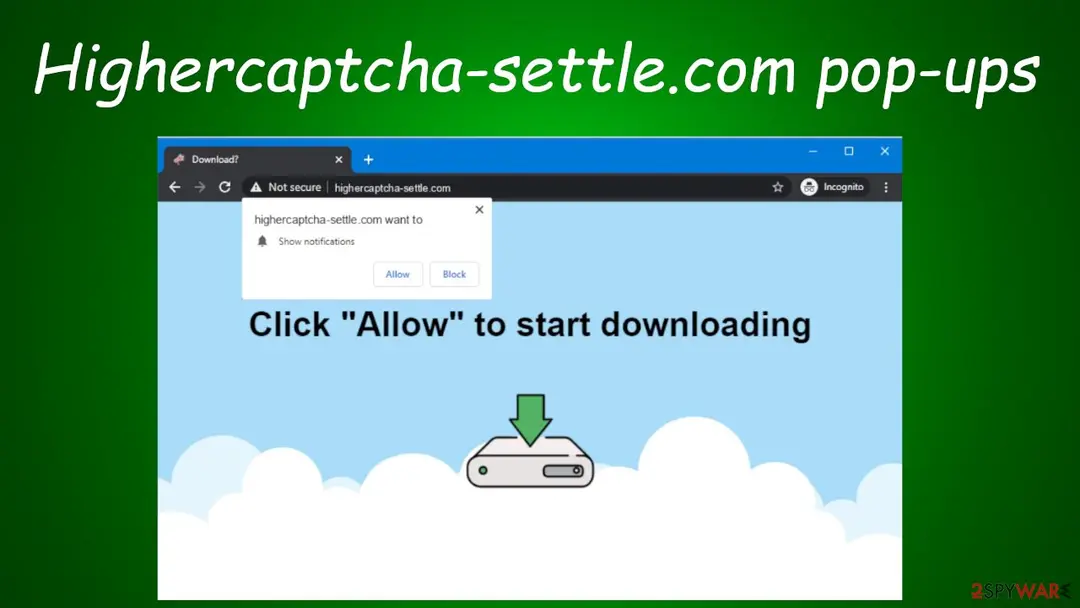
Higher Captcha-Settle pop-ups: summary
| Distribution | Software bundles, fake Flash Player updates |
|---|---|
| Damage | Redirects might lead to dangerous sites riddled with malware. Data-tracking might result in privacy loss |
| name | Higher Captcha-Settle pop-ups |
| Type | Push notification virus, PUP, adware |
| Symptoms | Redirects to questionable websites; diminished devices performance and the browsing speed; ads in the form of notifications |
| Detection names | No Microsoft detection name is known |
| Removal | Scan the PC with security software to find and remove the malware and anything installed with it. Fortect scans Windows for malware and repairs the system files and settings it damaged. Remove it nowTo use the full-featured product, you have to purchase a license for Fortect. The scan is free. |
Show 6 more facts
| Name | Higher Captcha-Settle pop-ups |
|---|---|
| Evidence | 4 write-ups by security sites; details still limited |
| Imitates | A human-verification check |
| Domains | highercaptcha-settle[.]com |
| First seen | 23 June 2021 |
| Facts checked | 6 October 2026 |
Is the Higher Captcha-Settle pop-ups check real?
- Address:
highercaptcha-settle[.]com
From our report of Jun 2021 · not reviewed since
More from our earlier report on Higher Captcha-Settle pop-ups
- Use reliable anti-malware software to remove adware and every other unwelcomed guest
What the Higher Captcha-Settle pop-ups scammers want
From our report of Jun 2021 · not reviewed since
Higher Captcha-Settle pop-ups – the outcome of an adware infection
Many users have complained that after clicking a link in Google search (and possibly other search providers), they were redirected to Highercaptcha-settle.com website.
This happens because users have a potentially unwanted program installed on their devices.
Adware can cause various shenanigans, from redirects to questionable or even dangerous domains to showing bombarding desktops or browsers with tons of deceptive ads.
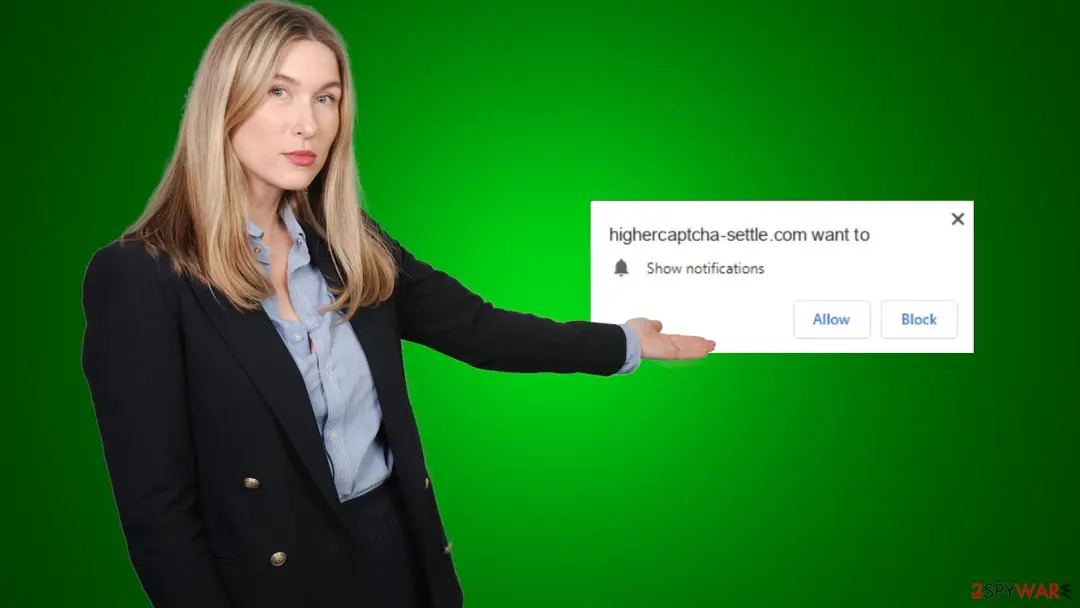
Higher Captcha Settle is a push notification virus that tries to trick its visitors into pressing the Allow button, which would enable its alerts. Push notifications are a great service that brings the latest sports updates, breaking news, special deals, and other useful information straight to your desktop or phone screen.
Unfortunately, that not the case with the article's culprit's pop-ups. They display misleading ads that appear in the top-right or bottom-right corners of your desktop or directly on your screen. The ads have nothing in common with the portals you'll be redirected to if they're clicked.
And it's hard not to do that, as they could have various alluring messages. They're impossible to close in some cases, as the "X" button doesn't work properly. It either does nothing or opens an affiliate site. If you encounter Higher Captcha Settle pop-ups, please don't interact with them in any way.
What to do if you ran the Higher Captcha-Settle pop-ups command
Whether you ran the command decides everything else, so the first step checks that.
Step 1: Check whether the pasted command ran
Press Windows + R and click the arrow at the right of the box: it lists the last commands typed there.
A long line starting with
powershell,mshta, cmd or curl means the page's command ran, and it usually downloads a password stealer. If it is there, disconnect from the internet now and do every step below, including the passwords.If the list holds nothing like it, you only saw the page, and closing it was enough. The Run box keeps this history in Windows 11 and Windows 10 alike.
Full procedure with screenshots: Run a Microsoft Defender Offline scan
Step 2: Scan the PC, then run the offline scan
Open Windows Security > Virus & threat protection > Scan options, run a Full scan and remove everything it finds. Then select Microsoft Defender Antivirus (offline scan) and click Scan now: the PC restarts and scans before Windows loads, which finds files that hide while Windows runs.
Save your work first, because the offline scan takes about 15 minutes. Both scans are built into Windows 11 and Windows 10, and a second scanner from another vendor is a useful extra opinion.

Windows 11: Windows Security > Virus & threat protection > Scan options. Full procedure with screenshots: Run a Microsoft Defender Offline scan
Step 3: Change passwords from another device and sign out other sessions
Assume that the passwords saved in this PC's browsers, and the accounts that were open in them, are known to the attacker. From a phone or a clean computer, change the e-mail password first, then banking, shopping, social and gaming accounts.
Use each service's option to sign out of all other sessions, because stolen cookies keep a session open even after a password change. Turn on two-step verification on each account. Wait with the infected Windows 11 or Windows 10 PC until the scans are clean.
Full procedure with screenshots: Turn on two-step verification / secure a hacked account
Step 4: Delete scheduled tasks that bring it back
Open Task Scheduler from the Start menu and click Task Scheduler Library. Select each task you do not recognise and read the Actions tab:
- a task that starts a file in
%AppData%or%Temp% - runs
powershellwith a long encoded line - opens a web address belongs to Higher Captcha-Settle pop-ups or a similar program
Right-click such a task and choose Delete, and check the subfolders too. Leave tasks from Microsoft, your PC's maker and programs you use. Task Scheduler is the same in Windows 11 and Windows 10.

Windows 11: Task Scheduler Library, the task selected, the Actions tab shows the file it runs. Full procedure with screenshots: Remove what malware leaves behind in Windows
- a task that starts a file in
Stream videos without limitations, no matter where you are
There are multiple parties that could find out almost anything about you by checking your online activity.
While this is highly unlikely, advertisers and tech companies are constantly tracking you online. The first step to privacy should be a secure browser that focuses on tracker reduction to a minimum.
Even if you employ a secure browser, you will not be able to access websites that are restricted due to local government laws or other reasons. In other words, you may not be able to stream Disney+ or US-based Netflix in some countries. To bypass these restrictions, you can employ a powerful VPN, which provides dedicated servers for torrenting and streaming, not slowing you down in the process.
Data backups are important - recover your lost files
Ransomware is one of the biggest threats to personal data.
Once it is executed on a machine, it launches a sophisticated encryption algorithm that locks all your files, although it does not destroy them. The most common misconception is that anti-malware software can return files to their previous states. This is not true, however, and data remains locked after the malicious payload is deleted.
While regular data backups are the only secure method to recover your files after a ransomware attack, tools such as can also be effective and restore at least some of your lost data.
From our report of Jun 2021 · not reviewed since
Instructions for adware removal
The first step to remove Higher Captcha-Settle pop-ups is to get rid of the potentially unwanted program that's causing redirects to this website.
Manual removal might be impossible as adware could be camouflaged as a legitimate app installed on your device.
PUPs aren't as dangerous as malware as they're not malicious themselves. Still, their caused redirects might lead to malicious sites where users could be exposed to various tech support scams, push notification viruses, and serious infections.
The security software has a ton of great reviews and is capable of locating and eliminating not only PUPs but also severe malware, such as ransomware, trojans, and alike.
Thus to remove Higher Captcha Settle adware, you should download the AV tool, install it, update its virus definitions database, and perform a full threat scan. It will be finished within a couple of minutes (depending on your device's storage capacity, speed, etc.), and the program will suggest removing all suspicious apps/entries. Please comply with the recommendations.
From our report of Jun 2021 · not reviewed since
Guidelines to remove Higher Captcha-Settle notifications
If you, your children, or anyone else that might have used your device has pressed the allow button when redirected to Highercaptcha-settle.com push notification virus site, you have to remove them from your browser. Unfortunately, there's no software that could help you do that.
Therefore, you'll have to do it yourself. But we'll help you. Since this PUP can infect any browser (Chrome, Safari, Firefox, etc.), this section of the article contains illustrated instructions on how to remove its notifications. For peace of mind, if you have all the below-mentioned browsers, check all of them.
Remove Highercaptcha-settle.com pop-ups from Google Chrome as follows:
Push notification viruses can also infect smartphones. The difference is that the deceptive ads would appear straight on your screen in the form of notifications. They would also contain catchy headlines but redirect to the same affiliate sites that may endanger your safety and privacy. Therefore you have to remove them from your Android device like this:
If you were redirected to Highercaptcha-settle.com and accepted its notification while using the Mozilla Firefox browser, you will need to take these actions to remove the annoying notifications:
And last but not least - the Safari browser. For a long time, Apple devices were impenetrable for various computer viruses. But those days are long gone. Macs, iPhones, and other popular products are susceptible to infections, as is the Safari browser.
Therefore, after you remove adware with reliable security software such as the , please follow these instructions to remove notifications of the treacherous site from your browser so that the annoying ads would finally stop interrupting you:
- Open Google Chrome browser and go to Menu > Settings.
- Locate the Privacy and security section and pick Site Settings > Notifications.
- Look at the Allow section and look for a suspicious URL.
- Click the three vertical dots next to it and pick Block. This should remove unwanted notifications from Google Chrome.
- Open Google Chrome and tap on Settings (three vertical dots).
- Select Notifications.
- Locate the unwanted URL and toggle the button to the left (as shown below).
- Open Mozilla Firefox and go to Menu > Options.
- Click on Privacy & Security section.
- Under Permissions, you should be able to see Notifications. Click the Settings button next to it.
- In the Settings – Notification Permissions window, click on the drop-down menu by the URL in question.
- Select Block and then click on Save Changes. This should remove unwanted notifications from Mozilla Firefox.
- Click on Safari > Preferences...
- Go to the Websites tab and, under General, select Notifications.
- Select the web address in question, click the drop-down menu and select Deny.
From our report of Jun 2021 · not reviewed since
Repair damages caused by various infections
Once all of the prior steps are completed, the adware caused redirects to untrustworthy sites, and the Higher Captcha-Settle pop-ups are gone, you should take care of your device's overall health. That must be done as each dangerous site leaves its imprint on the device (tracking cookies), and potentially unwanted programs could leave tons of traces in the various core system settings.
Finding and removing all those traces manually could take lots of time and require extensive IT knowledge. That's why cybersecurity experts highly recommend repairing all system-related irregularities and removing tracking cookies automatically.
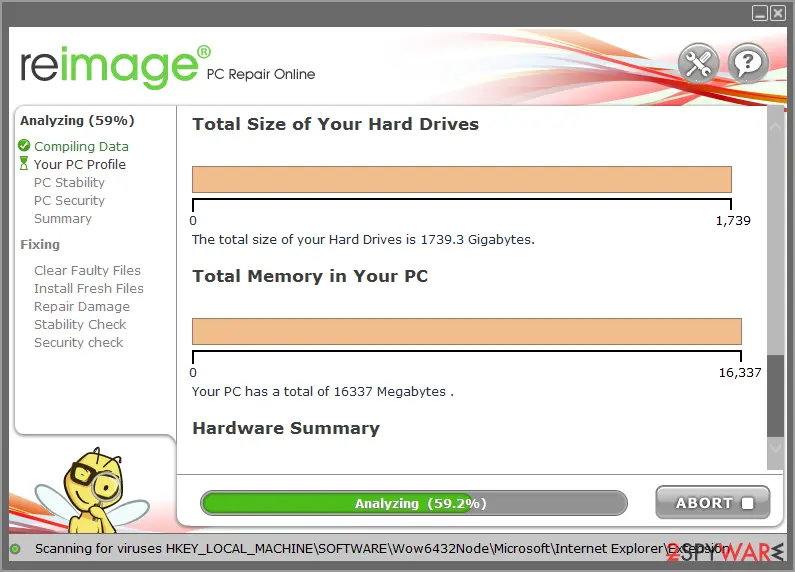
For this mission, they recommend using the patented system diagnostics tool. It will restore corrupted system files, fix broken DLLs, take out the trash, and make other essential actions needed to ensure a stable working environment. Here's what you need to do:
By following all these steps, your device will be as good as new. In the future, please be very attentive when installing new applications as software bundling is getting more and more popular. This technique doesn't disclose all apps that are preselected for installation, and as soon as you hit the Recommended or Quick installation button, all of them end up on your device.
Few good options to avoid potentially unwanted programs traveling along with legitimate apps are choosing the Advanced or Custom installation and going step-by-step through the process by deselecting all untrustworthy or suspicious apps. Another great way is to get yourself a trustworthy AV tool such as the to protect you and your device from PUPs and more severe infections.
- Download the application by clicking on the link above
- Click on the ReimageRepair.exe
- If User Account Control (UAC) shows up, select Yes
- Press Install and wait till the program finishes the installation process
- The analysis of your machine will begin immediately
Questions about Higher Captcha-Settle pop-ups
What did the highercaptcha-settle[.]com verification command do?
In ClickFix campaigns the pasted line starts a hidden PowerShell, mshta or curl process that fetches a script from a remote server and runs it. That script installs the real payload, most often an information stealer, sometimes a remote access tool or a loader that brings more malware later.
The exact payload of highercaptcha-settle[.]com can change from day to day, which is why the safe response does not depend on knowing it: scan offline, remove what was added and change passwords from another device. Look in the Run box history with Win+R to confirm the command was executed.
Why does highercaptcha-settle[.]com ask me to run a command to prove I am human?
Because the command is the attack. Real human checks, from Google, Cloudflare or anyone else, only ask you to click or solve a puzzle inside the page; none ever needs the Windows Run box. Criminals use this trick, called ClickFix, because browsers block malicious downloads but cannot stop you from running something yourself.
The page on highercaptcha-settle[.]com mimics a familiar verification box to make the request feel routine. If any page asks you to press Win+R, open PowerShell or paste anything into Windows, close it. That one rule defeats every ClickFix page.
Is Higher Captcha-Settle pop-ups really from a human-verification check?
No. It is a web page made to look like a message from a human-verification check. Websites cannot scan your computer, see your files or know whether your antivirus is active. Real security warnings appear in Windows Security or in your antivirus program, not as browser pages with phone numbers, countdowns or prize wheels.
Close the page; nothing was installed just by seeing it. If you want to check, open Windows Security from the Start menu and run a quick scan. It shows the real status of your protection.
Is highercaptcha-settle[.]com safe?
No. The site highercaptcha-settle[.]com hosts Higher Captcha-Settle pop-ups, a page that imitates a human-verification check to scare or lure visitors. Do not open it again to check; the content can change between visits and may include downloads. If you see it once, close the tab.
If it opens by itself, a notification permission, an extension or a redirecting site is sending you there; the steps in this guide remove each of these. You can report the address to your browser so that others get a warning page before it loads.
Does a human-verification check ever ask me to press Win + R?
Never. Real checks from a human-verification check run entirely inside the page:
- you tick a box
- click pictures
- simply wait a few seconds
They do not use the clipboard, do not open Windows tools and do not ask for keyboard shortcuts. Any page that shows Win + R, Ctrl + V and Enter as steps of a check is Higher Captcha-Settle pop-ups or a page like it.
Close it, and if you already followed the steps, disconnect from the internet and use the plan in this guide.
How did Higher Captcha-Settle pop-ups find me?
It did not target you personally. Pages like this buy traffic from shady ad networks and from hacked sites, and they show A fake CAPTCHA on highercaptcha-settle[.]com that asks you to paste a command to whoever is redirected to them.
Mistyped addresses, streaming and download sites, and earlier clicks on Allow for notifications are the most common entry points. Nothing about your PC was scanned or known in advance. Once you remove the trigger in the browser, the page has no way to reach you again unless you meet a similar ad.
Why does Higher Captcha-Settle pop-ups keep coming back?
Most often because a site has permission to send notifications, and those notifications lead to new scam pages. Remove notification permissions for unknown sites. Other causes are an adware extension, a browser that restores the previous session, or a site you visit often that shows such ads.
If the page appears outside the browser, a program on the PC is responsible; check Installed apps. If you cannot find the source, resetting the browser removes all of these causes at once.
Is my computer infected?
Seeing the page does not mean the PC is infected. You reached it through an ad, a redirect or a notification. Check whether something on the PC sends you there: if the page opens by itself or on every site, look for extensions and notification permissions, and run a scan.
If you downloaded or ran something the page offered, treat the PC as possibly infected and follow the plan. A full scan with Windows Security gives you a clear answer either way.
Is it safe to force-close the browser?
Yes. Ending the browser in Task Manager or restarting the PC does not damage Windows or your files, despite what pages like Higher Captcha-Settle pop-ups say. The warning "do not close this window" is part of the scam.
At worst you lose unsaved text in other tabs. After restarting, do not let the browser restore the previous session, because that would reopen the scam page.
If it reopens anyway, open the browser's settings for startup pages and remove the address. Then remove its notification permission if it has one.
Will Fortect remove Higher Captcha-Settle pop-ups?
Fortect scans Windows for malware and unwanted programs and repairs the system files and settings they change, and its free scan shows what it finds on your PC before you decide anything.
For Higher Captcha-Settle pop-ups, follow the plan above as well: the browser steps take back permissions and settings that no scanner treats as a threat, and uninstalling the program that brought it removes the source.
Run Microsoft Defender's full scan and, if anything was found, its offline scan as a second opinion. If the symptoms are gone after the plan and both scans are clean, there is nothing more to do.
Sources
- Reddit: Higher Captcha Settle (read October 6, 2026)
- Wikipedia: Potentially unwanted program (read October 6, 2026)
- Zondervirus: Zondervirus (read October 6, 2026)
- FTC: How to spot, avoid and report tech support scams (read October 6, 2026)
- FTC: How to recognize, remove and avoid malware (read October 6, 2026)