
Highpotencysoftware.com e-mail scam: how to spot it and what to do
Highpotencysoftware.com is not encountered intentionally - users get there after they click a link on some other suspicious website (e.g., peer-to-peer networks or illegal video streaming sites) or whenever they are led there by adware installed on their systems. Regardless of how users encounter it, they may be tricked into downloading potentially unwanted software or be redirected to some other malicious site.
Facts checked October 6, 2026. Removal steps tested on Windows 11 (26H2) and checked against Microsoft's and the browser makers' current documentation. Sections marked as our earlier report are the original text: they describe the threat as it was then and have not been reviewed since. The 2026 status, the removal steps and the questions are current.
Automatic
Get a free scan and check if your PC is infected.
Fortect finds malware, unwanted programs and the Windows damage they leave behind, and repairs it in one pass.
Do it yourself · free Remove Highpotencysoftware.com e-mail scam yourself 4 steps, about 12 minutes, no software needed.
Start the steps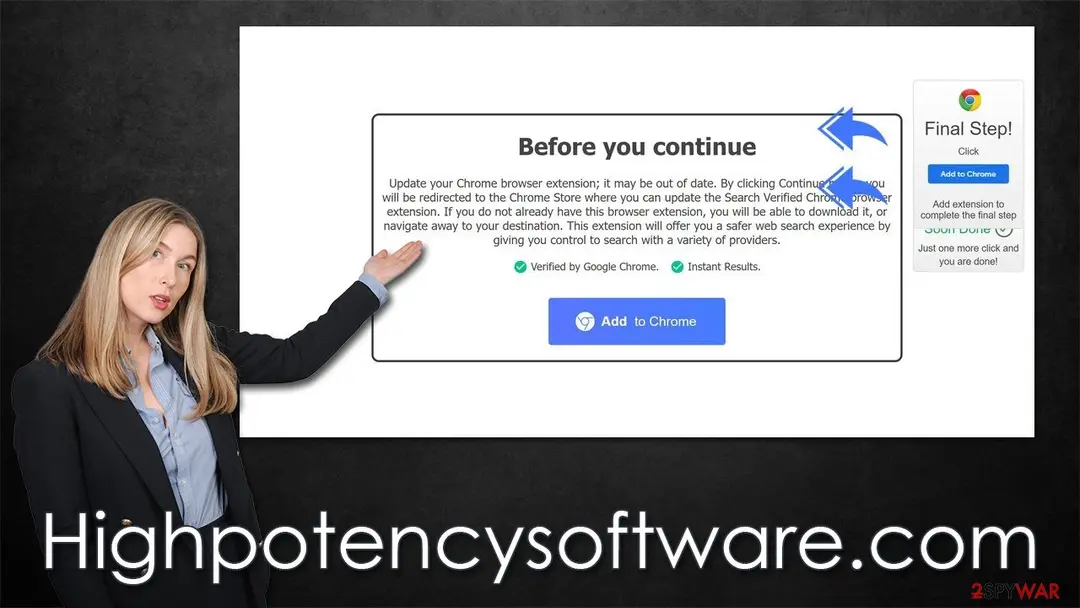
Highpotencysoftware.com e-mail scam: summary
| Distribution | Software bundling, redirects, misleading ads |
|---|---|
| Damage | Installation of potentially unwanted software, such as browser hijackers; redirects can also lead to other malicious websites, resulting in monetary loss or personal data disclosure to unknown parties |
| Name | Highpotencysoftware.com |
| Type | Redirect, scam, phishing, adware |
| Symptoms | Shows fake ads and promotes potentially unwanted applications |
| Evidence | 4 write-ups by security sites; details still limited |
| Removal | Scan the PC with security software to find and remove the malware and anything installed with it. Fortect scans Windows for malware and repairs the system files and settings it damaged. Remove it nowTo use the full-featured product, you have to purchase a license for Fortect. The scan is free. |
Show 6 more facts
| Arrives as | |
|---|---|
| Pretends to be | A well-known company |
| Claim | Your account needs urgent attention |
| Asks for | Your password |
| First seen | 16 June 2022 |
| Facts checked | 6 October 2026 |
What the Highpotencysoftware.com e-mail scam e-mail looks like
Text of a phishing e-mail asking you to sign in, as people saw it
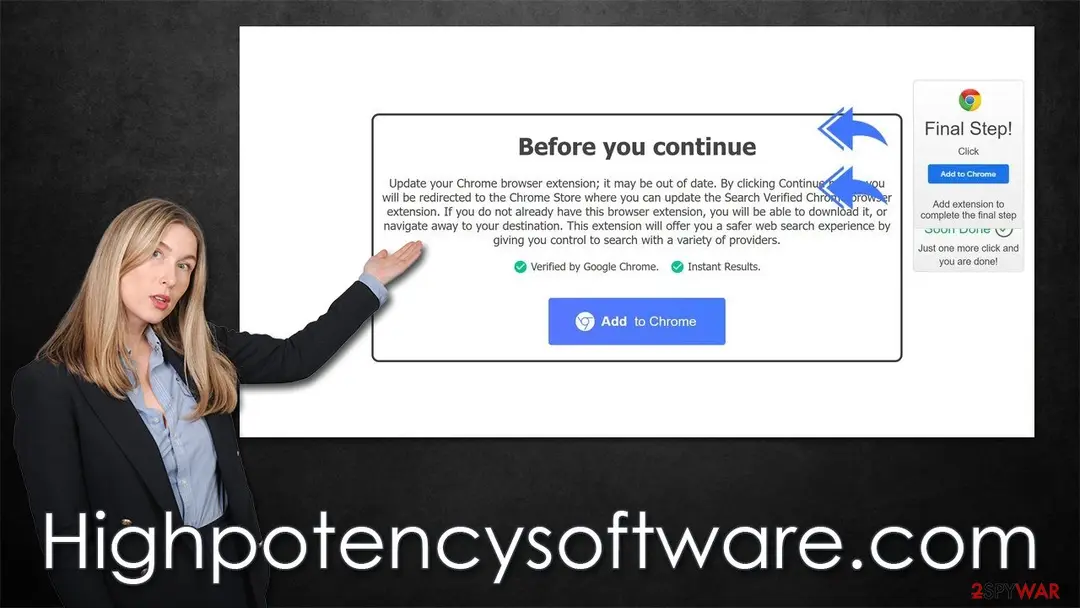
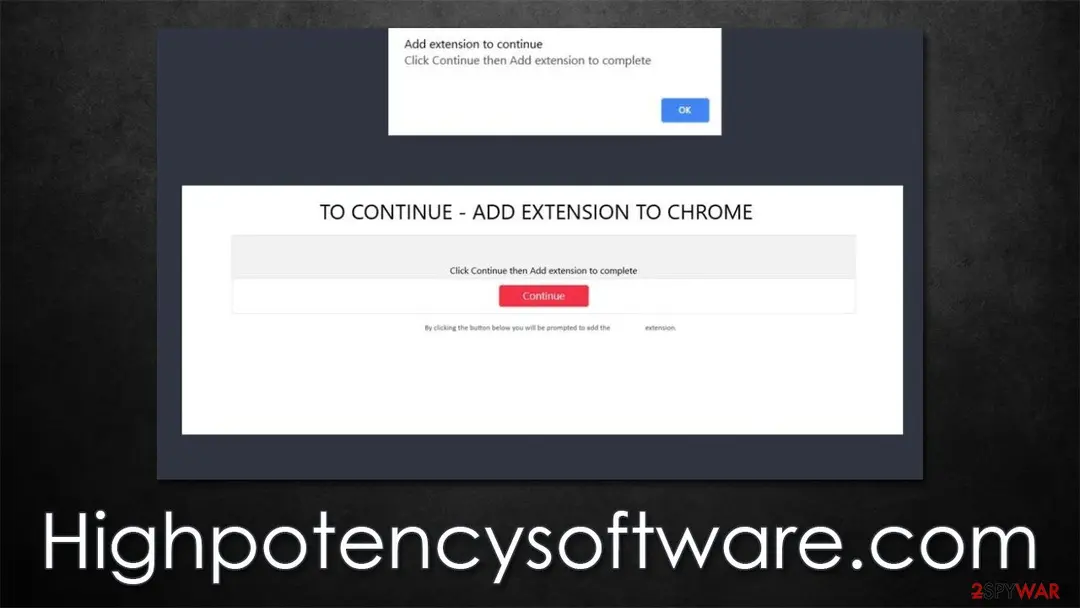
To continue - add extension to Chrome
Click Continue and Add extension to complete
From our report of Jun 2022 · not reviewed since
Highpotencysoftware.com is a suspicious website that tries to spread browser hijackers
Highpotencysoftware.com is not encountered intentionally - users get there after they click a link on some other suspicious website (e.g., peer-to-peer networks or illegal video streaming sites) or whenever they are led there by adware installed on their systems. Regardless of how users encounter it, they may be tricked into downloading potentially unwanted software or be redirected to some other malicious site.
As a result, people risk the installation of browser hijackers or other PUPs. These would consequently take over Chrome, Firefox, or another browser: change homepage and new tab settings, enforce a different search provider, and show sponsored links and ads at the top of the results.
In order t stop your browser from redirecting you to these sites, you should check it thoroughly and remove adware from your device.
How to tell the Highpotencysoftware.com e-mail scam e-mail is fake
From our report of Jun 2022 · not reviewed since
- Do not interact with scam content; if you did, uninstall the unwanted browser extension and check your system for other infections with anti-malware
- Remove caches and other web data to prevent data tracking - use the repair and maintenance tool.
- You can also repair damaged system components with it
What to do after the Highpotencysoftware.com e-mail
If you only received the message and clicked nothing, step 3 is all you need.
If you clicked the link or typed anything on the page it opened, do every step, starting with the password.
Step 1: Change the password you typed on the fake page
If you typed a password on the page the Highpotencysoftware.com message opened, assume the sender has it. Go to the real site by typing its address yourself and change the password there, choosing one you have never used.
Change it anywhere else the same password was used, and sign out all other sessions if the service offers it. Any browser on Windows 11 or Windows 10 will do, as long as you do not follow the e-mail's link.
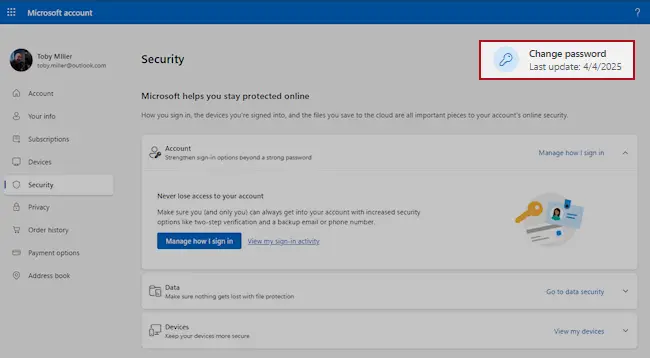
Microsoft account, Security page (account.microsoft.com/security): Change password. Full procedure with screenshots: Turn on two-step verification / secure a hacked account
Step 2: Turn on two-step verification
With two-step verification on, a stolen password alone no longer opens the account, because a sign-in from a new device also needs a code from your phone.
Switch it on for the e-mail account first, then for banking, shopping and social accounts that use that address.
Check the recovery phone, the recovery e-mail and any forwarding rules while you are in the settings, since attackers change them to come back. The pages are the same on Windows 11 and Windows 10.
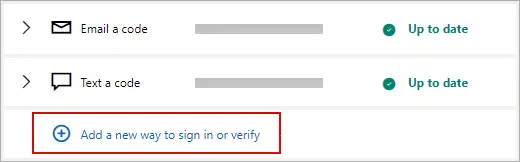
Microsoft account: Manage how I sign in, where two-step verification and the sign-in methods are. Full procedure with screenshots: Turn on two-step verification / secure a hacked account
Step 3: Report the e-mail and delete it
Do not reply and do not click anything else in the message. In Outlook select the e-mail and choose Report > Report phishing; in Gmail open the three-dot menu next to Reply and pick Report phishing.
That trains the filter for everyone on the service, and the message goes to the junk folder. If the e-mail came to a work address, forward it to your IT team as an attachment first.
The steps are the same in the web mail and the mail apps on Windows 11 and Windows 10.
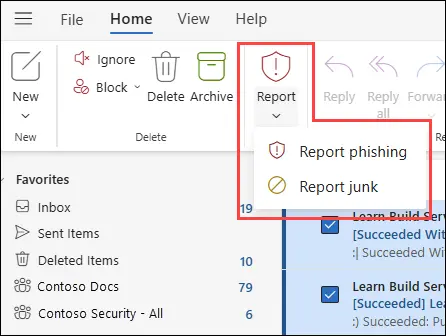
New Outlook for Windows and Outlook on the web: Report > Report phishing. Full procedure with screenshots: Report a phishing e-mail
Step 4: Scan the PC if you opened a file from the message
A fake sign-in page only steals what you type, so most readers can skip this step. If the Highpotencysoftware.com e-mail made you download or open a file, delete it and scan the PC.
In Windows Security > Virus & threat protection > Scan options, run a Full scan and then Microsoft Defender Antivirus (offline scan) > Scan now. The offline scan restarts Windows 11 or Windows 10 and takes about 15 minutes.
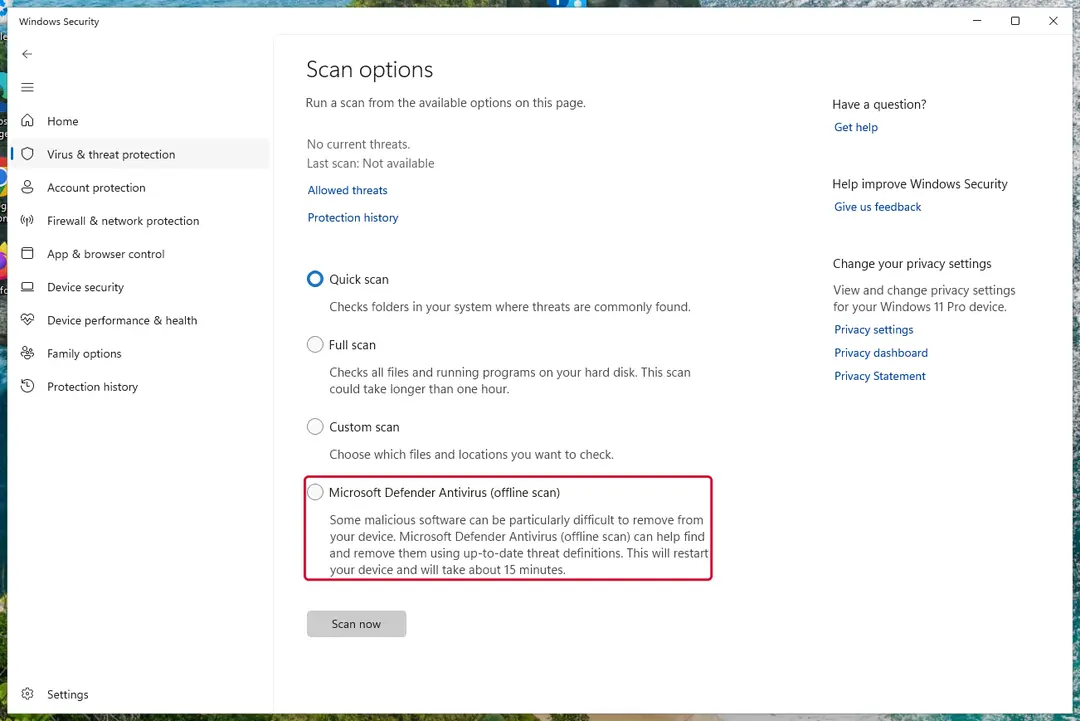
Windows 11: Windows Security > Virus & threat protection > Scan options. Full procedure with screenshots: Run a Microsoft Defender Offline scan
Choose a proper web browser and improve your safety with a VPN tool
Online spying has got momentum in recent years and people are getting more and more interested in how to protect their privacy online.
One of the basic means to add a layer of security - choose the most private and secure web browser. Although web browsers can't grant full privacy protection and security, some of them are much better at sandboxing, HTTPS upgrading, active content blocking, tracking blocking, phishing protection, and similar privacy-oriented features.
However, if you want true anonymity, we suggest you employ a powerful VPN - it can encrypt all the traffic that comes and goes out of your computer, preventing tracking completely.
Lost your files? Use data recovery software
While some files located on any computer are replaceable or useless, others can be extremely valuable.
Family photos, work documents, school projects - these are types of files that we don't want to lose. Unfortunately, there are many ways how unexpected data loss can occur:
- power cuts
- Blue Screen of Death errors
- hardware failures
- crypto-malware attack
- even accidental deletion
To ensure that all the files remain intact, you should prepare regular data backups. You can choose cloud-based or physical copies you could restore from later in case of a disaster. If your backups were lost as well or you never bothered to prepare any, can be your only hope to retrieve your invaluable files.
From our report of Jun 2022 · not reviewed since
How to avoid being tricked by online scams
One of the first useful tips out there is to look out for potentially unwanted applications and not to install them in the first place.
Highpotencysoftware.com is one of the scam sites that you may encounter because you have adware installed on your system, but you may also be tricked into installing even more unwanted software due to scam techniques used there.
The first advice would be to be careful with freeware distribution websites, as those are known to bundle software all the time. To avoid being a victim of the scheme, you should never rush through the installation steps - read the fine print, remove ticks from pre-ticked checkboxes, watch out for misplaced buttons and, most importantly, always choose Advanced instead of Recommended installation settings when prompted.
Now when it comes to phishing websites that distribute potentially unwanted programs, there could be many different scams out there, so you should be prepared for anything. For example, Highpotencysoftware.com might show the following message:
In other cases, you might be told that the extension installed on your device needs to be updated or that Flash Player is out of date. There are plenty of such social engineering tricks you should look out for. The best advice would be not to download software from ransomware websites you get redirected to and always check the URL of the page showing you prompts to download something.
From our report of Jun 2022 · not reviewed since
Get rid of adware and unwanted redirects
In most cases, adware comes in the form of a browser extension, so you should start from that.
Access the settings section and remove everything you don't recognize. In some cases, it is worth uninstalling every app and seeing if the ads and redirects are gone.
MS Edge (Chromium)
Adware can also be installed as a program that would run on the system level. One of the best examples of such adware is system optimizers, video converters, driver updaters, media players, and similar. These apps are usually installed whenever users are looking for its functionality and have no idea that it has a secondary function - to deliver ads and redirect to Highpotencysoftware.com and similar phishing websites.
If you are not quite sure which programs should be installed on your device, you should simply skip this step.
Moving the unwanted application to Trash is not enough, as adware and malware commonly use persistence mechanics. Therefore, you might have to clean the leftover files as follows:
To fully remove an unwanted app, you need to access Application Support, LaunchAgents, and LaunchDaemons folders and delete relevant files:
- Open Google Chrome, click on the Menu (three vertical dots at the top-right corner) and select More tools > Extensions.
- In the newly opened window, you will see all the installed extensions. Uninstall all the suspicious plugins that might be related to the unwanted program by clicking Remove.
- Open Mozilla Firefox browser and click on the Menu (three horizontal lines at the window's top-right).
- Select Add-ons.
- In here, select the unwanted plugin and click Remove.
- Open Edge and click select Settings > Extensions.
- Delete unwanted extensions by clicking Remove.
- Click Safari > Preferences...
- In the new window, pick Extensions.
- Select the unwanted extension and select Uninstall.
- Enter Control Panel into the Windows search box and hit Enter or click on the search result.
- Under Programs, select Uninstall a program.
- From the list, find the entry of the suspicious program.
- Right-click on the application and select Uninstall.
- If User Account Control shows up, click Yes.
- Wait till the uninstallation process is complete and click OK.
- From the menu bar, select Go > Applications.
- In the Applications folder, look for all related entries.
- Click on the app and drag it to Trash (or right-click and pick Move to Trash)
- Select Go > Go to Folder.
- Enter /Library/Application Support and click Go or press Enter.
- In the Application Support folder, look for any dubious entries and then delete them.
- Now enter /Library/LaunchAgents and /Library/LaunchDaemons folders the same way and terminate all the related .plist files.
From our report of Jun 2022 · not reviewed since
Delete cookies and cached files
You should also clean your browsers; if some components are not removed, it might pose privacy risks.
For example, cookies might be stolen by criminals in a so-called session hijacking attack, and personal accounts accessed - it can result in various security issues or even identity theft.
To avoid this, either reset your browser or remove caches, cookies, and other web data.
MS Edge (Chromium)
- Click on Menu and pick Settings.
- Under Privacy and security, select Clear browsing data.
- Select Browsing history, Cookies and other site data, as well as Cached images and files.
- Click Clear data.
- Click Menu and pick Options.
- Go to Privacy & Security section.
- Click on Clear Data...
- Select Cookies and Site Data, as well as Cached Web Content and press Clear.
- Click on Menu and go to Settings.
- Select Privacy and services.
- Under Clear browsing data, pick Choose what to clear.
- Under Time range, pick All time.
- Select Clear now.
- Click Safari > Clear History...
- From the drop-down menu under Clear, pick all history.
- Confirm with Clear History.
Questions about Highpotencysoftware.com e-mail scam
Does getting "To continue - add extension to Chrome" mean my account was compromised?
Not by itself. Phishing waves are sent to long lists of addresses collected from old breaches, websites and guessing, and the sender does not know whether you even have the account the message mentions. Getting "To continue - add extension to Chrome" only means your address is on such a list.
It becomes a problem if you sign in through the link. To be sure, open the real service from a bookmark and check recent activity and security alerts. If you see nothing unusual and you did not type your password into the fake page, your account is fine.
I typed my password after "To continue - add extension to Chrome". What now?
Act within the hour. From another device, open the real site of the account the message "To continue - add extension to Chrome" imitated and change the password. If the same password is used anywhere else, change it there too.
Sign out of all other sessions, check the recovery e-mail and phone number, and look for mail forwarding rules or filters you did not create. Then turn on two-step verification with an authenticator app or a passkey.
If the fake page also asked for a card number or a bank login, call your bank and ask them to block the card. Finally, report the e-mail so others are warned.
Could Highpotencysoftware.com be a genuine message?
We checked it, and it is not. A well-known company is only the costume. The message exists to get your password, and real companies handle that inside your account, after you sign in normally, not through links, attachments or phone numbers in a message you did not expect.
Scammers copy logos and footers perfectly, so the design proves nothing. The sender address, the link target and the request are the reliable signs, and all three point to a scam here. Delete it, and if you are worried, check your account directly.
Why does Highpotencysoftware.com say that your account needs urgent attention?
Because that story works. A problem that needs fixing, a deadline and a simple solution make people act before they check.
The claim that your account needs urgent attention is the same for everyone who received Highpotencysoftware.com; it was written once and sent in bulk. Nothing about your own situation triggered it.
If you are unsure, look at the real account or service the normal way, without using the message. The claim will not be there, which settles the question. Then report the message.
What does Highpotencysoftware.com want from me?
In the end, your password. Everything else in Highpotencysoftware.com, from the logo to the deadline, is there to get you to that point without stopping to think. Knowing the goal helps you judge your risk.
If you did not give it, you lost nothing and can delete the message. If you did, the steps in this guide are ordered by what you handed over:
- passwords first
- then card and bank details
- then documents and anything you installed
- ran
Act on the highest item on that list first.
How do I contact the real a well-known company?
Not through anything in Highpotencysoftware.com. Type the official website address into the browser yourself, use the app you already have, or use the phone number printed on your card, contract or a previous genuine invoice. Search results can be risky too, because scammers buy ads for support numbers.
Once you reach the real a well-known company, you can ask whether there is any problem with your account and report the scam message; many companies have a dedicated address for phishing reports on their security page.
Is it worth reporting a scam if I lost nothing?
Yes. Reports from people who did not fall for Highpotencysoftware.com are how blocklists, mail filters and hosting companies find new scam pages quickly, often before most recipients open the message. Reporting the message as phishing in your mail app is enough for most people.
If the message impersonates a company, its security or abuse team usually accepts forwarded copies too. Police reports matter mainly when money or documents were lost, but national fraud centres also collect reports without losses to spot campaigns.
Should I scan my PC after Highpotencysoftware.com?
Yes, it is a quick way to rule out one possible cause. Open Windows Security and run a full scan; it takes about half an hour.
If it finds nothing and there are no unknown programs or extensions, the account problem behind an e-mail with the subject "To continue - add extension to Chrome" most likely started with a leaked or phished password.
If it finds a stealer or trojan, remove it first, then change your passwords from another device, then sign out of all sessions, because stolen cookies keep working until you do.
Can I trick the scammers or waste their time?
Better not. Replying to Highpotencysoftware.com confirms that your address or number is live and puts it on lists that sell for more. Scammers who are teased sometimes switch to harassment or try to use any detail you reveal, such as your name, employer or location.
Playing along also risks a slip, like opening a link or a file they send. Report the message, block the sender and delete it. Your report does more damage to the operation than a conversation would.
Will Fortect remove Highpotencysoftware.com?
Fortect scans Windows for malware and unwanted programs and repairs the system files and settings they change, and its free scan shows what it finds on your PC before you decide anything.
For Highpotencysoftware.com, follow the plan above as well: the browser steps take back permissions and settings that no scanner treats as a threat, and uninstalling the program that brought it removes the source.
Run Microsoft Defender's full scan and, if anything was found, its offline scan as a second opinion. If the symptoms are gone after the plan and both scans are clean, there is nothing more to do.
Sources
- NTT: Cookies and Web Beacons (read October 6, 2026)
- Norton: Session hijacking: What is a session hijacking and how does it work? (read October 6, 2026)
- FTC: How to recognize and avoid phishing scams (read October 6, 2026)
- CISA: Recognize and report phishing (read October 6, 2026)
- Microsoft Support: Protect yourself from phishing (read October 6, 2026)