

News-venere.com – a push notifications virus that mysteriously modifies browser homepage and new tab search
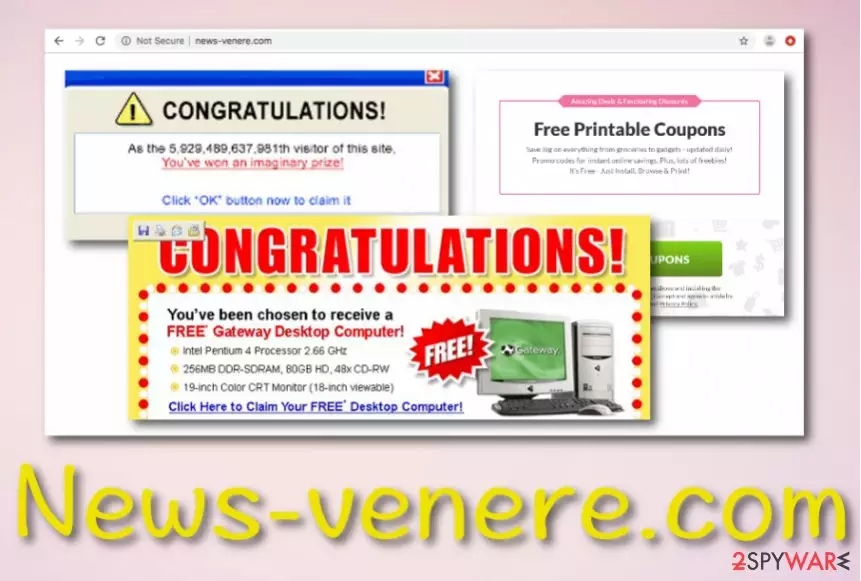
News-venere.com is an advertising domain that starts pushing bogus notifications after modifying web browsers and inserting BHOs (browser helper objects) into them. Once the adware program[1] appears on the system, it might change your default homepage and new tab search to its own and start forcing redirects during your browsing activities. The aim of News-venere.com virus is to push as many redirects and notifications as possible and collect pay-per-click revenue from each ad clicked. Even though this PUP is not malware itself, it still gains the name of “virus” due to the potential danger that its redirects might bring to the user and his/her computer system if forced to land on a malware-laden website.
| Name | News-venere.com |
|---|---|
| Type | Adware application/potentially unwanted program |
| Possible danger | Even though this program is not malware itself, it can redirect you to a potentially dangerous website where malware might be distributed and attack you unknowingly |
| Activities | Adware programs are usually responsible for intense notification flows, providing you with redirects, inserting BHOs into your web browsers, modifying the homepage and new tab search zone |
| Goal(s) | To collect pay-per-click revenue from advertisements provided, redirect the user to affiliate websites where bogus products might also be promoted |
| Distribution | Adware software is often injected into bundled program packages, third-party hyperlinks/ads, p2p sites, and similar vulnerable locations. |
| Removal process | First, scan the entire system with FortectIntego. If this system tool or your chosen anti-malware software detects potentially unwanted objects on your machine, you can continue removing them automatically or manually. File repair tools can help fix possible damage after the manual virus termination |
News-venere.com is a potentially unwanted program that can promote different types of features. Besides advertising and redirecting, the ad-supported application might also inject browser helper objects (BHOs)[2] into your browser apps such as Googe Chrome, Mozilla Firefox, Internet Explorer, Microsoft Edge, and Safari. These products can come in forms of extensions, plug-ins, add-ons, or even cookies that allow spying on the user's browsing process.
News-venere.com might start collecting information about the most commonly visited websites, what types of offers you have been recently looking for, bookmarks that were recently saved, hyperlinks and advertisements clicked, the IP address, and similar. Many developers find this type of data beneficial as it allows them to generate attractive-looking offers, provide them to users, and convince them to purchase a specific product or service.
Furthermore, News-venere.com redirects might also take you to a third-party website where bogus security software might be advertised and presented as reliable programs that can be purchased for a good price. However, these types of offers aim to trick users and convince them to download useless products instead. Be aware of what kinds of places you are taken too by this adware program and better close all of them once landed to prevent useless purchases and possible malware.
Various Trojan viruses, ransomware, cryptocurrency mining threats are often distributed through third-party domains as this is one of the easiest ways to trick users into clicking on some malicious hyperlink or ad. Prevent this type of possibility by performing News-venere.com removal with the help of reliable software or step-by-step guidelines that are added to the end of this article. In addition, scan your computer with FortectIntego software to find suspicious components and Windows entries.

Another reason to remove News-venere.com is that the adware might decrease your browsing quality slightly. Due to the fast speed of incoming adverts, redirects, and other activities, your computer's CPU will be forced to work harder. If the processor's job goes over 90%, you might start facing software and system struggles. All in all, adware programs make computing work harder to maintain in full-quality and you might find even simple tasks difficult to carry out.
In some cases, News-venere.com pop-up ads might be delivered only occasionally if you tend to step on a bogus website. For this purpose, installing AdBlock or Adblock Plus[3] should be enough. However, if the advertising starts getting more intense and you want to try all possible ways for preventing its notification flow, you can also proceed with the following:
- Open the web browser that is showing adverts.
- Locate the three dots/lines or arrow sign on your upper right.
- Launch the menu and continue with Settings.
- Furthermore, find Notifications that should be placed under the Site Settings option.
- Find anything related to News-venere.com domain and remove/disable it from the list.

Adware gets promoted via software bundles
Experts from Virusai.lt[4] claim that ad-supported applications use sneaky techniques for infiltration. Developers often inject their bogus products into software bundles as these packages usually come for free and trick users by their attractive look.
Besides, people often let various potentially unwanted programs in their computer systems by choosing the wrong installation mode. You should always opt for the Custom/Advanced configuration and avoid settings such as Quick/Recommended as the first option allows you to take full control of incoming objects.
In addition, adware-related content can come injected into hyperlinks and advertisements for stealth distribution. Additionally, you might find this type of program promoted through p2p networks and other third services. Be aware to keep a fair distance from pages which has questionable security or gives you doubts about its content.
Removal steps for News-venere.com adware and its BHOs
News-venere.com removal should be completed if you want to maintain quality-full browsing and computing work. Avoid struggles that might be caused by the adware program and terminate it with the help of antimalware software or by using step-by-step guidelines that are added to the end of this article.
If you have not yet gathered enough skills to remove News-venere.com on your own, do not worry as you can always employ reliable automatical software. For this purpose, you can choose a program from our below-provided list or search for users' reviews on the Internet and choose another reliable developer.
However, if you feel self-confident enough to uninstall News-venere.com virus by yourself, use the following guidelines to clean and optimize the OS and web browsers such as Chrome, Firefox, Explorer, Edge, or Safari.
Uninstall from Windows
Uninstall from Windows 10/8:
- Type Control Panel into the Windows search box and open the result.
- Under Programs, select Uninstall a program.


Uninstall from Windows 7/XP:
- Click on Windows Start > Control Panel (Windows XP users should click on Add/Remove Programs).
- In Control Panel, select Programs > Uninstall a program.


Remove the unwanted program:
- In the Programs and Features window, look for any recently installed suspicious entries, select them, and click Uninstall.
- If User Account Control appears, click Yes to confirm, then complete the removal.


Delete from macOS
Remove the unwanted application:
- From the menu bar, select Go > Applications.
- In the Applications folder, look for any suspicious entries, then drag them to Trash (or right-click and pick Move to Trash).


Delete leftover files and folders:
- Select Go > Go to Folder.
- Enter /Library/Application Support and remove any suspicious folders related to the unwanted program.
- Repeat the same check in the /Library/LaunchAgents and /Library/LaunchDaemons folders, deleting any suspicious entries.

- Finally, empty the Trash to permanently remove the leftovers.

Reset Internet Explorer
Remove dangerous add-ons:
- Open Internet Explorer, click on the Gear icon (IE menu) on the top-right corner of the browser
- Pick Manage Add-ons.
- You will see a Manage Add-ons window. Here, look for suspicious plugins. Click on these entries and select Disable.


Change your homepage if it was altered:
- Open IE and click on the Gear icon.
- Select Internet Options.
- In the General tab, delete the Home page address and replace it by your preferred one (for example, Google.com).
- Click Apply and then select OK.


Delete temporary files:
- Press on the Gear icon and select Internet Options.
- Under Browsing history, click Delete...
- Select relevant fields and press Delete.


Reset Internet Explorer:
- Click on Gear icon > Internet options and select Advanced tab.
- Select Reset.
- In the new window, check Delete personal settings and select Reset.


Remove from Microsoft Edge
Delete unwanted extensions from MS Edge:
- Select Menu (three horizontal dots at the top-right of the browser window) and pick Extensions.
- From the list, pick the extension and click on the Gear icon.
- Click Remove.


Clear cookies and other browser data:
- Click on the Menu (three horizontal dots at the top-right of the browser window) and select Settings > Privacy, search, and services..
- Under Clear browsing data, pick Choose what to clear.
- Select Cookies and other site data and Cached images and files. (apart from passwords, although you might want to include Media licenses as well, if applicable) and click on Clear.


Restore new tab and homepage settings:
- Click the menu icon and choose Settings.
- Then find On startup section.
- Click Remove next to any suspicious startup page.
Reset MS Edge if the above steps did not work:
- Press on Ctrl + Shift + Esc to open Task Manager.
- Click on More details arrow at the bottom of the window.
- Select Details tab.
- Now scroll down and locate every entry with Microsoft Edge name in it. Right-click on each of them and select End Task to stop MS Edge from running.


Instructions for Chromium-based Edge
Delete extensions from MS Edge (Chromium):
- Open Edge and click select Settings > Extensions.
- Delete unwanted extensions by clicking Remove.


Clear cache and site data:
- Click on Menu and go to Settings.
- Select Privacy, search and services.
- Under Clear browsing data, pick Choose what to clear.
- Under Time range, pick All time.
- Select Clear now.


Reset Chromium-based MS Edge:
- Click on Menu and select Settings.
- On the left side, pick Reset settings.
- Select Restore settings to their default values.
- Confirm with Reset.
- This will disable extensions and reset startup pages but will not delete bookmarks, saved passwords, or browsing history.


Remove from Mozilla Firefox (FF)
Remove dangerous extensions:
- Open Mozilla Firefox browser and click on the Menu (three horizontal lines at the top-right of the window).
- Select Add-ons.
- In here, select the unwanted extension and click Remove.


Reset the homepage:
- Click three horizontal lines at the top right corner to open the menu.
- Choose Settings.
- Under Home, set your preferred homepage and new tab settings.
Clear cookies and site data:
- Click Menu and pick Settings.
- Go to Privacy & Security section.
- Scroll down to locate Cookies and Site Data.
- Click on Clear Data...
- Select Cookies and Site Data and Temporary cached files and pages, then click Clear.


Reset Mozilla Firefox
If clearing the browser as explained above did not help, reset Mozilla Firefox:
- Open Mozilla Firefox browser and click the Menu.
- Go to Help and then choose Troubleshooting Information.

- Under Give Firefox a tune up section, click on Refresh Firefox...
- Once the pop-up shows up, confirm the action by pressing on Refresh Firefox.



Remove from Google Chrome
Delete malicious extensions from Google Chrome:
- Open Google Chrome, click on the Menu (three vertical dots at the top-right corner) and select More tools > Extensions.
- In the newly opened window, you will see all the installed extensions. Uninstall all suspicious extensions related to the unwanted program by clicking Remove.


Clear cache and web data from Chrome:
- Click on Menu and pick Settings.
- Under Privacy and security, select Clear browsing data.
- Select Browsing history, Cookies and other site data, as well as Cached images and files.
- Click Clear data.


Change your homepage:
- Click menu and choose Settings.
- Look for a suspicious site in the On startup section.
- Click on Open a specific or set of pages and click on three dots to find the Remove option.
Reset Google Chrome:
If the previous methods did not help you, reset Google Chrome to eliminate all the unwanted components:
- Click on Menu and select Settings.
- In the Settings, scroll down and click Advanced.
- Scroll down and locate Reset and clean up section.
- Now click Restore settings to their original defaults.
- Confirm with Reset settings.


Delete from Safari
Remove dangerous extensions:
- Open Safari, click Safari in the menu at the top-left of the screen, and select Preferences.
- Go to the Extensions tab, look for any suspicious entries, and click Uninstall to remove them.


Clear history and website data:
- Click Safari in the menu and pick Clear History.
- Set Clear to all history and confirm with Clear History.


Reset Safari:
- Click Safari in the menu and select Preferences > Advanced.
- Enable Show Develop menu in menu bar.
- From the menu bar, click Develop and select Empty Caches.


Did this guide help?
Be the first to comment