

Ouo.io – an adware-related app which offers to earn money by shortening URLs
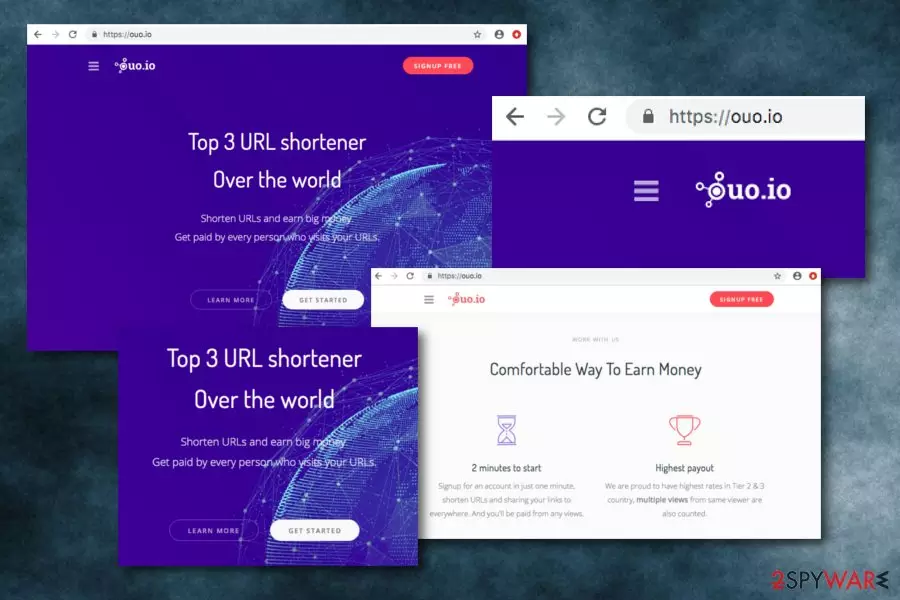
Ouo.io is considered to be an adware program which provided an URL shortening feature. If you visit this program's official website, you will spot that it presents itself as the Top 3 URL shortener all over the world. Furthermore, Ouo.io virus suggests shortening URLs for earning some income that can be gathered from each person that manages to visit the shortened link. However, this is just another marketing trick to promote the suspicious application and gain income from all visitors. Users who enter this page might be urged to click on various push notifications or be redirected to infectious websites.
Ouo.io pop-up might appear as a sign of adware that has been secretly installed on the computer system. Push notifications might start irritating you even more and more as they supposedly will appear frequently during browsing sessions on web browser applications such as Google Chrome, Mozilla Firefox, Internet Explorer, Safari, and similar apps.
| Name | Ouo.io |
|---|---|
| Program type | Adware program |
| Feature | Offers to shorten URLs |
| Activities | Advertising, redirecting, collecting browsing data |
| Purpose | To gain income from adverts and user's browsing information |
| Presented as | Top 3 URL shortener |
| Distributed | Bundled freeware, original website |
| Remove it | FortectIntego can help you with this process |
Ouo.io is described as a profit gaining website for all computer users, however, it has more disadvantages than advantages. If you decide to use the application, you will supposedly start experiencing suspicious redirecting activities through which you might land even on malware-based websites and sources. We guess that you definitely do not want that happening.
However, if you experience pop-up ads from Ouo.io only occasionally, AdBlock[1] might be enough to stop these advertisements from appearing on the computer system. Sadly, if you have spotted rogue changes in your browser app and advertising posts keep intruding you more than before, you should look for ways to get rid of it.
Having a suspicious application such as Ouo.io adware on your computer might relate not only to advertising and redirecting activities. Ad-supported programs are also capable of collecting browsing-related data for income-gaining purposes. This rogue app might start gathering information about your last visited pages, entered hyperlinks, bookmarks,[2] etc.
Remove Ouo.io from the computer system as soon as you recognize that it is adware. For this process, we recommend saving some time and using a reliable anti-malware program such as FortectIntego or SpyHunterCombo Cleaner. However, if you are looking for manual removal instructions, you can also find them at the end of this article.
Ouo.io removal is a process that you definitely need to complete if you want to bring your web browser applications back to their previous states, optimize your machine and get rid of all adware-related activities. Note that all infected locations need to be properly cleaned or the adware might renew itself within the next computer reboot.

Adware comes to the computer as a product of bundling
Researchers from Virusai.lt[3] claim that adware-related programs and additional content are carried in software packages and installed on the computer system by using stealth techniques. However, the most common adware distribution source is known as “bundling” when the potentially unwanted content enters the computer through other software.
Other adware spreading sources include unprotected third-party websites, infectious hyperlinks, and advertisements. If you are wondering how to stop adware programs from approaching you, read the following steps:
- Use reliable downloading sources. Do not use any third-party downloaders/installers as they let different types of suspicious content to install on the computer. Furthermore, choose the Custom/Advanced configuration for completing your installations.
- Keep a distance from third-party sources. Make sure to avoid various websites such as peer-to-peer networks (Torrents, The Pirate Bay), and all third-party content that is lurking in the cyberspace.
- Installing reputable antivirus protection is necessary. You need to make sure that you get a reliable virus-removing and computer-protecting tool that will ensure your machine's and work's safety 24/7. This way you will be able to prevent the secret installation of various threats such as adware.
Removal guidelines for the potentially unwanted program – Ouo.io
All adware-based content is created for revenue bringing purposes and Ouo.io virus is not an exception. However, income reaches only the developers and creators of the program. Users usually experience unwanted changes in their web browser applications, face intrusive advertising and redirecting activities which appear whenever browsing the web.
If this potentially unwanted application has appeared on your Mac or Windows machine, you need to remove Ouo.io from the system as you will supposedly experience unpleasant consequences later on. You can easily get rid of the cyber threat and optimize your computer system together with a reputable anti-malware program.[4]
Also, we have provided manual instructions for Ouo.io removal purposes. We recommend observing your skills and abilities that are required for terminating potentially unwanted programs. If you are sure that you are capable of this, you can continue with the following lines and get rid of adware from Google Chrome, Mozilla Firefox, and other browsers.
Uninstall from Windows
Uninstall from Windows 10/8:
- Type Control Panel into the Windows search box and open the result.
- Under Programs, select Uninstall a program.


Uninstall from Windows 7/XP:
- Click on Windows Start > Control Panel (Windows XP users should click on Add/Remove Programs).
- In Control Panel, select Programs > Uninstall a program.


Remove the unwanted program:
- In the Programs and Features window, look for any recently installed suspicious entries, select them, and click Uninstall.
- If User Account Control appears, click Yes to confirm, then complete the removal.


Delete from macOS
Remove the unwanted application:
- From the menu bar, select Go > Applications.
- In the Applications folder, look for any suspicious entries, then drag them to Trash (or right-click and pick Move to Trash).


Delete leftover files and folders:
- Select Go > Go to Folder.
- Enter /Library/Application Support and remove any suspicious folders related to the unwanted program.
- Repeat the same check in the /Library/LaunchAgents and /Library/LaunchDaemons folders, deleting any suspicious entries.

- Finally, empty the Trash to permanently remove the leftovers.

Reset Internet Explorer
Remove dangerous add-ons:
- Open Internet Explorer, click on the Gear icon (IE menu) on the top-right corner of the browser
- Pick Manage Add-ons.
- You will see a Manage Add-ons window. Here, look for suspicious plugins. Click on these entries and select Disable.


Change your homepage if it was altered:
- Open IE and click on the Gear icon.
- Select Internet Options.
- In the General tab, delete the Home page address and replace it by your preferred one (for example, Google.com).
- Click Apply and then select OK.


Delete temporary files:
- Press on the Gear icon and select Internet Options.
- Under Browsing history, click Delete...
- Select relevant fields and press Delete.


Reset Internet Explorer:
- Click on Gear icon > Internet options and select Advanced tab.
- Select Reset.
- In the new window, check Delete personal settings and select Reset.


Remove from Microsoft Edge
Delete unwanted extensions from MS Edge:
- Select Menu (three horizontal dots at the top-right of the browser window) and pick Extensions.
- From the list, pick the extension and click on the Gear icon.
- Click Remove.


Clear cookies and other browser data:
- Click on the Menu (three horizontal dots at the top-right of the browser window) and select Settings > Privacy, search, and services..
- Under Clear browsing data, pick Choose what to clear.
- Select Cookies and other site data and Cached images and files. (apart from passwords, although you might want to include Media licenses as well, if applicable) and click on Clear.


Restore new tab and homepage settings:
- Click the menu icon and choose Settings.
- Then find On startup section.
- Click Remove next to any suspicious startup page.
Reset MS Edge if the above steps did not work:
- Press on Ctrl + Shift + Esc to open Task Manager.
- Click on More details arrow at the bottom of the window.
- Select Details tab.
- Now scroll down and locate every entry with Microsoft Edge name in it. Right-click on each of them and select End Task to stop MS Edge from running.


Instructions for Chromium-based Edge
Delete extensions from MS Edge (Chromium):
- Open Edge and click select Settings > Extensions.
- Delete unwanted extensions by clicking Remove.


Clear cache and site data:
- Click on Menu and go to Settings.
- Select Privacy, search and services.
- Under Clear browsing data, pick Choose what to clear.
- Under Time range, pick All time.
- Select Clear now.


Reset Chromium-based MS Edge:
- Click on Menu and select Settings.
- On the left side, pick Reset settings.
- Select Restore settings to their default values.
- Confirm with Reset.
- This will disable extensions and reset startup pages but will not delete bookmarks, saved passwords, or browsing history.


Remove from Mozilla Firefox (FF)
Remove dangerous extensions:
- Open Mozilla Firefox browser and click on the Menu (three horizontal lines at the top-right of the window).
- Select Add-ons.
- In here, select the unwanted extension and click Remove.


Reset the homepage:
- Click three horizontal lines at the top right corner to open the menu.
- Choose Settings.
- Under Home, set your preferred homepage and new tab settings.
Clear cookies and site data:
- Click Menu and pick Settings.
- Go to Privacy & Security section.
- Scroll down to locate Cookies and Site Data.
- Click on Clear Data...
- Select Cookies and Site Data and Temporary cached files and pages, then click Clear.


Reset Mozilla Firefox
If clearing the browser as explained above did not help, reset Mozilla Firefox:
- Open Mozilla Firefox browser and click the Menu.
- Go to Help and then choose Troubleshooting Information.

- Under Give Firefox a tune up section, click on Refresh Firefox...
- Once the pop-up shows up, confirm the action by pressing on Refresh Firefox.



Remove from Google Chrome
Delete malicious extensions from Google Chrome:
- Open Google Chrome, click on the Menu (three vertical dots at the top-right corner) and select More tools > Extensions.
- In the newly opened window, you will see all the installed extensions. Uninstall all suspicious extensions related to the unwanted program by clicking Remove.


Clear cache and web data from Chrome:
- Click on Menu and pick Settings.
- Under Privacy and security, select Clear browsing data.
- Select Browsing history, Cookies and other site data, as well as Cached images and files.
- Click Clear data.


Change your homepage:
- Click menu and choose Settings.
- Look for a suspicious site in the On startup section.
- Click on Open a specific or set of pages and click on three dots to find the Remove option.
Reset Google Chrome:
If the previous methods did not help you, reset Google Chrome to eliminate all the unwanted components:
- Click on Menu and select Settings.
- In the Settings, scroll down and click Advanced.
- Scroll down and locate Reset and clean up section.
- Now click Restore settings to their original defaults.
- Confirm with Reset settings.


Delete from Safari
Remove dangerous extensions:
- Open Safari, click Safari in the menu at the top-left of the screen, and select Preferences.
- Go to the Extensions tab, look for any suspicious entries, and click Uninstall to remove them.


Clear history and website data:
- Click Safari in the menu and pick Clear History.
- Set Clear to all history and confirm with Clear History.


Reset Safari:
- Click Safari in the menu and select Preferences > Advanced.
- Enable Show Develop menu in menu bar.
- From the menu bar, click Develop and select Empty Caches.


Did this guide help?
Be the first to comment