
Ritingsynther.com ads: what it is and how to remove it
Ritingsynther.com is a deceptive website that users often encounter as a result of being led astray by compromised links on other high-risk web pages. These unsafe sources can include torrent websites, free streaming services, or even online platforms offering free downloads of copyrighted material.
Facts checked October 7, 2026. Removal steps tested on Windows 11 (26H2) and checked against Microsoft's and the browser makers' current documentation. Sections marked as our earlier report are the original text: they describe the threat as it was then and have not been reviewed since. The 2026 status, the removal steps and the questions are current.
Automatic
Get a free scan and check if your PC is infected.
Fortect finds malware, unwanted programs and the Windows damage they leave behind, and repairs it in one pass.
A quick scan confirms that the ritingsynther.com notifications did not lead to anything being installed.
Do it yourself · free Remove Ritingsynther.com ads yourself 2 steps, about 6 minutes, no software needed.
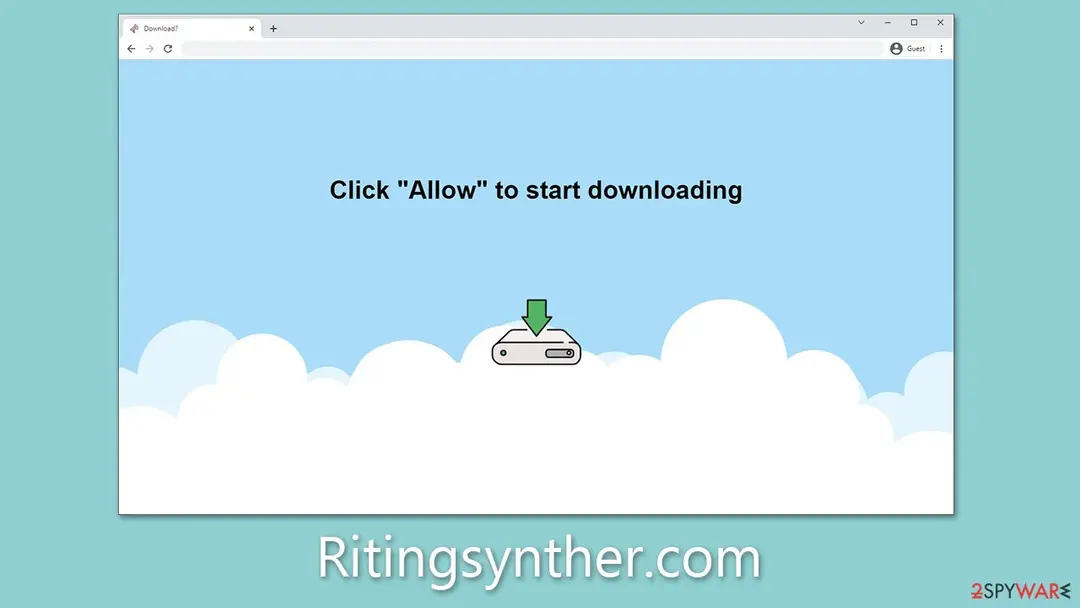
Ritingsynther.com ads: summary
| Distribution | Push notifications show up at some point after the "Allow" button in the notification prompt is clicked |
|---|---|
| Damage | Shown pop-ups incorporate fake notices and push scams. Links can also lead to websites filled with malware |
| Name | Ritingsynther.com |
| Type | Push notifications, ads, pop-ups, scam |
| Symptoms | Pop-up notifications are shown on a desktop at random times |
| Detection names | No Microsoft detection name is known |
| Removal | Scan the PC with security software to find and remove the malware and anything installed with it. Fortect scans Windows for malware and repairs the system files and settings it damaged. Remove it nowTo use the full-featured product, you have to purchase a license for Fortect. The scan is free. |
Show 7 more facts
| Evidence | One write-up by a security site; details still limited |
|---|---|
| Domains | ritingsynther.com |
| Ads shown as | Desktop notifications |
| Browsers | Chrome, Edge and Firefox |
| Installed on the PC | Nothing; a browser notification permission only |
| First seen | 9 May 2023 |
| Facts checked | 7 October 2026 |
Is Ritingsynther.com ads dangerous?
From our report of May 2023 · not reviewed since
Ritingsynther.com is a push notification scam site you should not interact with
Ritingsynther.com is a deceptive website that users often encounter as a result of being led astray by compromised links on other high-risk web pages.
These unsafe sources can include torrent websites, free streaming services, or even online platforms offering free downloads of copyrighted material.
In some cases, the redirects to Ritingsynther.com may be triggered by adware that has been clandestinely installed on the users' systems, of which they remain blissfully unaware. Regardless of how individuals arrive at this malevolent website, the encounters are never intentional, a fact that significantly aids the scammers' operations.
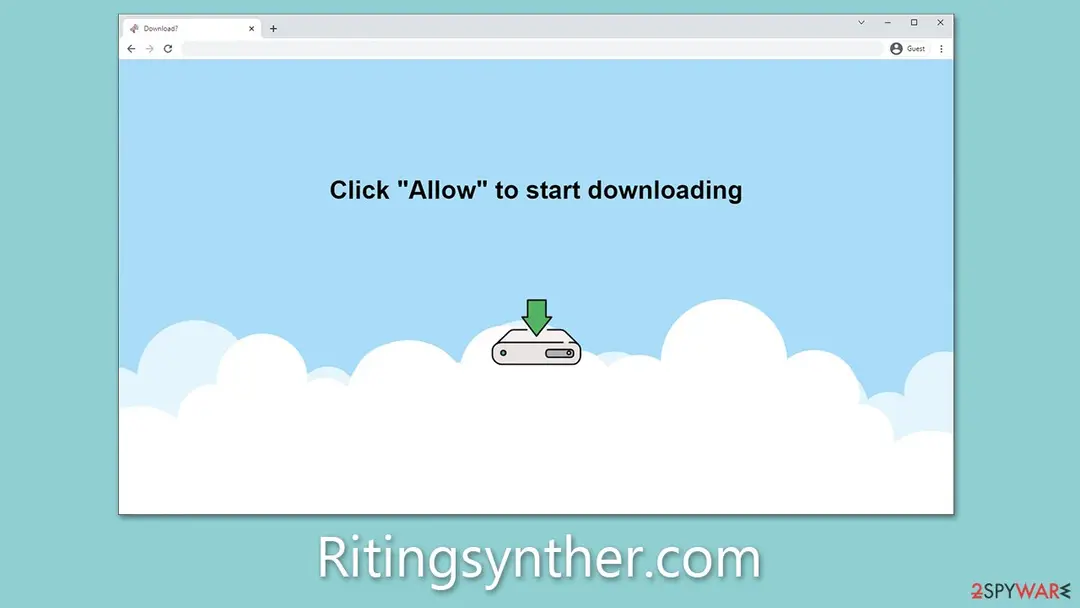
Upon landing on Ritingsynther.com, visitors are immediately greeted by misleading pop-up messages. These typically ask users to verify that they are not robots or provide some similar form of validation. The central aim of these cybercriminals is to hoodwink people into believing that the "Allow" button presented in the push notification prompt serves a purpose other than its actual function - to authorize the website to send notifications at any time.
Users who fall into this trap and press the "Allow" button may not immediately observe any changes and as such, might dismiss the incident from their minds. However, the repercussions of this action soon become evident as intrusive Ritingsynther.com advertisements begin to pop up on their screens, obstructing their ongoing activities. These intrusive ads can even disrupt full-screen operations, further underscoring the nefarious nature of the Ritingsynther.com push notification scam.
From our report of May 2023 · not reviewed since
Scam techniques used
With an overwhelming number of dubious websites populating the internet, it becomes a challenge to distinguish legitimate ones from the fraudulent ones.
Ritingsynther.com is an example of the myriad sites that employ deceptive visuals and text with the aim of tricking users into subscribing to their push notification spam.
These types of scams often bear striking similarities to one another. Consider the examples of websites like Pressrestraint.com or Asnzvu.com, where you can see the same deceptive language woven into scam messages, all with one objective: to gain permission to send notifications they have no right to deliver. Let's delve into some of the most common scams currently in operation:
Don't allow yourself to be fooled by the false promises displayed on Ritingsynther.com - there is absolutely no content available, and you won't find a video or win any prize as purported.
More likely than not, clicking anything on this site will redirect you to another harmful website making similar demands for information - avoid engaging with them. Instead, ensure that push notifications from dubious websites are blocked by adhering to the guidelines provided further below.
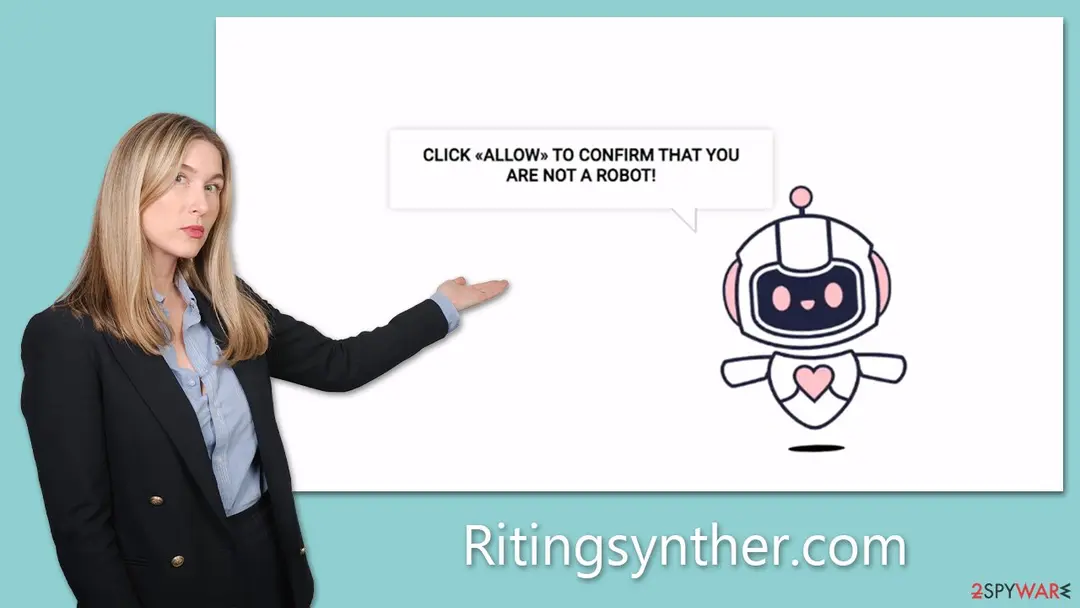
- "Click Allow to confirm you're not a robot" is a frequently seen phrase in push notification scams. Given users' familiarity with human verification processes like captchas, this request might come across as authentic. Scammers exploit this trust by innovating ways to misuse it.
- "Press Allow to Watch Video" is another popular scam phrase used in push notifications. Here, fraudsters often display counterfeit video GIFs or mimic the format of YouTube videos.
- "If you are 18+, click Allow" - this is a standard verification process used on legitimate websites to authenticate users' ages before providing access to age-restricted content. However, cybercriminals manipulate these requests for their gain.
- The statement "Click Allow to win a prize and get it in our shop!" is a misleading promotion of a fictitious giveaway, offering valuable prizes for free, sans any proof of actual prizes or winners.
From our report of May 2023 · not reviewed since
More from our earlier report on Ritingsynther.com
- Access browser settings to stop intrusive push notifications.
- After that, make sure that your system is not infected with adware or malware - scan it with
- You can employ to clean your browsers from trackers and fix any issues that could arise due to adware/malware infections
How Ritingsynther.com ads got into your browser
From our report of May 2023 · not reviewed since
Users seldom navigate intentionally to websites like Ritingsynther.com.
Attempting to directly access such sites by inputting the URL in the address bar typically results in no response. Instead, users are inadvertently redirected to these sites, a situation that plays into the hands of scammers, as the probability of errors or misclicks significantly increases under such circumstances.
The most common origin of such redirects is the unintended activation of malicious links found elsewhere on the web. Peer-to-peer networks are notorious for their deceptive "Download" buttons and misleading URLs, which, more often than not, lead users to potentially harmful websites.
Certain high-risk websites employ automated scripts that redirect visitors without any direct action from their side. Users may witness a series of redirects through multiple URLs, culminating at the final destination, which could be a site like Ritingsynther.com.
Considering the high risk of these websites being riddled with malware, and the possibility of them serving as gateways to other dangerous sites, we strongly recommend steering clear of them. The installation of a reliable ad-blocking application, coupled with robust security software, can significantly mitigate the risk posed by malicious scripts and links online, offering a safer browsing experience.
Check your browser and PC
- Address:
ritingsynther.com
How to remove Ritingsynther.com ads
How to stop Ritingsynther.com notifications
Do this in every browser you use, and in every profile inside it: each keeps its own list of sites allowed to send notifications.
Nothing has to be uninstalled for the notifications themselves.
Which browser shows the ads?
Step 1: Remove ritingsynther.com from Chrome's notification list
Chrome keeps a list of every site you once allowed to send notifications, and
ritingsynther.comis on it. Pastechrome://settings/content/notificationsinto the address bar, find ritingsynther.com under Allowed to send notifications, open the three-dot menu next to it and pick Remove.Then click Add next to Not allowed to send notifications and type ritingsynther.com, so the site cannot ask a second time. Repeat it in every Chrome profile you use on Windows 11 or Windows 10, since each profile has its own list.
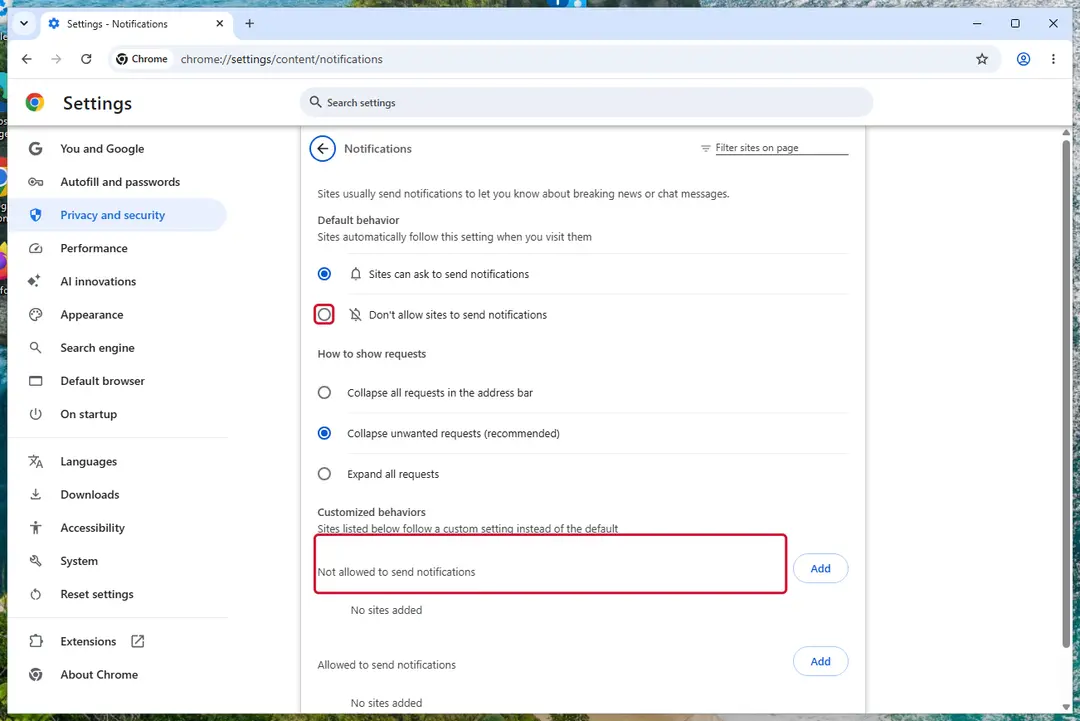
Chrome on Windows 11: Settings > Privacy and security > Site settings > Notifications. Full procedure with screenshots: Stop website notifications and pop-ups
Step 1: Remove ritingsynther.com from Edge's notification list
Open Settings and more (the three dots) > Settings > Privacy, search, and services > Site permissions > All permissions > Notifications. Remove
ritingsynther.comfrom the Allowed list, then click Add site next to Not allowed to send notifications and enter it there.Edge is built into both Windows 11 and Windows 10, so check it even if you normally use another browser. If the notifications came with the Edge logo, this is the browser that holds the permission.
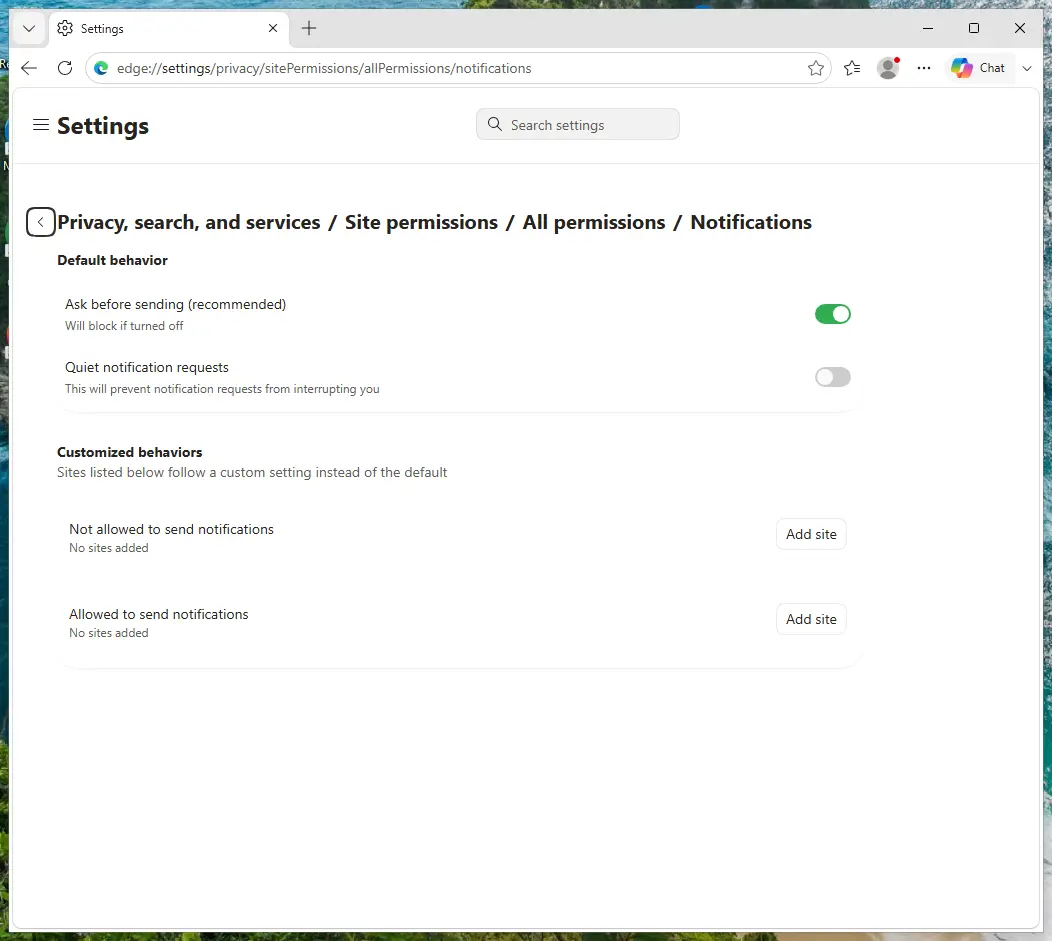
Edge on Windows 11: Site permissions > All permissions > Notifications. Full procedure with screenshots: Stop website notifications and pop-ups
Step 1: Remove ritingsynther.com from Firefox's notification permissions
Open the menu (three lines) > Settings and click Permissions and data in the left list, then Notifications. Select
ritingsynther.com, click Remove Website and confirm with Save Changes.In versions older than Firefox 152 the same list sits under Privacy & Security, behind a Settings button next to Notifications. Firefox shows these notifications only while it is running, on Windows 11 and Windows 10 alike.
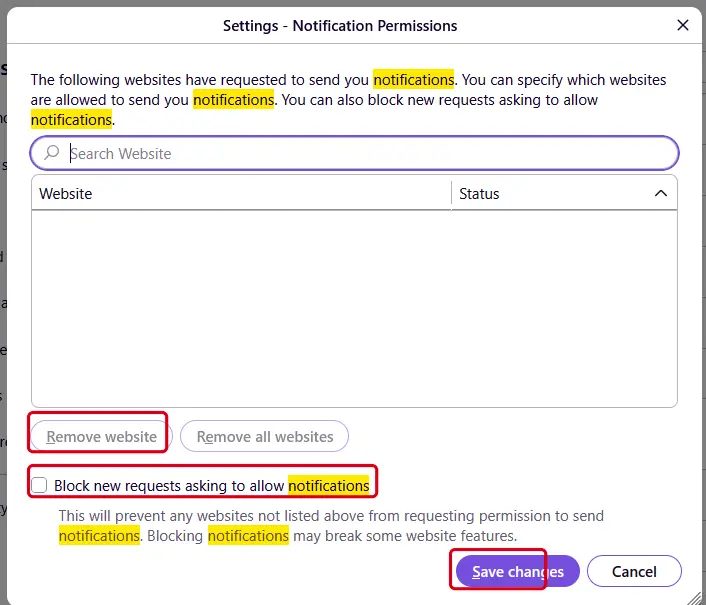
Firefox on Windows 11: the Notification Permissions window. Full procedure with screenshots: Stop website notifications and pop-ups
Then, whichever browser you use
Step 2: Scan the PC if you downloaded anything from the ads
If you only saw the notifications and clicked nothing, you can stop before this step. If a notification led you to download or run something, delete that file, then scan Windows.
In Windows Security > Virus & threat protection > Scan options, run a Full scan, then choose Microsoft Defender Antivirus (offline scan) and Scan now. The offline scan restarts the PC and takes about 15 minutes on Windows 11 and Windows 10.
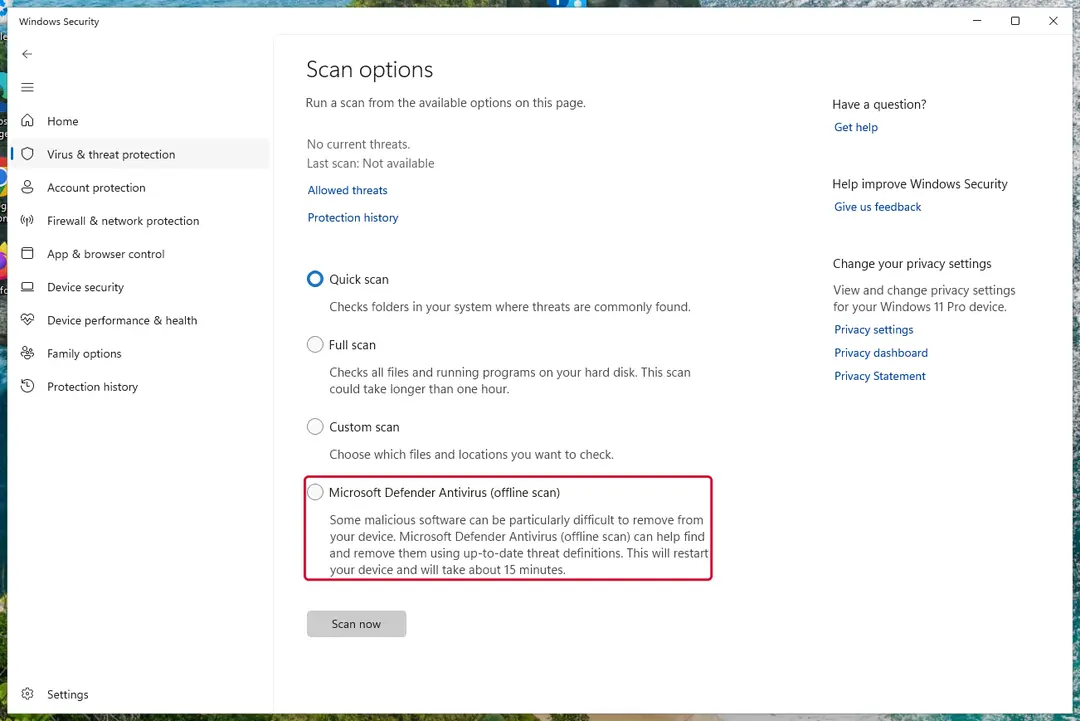
Windows 11: Windows Security > Virus & threat protection > Scan options. Full procedure with screenshots: Run a Microsoft Defender Offline scan
More removal instructions
For programs installed on the PC and older browsers. Open the one you need.
Removal of Ritingsynther.com ads
While unfortunate redirects often lead users to scam websites, the frequency of encountering such phishing websites may increase if the system is infected with adware.
This is especially likely if you also observe additional suspicious activities such as pop-ups, offers, coupons, sponsored links, or rerouting through dubious web addresses while browsing the internet.
Doing so not only ensures your system is clear of malware, including adware, browser hijackers, trojans, backdoors, and other threats, but it also makes future malware infections less likely. Once potentially unwanted and harmful applications have been eliminated, we suggest using to clean your browsers and fix any possible virus-induced damage.
To eliminate the pesky push notifications, you need to navigate to your browser settings and block the Ritingsynther.com URL. Locate the section corresponding to the browser you are using and follow the steps provided:
Google Chrome (Android)
MS Edge (Chromium)
- Open the Google Chrome browser and go to Menu > Settings.
- Locate the Privacy and security section and pick Site Settings > Notifications.
- Look at the Allow section and look for a suspicious URL.
- Click the three vertical dots next to it and pick Block. This should remove unwanted notifications from Google Chrome.
- Open Google Chrome and tap on Settings (three vertical dots).
- Select Notifications.
- Locate the unwanted URL and toggle the button to the left (Off position).
- Open Mozilla Firefox and go to Menu > Options.
- Click on Privacy & Security section.
- Under Permissions, you should be able to see Notifications. Click the Settings button next to it.
- In the Settings – Notification Permissions window, click on the drop-down menu by the URL in question.
- Select Block and then click on Save Changes. This should remove unwanted notifications from Mozilla Firefox.
- Click on Safari > Preferences...
- Go to the Websites tab and, under General, select Notifications.
- Select the web address in question, click the drop-down menu and select Deny.
- Open Microsoft Edge, and go to Settings.
- Select Site permissions.
- Go to Notifications on the right.
- Under Allow, you will find the unwanted entry.
- Click on More actions and select Block.
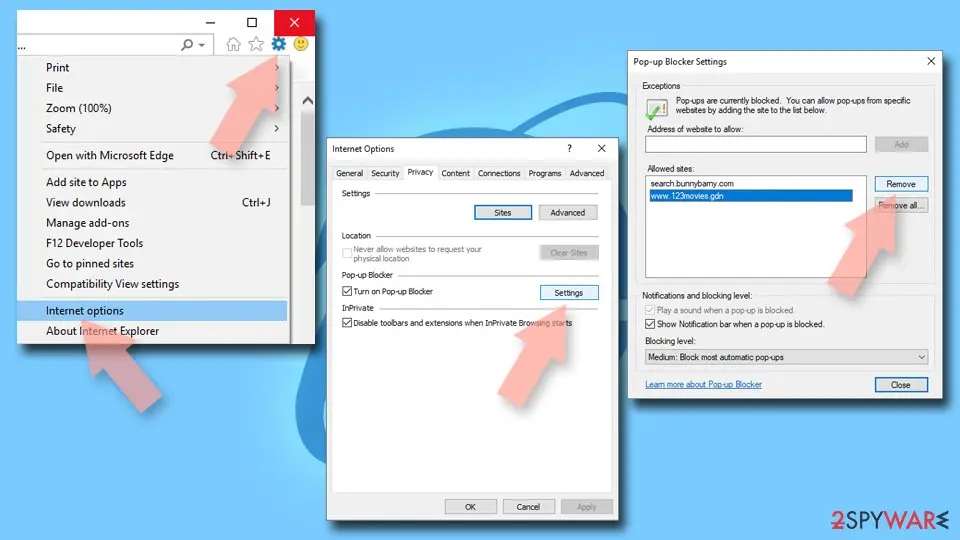
- Open Internet Explorer, and click on the Gear icon at the top-right of the window.
- Select Internet options and go to the Privacy tab.
- In the Pop-up Blocker section, click on Settings.
- Locate the web address in question under Allowed sites and pick Remove.
Protect your privacy - employ a VPN
There are several ways how to make your online time more private - you can access an incognito tab.
However, there is no secret that even in this mode, you are tracked for advertising purposes. There is a way to add an extra layer of protection and create a completely anonymous web browsing practice with the help of VPN. This software reroutes traffic through different servers, thus leaving your IP address and geolocation in disguise.
Besides, it is based on a strict no-log policy, meaning that no data will be recorded, leaked, and available for both first and third parties. The combination of a secure web browser and VPN will let you browse the Internet without a feeling of being spied or targeted by criminals.
No backups? No problem. Use a data recovery tool
If you wonder how data loss can occur, you should not look any further for answers - human errors, malware attacks, hardware failures, power cuts, natural disasters, or even simple negligence.
In some cases, lost files are extremely important, and many straight out panic when such an unfortunate course of events happen. Due to this, you should always ensure that you prepare proper data backups on a regular basis.
If you were caught by surprise and did not have any backups to restore your files from, not everything is lost. is one of the leading file recovery solutions you can find on the market - it is likely to restore even lost emails or data located on an external device.
Questions about Ritingsynther.com ads
Why do I get notifications from ritingsynther.com when the browser is closed?
Chrome and Edge can keep a small part running in the background so that sites can deliver notifications, and Windows shows them in its notification area. That is why messages from ritingsynther.com keep arriving with no browser window open.
The permission to send them was granted when someone clicked Allow on a prompt from that site, often disguised as a robot check or a video player. Closing the browser does not remove it; only the notification settings do.
Remove ritingsynther.com from the allowed sites and the background messages stop. You can also stop the browser from running in the background in its system settings, but the permission is the real fix.
I clicked a notification from ritingsynther.com. What should I do?
If you only opened the page and closed it, nothing else is needed besides removing the permission from ritingsynther.com. If the page asked for card details, a phone number or a password and you entered them, act on that: call the bank to block the card, or change the password from another device.
If it offered a download, delete the file unopened, or uninstall it from Installed apps if you ran it, then run a full scan. If you called a number shown on the page, follow the steps for callers in this guide. Finally, remove the permission so that no more messages arrive.
Why does Ritingsynther.com show me ads?
Because that is its whole purpose. Ritingsynther.com is a push-notification spam site, and its operators are paid for every ad it displays and every click it gets. In this case the ads take the form of desktop notifications.
They are chosen by ad networks that accept almost any advertiser, which is why so many look like warnings or prizes. The ads are not a sign that your PC is broken or infected with something worse; they are a sign that something on it, or in the browser, has permission to advertise. Removing that permission or program stops them.
Is ritingsynther.com safe to visit?
No. The site ritingsynther.com exists to push visitors towards ads, and the pages it leads to include fake virus warnings, fake updates, prize scams and notification prompts. Visiting it once does not infect an up-to-date PC, but anything you click or download there is a gamble.
Do not enter personal details, do not allow notifications and do not call phone numbers it shows. If it opens by itself, close the tab and check the browser's extensions and notification permissions. Blocking the single domain helps little, because the operators register new names regularly.
Which browser is sending the ritingsynther.com notifications?
Each notification shows the name of the browser and the site in its small print. In the cases we saw, the messages from ritingsynther.com came through Chrome, Edge and Firefox. Permissions are stored per browser and per profile, so removing the site in one browser does not affect another.
If you use several Chrome or Edge profiles, check each one. If you sync the browser with an account, remove the permission while signed in, otherwise another computer may still hold it and keep receiving the same messages.
How do I know the ads come from Ritingsynther.com?
Look for notifications from ritingsynther.com. That is the trace Ritingsynther.com leaves, and it shows up as desktop notifications. Ads that appear on every site, including ones that never carried ads before, point to something on your PC or in the browser rather than to the sites themselves.
A quick test is a private window, where extensions are off by default: if the ads disappear there, an extension is responsible. If they appear even with the browser closed, the source is a notification permission or a program in Windows.
Why didn't my antivirus catch Ritingsynther.com?
Many security products do not block adware or notification sites by default, because users often agreed to them, even through a misleading prompt. Notification spam installs nothing at all, so there is no file to detect.
In Windows 11 you can make Microsoft Defender block potentially unwanted apps: open Windows Security > App & browser control > Reputation-based protection settings and turn on Potentially unwanted app blocking. If notifications caused the pop-ups, no scanner will report them; the fix is in the browser's site settings.
I clicked on one of the ads. Am I infected?
Probably not. Clicking an ad usually only opens a page, and a page cannot install programs on an up-to-date Windows PC without your help.
You are at risk only if you then downloaded and ran a file, allowed notifications, entered card or login details, or called a phone number shown on the page. Delete any download and run a full and offline scan.
Change passwords you typed, from a clean device. Call your bank if you gave card details. If you called a number or allowed remote access, see the next question.
An ad showed a phone number and I called it. What now?
The number belongs to scammers, not to Microsoft or an antivirus company. If you only talked, hang up and do not call back. If you let them connect to the PC, disconnect it from the internet, uninstall the remote access program they used, such as AnyDesk, TeamViewer, ScreenConnect or UltraViewer, and run a full and offline scan.
If you paid or gave bank details, call your bank at once on the number printed on your card. Change any passwords you typed while they were connected, and report the call.
Will Fortect remove Ritingsynther.com?
No program removes Ritingsynther.com itself, because there is nothing on the PC to remove: the notifications come through a permission saved in the browser, and only the browser's settings take it away, as the steps above show.
What Fortect can do is check the rest of Windows. Its free scan looks for malware, unwanted programs and damaged system files, which is useful if you clicked the ads, downloaded something from the pages they opened, or are not sure what else changed on the PC.
If the scan finds nothing and the notifications stopped after you removed the permission, this problem is solved. Use Microsoft Defender as a second opinion whenever you have downloaded files from pages like these.
Sources
- Google Chrome Help: Use notifications to get alerts (no longer online) (read October 7, 2026)
- FTC: How to recognize, remove and avoid malware (read October 7, 2026)
- Microsoft Learn: Microsoft Defender Offline (read October 7, 2026)
- Microsoft Learn: How Microsoft names malware (read October 7, 2026)