

Roboverify.xyz – an adware domain that requires human verification by clicking the “Allow” button
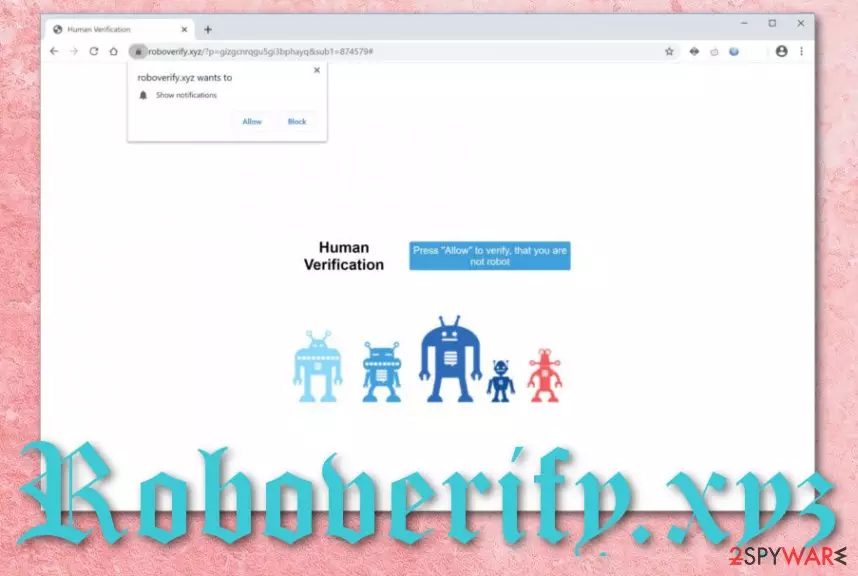
Roboverify.xyz is a third-party domain that urges users to click on the “Allow” section to confirm that they are not robots. We recommend closing the window instead of following this requirement as you will agree with the incoming notification flow. The adware targets all types of web browsers and floods the user with annoying advertisements that hold misleading deals, offers, and surveys. Additionally, Roboverify.xyz virus forces redirects to unknown locations some of which might be potentially malicious. You should put no trust in this app as its main goal is to collect income from the advertisements that it provides you with and from the browsing-related details regarding your online sessions that it shares with other parties.
| Name | Roboverify.xyz |
|---|---|
| Type | Adware/PUP |
| Activities | Adware programs such as this one are known for their intrusive advertising activities, redirecting sessions to sponsored domains, and collection of browsing-related material |
| Danger | Even though this app is not categorized as malware, it can easily redirect you to potentially infectious sources. There you might catch a malware infection, e.g. Trojan horse |
| Removal | You can eliminate the adware with the help of automatical software or the manual instructions that have been added to the end of this article |
| System fix | If your system has experienced some type of corruption during the adware attack, you can try fixing your machine with software such as FortectIntego |
Roboverify.xyz pop-up ads might start interrupting your browsing sessions and hardening your browsing process. If the advertising activity gets too intense, you might start experiencing frequent browser struggles and even crashes. Additionally, your system resources can get overused too and your computer might also start freezing.
The main goal of the ads is to bring income from the cost-per-click technique[1] and provide users with various deals most of which often appear to be misleading and fake. Roboverify.xyz aims to generate revenue from its advertisements, so it tries to attract as many subscribers as possible by loading such message on the user's web browser:
Roboverify.xyz wants to Show notifications
Click “Allow” to close this window
This window can be closed by pressing “Allow”. If you wish to continue browsing this website just click the more info button
Click Allow to confirm that you are not a robot!
As you can see, Roboverify.xyz uses deceptive techniques to attract as many visitors as possible. You should not fall for such trick as you will likely end up with an excessive amount of ads intruding your browsing sessions daily.
Another relevant problem with Roboverify.xyz is its redirecting activities. The developers create their apps in a way that they take the users to sponsored locations and load them with additional offers. If this happens to you, be aware that you may have landed on an infectious website and you should close the opened window immediately.

Continuously, Roboverify.xyz removal is advised if you want to get rid of all of these unwanted activities from your computer. Be aware that the adware app might have added rogue entries and processes in directories such as the Task Manager and Windows Registry, so these sections require cleaning too.
Another reason to remove Roboverify.xyz from your machine and browsers is that the app might be capable of recording browsing-related information such as recently visited websites, bookmarks[2] saved, your IP address, browser type, and using the collected data for sharing with other parties or getting you involved in targeted advertising.
Roboverify.xyz is an app that can bring other potentially unwanted programs to your computer system. So, once infected with this adware, do not be surprised to see other suspicious apps such as browser hijacker or scareware placed on your computer system. The infiltration of adware signifies that your machine is not protected enough.
Once you get rid of Roboverify.xyz permanently, do not forget to refresh your web browsers as these might have experienced changes in their homepage and new tab URL bar sections. Additionally, if you have discovered some signs of compromisation on your computer, you can try repairing the system with specific software such as FortectIntego.

Delivery techniques of adware programs
Technology experts from LesVirus.fr[3] claim that adware applications can get delivered through a deceptive technique known as “bundling”. The developers are likely to pack the PUP within an official package of freeware and shareware.[4]
The adware application is very likely to end up on computer systems that have the “Recommended” downloading mode selected as default. We recommend changing the configuration to “Advanced” where you will be the one in control of all of your incoming downloads and be able to deselect the bogus-looking ones.
Be aware that adware can sneak into your computer from third-party downloading sources such as softonic.com, cnet.com, or download.com. Get all of your software and services only from their original websites or from their official developers as this will be much safer that installing products from third-parties.
Continuously, adware apps can get installed into hyperlinks and advertisements. If you are a frequent user of the Internet, you should be aware of various third-party sources that are marked as unsafe. Also, prevent yourself from clicking on hyperlinks and advertisements that carry a look of suspicion.
Last but not least, PUPs can try to sneak into computer systems by pretending to be fake flash player or other software updates. Install an antivirus tool that will alert if you are dealing with unknown content. Also, always check all updates at the program's official update release page.
Learn how to eliminate Roboverify.xyz virus
If you have been looking for Roboverify.xyz removal guidelines, you have entered the right page. Here we will teach you how to perform the elimination manually and automatically. The automatical technique requires only downloading and installing reliable antimalware tools.
However, the manual elimination method requires more of the user's effort and time. Below we have provided some guidelines that will show you how to clean your computer system and web browsers such as Chrome, Firefox, Edge, Explorer, and Safari from Roboverify.xyz virus.
Keep in mind that Roboverify.xyz might have added additional components to your computer system, so it is important to get rid of all of them, otherwise, the adware program might easily return within the next machine boot process.
Uninstall from Windows
Uninstall from Windows 10/8:
- Type Control Panel into the Windows search box and open the result.
- Under Programs, select Uninstall a program.


Uninstall from Windows 7/XP:
- Click on Windows Start > Control Panel (Windows XP users should click on Add/Remove Programs).
- In Control Panel, select Programs > Uninstall a program.


Remove the unwanted program:
- In the Programs and Features window, look for any recently installed suspicious entries, select them, and click Uninstall.
- If User Account Control appears, click Yes to confirm, then complete the removal.


Delete from macOS
Remove the unwanted application:
- From the menu bar, select Go > Applications.
- In the Applications folder, look for any suspicious entries, then drag them to Trash (or right-click and pick Move to Trash).


Delete leftover files and folders:
- Select Go > Go to Folder.
- Enter /Library/Application Support and remove any suspicious folders related to the unwanted program.
- Repeat the same check in the /Library/LaunchAgents and /Library/LaunchDaemons folders, deleting any suspicious entries.

- Finally, empty the Trash to permanently remove the leftovers.

Reset Internet Explorer
Remove dangerous add-ons:
- Open Internet Explorer, click on the Gear icon (IE menu) on the top-right corner of the browser
- Pick Manage Add-ons.
- You will see a Manage Add-ons window. Here, look for suspicious plugins. Click on these entries and select Disable.


Change your homepage if it was altered:
- Open IE and click on the Gear icon.
- Select Internet Options.
- In the General tab, delete the Home page address and replace it by your preferred one (for example, Google.com).
- Click Apply and then select OK.


Delete temporary files:
- Press on the Gear icon and select Internet Options.
- Under Browsing history, click Delete...
- Select relevant fields and press Delete.


Reset Internet Explorer:
- Click on Gear icon > Internet options and select Advanced tab.
- Select Reset.
- In the new window, check Delete personal settings and select Reset.


Remove from Microsoft Edge
Delete unwanted extensions from MS Edge:
- Select Menu (three horizontal dots at the top-right of the browser window) and pick Extensions.
- From the list, pick the extension and click on the Gear icon.
- Click Remove.


Clear cookies and other browser data:
- Click on the Menu (three horizontal dots at the top-right of the browser window) and select Settings > Privacy, search, and services..
- Under Clear browsing data, pick Choose what to clear.
- Select Cookies and other site data and Cached images and files. (apart from passwords, although you might want to include Media licenses as well, if applicable) and click on Clear.


Restore new tab and homepage settings:
- Click the menu icon and choose Settings.
- Then find On startup section.
- Click Remove next to any suspicious startup page.
Reset MS Edge if the above steps did not work:
- Press on Ctrl + Shift + Esc to open Task Manager.
- Click on More details arrow at the bottom of the window.
- Select Details tab.
- Now scroll down and locate every entry with Microsoft Edge name in it. Right-click on each of them and select End Task to stop MS Edge from running.


Instructions for Chromium-based Edge
Delete extensions from MS Edge (Chromium):
- Open Edge and click select Settings > Extensions.
- Delete unwanted extensions by clicking Remove.


Clear cache and site data:
- Click on Menu and go to Settings.
- Select Privacy, search and services.
- Under Clear browsing data, pick Choose what to clear.
- Under Time range, pick All time.
- Select Clear now.


Reset Chromium-based MS Edge:
- Click on Menu and select Settings.
- On the left side, pick Reset settings.
- Select Restore settings to their default values.
- Confirm with Reset.
- This will disable extensions and reset startup pages but will not delete bookmarks, saved passwords, or browsing history.


Remove from Mozilla Firefox (FF)
Remove dangerous extensions:
- Open Mozilla Firefox browser and click on the Menu (three horizontal lines at the top-right of the window).
- Select Add-ons.
- In here, select the unwanted extension and click Remove.


Reset the homepage:
- Click three horizontal lines at the top right corner to open the menu.
- Choose Settings.
- Under Home, set your preferred homepage and new tab settings.
Clear cookies and site data:
- Click Menu and pick Settings.
- Go to Privacy & Security section.
- Scroll down to locate Cookies and Site Data.
- Click on Clear Data...
- Select Cookies and Site Data and Temporary cached files and pages, then click Clear.


Reset Mozilla Firefox
If clearing the browser as explained above did not help, reset Mozilla Firefox:
- Open Mozilla Firefox browser and click the Menu.
- Go to Help and then choose Troubleshooting Information.

- Under Give Firefox a tune up section, click on Refresh Firefox...
- Once the pop-up shows up, confirm the action by pressing on Refresh Firefox.



Remove from Google Chrome
Delete malicious extensions from Google Chrome:
- Open Google Chrome, click on the Menu (three vertical dots at the top-right corner) and select More tools > Extensions.
- In the newly opened window, you will see all the installed extensions. Uninstall all suspicious extensions related to the unwanted program by clicking Remove.


Clear cache and web data from Chrome:
- Click on Menu and pick Settings.
- Under Privacy and security, select Clear browsing data.
- Select Browsing history, Cookies and other site data, as well as Cached images and files.
- Click Clear data.


Change your homepage:
- Click menu and choose Settings.
- Look for a suspicious site in the On startup section.
- Click on Open a specific or set of pages and click on three dots to find the Remove option.
Reset Google Chrome:
If the previous methods did not help you, reset Google Chrome to eliminate all the unwanted components:
- Click on Menu and select Settings.
- In the Settings, scroll down and click Advanced.
- Scroll down and locate Reset and clean up section.
- Now click Restore settings to their original defaults.
- Confirm with Reset settings.


Delete from Safari
Remove dangerous extensions:
- Open Safari, click Safari in the menu at the top-left of the screen, and select Preferences.
- Go to the Extensions tab, look for any suspicious entries, and click Uninstall to remove them.


Clear history and website data:
- Click Safari in the menu and pick Clear History.
- Set Clear to all history and confirm with Clear History.


Reset Safari:
- Click Safari in the menu and select Preferences > Advanced.
- Enable Show Develop menu in menu bar.
- From the menu bar, click Develop and select Empty Caches.


Did this guide help?
Be the first to comment