

S3arch.page – a browser hijacker that displays altered search results
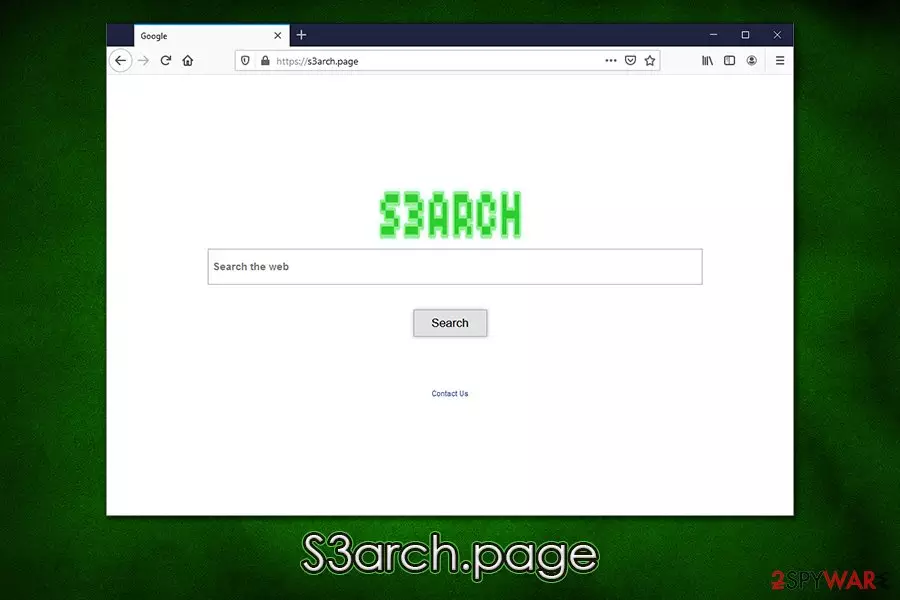
S3arch.page virus is a potentially unwanted application[1] (PUA) that usually gets installed in the form of an extension for Google Chrome, Mozilla Firefox, MS Edge, or another web browser. While the website can be visited manually, users who have the hijacker installed will not be able to perform searches like previously, as all their browser settings will be changed – new tab URL and the homepage set to hxxps://s3arch.page, and a customized search engine applied. Besides, the app will spy on users' online activity in order to promote more relevant (but affiliated) websites and earn financial benefits in such a way.
S3arch.page virus typically arrives at the computer with other applications downloaded from third-party websites. These, so-called software bundles, often carry several programs in a single package, and users are deliberately mislead into installing optional components. The hijack of this suspicious search provider can can be attributed to many different apps, such as Suls APP.
| Name | S3arch.page |
|---|---|
| Type | Browser hijacker, potentially unwanted program |
| Infiltration | Software bundle packages downloaded from third-party websites |
| Symptoms |
|
| Risks | Installation of other unwanted programs, privacy issues due to tracking, loss of money due to scams, etc. |
| Elimination | You can eliminate potentially unwanted applications as per instructions below or scan your machine with anti-malware software that detects PUPs |
| Optimization | If you noticed that your computer is lagging, crashing, returning errors, or is suffering from other stability issues, scan it with FortectIntego |
Typically, browser hijackers are no longer as dangerous as they used to be several years ago, so they do not pose direct threat like malware does. However, combination of deceptive distribution practices, data gathering and intentional use of misleading attributes should be enough reasons to remove S3arch.page from the computer.
Once the S3arch.page hijack occurs, users will immediately notice changes to their web browsers, even if they come unexpectedly (since the app which causes browser changes might be installed without consent). Another symptom is the change to the URL in the address bar – s3arch.page will be assigned as the homepage, and all the searchers will have to be performed via the customized search bar.
While S3arch.page search bar might look as any ordinary search engine – it is not. First of all, it uses the “Google” tab name to deliberately confuse users and make them believe that they are still using a reliable search provider. As soon as they type in the search query and press Enter or Search, they will be redirected to search results that are legitimate or reliable.
At the top of the the search results, which are directed to https://s3arch.page/results.php?q=, users will see multitude of sponsored links, which will be marked as “Ad.” However, the marking is relatively small, and less experienced individuals would not be able to distinguish between an organic result and a fake one. This way, S3arch.page hijack makes people visit websites that they would otherwise not visit, changing the way they browse the internet.

Besides, S3arch.page removal should also not be delayed due to information tracking practices that the app undertakes. While it does not provide the Privacy Policy, typically such apps can track the following data:
- IP address;
- Geo-location;
- Search terms;
- Website visited;
- Ad clicks;
- Technical details, and much more.
This is a very typical practice of potentially unwanted programs (including hijackers) since it allows the developers to provide the alleged service for free and monetize on users' clicks and sponsored content. Nevertheless, services like S3arch.page have no real value to end-users, as they are shown ads, fake search results, and being tracked on. To eliminate the app, follow the guide we provide below – the process differs from one user to another.
Additionally, in case you noticed S3arch.page virus on your machine unexpectedly, you should also check for far more nefarious threats, such as Trojans or crypto-malware.[2] For that, experts[3] recommend scanning the machine with reputable anti-malware software and then fixing virus damage with tools like FortectIntego.
Prevent unauthorized infiltration of potentially unwanted programs
As mentioned above, PUPs typically use deceptive methods to get installed on users' machines, as most do not do it purposely. People who do install browser hijackers on their systems are typically unaware of their functionality and features like extensive information tracking, ads, redirects, sponsored search results, etc. Thus, if you installed a potentially unwanted application intentionally (for example, via the Google Web Store), we recommend first reading online reviews about programs and extensions you never heard of, as descriptions often hint on deception.
On the other hand, many users install PUPs without having an intention to do so in the first place, so they often notice the symptoms instead of the app itself. What makes it more complicated is that unwanted apps are often using misleading names and do not correlate with the browser changes that were made (for example, an increased number of ads does not provide details on what is causing such issues).
Therefore, you should always ensure you do everything to prevent the infiltration of such deceptive programs in the first place. If possible, opt for official sources for your downloads, always pick Advanced/Custom settings instead of Recommended ones, watch out for pre-ticked boxes, read through the installation instructions carefully, and decline all the deals/offers on the way. This way, you will not find unexpected guests on your computer after you complete the installation of the desired app.
Get rid of S3arch.page hijack quickly
For S3arch.page removal (in case the hijacking is associated with a browser extension), you should first check all the installed add-ons on your Google Chrome, Mozilla Firefox, and all the other web browsers. If the changes to your homepage, new tab, and the search engine occur just on one of the browsers, means it is highly likely an extension is at fault. If the problem is universal, it means that your a standalone application installed on your system.

To remove S3arch.page virus, you can use our guide provided below – simply access the list of all the installed apps, and check for anything suspicious. In most cases, applications like media players, PDF converters, system optimizers, and similar tools are at fault. Nonetheless, since some apps might use misleading names or be not present in the list at all, it is sometimes best to rely on automatic tools for PUP elimination.
You can simply download and install reputable anti-malware, and then perform a full system scan. This will not only eliminate S3arch.page hijack (in most cases) but will also check your computer for more dangerous threats that might be completely invisible to you.
Uninstall from Windows
Uninstall from Windows 10/8:
- Type Control Panel into the Windows search box and open the result.
- Under Programs, select Uninstall a program.


Uninstall from Windows 7/XP:
- Click on Windows Start > Control Panel (Windows XP users should click on Add/Remove Programs).
- In Control Panel, select Programs > Uninstall a program.


Remove the unwanted program:
- In the Programs and Features window, look for any recently installed suspicious entries, select them, and click Uninstall.
- If User Account Control appears, click Yes to confirm, then complete the removal.


Delete from macOS
Remove the unwanted application:
- From the menu bar, select Go > Applications.
- In the Applications folder, look for any suspicious entries, then drag them to Trash (or right-click and pick Move to Trash).


Delete leftover files and folders:
- Select Go > Go to Folder.
- Enter /Library/Application Support and remove any suspicious folders related to the unwanted program.
- Repeat the same check in the /Library/LaunchAgents and /Library/LaunchDaemons folders, deleting any suspicious entries.

- Finally, empty the Trash to permanently remove the leftovers.

Reset Internet Explorer
Remove dangerous add-ons:
- Open Internet Explorer, click on the Gear icon (IE menu) on the top-right corner of the browser
- Pick Manage Add-ons.
- You will see a Manage Add-ons window. Here, look for suspicious plugins. Click on these entries and select Disable.


Change your homepage if it was altered:
- Open IE and click on the Gear icon.
- Select Internet Options.
- In the General tab, delete the Home page address and replace it by your preferred one (for example, Google.com).
- Click Apply and then select OK.


Delete temporary files:
- Press on the Gear icon and select Internet Options.
- Under Browsing history, click Delete...
- Select relevant fields and press Delete.


Reset Internet Explorer:
- Click on Gear icon > Internet options and select Advanced tab.
- Select Reset.
- In the new window, check Delete personal settings and select Reset.


Remove from Microsoft Edge
Delete unwanted extensions from MS Edge:
- Select Menu (three horizontal dots at the top-right of the browser window) and pick Extensions.
- From the list, pick the extension and click on the Gear icon.
- Click Remove.


Clear cookies and other browser data:
- Click on the Menu (three horizontal dots at the top-right of the browser window) and select Settings > Privacy, search, and services..
- Under Clear browsing data, pick Choose what to clear.
- Select Cookies and other site data and Cached images and files. (apart from passwords, although you might want to include Media licenses as well, if applicable) and click on Clear.


Restore new tab and homepage settings:
- Click the menu icon and choose Settings.
- Then find On startup section.
- Click Remove next to any suspicious startup page.
Reset MS Edge if the above steps did not work:
- Press on Ctrl + Shift + Esc to open Task Manager.
- Click on More details arrow at the bottom of the window.
- Select Details tab.
- Now scroll down and locate every entry with Microsoft Edge name in it. Right-click on each of them and select End Task to stop MS Edge from running.


Instructions for Chromium-based Edge
Delete extensions from MS Edge (Chromium):
- Open Edge and click select Settings > Extensions.
- Delete unwanted extensions by clicking Remove.


Clear cache and site data:
- Click on Menu and go to Settings.
- Select Privacy, search and services.
- Under Clear browsing data, pick Choose what to clear.
- Under Time range, pick All time.
- Select Clear now.


Reset Chromium-based MS Edge:
- Click on Menu and select Settings.
- On the left side, pick Reset settings.
- Select Restore settings to their default values.
- Confirm with Reset.
- This will disable extensions and reset startup pages but will not delete bookmarks, saved passwords, or browsing history.


Remove from Mozilla Firefox (FF)
Remove dangerous extensions:
- Open Mozilla Firefox browser and click on the Menu (three horizontal lines at the top-right of the window).
- Select Add-ons.
- In here, select the unwanted extension and click Remove.


Reset the homepage:
- Click three horizontal lines at the top right corner to open the menu.
- Choose Settings.
- Under Home, set your preferred homepage and new tab settings.
Clear cookies and site data:
- Click Menu and pick Settings.
- Go to Privacy & Security section.
- Scroll down to locate Cookies and Site Data.
- Click on Clear Data...
- Select Cookies and Site Data and Temporary cached files and pages, then click Clear.


Reset Mozilla Firefox
If clearing the browser as explained above did not help, reset Mozilla Firefox:
- Open Mozilla Firefox browser and click the Menu.
- Go to Help and then choose Troubleshooting Information.

- Under Give Firefox a tune up section, click on Refresh Firefox...
- Once the pop-up shows up, confirm the action by pressing on Refresh Firefox.



Remove from Google Chrome
Delete malicious extensions from Google Chrome:
- Open Google Chrome, click on the Menu (three vertical dots at the top-right corner) and select More tools > Extensions.
- In the newly opened window, you will see all the installed extensions. Uninstall all suspicious extensions related to the unwanted program by clicking Remove.


Clear cache and web data from Chrome:
- Click on Menu and pick Settings.
- Under Privacy and security, select Clear browsing data.
- Select Browsing history, Cookies and other site data, as well as Cached images and files.
- Click Clear data.


Change your homepage:
- Click menu and choose Settings.
- Look for a suspicious site in the On startup section.
- Click on Open a specific or set of pages and click on three dots to find the Remove option.
Reset Google Chrome:
If the previous methods did not help you, reset Google Chrome to eliminate all the unwanted components:
- Click on Menu and select Settings.
- In the Settings, scroll down and click Advanced.
- Scroll down and locate Reset and clean up section.
- Now click Restore settings to their original defaults.
- Confirm with Reset settings.


Delete from Safari
Remove dangerous extensions:
- Open Safari, click Safari in the menu at the top-left of the screen, and select Preferences.
- Go to the Extensions tab, look for any suspicious entries, and click Uninstall to remove them.


Clear history and website data:
- Click Safari in the menu and pick Clear History.
- Set Clear to all history and confirm with Clear History.


Reset Safari:
- Click Safari in the menu and select Preferences > Advanced.
- Enable Show Develop menu in menu bar.
- From the menu bar, click Develop and select Empty Caches.


Did this guide help?
Be the first to comment