

Save yourself email scam is the campaign that tricks people into paying $800 or their personal data gets exposed
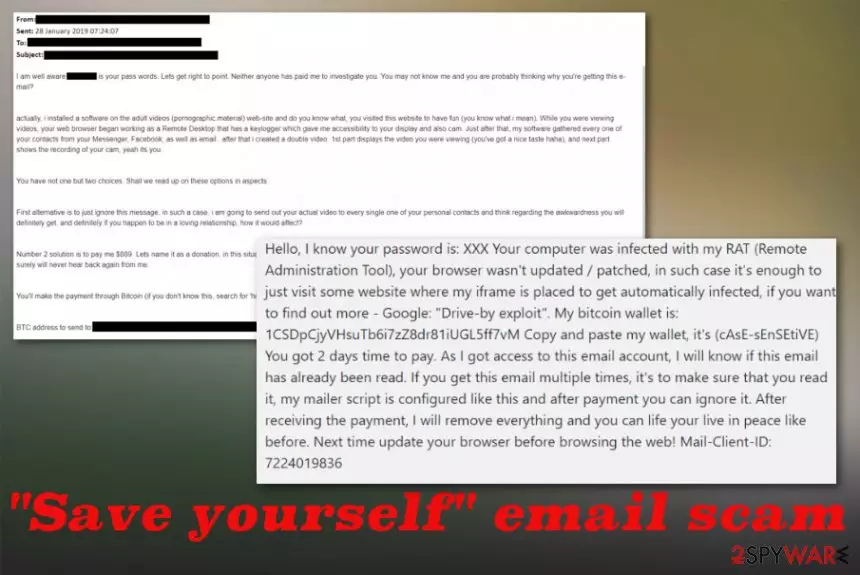
Unfortunately, Save yourself email scam can come to anyone, so you should be aware of the possibility to get targeted by cybercriminals. Although the claims may seem legitimate and you don't want to get exposed to all the people in your contacts, there is a possibility that scammers have nothing on you and those allegations are fake. Also, the password that they display as the one you use for a particular account might be a successful guess or information obtained due to a data breach or another malware infection.
| Name | Save yourself email scam |
|---|---|
| Type | Email scam |
| Possible danger | Spreads other malware, can lead to privacy issues, identity theft, permanent money or data loss |
| Symptoms | Email messages stating about suspicious material, claiming you need to pay in the given time or some sensitive footage gets sent to your contact list |
| Distribution | Spam email campaigns, deceptive websites, shady software |
| Email address | saveyou@{random}.com |
| Ransom amount | $800 in Bitcoin |
| Elimination | Avoid clicking on anything in the email, get FortectIntego to clean the system fully and remove Save yourself email scam virus damage |
Save yourself email scam is a massive campaign that involves various distribution techniques. As users report, they have received more than one email at the same time. Some of these campaigns deliver more than 100 emails to one person per day.[1] Even though, many of those notifications come to the spam email box, malicious content fills the box, causes other errors, and keeps users puzzled why.
Save yourself emails – one of many extortion attempts that have surfaced online for years now. Various email accounts, including Gmail, Yahoo, ATT, and people on other platforms, receive these messages. The only thing you need to do is ignore the emails and trash them immediately. Unfortunately, people are not quick to do so.
Scammers behind the “Save yourself” email scam campaign claim to know your password, have compromising material, sensitive footage and can use it against you by making it public or sending to all your contacts. To avoid such an event, the victim is encouraged to pay up. In most cases, the amount is barely under $1000 and asked to transfer to scammers' wallet in less than 48 hours.
Save yourself email scam is almost identical to campaigns of ChaosCC Hacker Group email scam or I infected your computer with my private malware scam, that are one of the more dangerous malware spreading and money extorting hacker campaigns.
Save yourself emails state information that is designed to scare people but there is nothing legitimate about those notifications, and users shouldn't be scared when received such email. Avoid contacting criminals at any cost and restrain from paying the demanded ransom. If you pay, there is nothing positive happening since you paid for false claims.

“Save yourself” email scam can also claim that your device gotten infected with malware already. This is yet another false claim, but if you click on provided links, open or download files attached to the email, you can get trojan or worm on the computer.
The propagation Save yourself emails scam uses various deceptive techniques as any other product of malicious actors. Based on the number of emails distributed during this campaign, experts[2] think that there can be thousands and millions of potential victims of this spam email scam campaign.
If this is true, there is a more significant risk to get infected with malware related to the email scam and bigger need of tips and tricks on how to remove Save yourself email scam, avoid malware infiltration. The most important tip is not to panic once such an email appears in your box.
You can avoid malware infiltration if you remove Save yourself email scam and all the messages from the email box immediately. Without opening the email, hackers cannot affect the machine. To be more cautious and fight any malware that might be on the system already, install FortectIntego, and run a scan to clean the machine fully.

Deceptive sites and data breaches lead to extortion scams and spam campaigns
Scams like this are not new, but scammers have gotten more advanced throughout the years. There are many methods for how scammers might have obtained personal information of yours. One of the more common might be domains that harvest such information while pretending to collect important information as a survey or lottery page. Such pages have the only data harvesting purpose.
Another method is that your personal data got used in the scam due to public breaches and leaks.[3] Your email address might have been included in a server or database that got breached in the past year or so and scammers used the load of the emails and passwords or guessed random ones to target you, in particular.
“Save yourself” email scam elimination requires more help
Save yourself email scam virus involves cryptocurrency and payments or even sensitive information if you reveal anything more for these scammers. There is no need to wait for another campaign or a much bigger ransom demand, you need to react to the extortion email as soon as possible.
You should never pay the ransom and always go straight to Save yourself email scam removal no matter when claims the blackmail email has listed. You can lose significant amounts of money, so delete the email and clean the email box in general.
However, when you are not sure that you need to remove Save yourself email scam or anything more like malware from the system since malware infiltration may happen in the background, get a proper tool for system cleaning. Anti-malware programs like FortectIntego, SpyHunterCombo Cleaner, or MalwarebytesMalwarebytes can help with general malware infiltrations and eliminate virus damage if there is something left on the system. You need to run a full scan on the affected machine and follow the suggestions further.
Did this guide help?
Be the first to comment