

Saver adware is an annoying computer parasite that displays intrusive ads during browsing. If you have noticed “ads by Saver,” “Saver ads,” “by Saver” and similar pop-up banners, pop-up ads and other forms of advertisements, it indicates that this potentially unwanted program has occupated your computer without your knowledge. To find out more information about this program, continue reading below.
What is known about Saver?
Saver adware is an ad-supported potentially unwanted program (PUP), which can be installed alongside other freeware or shareware. Once this software gets installed on the computer, it collects particular information about the user and then, based on such info, it selects targeted ads and floods victim’s computer screen with them. The information Saver PUP collects includes user’s browsing history, search queries, PC geolocation and IP address. You should keep in mind that ads by Saver can look impressive and display catchy price comparisons, discount codes, coupons and other ‘money saving’ content, however, most of these ads are worthless as they only seek to make you click on them.
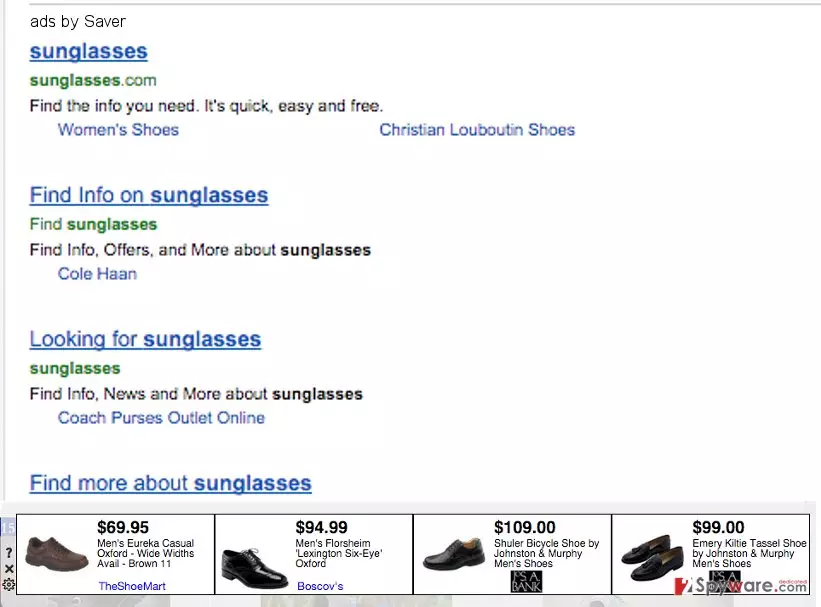
Why should you not click on these ads?
We strongly recommend you NOT to click on these ads. Saver and similar adware apps usually display catchy ads that are meaningless, because they often cause redirects to the websites that sponsor such apps. Moreover, pages that seek to promote themselves via such shady way are believed to be insecure or even contain malicious content. So be aware of any suggestions to install free apps or updates from websites that are promoted by Saver; otherwise, you might end up with a doubtful application, or, in the worst scenario, a computer threat. To keep your computer safe and clean of spyware or malware, you should install a spyware and malware fighting tool like SpyHunter and from time to time run a full system scan with it. Such software can easily detect and remove numerous computer infections.
I did not install this program. So how did Saver hijack my PC?
It is not surprising that you do not know how did Saver hijack your PC. Many computer users tend to install software in a careless way, and that is why they end up with PUPs or even more dangerous apps on their machines. You should know that many computer programs that are considered to be potentially unwanted are spread via bundling method, which is also the most popular way to distribute such programs. Bundling means grouping several apps into one software pack; such software pack can be installed with one installation setup. The question is, how to avoid installing unwanted programs?
You have to carefully investigate the statements on the installation setup. Make sure you read the Terms of Use and Privacy Policy documents. Look for statements about promotion of third-party software;
Configure installation process by refusing to install the additional unwanted programs. For that, opt for Advanced/Custom installation settings. Then, opt out the tick from the agreements to install optional applications.
If you have already installed a software bundle that included Saver adware, then you might want to find out how to remove it. You can find the removal guidelines on page 2.
How to remove it?
Adware programs can hardly help you to save time or money, as they usually promise. Saver virus is definitely not a useful application, and it should not be kept installed on the PC. There are a few ways how you can remove it from the computer. If you want to remove it manually, scroll this page down to see manual removal instructions. Follow each step closely, and get rid of this PC intruder. If you want to, you can uninstall this program automatically. For that, you need to install an anti-spyware program. Use one of the ones we recommend:
Uninstall from Windows
Uninstall from Windows 10/8:
- Type Control Panel into the Windows search box and open the result.
- Under Programs, select Uninstall a program.


Uninstall from Windows 7/XP:
- Click on Windows Start > Control Panel (Windows XP users should click on Add/Remove Programs).
- In Control Panel, select Programs > Uninstall a program.


Remove the unwanted program:
- In the Programs and Features window, look for any recently installed suspicious entries, select them, and click Uninstall.
- If User Account Control appears, click Yes to confirm, then complete the removal.


Delete from macOS
Remove the unwanted application:
- From the menu bar, select Go > Applications.
- In the Applications folder, look for any suspicious entries, then drag them to Trash (or right-click and pick Move to Trash).


Delete leftover files and folders:
- Select Go > Go to Folder.
- Enter /Library/Application Support and remove any suspicious folders related to the unwanted program.
- Repeat the same check in the /Library/LaunchAgents and /Library/LaunchDaemons folders, deleting any suspicious entries.

- Finally, empty the Trash to permanently remove the leftovers.

Remove from Microsoft Edge
Delete unwanted extensions from MS Edge:
- Select Menu (three horizontal dots at the top-right of the browser window) and pick Extensions.
- From the list, pick the extension and click on the Gear icon.
- Click Remove.


Clear cookies and other browser data:
- Click on the Menu (three horizontal dots at the top-right of the browser window) and select Settings > Privacy, search, and services..
- Under Clear browsing data, pick Choose what to clear.
- Select Cookies and other site data and Cached images and files. (apart from passwords, although you might want to include Media licenses as well, if applicable) and click on Clear.


Restore new tab and homepage settings:
- Click the menu icon and choose Settings.
- Then find On startup section.
- Click Remove next to any suspicious startup page.
Reset MS Edge if the above steps did not work:
- Press on Ctrl + Shift + Esc to open Task Manager.
- Click on More details arrow at the bottom of the window.
- Select Details tab.
- Now scroll down and locate every entry with Microsoft Edge name in it. Right-click on each of them and select End Task to stop MS Edge from running.


Instructions for Chromium-based Edge
Delete extensions from MS Edge (Chromium):
- Open Edge and click select Settings > Extensions.
- Delete unwanted extensions by clicking Remove.


Clear cache and site data:
- Click on Menu and go to Settings.
- Select Privacy, search and services.
- Under Clear browsing data, pick Choose what to clear.
- Under Time range, pick All time.
- Select Clear now.


Reset Chromium-based MS Edge:
- Click on Menu and select Settings.
- On the left side, pick Reset settings.
- Select Restore settings to their default values.
- Confirm with Reset.
- This will disable extensions and reset startup pages but will not delete bookmarks, saved passwords, or browsing history.


Remove from Mozilla Firefox (FF)
Remove dangerous extensions:
- Open Mozilla Firefox browser and click on the Menu (three horizontal lines at the top-right of the window).
- Select Add-ons.
- In here, select the unwanted extension and click Remove.


Reset the homepage:
- Click three horizontal lines at the top right corner to open the menu.
- Choose Settings.
- Under Home, set your preferred homepage and new tab settings.
Clear cookies and site data:
- Click Menu and pick Settings.
- Go to Privacy & Security section.
- Scroll down to locate Cookies and Site Data.
- Click on Clear Data...
- Select Cookies and Site Data and Temporary cached files and pages, then click Clear.


Reset Mozilla Firefox
If clearing the browser as explained above did not help, reset Mozilla Firefox:
- Open Mozilla Firefox browser and click the Menu.
- Go to Help and then choose Troubleshooting Information.

- Under Give Firefox a tune up section, click on Refresh Firefox...
- Once the pop-up shows up, confirm the action by pressing on Refresh Firefox.



Remove from Google Chrome
Delete malicious extensions from Google Chrome:
- Open Google Chrome, click on the Menu (three vertical dots at the top-right corner) and select More tools > Extensions.
- In the newly opened window, you will see all the installed extensions. Uninstall all suspicious extensions related to the unwanted program by clicking Remove.


Clear cache and web data from Chrome:
- Click on Menu and pick Settings.
- Under Privacy and security, select Clear browsing data.
- Select Browsing history, Cookies and other site data, as well as Cached images and files.
- Click Clear data.


Change your homepage:
- Click menu and choose Settings.
- Look for a suspicious site in the On startup section.
- Click on Open a specific or set of pages and click on three dots to find the Remove option.
Reset Google Chrome:
If the previous methods did not help you, reset Google Chrome to eliminate all the unwanted components:
- Click on Menu and select Settings.
- In the Settings, scroll down and click Advanced.
- Scroll down and locate Reset and clean up section.
- Now click Restore settings to their original defaults.
- Confirm with Reset settings.


Delete from Safari
Remove dangerous extensions:
- Open Safari, click Safari in the menu at the top-left of the screen, and select Preferences.
- Go to the Extensions tab, look for any suspicious entries, and click Uninstall to remove them.


Clear history and website data:
- Click Safari in the menu and pick Clear History.
- Set Clear to all history and confirm with Clear History.


Reset Safari:
- Click Safari in the menu and select Preferences > Advanced.
- Enable Show Develop menu in menu bar.
- From the menu bar, click Develop and select Empty Caches.


Did this guide help?
4 comments
hyuko
Inserts stupid ads that look like search results on ebay! what the hell? why? and what for? it is extremely annoying. that is the main reason why I have removed this virus once I have noticed its name saver.
T.i.
managed to remove it like a pro on my own! yay!
doe
you should not waste your time trying to explore savers deals as they are fake and the prices it displays are totally invented...
Jeager
dude i removed it manually, too, its super easy