

What is known about Search.funsecuritytabsearch.com?
Search.funsecuritytabsearch.com virus is just one of hundreds of browser hijackers that are advertised as beneficial computer system additions. It is yet another product released by Imali Media – and it seems that this shady company is not going to stop developing them anytime soon. Browser hijackers are pieces of software that modify browser settings with an intention to switch homepage and new tab page URLs to a specific one, in this case, Search.funsecuritytabsearch.com. This website is closely related to Search.Safefinder.com search engine, as this address can be noticed right after entering a search query into the search engine provided on FunSecurityTab homepage. If you are attentive enough, you will quickly see that several redirects occur, and that seems a bit suspicious. Later on, the search engine produces a list of regular-looking results featuring sponsored ones, including ads related to user’s search term and popular shopping results as well. If you do not like to receive a lot of sponsored content, these promotional offers will annoy you. Nonetheless, there is something more. 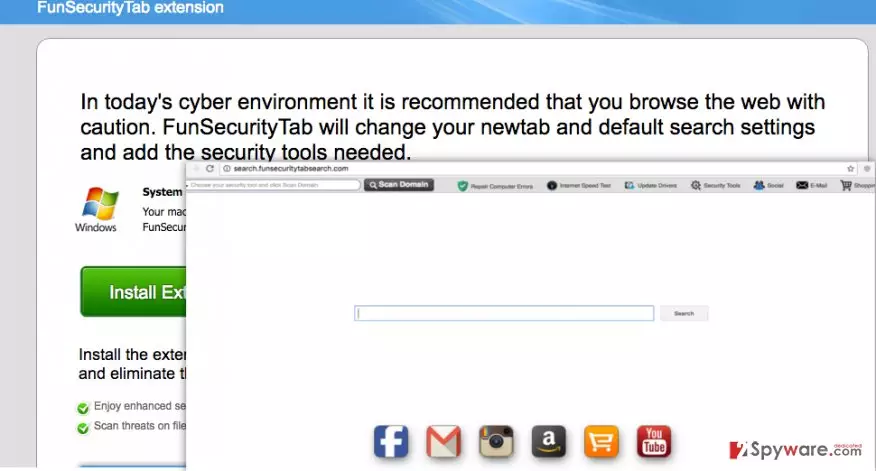
This browser is sometimes called as Search.funsecuritytabsearch.com redirect virus not without a reason. It appears that some of its search outcomes can reroute the user to suspicious third-party websites, which can contain highly questionable content. You might be introduced to apps, updates, and other files that can be downloaded for free, but do not be fooled; such content can contain components that might start displaying pop-up ads, banners, inject hyperlinks into random text lines, or initiate dangerous activities on your computer. In the worst scenario, you can end up installing a malicious piece of software that can lock your computer and ask you to pay a ransom. We do not say that Search.funsecuritytabsearch.com is responsible for that, but we just want to warn you and advise you to be careful while browsing through unknown websites, especially if you are forced to visit them (because of redirects). If you want to keep your computer secure, we recommend using a different search engine, for example, Google, and remove Search.funsecuritytabsearch.com redirect virus from the computer. This can be easily done with a help of FortectIntego spyware removal tool.
How does this program spread?
FunSecurityTab can be added to your browser from its official site, but it is only compatible with Chrome and Firefox browsers. This browser hijacker cannot affect other Internet browsers, at least at the moment of writing this report. Do not be surprised if you discover the previously mentioned search engine on your homepage after launching one of these web browsers even if you did not click anywhere to download this PUP. This hijacker can enter your PC beside other apps, for instance, free games, download managers, media players, PDF file converters, and similar tools that computer users tend to download a lot. If you want to protect your computer from Search.funsecuritytabsearch.com hijack and other PUPs, follow these steps whenever you install a new program on your computer:
- Browse through Terms of Use and Privacy Policy documents thoroughly. Make sure you read the part where the software explains its relations with third-party advertisers and find out whether the program is going to integrate sponsored links or not.
- Follow guidelines of the installation wizard and, once you reach the “Settings” step, adjust settings and set them to Advanced/Custom value.
How to remove Search.funsecuritytabsearch.com?
To remove Search.funsecuritytabsearch.com virus, please carefully study the instructions provided below this article. Most likely you will be able to eliminate this PUP on your own; if you find this task difficult, then just employ an automatic Search.funsecuritytabsearch.com removal tool and delete it from the computer by running a full system scan.
Uninstall from Windows
Uninstall from Windows 10/8:
- Type Control Panel into the Windows search box and open the result.
- Under Programs, select Uninstall a program.


Uninstall from Windows 7/XP:
- Click on Windows Start > Control Panel (Windows XP users should click on Add/Remove Programs).
- In Control Panel, select Programs > Uninstall a program.


Remove the unwanted program:
- In the Programs and Features window, look for any recently installed suspicious entries, select them, and click Uninstall.
- If User Account Control appears, click Yes to confirm, then complete the removal.


Delete from macOS
Remove the unwanted application:
- From the menu bar, select Go > Applications.
- In the Applications folder, look for any suspicious entries, then drag them to Trash (or right-click and pick Move to Trash).


Delete leftover files and folders:
- Select Go > Go to Folder.
- Enter /Library/Application Support and remove any suspicious folders related to the unwanted program.
- Repeat the same check in the /Library/LaunchAgents and /Library/LaunchDaemons folders, deleting any suspicious entries.

- Finally, empty the Trash to permanently remove the leftovers.

Remove from Mozilla Firefox (FF)
Remove dangerous extensions:
- Open Mozilla Firefox browser and click on the Menu (three horizontal lines at the top-right of the window).
- Select Add-ons.
- In here, select the unwanted extension and click Remove.


Reset the homepage:
- Click three horizontal lines at the top right corner to open the menu.
- Choose Settings.
- Under Home, set your preferred homepage and new tab settings.
Clear cookies and site data:
- Click Menu and pick Settings.
- Go to Privacy & Security section.
- Scroll down to locate Cookies and Site Data.
- Click on Clear Data...
- Select Cookies and Site Data and Temporary cached files and pages, then click Clear.


Reset Mozilla Firefox
If clearing the browser as explained above did not help, reset Mozilla Firefox:
- Open Mozilla Firefox browser and click the Menu.
- Go to Help and then choose Troubleshooting Information.

- Under Give Firefox a tune up section, click on Refresh Firefox...
- Once the pop-up shows up, confirm the action by pressing on Refresh Firefox.



Remove from Google Chrome
Delete malicious extensions from Google Chrome:
- Open Google Chrome, click on the Menu (three vertical dots at the top-right corner) and select More tools > Extensions.
- In the newly opened window, you will see all the installed extensions. Uninstall all suspicious extensions related to the unwanted program by clicking Remove.


Clear cache and web data from Chrome:
- Click on Menu and pick Settings.
- Under Privacy and security, select Clear browsing data.
- Select Browsing history, Cookies and other site data, as well as Cached images and files.
- Click Clear data.


Change your homepage:
- Click menu and choose Settings.
- Look for a suspicious site in the On startup section.
- Click on Open a specific or set of pages and click on three dots to find the Remove option.
Reset Google Chrome:
If the previous methods did not help you, reset Google Chrome to eliminate all the unwanted components:
- Click on Menu and select Settings.
- In the Settings, scroll down and click Advanced.
- Scroll down and locate Reset and clean up section.
- Now click Restore settings to their original defaults.
- Confirm with Reset settings.


Did this guide help?
4 comments
waves
Search.funsecuritytabsearch.com didnt work as I thought it will, so i am saying goodbye to it.
Al3x
Thanks - Reimage removed this for me. Now I am going to try its optimization feature.
GerdaWith
No idea how I installed this crapware... this was probably the worst search engine ever
Lauren
Not a virus, hah. The first idea that came to my mind after an unsuccessful attempt to change my homepage was - oh god, ive got a virus on my pc!