

Search.searchtmpn4.com – a browser hijacker that is often bundled with freeware
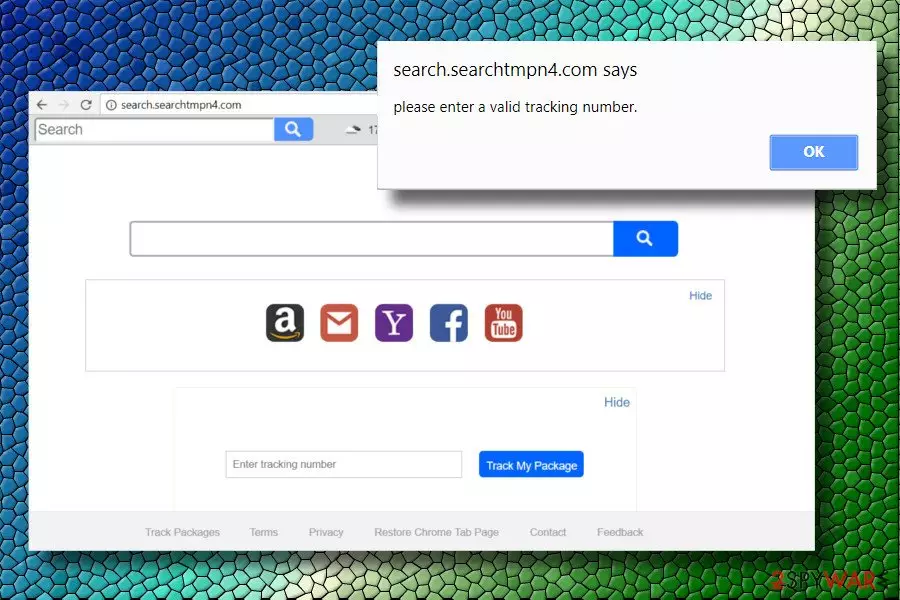
Search.searchtmpn4.com is a search site has been developed by Polarity Technologies Ltd. This company is infamous for the development of thematic web browser extensions that offer services, including but not limited to file converting, currency tracking, video streaming.
In addition to the provision of allegedly more effective searches, it should enable users to track packages. However, even though such a service seems useful, do not count on this search site because it's another marketing-related tool used to maximize third parties' profit.
| Name | Search.searchtmpn4.com |
|---|---|
| Type | Browser hijacker |
| Related extension | Track Packages by Polarity Technologies Ltd |
| Symptoms | A new extension installed on the web browser; homepage and new tab changed; search results are filled with sponsored links |
| Removal | Terminate the related browser extension and clean your web browsers; scan your machine with security software |
| System fix | After you delete adware or malware, your computer might start malfunctioning. If that happens, you can fix virus damage with FortectIntego repair tool |
Search.searchtmpn4.com URL has already been included in the list of potentially unwanted programs.[1] Such classification indicates that it's capable of installing without requiring users' permissions directly and hijacks Chrome, Firefox, IE, Edge, and other web browsers right after that.
Apart from a forceful replacement of the default start page, search engine, new tab URL, the app can initiate suspicious activities for the sake of web traffic modification. Despite the fact what search query its users type in, it may return adapted results that contain links to affiliated websites in priority.
Do not fall for believing that it generates actual Yahoo search results. Yahoo is a legitimate provider that is often used as an engine for browser hijackers, and the top results provided come from the latter. To check that, you can access a genuine Yahoo search and type the same query as you entered in the searchtmpn4.com search tab. You will see that the results do not coincide.
Those who cannot stand pop-up ads, misleading survey prompts, scam alerts, fake software updates,[2], and other content that pose a risk of getting the system infected with malware or exposing personal data or risk of being leaked should initiate PUP removal asap.
Polarity Technologies collaborates with third parties and allows them to inject whatever commercial content they want into the search results. While affiliate marketing is a known practice being applied for promoting websites, the fact that Track Packages search does not monitor advertisements and other displayed content is worrying because some links may expose you to unsafe content or hacked websites.

If your web browser has already been hijacked, Virukset.fi[3] security researchers recommend you remove the PUP from the system immediately. Otherwise, it will not only inject cookies and web beacons into your web browser but can also “Allow first-party publisher or Partner Cookies to be installed in your browser.” Third parties may try to gather not only search data but also sensitive information, such as email address, your name, geo-location, IP address, etc.
You can pick up one of the options to uninstall it from the system – either delete it manually (removal tutorial provided at the bottom of this article) or automatically. The latter method requires the installation of a reputable anti-malware tool. Our top pick tools are FortectIntego and SpyHunterCombo Cleaner.
Custom and Advanced freeware installation can save people from browser's hijack
People who prefer Quick or Basic freeware installation methods are at great risk of getting tricked into installing browser hijackers and other PUPs. Those who ask why probably did not hear about “bundling.” The term bundling refers to the software distribution technique, which allows combining free applications with web browser extensions, add-ons, plug-ins, etc.
Such software dissemination cannot be suspended because it's legitimate. People are informed about “optional downloads,” but there's a catch. They will not find a warning about attachments when relying on Quick or Basic installation methods. The success of freeware installation depends on the user's carefulness, so each time you decide to install a new app, make sure to follow these steps:
- Pick up a reliable download source (preferably official website);
- Download the application you need and select Advanced/Custom installation method;
- Read EULA and Privacy Policy;
- Look for optional components. Usually, they are disclosed misleadingly – small font, at the bottom of the window, marked by default;
- Remove check marks saying that you agree with the installation of extensions and plugins.
Eliminate searchtmpn4 virus to restore your web browser's settings
Browser hijacker removal will protect your Search Data and block malicious content that third parties may seek to visit. PUP elimination can be initiated manually. For this purpose, you should open Control Panel and get rid of all suspicious entries.
However, cybersecurity experts recommend people use a reliable anti-malware tool to remove searchtmpn4.com and similar PUPs. That's because they tend to spread in packages with other untrustworthy tools and inject related components in various system's locations. Consequently, the removal of the primary file may not stop suspicious activities on the web browser.
Uninstall from Windows
Uninstall from Windows 10/8:
- Type Control Panel into the Windows search box and open the result.
- Under Programs, select Uninstall a program.


Uninstall from Windows 7/XP:
- Click on Windows Start > Control Panel (Windows XP users should click on Add/Remove Programs).
- In Control Panel, select Programs > Uninstall a program.


Remove the unwanted program:
- In the Programs and Features window, look for any recently installed suspicious entries, select them, and click Uninstall.
- If User Account Control appears, click Yes to confirm, then complete the removal.


Delete from macOS
Remove the unwanted application:
- From the menu bar, select Go > Applications.
- In the Applications folder, look for any suspicious entries, then drag them to Trash (or right-click and pick Move to Trash).


Delete leftover files and folders:
- Select Go > Go to Folder.
- Enter /Library/Application Support and remove any suspicious folders related to the unwanted program.
- Repeat the same check in the /Library/LaunchAgents and /Library/LaunchDaemons folders, deleting any suspicious entries.

- Finally, empty the Trash to permanently remove the leftovers.

Remove from Microsoft Edge
Delete unwanted extensions from MS Edge:
- Select Menu (three horizontal dots at the top-right of the browser window) and pick Extensions.
- From the list, pick the extension and click on the Gear icon.
- Click Remove.


Clear cookies and other browser data:
- Click on the Menu (three horizontal dots at the top-right of the browser window) and select Settings > Privacy, search, and services..
- Under Clear browsing data, pick Choose what to clear.
- Select Cookies and other site data and Cached images and files. (apart from passwords, although you might want to include Media licenses as well, if applicable) and click on Clear.


Restore new tab and homepage settings:
- Click the menu icon and choose Settings.
- Then find On startup section.
- Click Remove next to any suspicious startup page.
Reset MS Edge if the above steps did not work:
- Press on Ctrl + Shift + Esc to open Task Manager.
- Click on More details arrow at the bottom of the window.
- Select Details tab.
- Now scroll down and locate every entry with Microsoft Edge name in it. Right-click on each of them and select End Task to stop MS Edge from running.


Instructions for Chromium-based Edge
Delete extensions from MS Edge (Chromium):
- Open Edge and click select Settings > Extensions.
- Delete unwanted extensions by clicking Remove.


Clear cache and site data:
- Click on Menu and go to Settings.
- Select Privacy, search and services.
- Under Clear browsing data, pick Choose what to clear.
- Under Time range, pick All time.
- Select Clear now.


Reset Chromium-based MS Edge:
- Click on Menu and select Settings.
- On the left side, pick Reset settings.
- Select Restore settings to their default values.
- Confirm with Reset.
- This will disable extensions and reset startup pages but will not delete bookmarks, saved passwords, or browsing history.


Remove from Mozilla Firefox (FF)
Remove dangerous extensions:
- Open Mozilla Firefox browser and click on the Menu (three horizontal lines at the top-right of the window).
- Select Add-ons.
- In here, select the unwanted extension and click Remove.


Reset the homepage:
- Click three horizontal lines at the top right corner to open the menu.
- Choose Settings.
- Under Home, set your preferred homepage and new tab settings.
Clear cookies and site data:
- Click Menu and pick Settings.
- Go to Privacy & Security section.
- Scroll down to locate Cookies and Site Data.
- Click on Clear Data...
- Select Cookies and Site Data and Temporary cached files and pages, then click Clear.


Reset Mozilla Firefox
If clearing the browser as explained above did not help, reset Mozilla Firefox:
- Open Mozilla Firefox browser and click the Menu.
- Go to Help and then choose Troubleshooting Information.

- Under Give Firefox a tune up section, click on Refresh Firefox...
- Once the pop-up shows up, confirm the action by pressing on Refresh Firefox.



Remove from Google Chrome
Delete malicious extensions from Google Chrome:
- Open Google Chrome, click on the Menu (three vertical dots at the top-right corner) and select More tools > Extensions.
- In the newly opened window, you will see all the installed extensions. Uninstall all suspicious extensions related to the unwanted program by clicking Remove.


Clear cache and web data from Chrome:
- Click on Menu and pick Settings.
- Under Privacy and security, select Clear browsing data.
- Select Browsing history, Cookies and other site data, as well as Cached images and files.
- Click Clear data.


Change your homepage:
- Click menu and choose Settings.
- Look for a suspicious site in the On startup section.
- Click on Open a specific or set of pages and click on three dots to find the Remove option.
Reset Google Chrome:
If the previous methods did not help you, reset Google Chrome to eliminate all the unwanted components:
- Click on Menu and select Settings.
- In the Settings, scroll down and click Advanced.
- Scroll down and locate Reset and clean up section.
- Now click Restore settings to their original defaults.
- Confirm with Reset settings.


Delete from Safari
Remove dangerous extensions:
- Open Safari, click Safari in the menu at the top-left of the screen, and select Preferences.
- Go to the Extensions tab, look for any suspicious entries, and click Uninstall to remove them.


Clear history and website data:
- Click Safari in the menu and pick Clear History.
- Set Clear to all history and confirm with Clear History.


Reset Safari:
- Click Safari in the menu and select Preferences > Advanced.
- Enable Show Develop menu in menu bar.
- From the menu bar, click Develop and select Empty Caches.


Did this guide help?
Be the first to comment