

Searchhome-page.com might take over your browser without permission
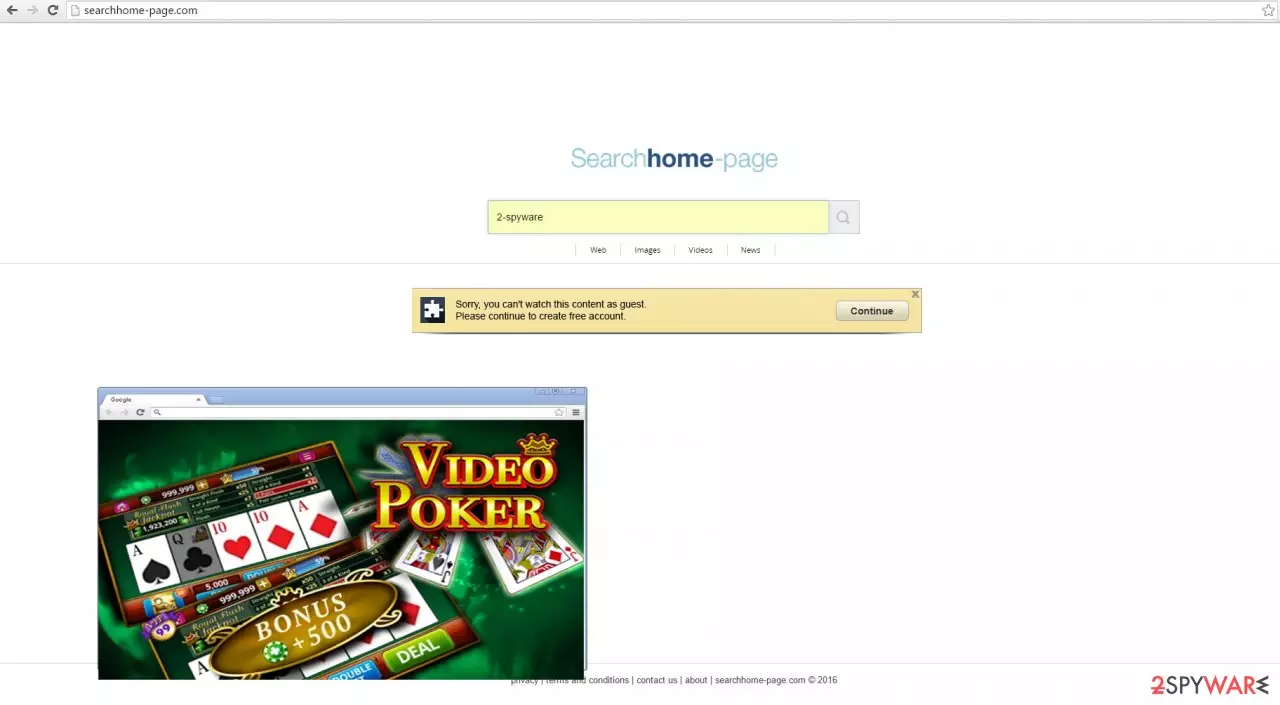
Avoid searchhome-page.com, it is a browser hijacker and can occupy your search engine, replace the homepage on your computer with its own home page, or attach other fishy extensions to browsers like Chrome. It's difficult to delete completely as well since they're constantly updating their webpage, so users will not be able to find any traces of them for you to remove them from using Google Chrome again without worries about being hijacked by this app ever again.
To make matters worse, the app is likely to be installed on your system without permission, as it is often coupled with legitimate or trusted programs when downloaded from third-party websites.
| Name | searchhome-page.com, |
|---|---|
| Type | Browser hijacker, potentially unwanted program |
| Distribution | Software bundles, deceptive ads |
| Symptoms | Unknown extension or application is installed on the system; homepage and new tab address altered; search results are filled with ads |
| Removal | You can uninstall potentially unwanted programs by following the manual guide below or by scanning the computer with powerful anti-malware |
| Optional steps | Computer infections can cause significant damage to system files or disrupt normal settings. To revert these changes and remediate the OS, perform a full system scan with FortectIntego repair software |
There are multiple entities of browser hijackers which vary in design, choice of functionalities, and level of aggressiveness. While others attract attention by offering instant access to popular social networks and other entertaining domains, this sample seems quite plain.
On the other hand, search engines overcrowded with buttons and links instantly cause suspicion. Perhaps the owners of Search Home Page decided to go the other way by appealing to those users who seek quality instead of a cheap veneer. However, this PUP instantly shatters all expectations. Whatever topic you enter, it informs that no search results can be found. Most probably, the developers are not interested in retaining the users but instead aiming for a bigger number of visits.
Though this hijacker does not seem like a significant threat, you are still unlikely to escape the bothersome effects of searchhome-page.com redirect. It might occur at the time of your browsing session. When you enter one or another website, a redirected window might pop up alongside your main web page.
The problem is that while attempting to cancel it, you might accidentally click on a fake “download” or “exit” button. Likewise, you might unintentionally activate a hyperlink which either leads you to another redirect domain or secretly downloads a computer worm or other sort of malware. Thus, you should be extremely careful with these domains. Before they completely ruin your browsing experience, remove searchhome-page.com immediately.
Searchhome-page.com removal methods
If you do not want to meddle with the hijacker too long, entrust the elimination to malware removal utility. This program will ensure that the hijacker is fully exterminated without leaving any related programs or files, which might increase the risk of getting infected with this kind of malware again.
Alternatively, there is also a manual elimination method. First of all, you should check whether there are potentially unwanted programs installed on your system:
- Enter Control Panel into Windows search box and hit Enter or click on the search result.
- Under Programs, select Uninstall a program.

- From the list, find the entry of the suspicious program.
- Right-click on the application and select Uninstall.
- If User Account Control shows up, click Yes.
- Wait till uninstallation process is complete and click OK.

However, it is important to note that browser changes can be caused by an extension. Therefore, you should ensure that you clean Google Chrome, Mozilla Firefox, or MS Edge properly. You can do that automatically with FortectIntego maintenance and repair software. Otherwise, proceed with the following steps for Google Chrome (you can find instructions for other browsers below):
- Open Google Chrome, click on the Menu and select More tools > Extensions.
- In the newly opened window, you will see all the installed extensions. Uninstall all the suspicious plugins that might be related to the unwanted program by clicking Remove.
Clear cache and web data from Chrome:
- Click on Menu and pick Settings.
- Under Privacy and security, select Clear browsing data.
- Select Browsing history, Cookies and other site data, as well as Cached images and files.
- Click Clear data.


Infiltration technique explained
Do you recall installing a new application? Most probably, you unintentionally installed the hijacker along with the recently downloaded video converter or a pdf viewer. If you still do not understand how the hijack works, keep reading. You see, there is a common tendency among Internet users to rush through the installation instructions and end the installation wizard as soon as possible.
Crooks exploit this vice and attach adware, browser hijacker, and other unwanted applications, knowing that they will successfully infiltrate the computer. In order to decrease the probability of a hijack again, you need to follow these recommendations. First of all, opt for “Custom” settings. After that, carefully check the settings to unmark all programs that you find suspicious and futile.
As evident, protecting your system from malicious software is only possible with powerful anti-malware software. Also, do not forget that good security practices are also very important.
Remove from Microsoft Edge
Delete unwanted extensions from MS Edge:
- Select Menu (three horizontal dots at the top-right of the browser window) and pick Extensions.
- From the list, pick the extension and click on the Gear icon.
- Click Remove.


Clear cookies and other browser data:
- Click on the Menu (three horizontal dots at the top-right of the browser window) and select Settings > Privacy, search, and services..
- Under Clear browsing data, pick Choose what to clear.
- Select Cookies and other site data and Cached images and files. (apart from passwords, although you might want to include Media licenses as well, if applicable) and click on Clear.


Restore new tab and homepage settings:
- Click the menu icon and choose Settings.
- Then find On startup section.
- Click Remove next to any suspicious startup page.
Reset MS Edge if the above steps did not work:
- Press on Ctrl + Shift + Esc to open Task Manager.
- Click on More details arrow at the bottom of the window.
- Select Details tab.
- Now scroll down and locate every entry with Microsoft Edge name in it. Right-click on each of them and select End Task to stop MS Edge from running.


Instructions for Chromium-based Edge
Delete extensions from MS Edge (Chromium):
- Open Edge and click select Settings > Extensions.
- Delete unwanted extensions by clicking Remove.


Clear cache and site data:
- Click on Menu and go to Settings.
- Select Privacy, search and services.
- Under Clear browsing data, pick Choose what to clear.
- Under Time range, pick All time.
- Select Clear now.


Reset Chromium-based MS Edge:
- Click on Menu and select Settings.
- On the left side, pick Reset settings.
- Select Restore settings to their default values.
- Confirm with Reset.
- This will disable extensions and reset startup pages but will not delete bookmarks, saved passwords, or browsing history.


Remove from Mozilla Firefox (FF)
Remove dangerous extensions:
- Open Mozilla Firefox browser and click on the Menu (three horizontal lines at the top-right of the window).
- Select Add-ons.
- In here, select the unwanted extension and click Remove.


Reset the homepage:
- Click three horizontal lines at the top right corner to open the menu.
- Choose Settings.
- Under Home, set your preferred homepage and new tab settings.
Clear cookies and site data:
- Click Menu and pick Settings.
- Go to Privacy & Security section.
- Scroll down to locate Cookies and Site Data.
- Click on Clear Data...
- Select Cookies and Site Data and Temporary cached files and pages, then click Clear.


Reset Mozilla Firefox
If clearing the browser as explained above did not help, reset Mozilla Firefox:
- Open Mozilla Firefox browser and click the Menu.
- Go to Help and then choose Troubleshooting Information.

- Under Give Firefox a tune up section, click on Refresh Firefox...
- Once the pop-up shows up, confirm the action by pressing on Refresh Firefox.



Delete from Safari
Remove dangerous extensions:
- Open Safari, click Safari in the menu at the top-left of the screen, and select Preferences.
- Go to the Extensions tab, look for any suspicious entries, and click Uninstall to remove them.


Clear history and website data:
- Click Safari in the menu and pick Clear History.
- Set Clear to all history and confirm with Clear History.


Reset Safari:
- Click Safari in the menu and select Preferences > Advanced.
- Enable Show Develop menu in menu bar.
- From the menu bar, click Develop and select Empty Caches.


Did this guide help?
3 comments
Natalie
Its laughably useless.
Bonny
Do not underestimate this hijacker.
Tom
Its privacy policy barely reveals anything useful.