
Top-captcharesolver.com pop-ups: what it is and how to remove it
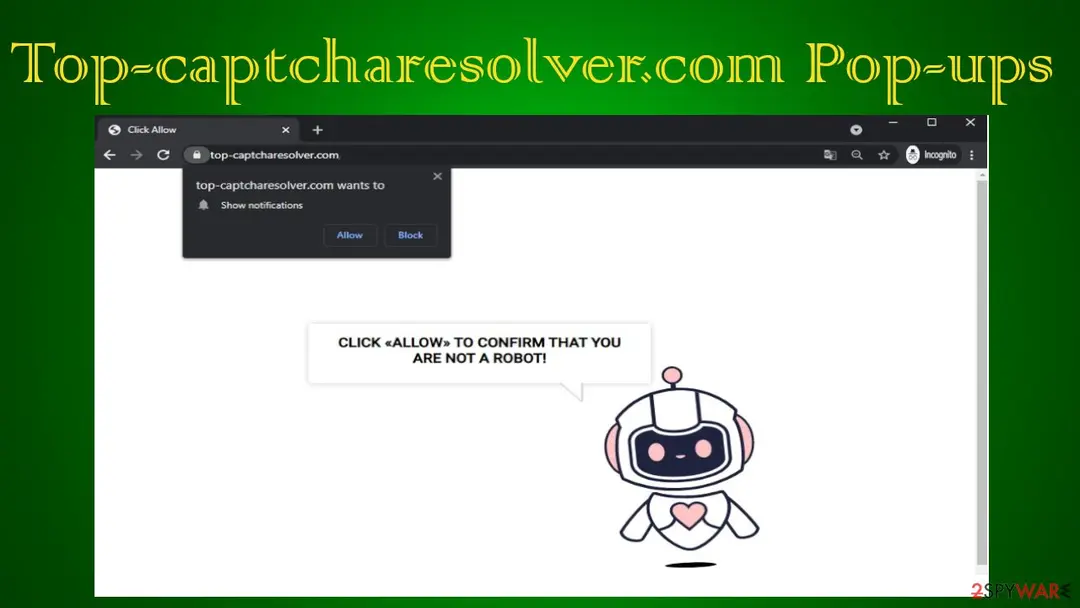
Top-captcharesolver.com is a treacherous website that tries to trick users into accepting its notifications by showing misleading page backgrounds. These backgrounds might change every time you visit it.
Facts checked October 6, 2026. Removal steps tested on Windows 11 (26H2) and checked against Microsoft's and the browser makers' current documentation. Sections marked as our earlier report are the original text: they describe the threat as it was then and have not been reviewed since. The 2026 status, the removal steps and the questions are current.
Automatic
Get a free scan and check if your PC is infected.
Fortect finds malware, unwanted programs and the Windows damage they leave behind, and repairs it in one pass.
Not sure whether the top-captcharesolver[.]com command did anything? An automatic scan looks through the places it would hide.
Do it yourself · free Remove Top-captcharesolver.com pop-ups yourself 4 steps, about 12 minutes, no software needed.
Start the steps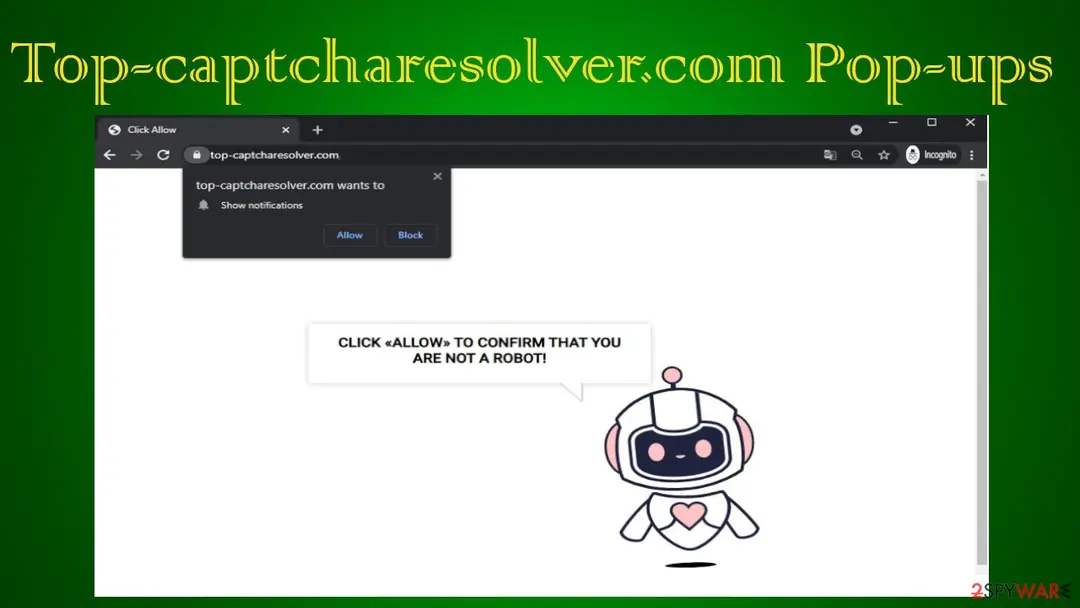
Top-captcharesolver.com pop-ups: summary
| Distribution | Fake Flash Player updates, deceptive ads, software bundling, freeware |
|---|---|
| Damage | Deceptive ads might lead to dangerous portals where you could get your device infected with malware; your personal information could be drawn out, etc. |
| name | Top-captcharesolver.com pop-ups |
| type | Push notification virus, adware, PUP |
| Symptoms | The device is running visibly slower; tons of deceptive ads appear in the form of notifications on the top-right or bottom-right corners of the desktop or directly on the phone screen |
| Detection names | No Microsoft detection name is known |
| Removal | Scan the PC with security software to find and remove the malware and anything installed with it. Fortect scans Windows for malware and repairs the system files and settings it damaged. Remove it nowTo use the full-featured product, you have to purchase a license for Fortect. The scan is free. |
Show 7 more facts
| Name | Top-captcharesolver.com pop-ups |
|---|---|
| Type | Fake CAPTCHA page |
| Evidence | 4 write-ups by security sites; details still limited |
| Imitates | A human-verification check |
| Domains | top-captcharesolver[.]com |
| First seen | 8 June 2021 |
| Facts checked | 6 October 2026 |
Is the Top-captcharesolver.com pop-ups check real?
- Address:
top-captcharesolver[.]com
From our report of Jun 2021 · not reviewed since
More from our earlier report on Top-captcharesolver.com pop-ups
- Remove all PUPs hiding in your device by running a scan with trustworthy anti-malware software.
- Use the system diagnostics tool to delete all tracking cookies stored by hazardous sites and repair corrupted system files
What the Top-captcharesolver.com pop-ups scammers want
From our report of Jun 2021 · not reviewed since
Top-captcharesolver.com Pop-ups arise when your device is infected with adware
Top-captcharesolver.com is a treacherous website that tries to trick users into accepting its notifications by showing misleading page backgrounds.
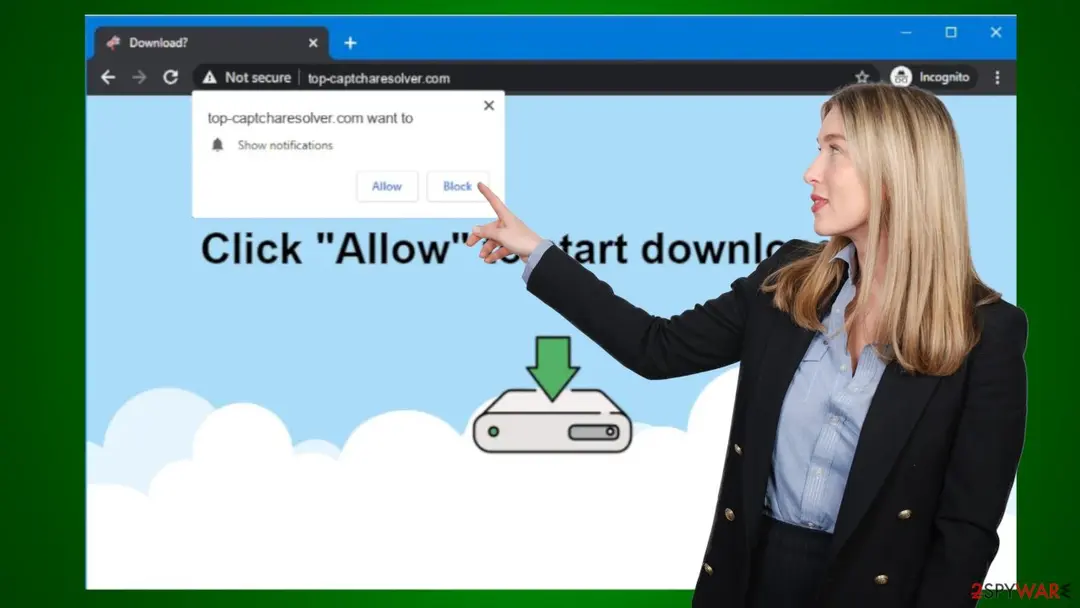
These backgrounds might change every time you visit it. At the time of writing, we detected two versions.
The first one urged to press the Allow button enabling its notifications to prove that you're not a robot, while the second one – to start downloading something unidentified if a user that either willingly or not visited the site accepts its notification, soon after, pop-up ads will start appearing in the form of notifications.
The Top-captcharesolver.com ads will most definitely irritate you as they will pop up at any given time, and in some cases, they are impossible to close as pressing the "X" button doesn't close them but opens an affiliate site. And that's where you might get in trouble. It's worth noting that any device, including Mac and Windows devices, and smartphones could catch this pesky infection.
Developers of such sites don't care for their users' privacy or safety. Therefore you might be redirected to pages with all kinds of questionable material. Since we're helping people to resolve cybersecurity issues for more than a decade, we can speculate that by clicking the article's culprits ads, you could end up on websites with:
There are numerous websites like these, and new ones are created daily. They're called push notification viruses. People can visit them by mistyping an address, clicking on a deceptive ad on a high-risk domain, or if they have a potentially unwanted program (PUP) installed on their devices.
This article contains detailed, illustrated instructions to eliminate the adware that's causing redirects to questionable sites and remove Top-captcharesolver.com pop-ups if you've pressed the Allow button. Please follow the guidelines thoroughly so you could once again enjoy your device anew.
- gambling,
- tech support scams,
- porn,
- other push notification viruses,
- websites that urge to install PUPs,
- malware, etc.
What to do if you ran the Top-captcharesolver.com pop-ups command
Whether you ran the command decides everything else, so the first step checks that.
Step 1: Check whether the pasted command ran
The fake check asked you to press Windows + R, paste and press Enter. Open the same box and look at its drop-down history: a
powershell,mshtaor curl line you did not type yourself is the command Top-captcharesolver.com pop-ups gave.Once run, it fetches malware within seconds, so take the PC offline and follow all the remaining steps. If the history is empty or harmless, nothing was started on the Windows 11 or Windows 10 PC.
Full procedure with screenshots: Run a Microsoft Defender Offline scan
Step 2: Scan the PC, then run the offline scan
A scan finds the parts of Top-captcharesolver.com pop-ups that the manual steps cannot see. In Windows Security > Virus & threat protection > Scan options, start a Full scan and quarantine what it reports.
Follow it with Microsoft Defender Antivirus (offline scan) > Scan now, which restarts the PC and checks the disk while Windows and the malware are not running.
It takes about 15 minutes and works the same in Windows 11 and Windows 10. If either scan finds something, run the full scan again after removal until it comes back clean.

Windows 11: Windows Security > Virus & threat protection > Scan options. Full procedure with screenshots: Run a Microsoft Defender Offline scan
Step 3: Change passwords from another device and sign out other sessions
Top-captcharesolver.com pop-ups can copy saved passwords, cookies and session tokens and send them out in seconds, so cleaning the PC does not undo the theft.
Change your passwords on a device that was never infected, starting with the e-mail account, since every other reset goes through it. On each account, end all other sessions and check the recovery e-mail, phone number and forwarding rules.
Then turn on two-step verification. Sign in on the Windows 11 or Windows 10 PC again only after the offline scan is clean.
Full procedure with screenshots: Turn on two-step verification / secure a hacked account
Step 4: Delete scheduled tasks that bring it back
Programs like Top-captcharesolver.com pop-ups add a scheduled task so they return after an uninstall or reopen a page at every sign-in. Start Task Scheduler, open Task Scheduler Library and sort by Last Run Time to see what ran recently.
On the Actions tab, a program in a user folder, a script or a web address is a warning sign; right-click such a task and choose Delete.
Tasks with names copying Google, Edge or Windows updaters but pointing to an odd folder are typical. The tool looks the same in Windows 11 and Windows 10.

Windows 11: Task Scheduler Library, the task selected, the Actions tab shows the file it runs. Full procedure with screenshots: Remove what malware leaves behind in Windows
Stream videos without limitations, no matter where you are
There are multiple parties that could find out almost anything about you by checking your online activity.
While this is highly unlikely, advertisers and tech companies are constantly tracking you online. The first step to privacy should be a secure browser that focuses on tracker reduction to a minimum.
Even if you employ a secure browser, you will not be able to access websites that are restricted due to local government laws or other reasons. In other words, you may not be able to stream Disney+ or US-based Netflix in some countries. To bypass these restrictions, you can employ a powerful VPN, which provides dedicated servers for torrenting and streaming, not slowing you down in the process.
Data backups are important - recover your lost files
Ransomware is one of the biggest threats to personal data.
Once it is executed on a machine, it launches a sophisticated encryption algorithm that locks all your files, although it does not destroy them. The most common misconception is that anti-malware software can return files to their previous states. This is not true, however, and data remains locked after the malicious payload is deleted.
While regular data backups are the only secure method to recover your files after a ransomware attack, tools such as can also be effective and restore at least some of your lost data.
From our report of Jun 2021 · not reviewed since
Get rid of adware that opens untrustworthy pages out of the blue
We're glad you chose us to guide you through Top-captcharesolver.com removal process.
First of all, you need to eliminate the potentially unwanted program that caused the initial redirect to the article pulpit's website. Such programs are also able to cover your browsers with deceptive ads and collecting various browsing-related data (IP addresses, frequently visited sites, device info, geolocations, etc.).
There are two ways to get rid of them. The first one would be scanning your device with trustworthy anti-malware software. This way, all suspicious, questionable, or untrustworthy applications are identified, and the possibility of removal is presented to you.
will not only remove adware, but it will also protect your device from various malware lurking on the internet. A proper security tool will prevent you from visiting dangerous sites (including the article's culprit) and similar treacherous domains and stop all kinds of cyber infections from entering your device.
If you decide to remove PUPs manually, please be advised that the infection could renew if you overlook some files or entries on the system. If you're using a computer with Windows10/8, please follow these steps:
If your device runs on Windows 7 or XP, please remove the adware as such:
If you didn't find any suspicious programs or if you did but removing them didn't stop redirects to dubious websites, we highly recommend you perform a full system scan with or similar security software. Only after eliminating all suspicious and possibly hazardous entires proceed to the next step.
For some time, Macs were impenetrable for malware, but those days are long gone. All types of infections can infect Apple production. Thus if you experience Top-captcharesolver.com pop-ups on your Mac, please take these steps to remove potentially unwanted programs:
To fully remove an unwanted app, you need to access Application Support, LaunchAgents, and LaunchDaemons folders and delete relevant files:
- Enter Control Panel into Windows search box and hit Enter or click on the search result.
- Under Programs, select Uninstall a program.
- From the list, find the entry of the suspicious program.
- Right-click on the application and select Uninstall.
- If User Account Control shows up, click Yes.
- Wait till the uninstallation process is complete and click OK.
- Click on Windows Start > Control Panel located on the right pane (if you are a Windows XP user, click on Add/Remove Programs).
- In Control Panel, select Programs > Uninstall a program.
- Pick the unwanted application by clicking on it once.
- At the top, click Uninstall/Change.
- In the confirmation prompt, pick Yes.
- Click OK once the removal process is finished.
- From the menu bar, select Go > Applications.
- In the Applications folder, look for all related entries.
- Click on the app and drag it to Trash (or right-click and pick Move to Trash)
- Select Go > Go to Folder.
- Enter /Library/Application Support and click Go or press Enter.
- In the Application Support folder, look for any dubious entries and then delete them.
- Now enter /Library/LaunchAgents and /Library/LaunchDaemons folders the same way and terminate all the related .plist files.
From our report of Jun 2021 · not reviewed since
Remove Top-captcharesolver.com notifications to stop its ads from annoying you
Please note that push notifications are a legitimate service that can show you the latest news, sports updates, amazing offers, and so on.
But cybercriminals misuse it to deliver ads from their affiliates. As we've pointed out before, ads start appearing as notifications after you press the Allow button on a treacherous site. You or anyone else using your device might have pushed the button by accident. But whatever you do, please don't click on them.
Ads shown by push notification viruses are not safe for numerous reasons. They usually appear alluring but redirect to websites that have nothing to do with the ad contents.
That's why by clicking on an ad that offers a huge discount for a new laptop, you might end up on a site trying to lure your personal details through fake surveys or infect your device with malware through drive-by download technique.
Therefore, Top-captcharesolver.com pop-up removal is of utmost importance. Unfortunately, no program can help you to remove extensions from a browser. You will have to do it yourself. But you can easily accomplish it with our illustrated instructions shown below.
If your favorite browser is Google Chrome or any other Chromium-based app, please use these instructions to remove untrustworthy extensions:
Android devices are also vulnerable to push notification viruses. The only difference is that they will fill your whole screen with catchy headlines and misleading ads that will also redirect to untrustworthy websites. To remove Top-captcharesolver.com notifications from your Chrome browser on an Android device, follow these steps:
You could also receive Top-captcharesolver.com pop-ups when you've visited the treacherous site and accepted its notifications. Such extensions can be added to practically any browser. Therefore, if your preferred browser is Mozilla Firefox, please follow these step by step instructions to remove questionable notifications:
Neither Mac devices nor their default browser Safari is safe from push notification viruses. After removing potentially unwanted programs causing redirects to various questionable websites, please follow these instructions to eliminate deceitful notifications:
And last but not least - we're going to show you how to remove Top-captcharesolver.com notifications from MS Edge browsers. Please proceed with the guide below, and your computer will be ad-free in no time:
- Open Google Chrome browser and go to Menu > Settings.
- Locate the Privacy and security section and pick Site Settings > Notifications.
- Look at the Allow section and look for a suspicious URL.
- Click the three vertical dots next to it and pick Block. This should remove unwanted notifications from Google Chrome.
- Open Google Chrome and tap on Settings (three vertical dots).
- Select Notifications.
- Locate the unwanted URL and toggle the button to the left (Off setting).
- Open Mozilla Firefox and go to Menu > Options.
- Click on Privacy & Security section.
- Under Permissions, you should be able to see Notifications. Click the Settings button next to it.
- In the Settings – Notification Permissions window, click on the drop-down menu by the URL in question.
- Select Block and then click on Save Changes. This should remove unwanted notifications from Mozilla Firefox.
- Click on Safari > Preferences...
- Go to the Websites tab and, under General, select Notifications.
- Select the web address in question, click the drop-down menu and select Deny.
- Open Microsoft Edge, and click the Settings and more button (three horizontal dots) at the top-right of the window.
- Select Settings and then go to Advanced.
- Under Website permissions, pick Manage permissions and select the URL in question.
- Toggle the switch to the left to turn notifications off on Microsoft Edge.
From our report of Jun 2021 · not reviewed since
Getting the device's overall health back to the pre-contamination phase
Adware and push notifications can leave a lot of traces on your device.
For example, tracking cookies that store your browsing-related data. These entries and possible system file alterations need to be fixed. Thus after eliminating potentially unwanted programs and removing Top-captcharesolver.com pop-ups, you have to run system diagnostics.
Therefore, we and other cybersecurity-community experts, highly recommend using it. This is all you need to do:
By using this program at least once a week, you can forget about system irregularities and odd behavior. Your device will run as it was just delivered to you from the manufacturer. In case you have any other questions about Top-captcharesolver.com pop-ups, their removal, or any other issues, please feel free to contact our staff. We'll be more than happy to assist you.
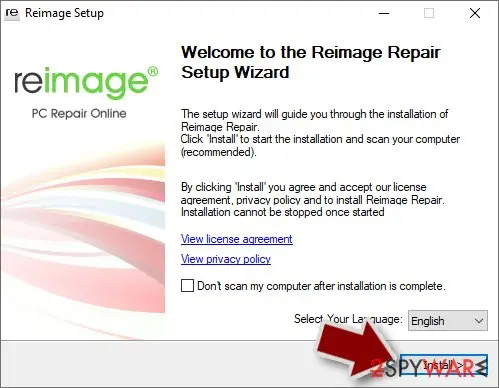
- Download the application by clicking on the link above
- Click on the ReimageRepair.exe
- If User Account Control (UAC) shows up, select Yes
- Press Install and wait till the program finishes the installation process
- The analysis of your machine will begin immediately
- Once complete, check the results - they will be listed in the Summary
- You can now click on each of the issues and fix them manually
Questions about Top-captcharesolver.com pop-ups
I only saw the top-captcharesolver[.]com CAPTCHA and closed it. Is that safe?
Yes. The page on top-captcharesolver[.]com copies a command to your clipboard, but a clipboard does nothing on its own. Unless you opened the Run box, PowerShell or Terminal and pasted it, nothing ran.
To be tidy, copy some harmless text so the command is no longer on the clipboard, and if clipboard history is on, delete the entry with Win+V. Then think about how you reached the page:
- a hacked site
- an ad
- a link in a message
If notifications from strange sites keep opening pages like it, remove them in the browser settings.
Was top-captcharesolver[.]com hacked, or is it a scam site?
Both happen. Many ClickFix pages are injected into legitimate websites whose software was not updated, so a site you know can suddenly show a fake check. Others sit on throwaway domains reached through ads or links in messages.
For you the answer is the same: do not follow the instructions on top-captcharesolver[.]com, and if you already did, clean the PC and change passwords. If the site belongs to a business you trust, let them know through a contact form; they may not realise their pages have been tampered with.
Does a human-verification check know about Top-captcharesolver.com pop-ups?
Large brands such as a human-verification check are aware that scammers copy their names and logos, and most have pages where you can report such abuse. They do not run these pages and do not profit from the warnings themselves.
Sometimes an affiliate of an antivirus vendor sends traffic through fake alerts, which breaks the vendor's rules and gets the affiliate banned when reported. If you want to help, report the page address to the brand's security team and to your browser through its report option.
Why does my browser keep opening top-captcharesolver[.]com?
Because something sends you there. The usual causes are a notification permission you gave to some site, an adware extension, or a site you visit often that shows redirect ads. The site itself cannot open on its own.
Remove unknown sites from the notification settings, check the extensions list, and do not restore the previous session when the browser starts. If the page appears even with the browser closed, look in Installed apps for programs you did not install. Running a scan with Windows Security afterwards confirms that nothing else is involved.
Why does Top-captcharesolver.com pop-ups use the a human-verification check design?
Because people see real a human-verification check checks every day and click through them without thinking. The attackers copy the familiar box, the colours and the wording, then add a few extra steps that look like part of the routine.
The trust in the real service is what makes the trick work. That is also why the page appears on ordinary websites: a hacked site with a familiar check feels safe. The extra keyboard steps are the only reliable sign, and they are always fake.
Can Top-captcharesolver.com pop-ups harm my PC just by being open?
No. A web page runs inside the browser's sandbox and cannot install programs, read your files or change Windows settings on its own. Top-captcharesolver.com pop-ups can only make noise, fill the screen and try to persuade you. The risk begins when you follow it:
- calling the number
- paying
- downloading a file
- pasting a command
Close the page, and if it frightened you into doing one of those, follow the matching steps in this guide. Otherwise, nothing on the PC needs cleaning or repairing.
I closed it, but it appeared again the next day. Why?
A page that returns on its own has a trigger. Look at how it appeared: from a pop-up in the corner of the screen means a notification permission; on start-up means a session restore or a changed start page; while browsing any site means an extension; on one particular site means that site's ads.
Each has a quick fix in the browser settings. If none of them explains it, reset the browser, which clears permissions, extensions and start pages together.
The page will not close. What can I do?
Press Esc to leave full-screen mode, then close the tab. If the browser is frozen, open Task Manager with Ctrl + Shift + Esc, select the browser and click End task. When you restart the browser, do not restore tabs.
If the page loads again on start, open a new window and close the old one, then remove the page from the browser's startup settings. Restarting the PC also works. Nothing was installed by the page, so closing it by force is safe and loses nothing.
Why is pasting a command so dangerous?
Because it skips every protection that would stop a normal download. Browsers check files you download and SmartScreen checks programs you open, but a command you type yourself is trusted as your own action. Pages like Top-captcharesolver.com pop-ups exploit exactly this.
The command fetches and runs code in memory, often leaving little on the disk for a quick scan to find. That is why the advice is absolute: no website has a legitimate reason to make you paste anything into Run, Terminal or PowerShell.
Will Fortect remove Top-captcharesolver.com pop-ups?
Fortect scans Windows for malware and unwanted programs and repairs the system files and settings they change, and its free scan shows what it finds on your PC before you decide anything.
For Top-captcharesolver.com pop-ups, follow the plan above as well: the browser steps take back permissions and settings that no scanner treats as a threat, and uninstalling the program that brought it removes the source.
Run Microsoft Defender's full scan and, if anything was found, its offline scan as a second opinion. If the symptoms are gone after the plan and both scans are clean, there is nothing more to do.
Sources
- Wikipedia: Potentially unwanted program (read October 6, 2026)
- Csoonline: What is adware? How it works and how to protect against it (read October 6, 2026)
- Dieviren: DieViren (read October 6, 2026)
- FTC: How to spot, avoid and report tech support scams (read October 6, 2026)
- FTC: How to recognize, remove and avoid malware (read October 6, 2026)