
Trojan.Win32.BitCoinMiner.la: what it is and how to remove it
Trojan.Win32.BitCoinMiner.la is a detection name of a malicious program that engages in cryptojacking activities or it can be a false positive triggered by compatibility issues, similar code to malware, etc. Cryptojacking is when a program uses the PC's resources like CPU power to mine cryptocurrencies.
Facts checked October 7, 2026. Removal steps tested on Windows 11 (26H2) and checked against Microsoft's and the browser makers' current documentation. Sections marked as our earlier report are the original text: they describe the threat as it was then and have not been reviewed since. The 2026 status, the removal steps and the questions are current.
Automatic
Get a free scan and check if your PC is infected.
Fortect finds malware, unwanted programs and the Windows damage they leave behind, and repairs it in one pass.
Unsure whether ReimageRepair.exe is safe? A free scan checks the file and what starts it.
Do it yourself · free Remove Trojan.Win32.BitCoinMiner.la yourself 6 steps, about 18 minutes, no software needed.
Start the steps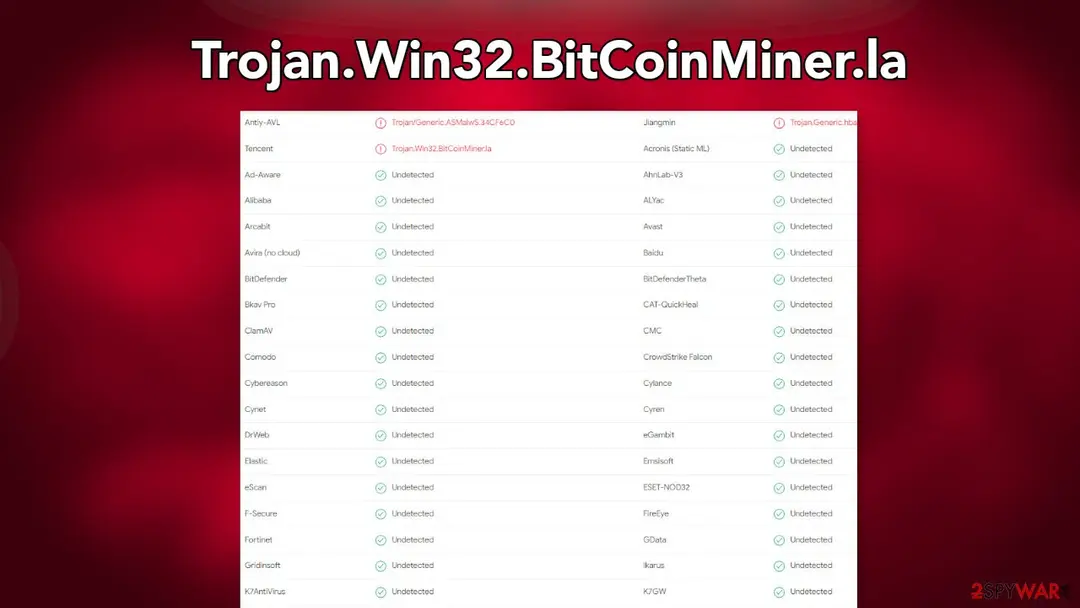
Trojan.Win32.BitCoinMiner.la: summary
| Distribution | Files attached to spam emails, torrent sites |
|---|---|
| NAME | Trojan.Win32.BitCoinMiner.la |
| TYPE | Trojan, cryptovirus, malware |
| SYMPTOMS | The slowness of the machine, suspicious processes running in the background, other threats installed, notifications from AV programs |
| DANGERS | Trojans can be set to act as a vector for different malware or directly steal information or even data from the computer. It can also use your machine's CPU power to mine cryptocurrencies |
| Detection names | No Microsoft detection name is known |
| Removal | Scan the PC with security software to find and remove the malware and anything installed with it. Fortect scans Windows for malware and repairs the system files and settings it damaged. Remove it nowTo use the full-featured product, you have to purchase a license for Fortect. The scan is free. |
Show 8 more facts
| Damage | Not recorded in the old report |
|---|---|
| Name | Trojan.Win32.BitCoinMiner.la |
| Type | Loader |
| Symptoms | An unknown process in Task Manager |
| Evidence | 5 write-ups by security sites; details still limited |
| File names | ReimageRepair.exe |
| First seen | 30 November 2021 |
| Facts checked | 7 October 2026 |
What Trojan.Win32.BitCoinMiner.la does on an infected PC
From our report of Nov 2021 · not reviewed since
Trojan.Win32.BitCoinMiner.la slows down the computer by mining cryptocurrencies and causes crashes, bugs
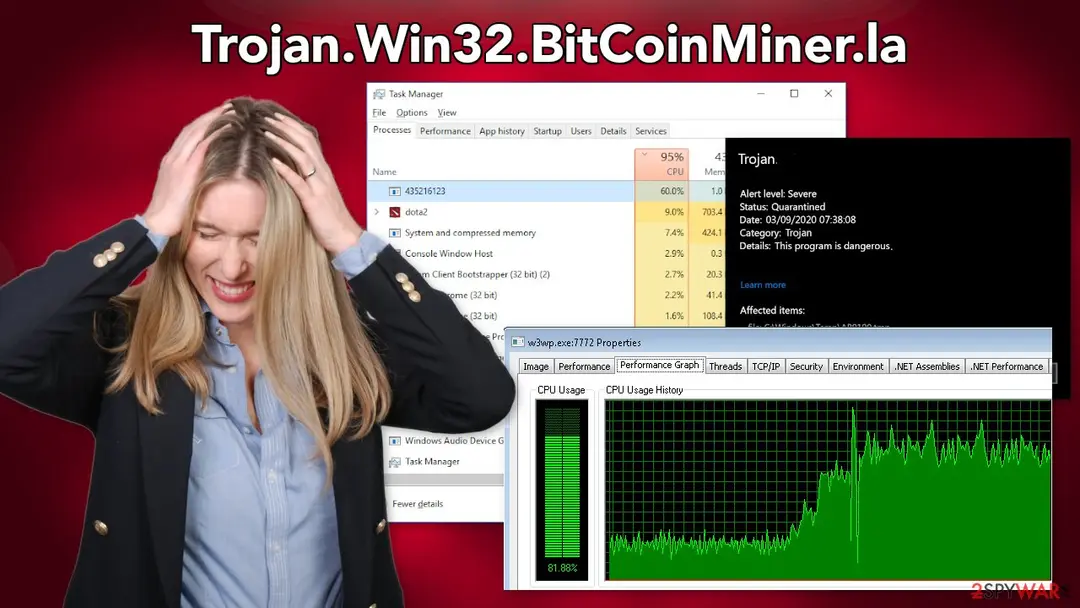
Trojan.Win32.BitCoinMiner.la is a detection name of a malicious program that engages in cryptojacking activities or it can be a false positive triggered by compatibility issues, similar code to malware, etc. Cryptojacking is when a program uses the PC's resources like CPU power to mine cryptocurrencies. This can have a lot of effects on the system like a decrease in performance, lagging issues, crashes, and bugs.
However, Trojans are also known for their ability to deliver other malicious programs onto the system like spyware, ransomware which could have even worse repercussions. If you have received a warning on your system about an intruder, we suggest you take action to remove it immediately.
It is better to be safe than sorry. If it is actually a Trojan, it could cause serious damage to your computer like delete, block, modify and copy data.
Most Trojans do not even show any signs of infection, that is why they are so dangerous. It is very important to pay close attention to the performance of your PC, and investigate if you experience any issues.
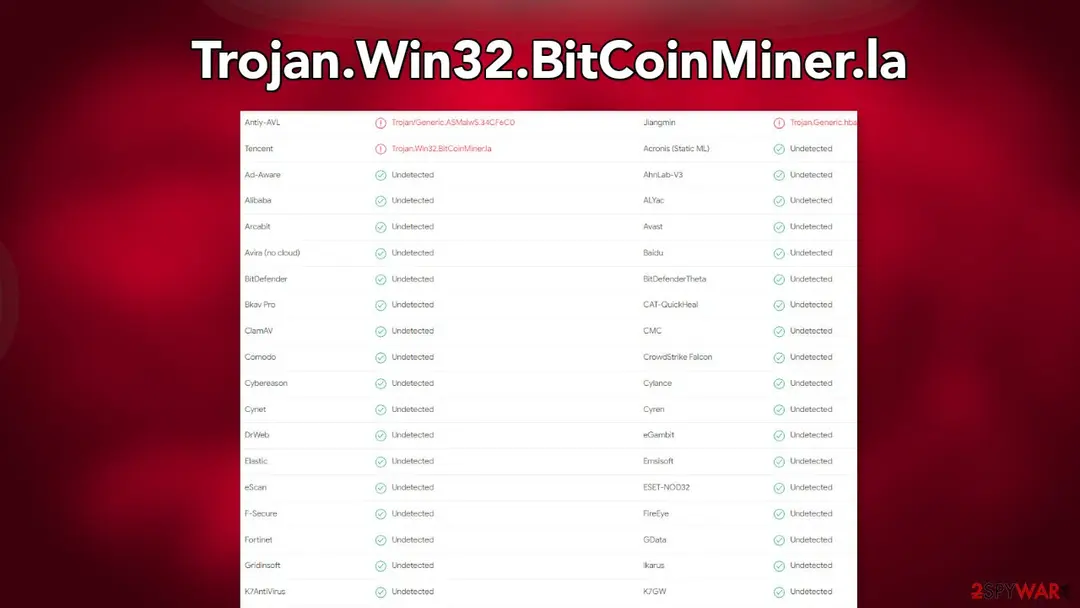
Of course, crashes, and lagging can be caused by many other things, but the easiest way to determine that is to open the Task Manager and see if there are any suspicious programs that consume a lot of your computers' resources.
From our report of Nov 2021 · not reviewed since
Ways people get infected with Trojans
Trojans do not only affect Windows PCs but Macs, tablets, and mobile phones too.
That is why there are many possibilities of how it may have infiltrated your device. Malware can be disguised as a handy tool like an antivirus program, so people can install these threats through torrent websites, "cracked" software.
Trojans are also delivered as email attachments. Most often, cybercriminals pretend to be a well-known company or someone from your friend list, so do not ever open attachments that you were not expecting or which seem to come from a random source. Executable files can be the beginning of a serious infection, so be very careful and make sure you know exactly who the file is coming from.
Malware can also exploit various OS or software vulnerabilities, so try to use secure programs or at least update them as soon as the updates are available to keep the risk as minimal as possible. You can also install a Trojan without even noticing with the help of drive-by downloads. Avoid websites that engage in illegal activities as they are more likely to contain malicious links.
From our report of Nov 2021 · not reviewed since
More from our earlier report on Trojan.Win32.BitCoinMiner.la
- Your device can be cleaned with anti-malware tools that check various parts of the machine to find all possible infections
How to check the PC for Trojan.Win32.BitCoinMiner.la
- File:
ReimageRepair.exe
How to remove Trojan.Win32.BitCoinMiner.la
A loader's job is to install other malware, so treat the PC as infected with more than one program until the scans are clean.
Step 1: Check where ReimageRepair.exe runs from and stop it
ReimageRepair.exeis the part you can see, and its location tells you whether it belongs there. Right-click it on the Processes page of Task Manager and choose Open file location, then right-click the file > Properties > Digital Signatures to see who signed it.An unsigned file, or one in a user folder such as
%AppData%, is the one to remove: end the task, then delete the file.Note the folder name, because the same folder usually holds its other files. This is the same in Windows 11 and Windows 10.
Full procedure with screenshots: Close a frozen app (Task Manager, Force Quit) On uGetFix
Step 2: Delete scheduled tasks that bring it back
Open Task Scheduler from the Start menu and click Task Scheduler Library. Select each task you do not recognise and read the Actions tab:
- a task that starts a file in
%AppData%or%Temp% - runs
powershellwith a long encoded line - opens a web address belongs to Trojan.Win32.BitCoinMiner.la or a similar program
Right-click such a task and choose Delete, and check the subfolders too. Leave tasks from Microsoft, your PC's maker and programs you use. Task Scheduler is the same in Windows 11 and Windows 10.
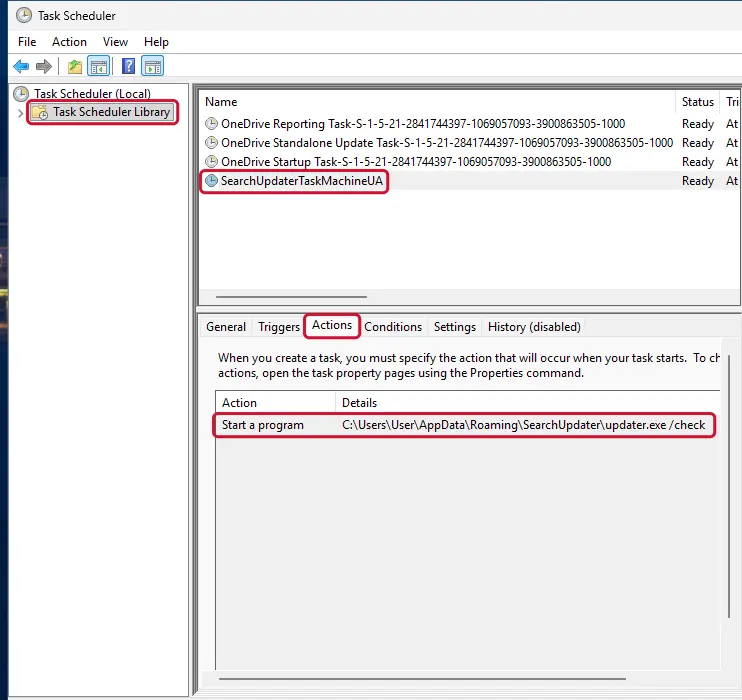
Windows 11: Task Scheduler Library, the task selected, the Actions tab shows the file it runs. Full procedure with screenshots: Remove what malware leaves behind in Windows
- a task that starts a file in
Step 3: Remove it from startup
Whatever Trojan.Win32.BitCoinMiner.la installed usually starts with Windows. Open Task Manager with Ctrl + Shift + Esc, go to Startup apps in Windows 11 or the Startup tab in Windows 10, and disable what you do not know, starting with entries that have an empty Publisher column.
Open file location on the right-click menu shows the file, which helps you decide and tells you what to delete later. Disabling is safe: if something you need stops working, switch it back on.
Full procedure with screenshots: Stop apps from opening at startup On uGetFix
Step 4: Delete the folders left behind
What the uninstaller leaves behind is usually in the user folders. Open File Explorer, switch on View > Show > Hidden items (in Windows 10 View > Hidden items), and go through
%LocalAppData%,%AppData%, %ProgramData% and the two Program Files folders.Sort by Date modified and delete folders that appeared together with the problem and belong to no program you use. Folders with random names that hold
.exe,.dll, .js or .ps1 files are the strongest sign.Full procedure with screenshots: Remove what malware leaves behind in Windows
Step 5: Scan the PC, then run the offline scan
Open Windows Security > Virus & threat protection > Scan options, run a Full scan and remove everything it finds. Then select Microsoft Defender Antivirus (offline scan) and click Scan now: the PC restarts and scans before Windows loads, which finds files that hide while Windows runs.
Save your work first, because the offline scan takes about 15 minutes. Both scans are built into Windows 11 and Windows 10, and a second scanner from another vendor is a useful extra opinion.
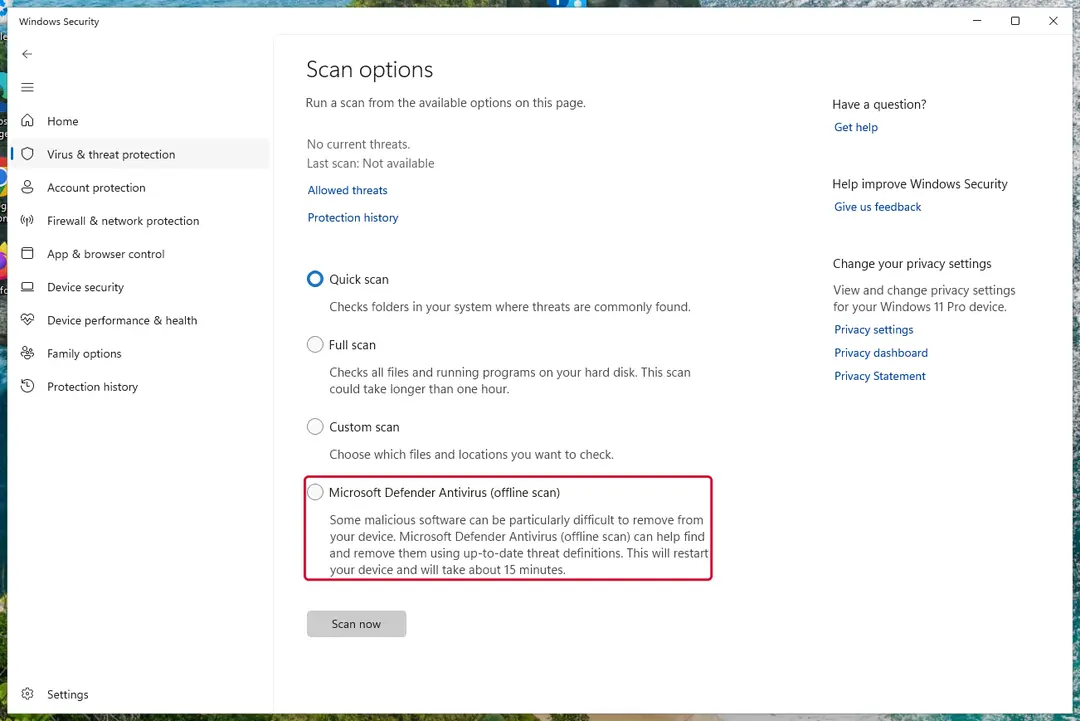
Windows 11: Windows Security > Virus & threat protection > Scan options. Full procedure with screenshots: Run a Microsoft Defender Offline scan
Step 6: Change passwords from another device and sign out other sessions
Assume that the passwords saved in this PC's browsers, and the accounts that were open in them, are known to the attacker. From a phone or a clean computer, change the e-mail password first, then banking, shopping, social and gaming accounts.
Use each service's option to sign out of all other sessions, because stolen cookies keep a session open even after a password change. Turn on two-step verification on each account. Wait with the infected Windows 11 or Windows 10 PC until the scans are clean.
Full procedure with screenshots: Turn on two-step verification / secure a hacked account
From our report of Nov 2021 · not reviewed since
Get rid of Trojans and other threats with anti-malware tools
Once a Trojan enters the system, there is no better way to remove it than good quality, automized professional security tools.
However, the malicious program may block such tools, so you need to perform additional steps. It becomes difficult to remove serious threats like this over time as their damage increases.
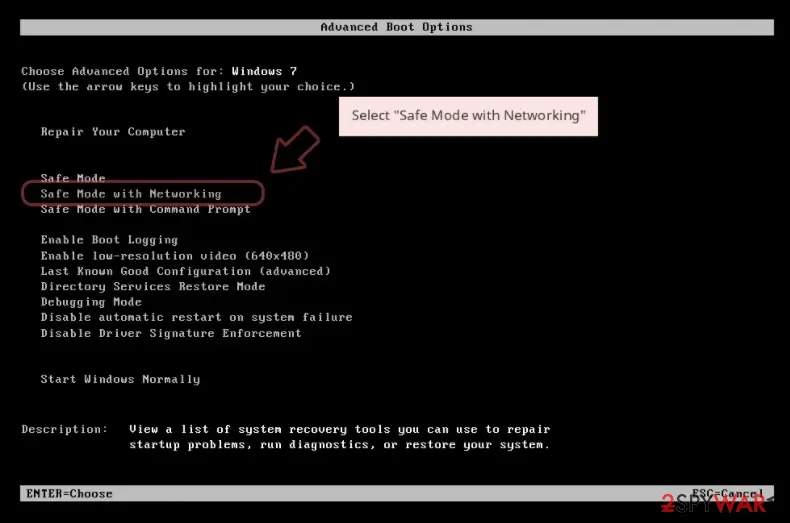
You need to enter Safe Mode with Networking if malware is blocking it. From there, you will be able to perform a scan with anti-malware tools with no problems. If you are not sure how to do that, follow the guide below:
Windows 7 / Vista / XP
Windows 10 / Windows 8
Once you reach Safe Mode, launch or , and perform a full system scan to eradicate malware and all its malicious components. Trojan.Win32.BitCoinMiner.la can cause serious damage if you leave it on the system.
Trojans can execute themselves automatically and install other threats on the machine without your permission. This is a sneaky infection that can perform malicious tasks unnoticed. Even though crypto mining does not cause you financial losses, this malware can sometimes access your credentials, sensitive data and steal funds from accounts online.
This is why we do not suggest you try to remove the threat manually, as the process is very complicated and not suitable for people with minimal IT skills.
Trojans are sometimes hard to locate in the system and in some cases, can even be invisible. They can be placed on the desktop and if users click by accident on the spot it is placed, it can launch the infection process.
- Click Start > Shutdown > Restart > OK.
- When your computer becomes active, start pressing F8 button (if that does not work, try F2, F12, Del, etc. - it all depends on your motherboard model) multiple times until you see the Advanced Boot Options window.
- Select Safe Mode with Networking from the list.
- Right-click on Start button and select Settings.
- On the left side of the window, pick Recovery.
- Click Restart now.
- Select Troubleshoot.
- Go to Advanced options.
- Select Startup Settings.
- Click Restart.
- Press 5 or click 5) Enable Safe Mode with Networking.
From our report of Nov 2021 · not reviewed since
Fix system damage
Not only can it fix virus damage after the infection, but it is also capable of removing malware that has already broken into the system thanks to several engines used by the program. Besides, the application is also capable of fixing various Windows-related issues that are not caused by malware infections, for example, Blue Screen errors, freezes, registry errors, damaged DLLs, etc.
By employing , you would not have to worry about future computer issues, as most of them could be fixed quickly by performing a full system scan at any time. Most importantly, you could avoid the tedious process of Windows reinstallation in case things go very wrong due to one reason or another.
Precautionary measures to follow
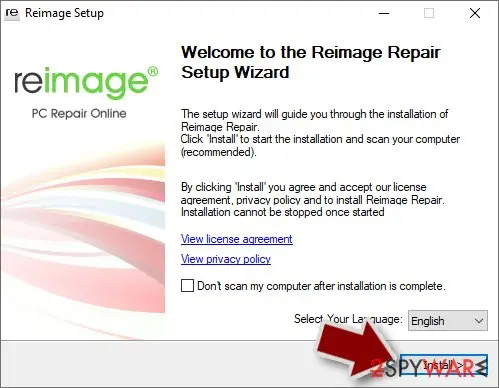
- Download the application by clicking on the link above.
- Click on the ReimageRepair.exe.
- If User Account Control (UAC) shows up, select Yes.
- Press Install and wait till the program finishes the installation process.
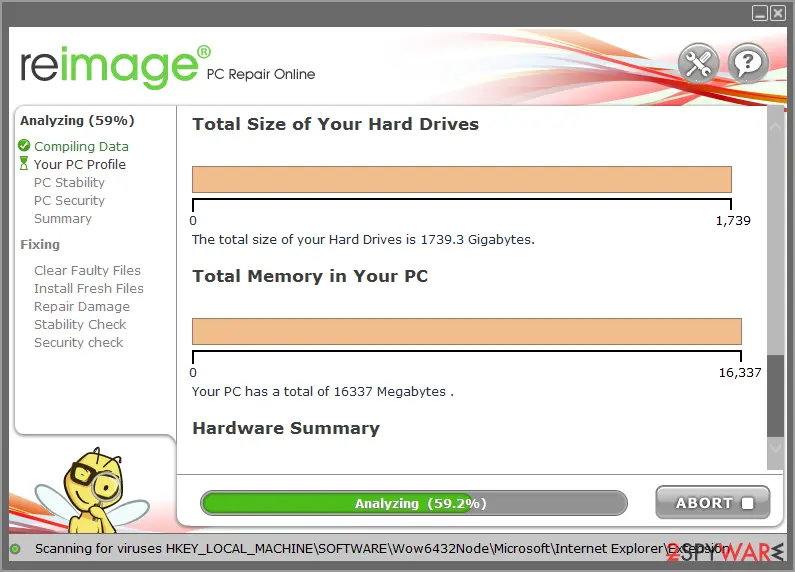
- The analysis of your machine will begin immediately.
- Once complete, check the results - they will be listed in the Summary.
- You can now click on each of the issues and fix them manually.
- Do not open email attachments from random senders. Investigate the sender and the text, look for grammar and spelling mistakes. If you are not sure what the attachment is, better not to open it.
- Keep your systems and software up to date. Cybercriminals always look for weak points in security to exploit so it is important to install required security updates.
- Do not click on links without thinking. There are links that are malicious and they deliver drive-by downloads. You might not even notice that something was installed while browsing through bogus sites.
- Try not to download programs from unofficial sources. If you are on your phone, we strongly recommend installing apps that are only offered in the Google Play or Apple store.
- Make all file extensions visible. This will show you if a file is secretly encrypted or is backed by an executable file.
- Use two-factor authentication and strong passwords.
- Try to back up your data regularly to external drives to protect it from ransomware and other malware infections that could corrupt it.
After removal: passwords, accounts and prevention
Accounts come next
Because the PC showed an unfamiliar process called ReimageRepair.exe in Task Manager, a sign of a program that could read browser data, the clean-up is only half of the work.
The other half happens in your online accounts.
Change passwords from a clean device, beginning with e-mail; sign out of all sessions; check forwarding rules and recovery phone numbers; and turn on two-step verification with an authenticator app or a passkey. Ask your bank to replace cards saved in the browser.
Why the order matters and what to check in each account: secure your accounts after malware.
Do not let government spy on you
The government has many issues in regards to tracking users' data and spying on citizens, so you should take this into consideration and learn more about shady information gathering practices.
Avoid any unwanted government tracking or spying by going totally anonymous on the internet.
You can choose a different location when you go online and access any material you want without particular content restrictions. You can easily enjoy internet connection without any risks of being hacked by using VPN.
Control the information that can be accessed by government any other unwanted party and surf online without being spied on. Even if you are not involved in illegal activities or trust your selection of services, platforms, be suspicious for your own security and take precautionary measures by using the VPN service.
Backup files for the later use, in case of the malware attack
Computer users can suffer from data losses due to cyber infections or their own faulty doings.
Ransomware can encrypt and hold files hostage, while unforeseen power cuts might cause a loss of important documents. If you have proper up-to-date backups, you can easily recover after such an incident and get back to work. It is also equally important to update backups on a regular basis so that the newest information remains intact - you can set this process to be performed automatically.
When you have the previous version of every important document or project you can avoid frustration and breakdowns. It comes in handy when malware strikes out of nowhere. Use for the data restoration process.
Questions about Trojan.Win32.BitCoinMiner.la
Is ReimageRepair.exe a virus?
The name ReimageRepair.exe is not enough to say. Malware often uses technical-sounding names, and harmless updaters often use odd ones. Check three things:
- the folder the file runs from
- the Digital Signatures tab in its properties
- the program that starts it (Startup apps, Task Scheduler or services)
A signed file from a company whose product you use is almost certainly fine. An unsigned file in a user folder that no installed program explains should be removed, and the PC scanned with Microsoft Defender in offline mode.
Can I delete the ReimageRepair.exe file?
Only after you know what it belongs to. If ReimageRepair.exe is part of a program, uninstall that program through Settings instead, so its services and tasks go too. If it belongs to nothing and is unsigned, end the process, disable whatever starts it and then delete its folder.
Do not delete files from the Windows folder or files signed by Microsoft: those are part of the system, and removing them can stop Windows from starting. When in doubt, run a Microsoft Defender scan first and let it decide.
Can I just delete ReimageRepair.exe?
Deleting ReimageRepair.exe by hand rarely removes Trojan.Win32.BitCoinMiner.la. While the trojan runs, Windows may refuse to delete the file, and if you succeed, a scheduled task, a service or a second copy may bring it back at the next restart.
The file can also be only one part of the infection: loaders and remote access tools often install other programs. Use the Microsoft Defender offline scan, which removes the file together with its startup entries before Windows loads, and then check startup items and scheduled tasks as described in the plan.
Should I reset my PC because of Trojan.Win32.BitCoinMiner.la?
Only if the signs point to deeper access. Reset when you see an unfamiliar process called ReimageRepair.exe in Task Manager again after removal, when Windows Security cannot start or update, when remote access tools you did not install keep appearing, or when you simply cannot trust the PC any more.
Otherwise, the plan in this guide plus an offline scan is enough. If you do reset, choose Remove everything and Cloud download for a fresh copy of Windows, restore only documents and photos, and reinstall programs from their official sites. Change important passwords from the clean system afterwards.
Is a trojan infection worth reporting to the police?
If there was harm, yes. Unauthorised payments, accounts used for fraud, blackmail or a remote session during a scam call all belong in a report, and banks often ask for its reference number before they refund anything.
If antivirus caught Trojan.Win32.BitCoinMiner.la before it ran and nothing was misused, there is nothing to report. Keep the evidence anyway:
- protection history
- the original download
- the dates
Businesses may also have to notify a data protection authority if personal data could have been accessed.
What are the signs of a trojan infection?
Most trojans try to leave no visible signs, so look for side effects. Common ones:
- Windows Security turned off or unable to update
- new entries in Startup apps or Task Scheduler
- programs in Installed apps you did not install
- browser settings that changed by themselves
- unusual network activity while the PC is idle
- password-reset or login-alert e-mails you did not trigger
None of these proves an infection on its own. Together with an antivirus alert naming Trojan.Win32.BitCoinMiner.la, they are a strong reason to follow the full plan.
Can Trojan.Win32.BitCoinMiner.la spread to other devices on my network?
Most trojans aimed at home users stay on the PC they infected, but an attacker with remote access can look at the network, open shared folders and try passwords on other devices. Loaders sometimes deliver worms or ransomware that do spread.
Disconnect the PC while cleaning, run a full scan on other Windows PCs, change the router's admin password and the Wi-Fi password if they were saved on the infected PC, and update the router's firmware. If other PCs show the same detection, treat them as infected too.
Can a normal remote support program be a backdoor?
Yes. Tools such as AnyDesk, TeamViewer and ScreenConnect are legitimate, but whoever controls the account behind them controls the PC. Scammers install them during fake support calls, and some trojan campaigns install them silently because antivirus programs do not flag a genuine, signed product.
If you find one you did not set up, uninstall it, check Startup apps for related entries and change passwords from another device. If money or accounts were involved, call your bank and report the incident.
Why didn't my antivirus stop Trojan.Win32.BitCoinMiner.la?
New trojan builds are packed and changed often so that signatures do not match, and some are signed with stolen or bought certificates. Many arrive inside password-protected archives, which scanners cannot open until you extract them.
Some downloads also tell the user to turn off the antivirus "because it gives false alarms", a common line in cracked software instructions. Keep real-time protection on, never disable it for an installer, and run the offline scan whenever you suspect something slipped through.
Will Fortect remove Trojan.Win32.BitCoinMiner.la?
Fortect scans Windows for malware and unwanted programs and repairs the system files and settings they change, and its free scan shows what it finds on your PC before you decide anything.
For Trojan.Win32.BitCoinMiner.la, follow the plan above as well: the browser steps take back permissions and settings that no scanner treats as a threat, and uninstalling the program that brought it removes the source.
Run Microsoft Defender's full scan and, if anything was found, its offline scan as a second opinion. If the symptoms are gone after the plan and both scans are clean, there is nothing more to do.
Sources
- Makeuseof: 5 Security Reasons Not to Download Cracked Software (read October 7, 2026)
- Kaspersky: What Is a Drive by Download (read October 7, 2026)
- FTC: How to recognize, remove and avoid malware (read October 7, 2026)
- Microsoft Learn: Microsoft Defender Offline (read October 7, 2026)
- Microsoft Learn: How Microsoft names malware (read October 7, 2026)