
Wikibuy add: what it is and how to remove it
Wikibuy is a popular and innovative extension that enhances the online shopping experience and helps users save money online. The price comparison and coupon tool can be used on online shops like Walmart, Target, eBay, and many others.
Facts checked October 7, 2026. Removal steps tested on Windows 11 (26H2) and checked against Microsoft's and the browser makers' current documentation. Sections marked as our earlier report are the original text: they describe the threat as it was then and have not been reviewed since. The 2026 status, the removal steps and the questions are current.
Automatic
Get a free scan and check if your PC is infected.
Fortect finds malware, unwanted programs and the Windows damage they leave behind, and repairs it in one pass.
Programs like Wikibuy add usually arrive in groups; a free scan lists the companions that are easy to miss.
Do it yourself · free Remove Wikibuy add yourself 4 steps, about 12 minutes, no software needed.
Start the steps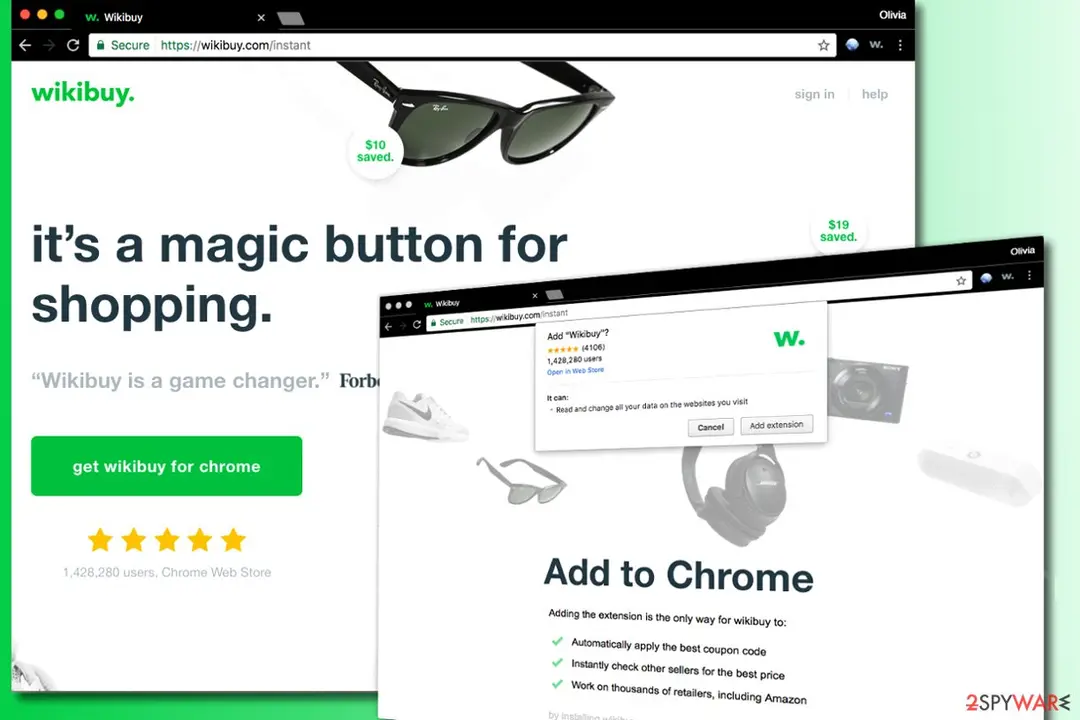
Wikibuy add: summary
| Detection names | No Microsoft detection name is known |
|---|---|
| Distribution | Not recorded in the old report |
| Damage | Not recorded in the old report |
| Name | Wikibuy add |
| Type | System optimizer |
| Symptoms | An unknown program in Installed apps |
| Removal | Scan the PC with security software to find and remove the malware and anything installed with it. Fortect scans Windows for malware and repairs the system files and settings it damaged. Remove it nowTo use the full-featured product, you have to purchase a license for Fortect. The scan is free. |
Show 4 more facts
| Evidence | 5 write-ups by security sites; details still limited |
|---|---|
| Program | Wikibuy add |
| First seen | 5 March 2021 |
| Facts checked | 7 October 2026 |
Is Wikibuy add safe? Why it is flagged
From our report of Mar 2021 · not reviewed since
Wikibuy - a Chrome extension that checks other online stores to find better deals for you
Wikibuy is a popular and innovative extension that enhances the online shopping experience and helps users save money online.
The price comparison and coupon tool can be used on online shops like Walmart, Target, eBay, and many others. Initially released by Impossible Ventures, LLC doing business as Wikibuy, LLC, in 2014, it quickly grew in popularity and was acquired by Capital One Bank in 2018, which produced it even more publicity.
Wikibuy is compatible with multiple browsers (available on Chrome, Firefox, Microsoft, Safari Stores, as well as the official website) and is also cross-platform, so users on iOS and Android can enjoy it on the go. This system tool is a browser extension that is currently compatible with Google Chrome browser only - it means that it works on Chrome browsers installed on any Windows or Mac operating system.
If you're wondering how much money can you save with Wikibuy, we can only say that this system tool will surprise you. We can assure that it is a 100% legitimate and trustworthy application - it isn't like annoying and useless adware programs that make empty promises only to deliver fake ads and generate pay-per-click revenue. For more information about bad ad-supported programs, visit VirusActivity site .
With this extension, you can actually save money. This browser extension uses an algorithm that checks other online shops such and delivers the best prices available.
The extension compares a lot of attributes such as item size, color, availability, and of course, price. It even calculates the final price of the item, including taxes and shipping. Finally, it searches the web for coupon codes to apply additional discounts.
It goes without saying that such a variety of helpful features makes this extension a hands-down great time-saver for people who love to shop online.
From our report of Mar 2021 · not reviewed since
Main advantages and disadvantages of WikiBuy
Wikibuy extension is quite new, however, it has over 3 million users worldwide.
Besides, the number of positive reviews on Chrome Web Store reveals that this system tool actually has great features to offer. Let's take a look at the main advantages of the extension and also discuss some disadvantages that show that there's still some room for improvement.
From our report of Mar 2021 · not reviewed since
Wikibuy Pros
- The extension doesn't ask for any intrusive permissions. It works quickly and delivers a guaranteed offer for a lower price within 15 seconds after you open a product page on any online store.
- The tool provides an user-friendly interface, allowing everyone to use it without any problems.
- The tool is a partner of Ebates, which helps to bring even bigger savings for customers. Ebates allows getting cash back when shopping at certain online stores.
- Wikibuy pays sellers with its own credit card, keeping user's payment information away from sellers. The user only has to share the credit card number with Wiki Buy. When placing an order, the user simply has to confirm shipping and payment details, product details and hit "Place Order."
- Refunds always come directly from the company, not the seller. As soon as the vendor receives a returned product, Wikibuy issues a refund to the user's card. The user usually receives a refund within 1-3 days.
From our report of Mar 2021 · not reviewed since
Wikibuy Cons
- Some users noted that the tool saved them less money than it promised. This shows that the tool can be improved, but still works well. It has been observed that the extension misses the expiration of temporary discounts. For this reason, we suggest that you double-check the offer yourself before placing the order. We can only hope that the developers of Wikibuy will arrange some improvements to fix this issue.
- This virtual shopping assistant tends to provide offers only from reputable sellers on eBay and similar shopping platforms, however, since the app is responsible for all issues, the time required to solve the issue might be prolonged. In other words, the tool decreases the risk on eBay purchases but doesn't eliminate them.
- The extension is likely to provide inaccurate shipping/availability information. Even if Wikibuy lists the product as available, it might be missing in the closest vendor's warehouse, and consequently, the user has to wait longer for the product to arrive.
- Unfortunately, the extension is useful only if you're living/staying in the United States - it can find savings for US addresses currently. However, it promises to work in order to provide savings for foreign customers as well.
From our report of Mar 2021 · not reviewed since
Final verdict on WikiBuy
Wikibuy is clearly an outstanding tool which we believe will be positively evaluated by most online shoppers.
It does not annoy the computer user, it doesn't interfere with web surfing, and it doesn't display ads on your screen when you're browsing regular websites and not online stores.
Although it doesn't work on other browsers, versions compatible with other popular web browsers might appear shortly.
If you did not like the extension and you're wondering how to remove WikiBuy, you can do it in a few simple steps - just enter chrome://extensions in Chrome's address bar and delete the right entry from the Extensions panel.
How to uninstall Wikibuy add
Uninstall it, then remove what keeps it starting with Windows.
Nothing it flagged needs fixing.
Step 1: Uninstall Wikibuy add
Open Settings > Apps > Installed apps in Windows 11, or Settings > Apps > Apps & features in Windows 10. Sort the list by install date and find Wikibuy add, then choose Uninstall from the three-dot menu next to it (in Windows 10, click the entry and then Uninstall).
Remove anything else installed on the same day that you do not recognise, because such programs usually arrive together in one installer. If the uninstaller opens a browser page with an offer or a survey, close it: the program is removed either way.
Full procedure with screenshots: Uninstall a program or app in Windows On uGetFix
Step 2: Remove it from startup
Whatever Wikibuy add installed usually starts with Windows. Open Task Manager with Ctrl + Shift + Esc, go to Startup apps in Windows 11 or the Startup tab in Windows 10, and disable what you do not know, starting with entries that have an empty Publisher column.
Open file location on the right-click menu shows the file, which helps you decide and tells you what to delete later. Disabling is safe: if something you need stops working, switch it back on.
Full procedure with screenshots: Stop apps from opening at startup On uGetFix
Step 3: Delete the folders left behind
What the uninstaller leaves behind is usually in the user folders. Open File Explorer, switch on View > Show > Hidden items (in Windows 10 View > Hidden items), and go through
%LocalAppData%,%AppData%, %ProgramData% and the two Program Files folders.Sort by Date modified and delete folders that appeared together with the problem and belong to no program you use. Folders with random names that hold
.exe,.dll, .js or .ps1 files are the strongest sign.Full procedure with screenshots: Remove what malware leaves behind in Windows
Step 4: Scan the PC, then run the offline scan
Open Windows Security > Virus & threat protection > Scan options, run a Full scan and remove everything it finds. Then select Microsoft Defender Antivirus (offline scan) and click Scan now: the PC restarts and scans before Windows loads, which finds files that hide while Windows runs.
Save your work first, because the offline scan takes about 15 minutes. Both scans are built into Windows 11 and Windows 10, and a second scanner from another vendor is a useful extra opinion.

Windows 11: Windows Security > Virus & threat protection > Scan options. Full procedure with screenshots: Run a Microsoft Defender Offline scan
Do not let government spy on you
The government has many issues in regards to tracking users' data and spying on citizens, so you should take this into consideration and learn more about shady information gathering practices.
Avoid any unwanted government tracking or spying by going totally anonymous on the internet.
You can choose a different location when you go online and access any material you want without particular content restrictions. You can easily enjoy internet connection without any risks of being hacked by using VPN.
Control the information that can be accessed by government any other unwanted party and surf online without being spied on. Even if you are not involved in illegal activities or trust your selection of services, platforms, be suspicious for your own security and take precautionary measures by using the VPN service.
Backup files for the later use, in case of the malware attack
Computer users can suffer from data losses due to cyber infections or their own faulty doings.
Ransomware can encrypt and hold files hostage, while unforeseen power cuts might cause a loss of important documents. If you have proper up-to-date backups, you can easily recover after such an incident and get back to work. It is also equally important to update backups on a regular basis so that the newest information remains intact - you can set this process to be performed automatically.
When you have the previous version of every important document or project you can avoid frustration and breakdowns. It comes in handy when malware strikes out of nowhere. Use for the data restoration process.
Questions about Wikibuy add
What is Wikibuy add and why is it on my PC?
Wikibuy add is a program that was installed on the PC, most likely together with something else you downloaded. Free software sites and many installers add extra programs on setup pages with pre-ticked boxes, so the extra install looks like your choice even though nobody read the page.
Check the install date in Settings, Apps, Installed apps: the program you installed that day is the probable carrier. If you do not need Wikibuy add, uninstall it. If it belongs to your hardware or to a program you use, search its exact name and publisher first, because drivers and their tools can have unfamiliar names.
Wikibuy add will not uninstall. What can I do?
First restart the PC and try again, because the program may have been running and locked its own files. If the uninstaller is missing or fails, start Windows in Safe Mode, where most third-party programs do not start, and remove Wikibuy add from Installed apps there.
If it still refuses, delete its startup entry and its scheduled task, restart, and try once more. A program that actively prevents removal is behaving like malware, so finish with a Microsoft Defender offline scan. Avoid third-party uninstallers offered on search ads; several of them are unwanted programs themselves.
Is Wikibuy add why my PC is slow?
It can be one reason. Programs of this kind often start with Windows, run updaters in the background and keep a process open all the time.
The sign reported, wikibuy add in the list of installed apps, means at least one such program is active. Open Task Manager, sort by CPU, memory and network, and see whether Wikibuy add or a related process is near the top.
If it is, removing it will help. If not, the slowdown has another cause, but removing a program you never chose is still worth doing. A restart after removal shows the difference best.
How do I remove Wikibuy add completely?
Work in three steps. First uninstall it from Settings > Apps > Installed apps, together with anything installed on the same day. Second, remove what restarts it: unknown entries under Settings > Apps > Startup and tasks in Task Scheduler with matching names.
Third, clean the browsers: extensions you did not add and changed search settings. Restart and watch for wikibuy add in the list of installed apps; if it does not come back within a day, the removal is complete.
If it does, run a Microsoft Defender offline scan, which works before Windows starts and finds helpers that hide while the PC runs.
Why does my antivirus call Wikibuy add a PUA or PUP?
These labels mean potentially unwanted application or program. They are used for software that is legal but uses deceptive distribution, aggressive ads, misleading claims or a hard removal. Microsoft's PUA categories include advertising software, bundlers, download managers, torrent clients, marketing software and miners.
A PUA detection is a warning, not proof of infection, and you decide whether to keep Wikibuy add. Other vendors use their own labels for the same idea, such as PUP.Optional or not-a-virus. Read more in our guide to potentially unwanted programs.
Can Windows block unwanted programs automatically?
Yes, with one setting. Windows Security has Potentially unwanted app blocking under App & browser control > Reputation-based protection settings. Block apps stops flagged programs from installing, and Block downloads works in Microsoft Edge.
On some PCs this was not switched on, which is how programs like Wikibuy add got through. It does not catch everything, so read installer screens, choose Custom setup and decline offers. Removing free tools you no longer use also helps, because their updates are a common route for new bundles.
Is my privacy at risk because of Wikibuy add?
A little, not dramatically. Unwanted programs tend to report what you install, which sites you visit or how you use the program back to their publisher. That data is sold or used for ads.
The sign people noticed, wikibuy add in the list of installed apps, is consistent with such a program, and nothing reported suggests access to your files, camera or passwords.
Remove it, delete its leftovers and clear the browser data if it touched the browser. From then on, keep Potentially unwanted app blocking switched on in Windows Security, which stops many of these programs before they install.
How long does removing Wikibuy add take?
Usually ten to twenty minutes. Uninstalling takes a minute; checking the Startup list, Task Scheduler and the browsers takes the rest. A full scan in Windows Security can add half an hour on a large drive, but you can keep using the PC while it runs.
Restart at the end and watch for wikibuy add in the list of installed apps. If it is gone after a day of normal use, you are finished. If it returns, plan for an offline scan, which restarts the PC and takes around fifteen minutes.
Should I call Wikibuy add malware?
Most security vendors would call it a potentially unwanted program rather than malware. The difference is intent and consent:
- malware hides and harms
- while unwanted programs are installed with a click someone barely noticed
- then do more than expected
The sign reported here, wikibuy add in the list of installed apps, is typical of the second group. In practice the label matters less than the result.
Whatever it is called, a program you did not choose should go, and the place it came from should be checked for other programs. Microsoft Defender can block this class of software if you switch on Potentially unwanted app blocking in Windows Security.
Will Fortect remove Wikibuy add?
Fortect scans Windows for malware and unwanted programs and repairs the system files and settings they change, and its free scan shows what it finds on your PC before you decide anything.
For Wikibuy add, follow the plan above as well: the browser steps take back permissions and settings that no scanner treats as a threat, and uninstalling the program that brought it removes the source.
Run Microsoft Defender's full scan and, if anything was found, its offline scan as a second opinion. If the symptoms are gone after the plan and both scans are clean, there is nothing more to do.
Sources
- UGetFix: Microsoft Edge's chances to become Chrome's rival are close to zero (read October 7, 2026)
- Wikipedia: Adware (read October 7, 2026)
- Virus Activity: Virus Activity (read October 7, 2026)
- Wallethacks: Wikibuy: Can This Free App Really Help You Save Money Effortlessly? (read October 7, 2026)
- FTC: How to recognize, remove and avoid malware (read October 7, 2026)