
Worldonsearch.com: what it is and how to remove it
Worldonsearch.com virus is one of those websites that appear on the web to serve their creators and bring them profit. This particular site was put up only a couple of months ago, and its IP points to the Netherlands.
Facts checked October 6, 2026. Removal steps tested on Windows 11 (26H2) and checked against Microsoft's and the browser makers' current documentation. Sections marked as our earlier report are the original text: they describe the threat as it was then and have not been reviewed since. The 2026 status, the removal steps and the questions are current.
Automatic
Get a free scan and check if your PC is infected.
Fortect finds malware, unwanted programs and the Windows damage they leave behind, and repairs it in one pass.
A quick scan confirms nothing else was installed alongside the worldonsearch.com search hijacker.
Do it yourself · free Remove Worldonsearch.com yourself 5 steps, about 15 minutes, no software needed.
Start the steps
Worldonsearch.com: summary
| Name | Worldonsearch.com |
|---|---|
| Type | Potentially unwanted program, browser hijacker |
| Dangers | Installation of other unwanted software, monetary loss, privacy risks |
| Symptoms | Unknown browser extension installed without permission; homepage and new tab address is set to something else; search results are filled with sponsored links; overall increased number of ads |
| Detection names | No Microsoft detection name is known |
| Distribution | Not recorded in the old report |
| Removal | Scan the PC with security software to find and remove the malware and anything installed with it. Fortect scans Windows for malware and repairs the system files and settings it damaged. Remove it nowTo use the full-featured product, you have to purchase a license for Fortect. The scan is free. |
Show 6 more facts
| Damage | Not recorded in the old report |
|---|---|
| Evidence | One write-up by a security site; details still limited |
| Search page | worldonsearch.com |
| Browsers | Chrome, Edge and Firefox |
| First seen | 9 December 2020 |
| Facts checked | 6 October 2026 |
Is Worldonsearch.com dangerous? What it collects
From our report of Dec 2020 · not reviewed since
Worldonsearch.com - a deceptive search engine you should never use
Worldonsearch.com virus is one of those websites that appear on the web to serve their creators and bring them profit.
This particular site was put up only a couple of months ago, and its IP points to the Netherlands. Unfortunately, this tells us practically nothing because there are numerous browser hijackers registered on this domain.
Despite this, you could get warnings from Chrome that the site is unsafe, as phishing has been detected. Thus, if you proceed, you might end up losing money or getting scammed into subscribing to useless services, as well as install malicious programs.
We can presume that this clearly isn't the final goal of this PUP's creators, and they are trying their best to increase the profit as much as possible. Sadly, such aspirations often result in unauthorized browser hijacks. The Worldonsearch virus is no different.
It sneaks into computers via deceptive malvertising or bundling and then uses various techniques to stay there for as long as possible. It may additionally install helper-objects -- toolbars, browser extensions, add-ons to help fortify its position on the infected device.
Naturally, if you decide to remove Worldonsearch.com from your computer, you will have to sort out these malicious programs as well.
To save time from eliminating each of them individually, run a full system scan of your PC with a reliable anti-malware tool like or and spend the rest of your energy reading up on how to fend off such programs in the future. Also, if you notice inconstancies within your computer performance after the elimination of PUPs, use to fix virus damage.
Sadly as it sounds, the Worldonsearch.com hijack is the least of the inconveniences users infected with this browser hijacker have to suffer. If you've ever heard about browser hijackers, you are probably already familiar with the term data tracking. Though this feature does not affect you directly, it may have some serious consequences in the future.
The collected non-personal information can be used to execute a user-targeted Worldonsearch.com redirect campaign or be sold to unknown third-parties. Though not significantly, all the activities that this virus carries out on the computer can reflect on the system performance as well. Your browser may become unusually slow or crash completely. Other applications may also experience similar malfunctions.
Warning: Regardless of how ill your PC may perform, never, we repeat, NEVER call any tech support number that may pop up while browsing online.
This is a common trick online scammers use to sell users fake technical support services. Such notification should disappear as soon as you close your browser. In case you cannot do that, run your Task Manager, and terminate your browser this way.


From our report of Dec 2020 · not reviewed since
PUPs are often planted on the users' computers without permission
Can you guess how did Worldonsearch.com managed to take over your browser?
Contrary to what most users believe, potentially unwanted programs do not simply crack all the security shields and install themselves on the computer. In fact, they need your permission to enter the system. But that does not mean you necessarily grant this permission consciously. It can be implemented in the "Advanced" software installation manager's setting, so it may be simply overlooked.
Most users choose "Quick" or "Recommended" modes to get over with the software installation faster. This is where the additional software package components have a chance to access the computer undetected.
Only the "Advanced" and "Custom" installation settings allow the users to deselect the software package components they do not wish to install. In the case of Worldonsearch.com, you should unmark the checkbox allowing you to make this site your default search engine and homepage.
From our report of Dec 2020 · not reviewed since
More from our earlier report on Worldonsearch.com
- You can uninstall the app manually or use security software to do it for you
- PUPs can tamper with operating systems significantly, and can cause errors, crashes, or other stability issues.
Check your browser and PC
- Address:
worldonsearch.com
How to remove Worldonsearch.com
How to remove Worldonsearch.com and get your search engine back
Remove the extension first.
The search settings only stay fixed once nothing on the PC can change them again.
Step 1: Remove extensions you did not add
In Chrome open
chrome://extensions, in Edgeedge://extensions, and in Firefox the menu > Extensions and themes.Remove every extension you do not remember adding, especially search, new tab, coupon, PDF, weather or video downloader add-ons. Check every browser and every profile, because each keeps its own list.
If an extension has no Remove button or comes back, a browser policy holds it (see "Managed by your organization" in the procedure below). The pages are the same on Windows 11 and Windows 10.
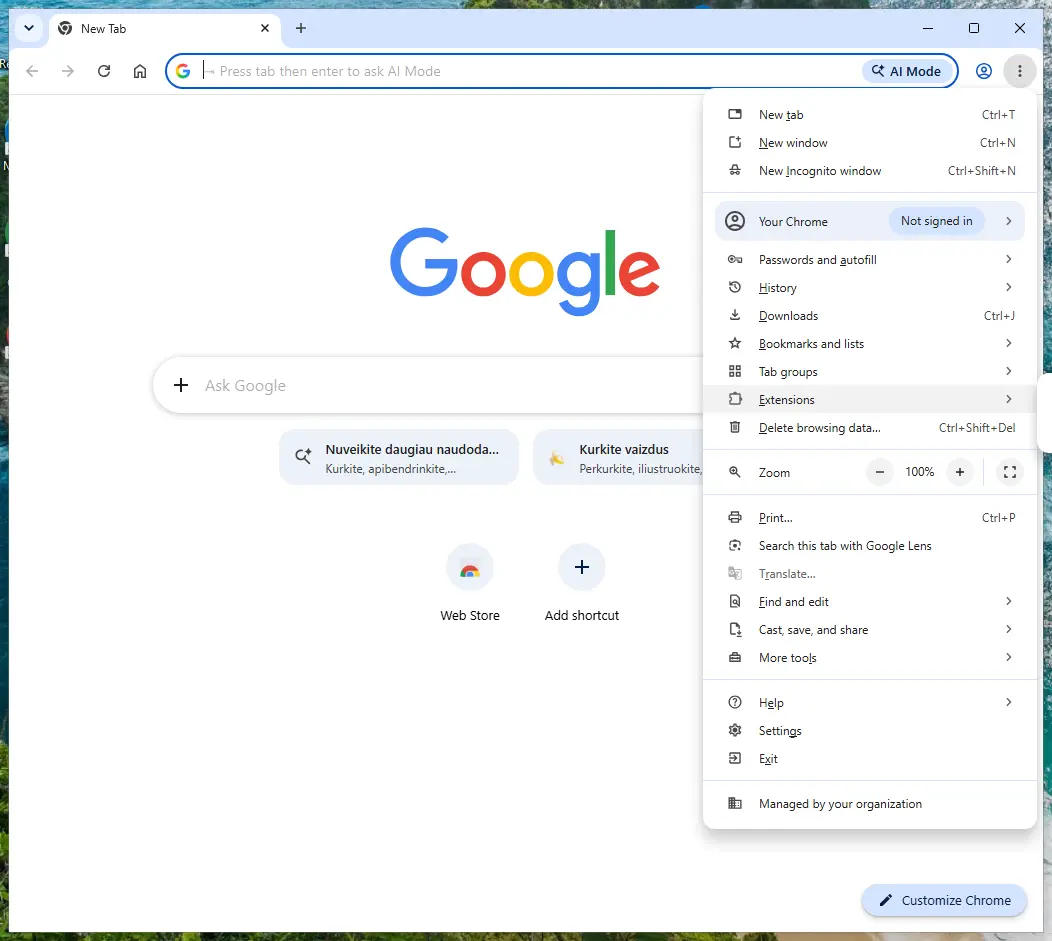
Chrome on Windows 11: More > Extensions > Manage extensions. Full procedure with screenshots: Remove a browser extension
Step 2: Put the search engine back and delete worldonsearch.com
In Chrome open Settings > Search engine > Manage search engines and site search, make an engine you trust the default, and delete
worldonsearch.comfrom the list.In Edge type
search engineinto the search box at the top of Settings and open Manage search engines; in Firefox use Settings > Search. Then check the homepage and the new tab page in the same settings, because hijackers change all three.If worldonsearch.com is back after a restart, an extension, a program or a policy still sets it, so finish the other steps and check again. The settings are the same on Windows 11 and Windows 10.
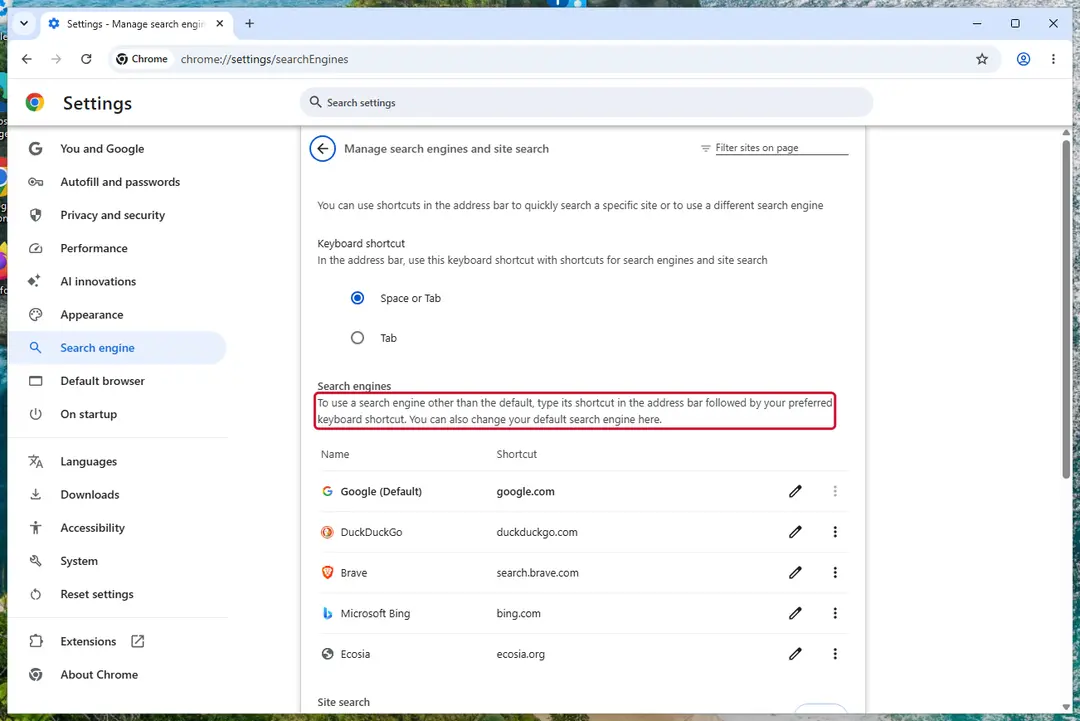
Chrome on Windows 11: check Search engine and On startup. Full procedure with screenshots: Reset a browser and fix a hijacked search engine
Step 3: Uninstall programs you did not mean to install
Worldonsearch.com rarely comes alone: it is usually installed by, or together with, a free program. In Windows 11 open Settings > Apps > Installed apps, in Windows 10 Settings > Apps > Apps & features, and sort by install date.
Uninstall every entry from the day the trouble began that you did not install on purpose, for example a download manager, a converter or a browser you never chose.
Keep drivers and entries from Microsoft, Intel, AMD, NVIDIA or your PC's maker unless you are sure.
Full procedure with screenshots: Uninstall a program or app in Windows On uGetFix
Step 4: Reset the browser
A reset removes what the steps above could miss:
- changed start pages
- site permissions
- hidden settings
In Chrome open Settings > Reset settings > Restore settings to their original defaults; in Edge Settings > Reset settings; in Firefox Help > More troubleshooting information > Refresh Firefox.
Tip: Bookmarks and saved passwords stay, while extensions are turned off and the search engine and start page return to the defaults.
Reset every browser on the PC, including Edge, which Windows 11 and Windows 10 always have.
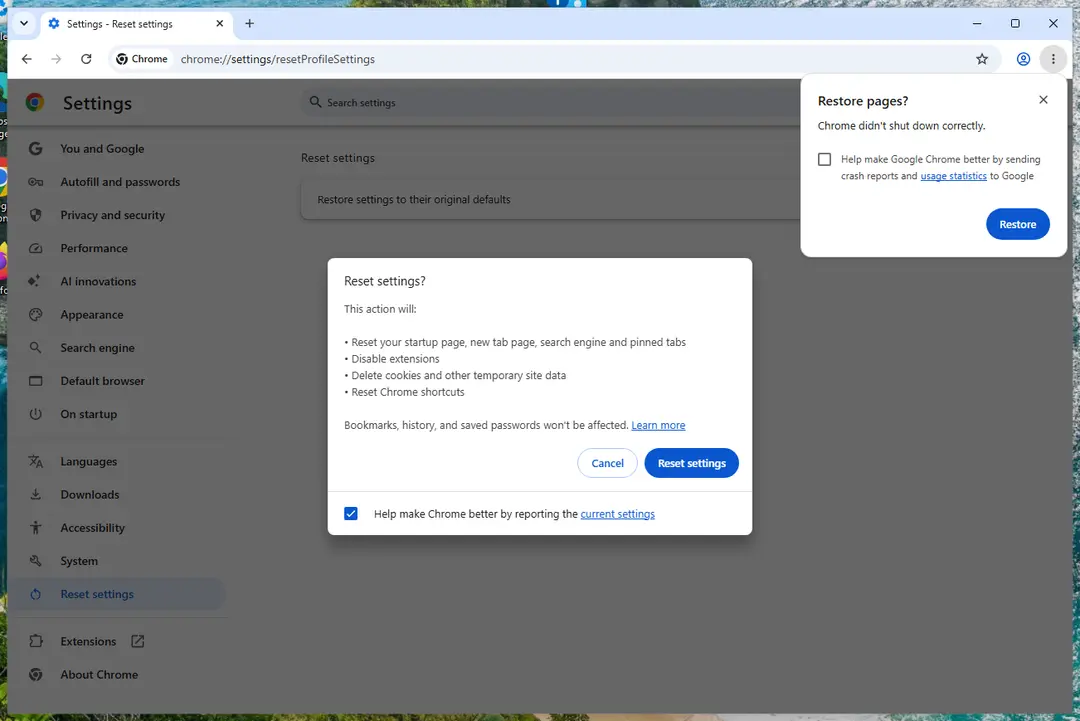
Chrome on Windows 11: Settings > Reset settings. Full procedure with screenshots: Reset a browser and fix a hijacked search engine
Step 5: Scan the PC, then run the offline scan
A scan finds the parts of Worldonsearch.com that the manual steps cannot see. In Windows Security > Virus & threat protection > Scan options, start a Full scan and quarantine what it reports.
Follow it with Microsoft Defender Antivirus (offline scan) > Scan now, which restarts the PC and checks the disk while Windows and the malware are not running.
It takes about 15 minutes and works the same in Windows 11 and Windows 10. If either scan finds something, run the full scan again after removal until it comes back clean.
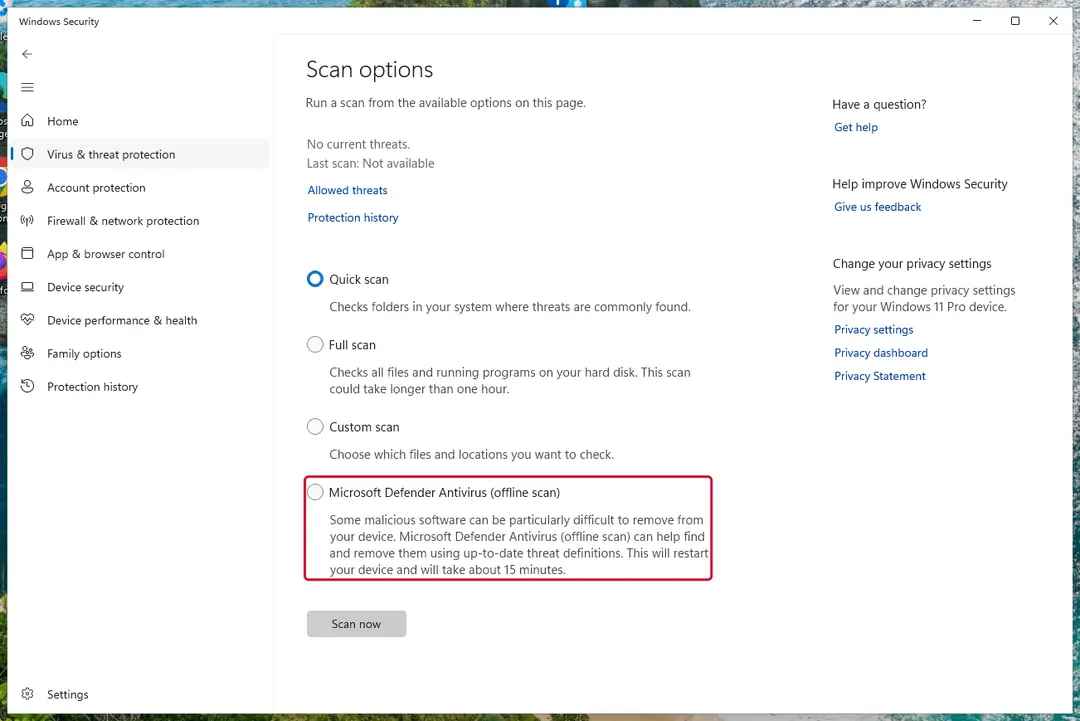
Windows 11: Windows Security > Virus & threat protection > Scan options. Full procedure with screenshots: Run a Microsoft Defender Offline scan
Instructions for each browser and system
The detailed steps for every browser and system this guide covers. Open the one you use.
Uninstall from Windows
Worldonsearch.com is mostly found on Windows OS, but you may not find it on your Add/Remove programs list. It might be there only under another name, so you should analyze every suspicious program you can find and delete it if your hunches turn out to be true.
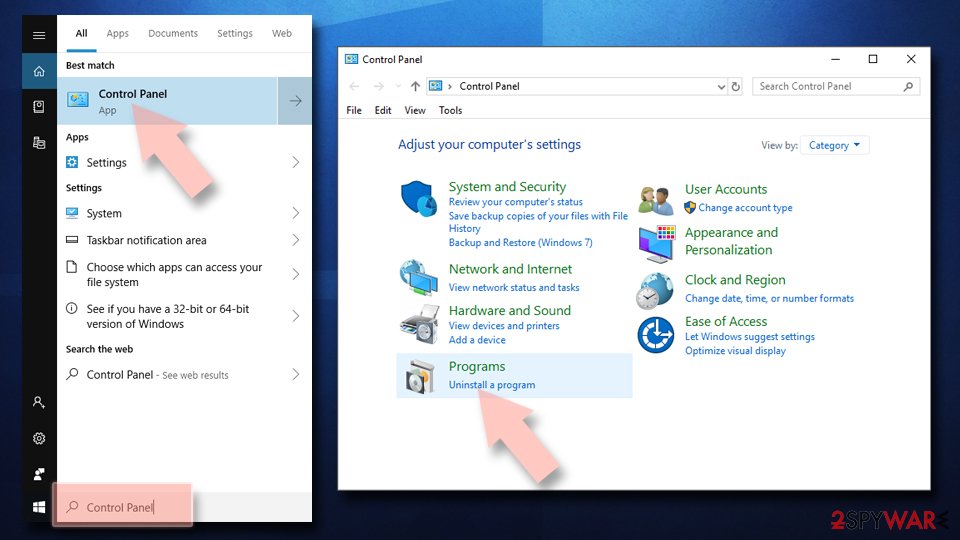
Uninstall from Windows 10/8:
- Type Control Panel into the Windows search box and open the result.
- Under Programs, select Uninstall a program.
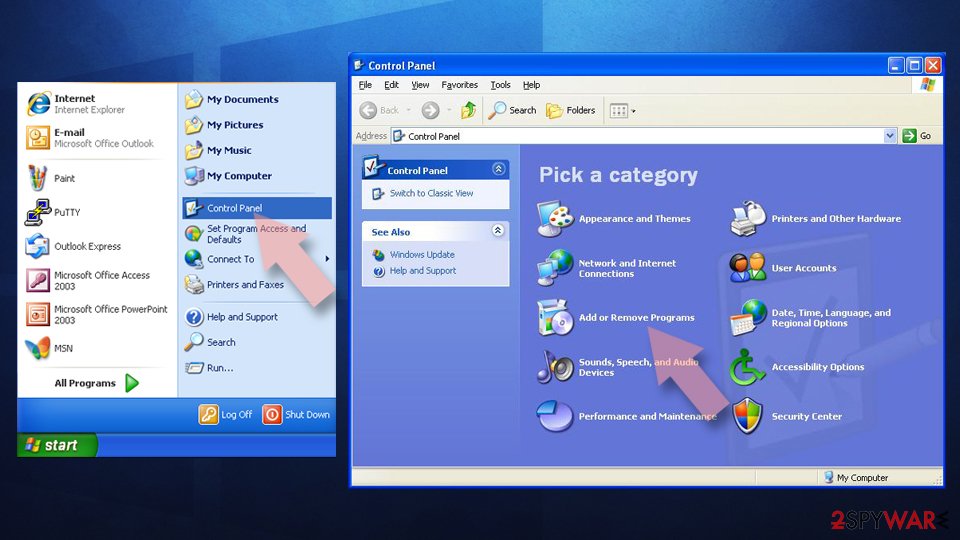
Uninstall from Windows 7/XP:
- Click on Windows Start > Control Panel (Windows XP users should click on Add/Remove Programs).
- In Control Panel, select Programs > Uninstall a program.
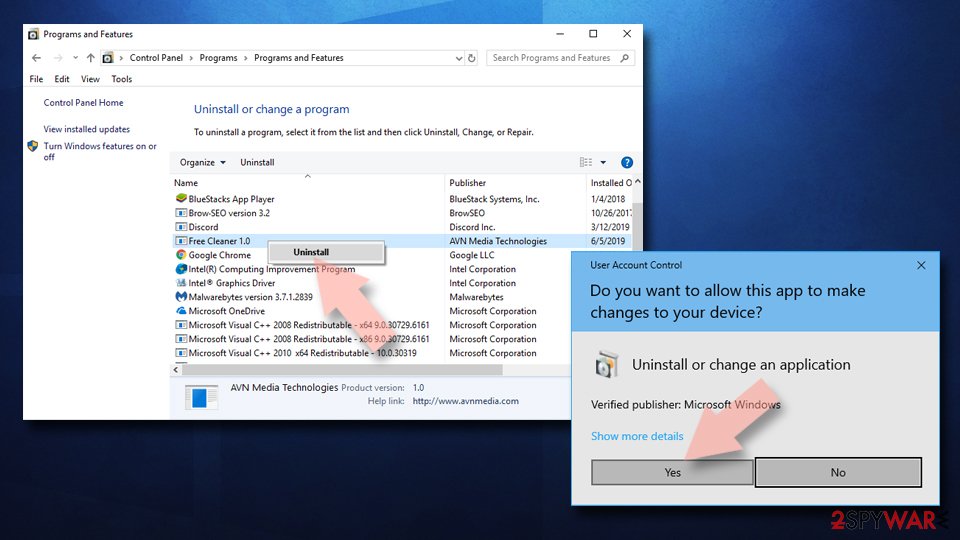
Remove the unwanted program:
- In the Programs and Features window, look for any recently installed suspicious entries, select them, and click Uninstall.
- If User Account Control appears, click Yes to confirm, then complete the removal.
Remove from Google Chrome
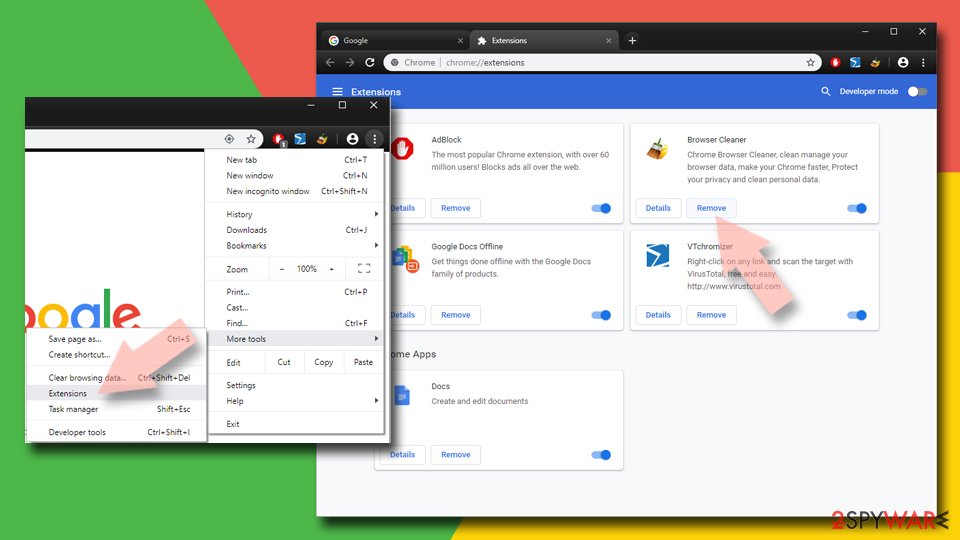
Delete malicious extensions from Google Chrome:
- Open Google Chrome, click on the Menu (three vertical dots at the top-right corner) and select More tools > Extensions.
- In the newly opened window, you will see all the installed extensions. Uninstall all suspicious extensions related to the unwanted program by clicking Remove.
Clear cache and web data from Chrome:
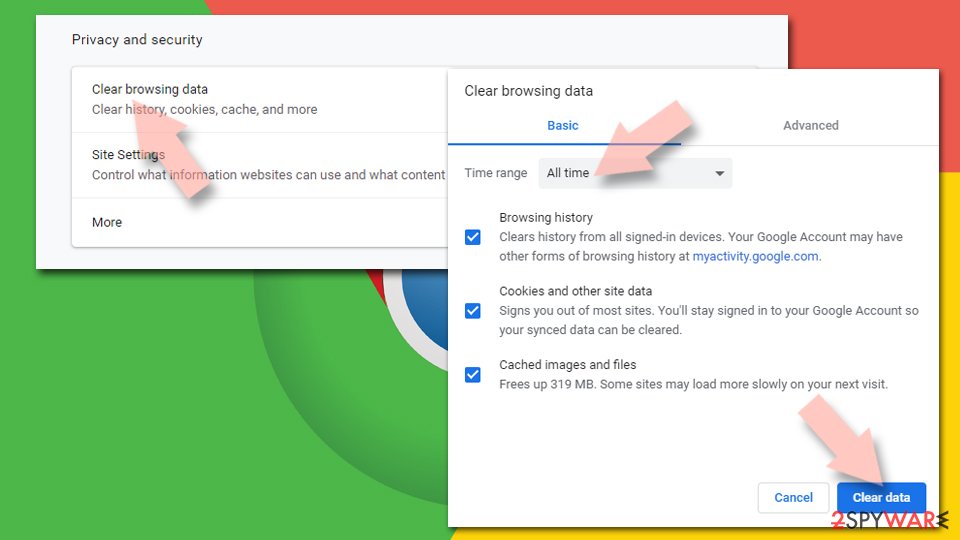
- Click on Menu and pick Settings.
- Under Privacy and security, select Clear browsing data.
- Select Browsing history, Cookies and other site data, as well as Cached images and files.
- Click Clear data.
Change your homepage:
- Click menu and choose Settings.
- Look for a suspicious site in the On startup section.
- Click on Open a specific or set of pages and click on three dots to find the Remove option.
Reset Google Chrome:
If the previous methods did not help you, reset Google Chrome to eliminate all the unwanted components:
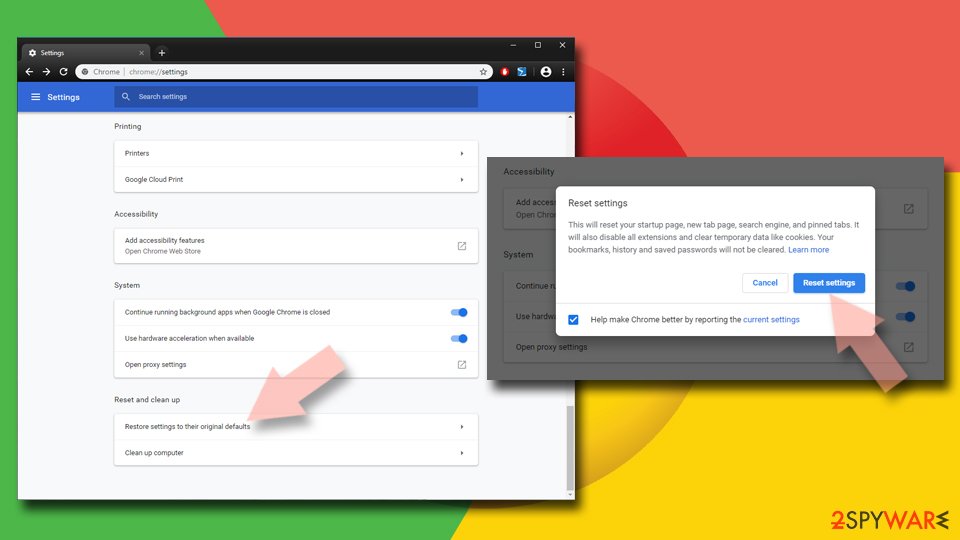
- Click on Menu and select Settings.
- In the Settings, scroll down and click Advanced.
- Scroll down and locate Reset and clean up section.
- Now click Restore settings to their original defaults.
- Confirm with Reset settings.
Remove from Microsoft Edge
Delete unwanted extensions from MS Edge:
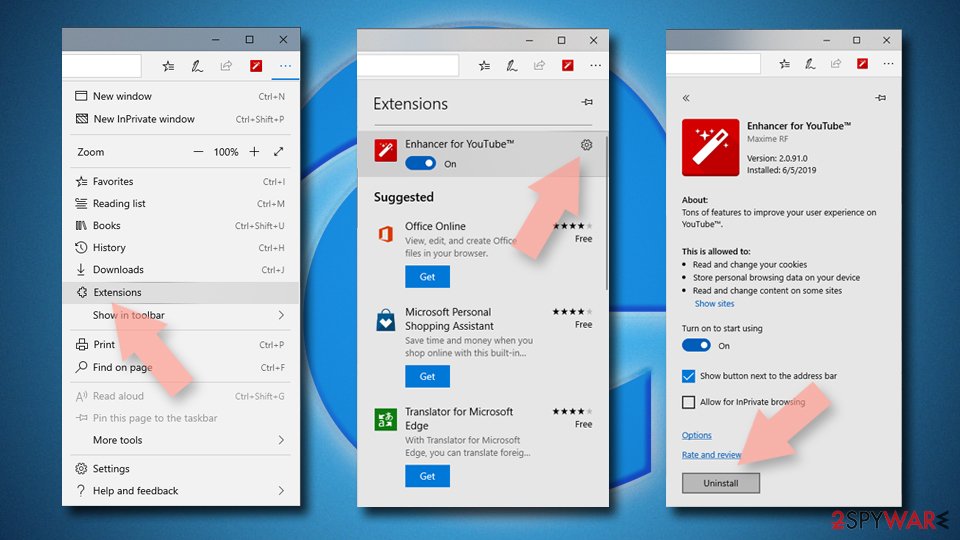
- Select Menu (three horizontal dots at the top-right of the browser window) and pick Extensions.
- From the list, pick the extension and click on the Gear icon.
- Click Remove.
Clear cookies and other browser data:
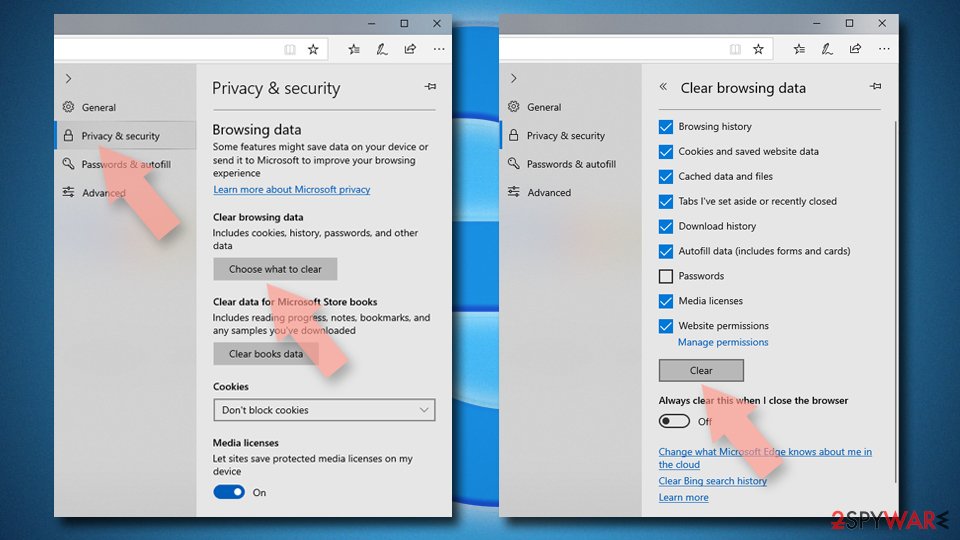
- Click on the Menu (three horizontal dots at the top-right of the browser window) and select Settings > Privacy, search, and services..
- Under Clear browsing data, pick Choose what to clear.
- Select Cookies and other site data and Cached images and files. (apart from passwords, although you might want to include Media licenses as well, if applicable) and click on Clear.
Restore new tab and homepage settings:
- Click the menu icon and choose Settings.
- Then find On startup section.
- Click Remove next to any suspicious startup page.
Reset MS Edge if the above steps did not work:
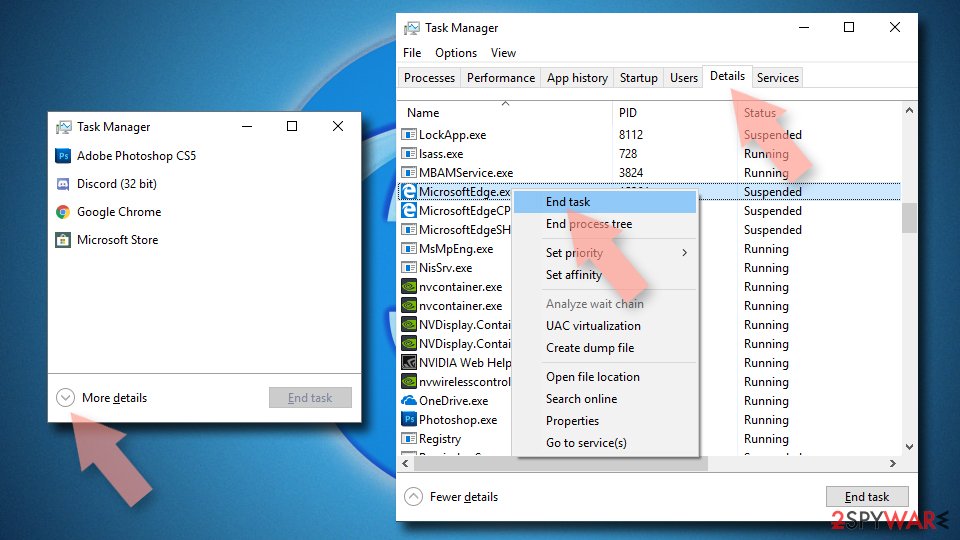
- Press on Ctrl + Shift + Esc to open Task Manager.
- Click on More details arrow at the bottom of the window.
- Select Details tab.
- Now scroll down and locate every entry with Microsoft Edge name in it. Right-click on each of them and select End Task to stop MS Edge from running.
Delete extensions from MS Edge (Chromium):
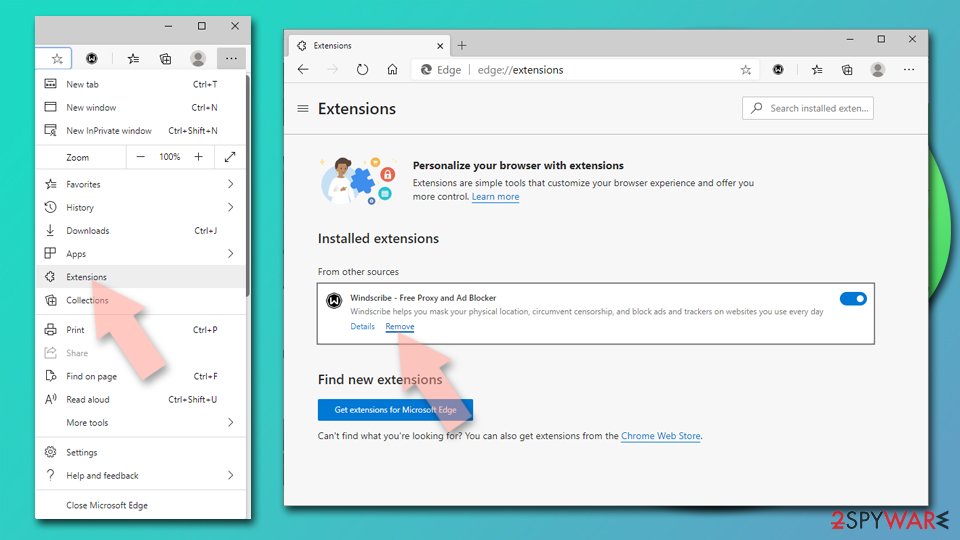
- Open Edge and click select Settings > Extensions.
- Delete unwanted extensions by clicking Remove.
Clear cache and site data:
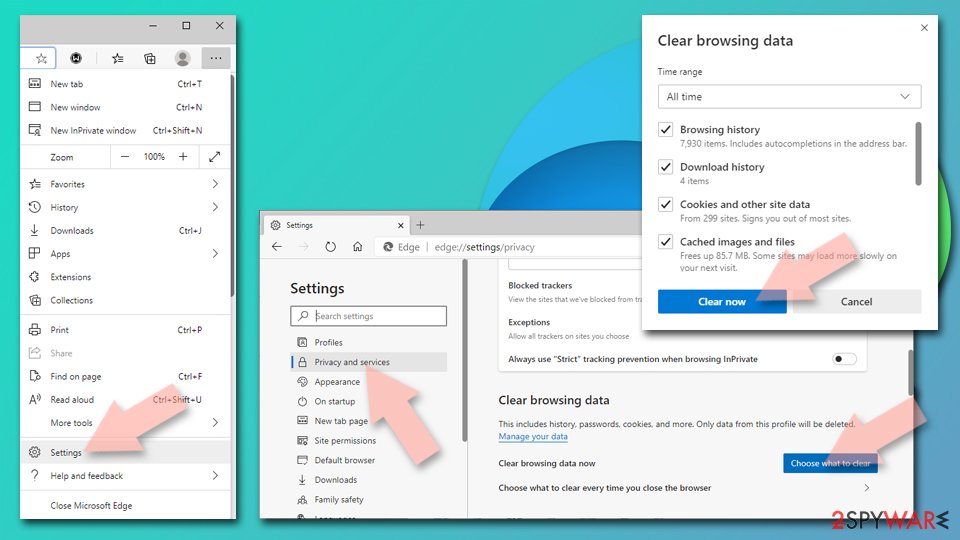
- Click on Menu and go to Settings.
- Select Privacy, search and services.
- Under Clear browsing data, pick Choose what to clear.
- Under Time range, pick All time.
- Select Clear now.
Reset Chromium-based MS Edge:
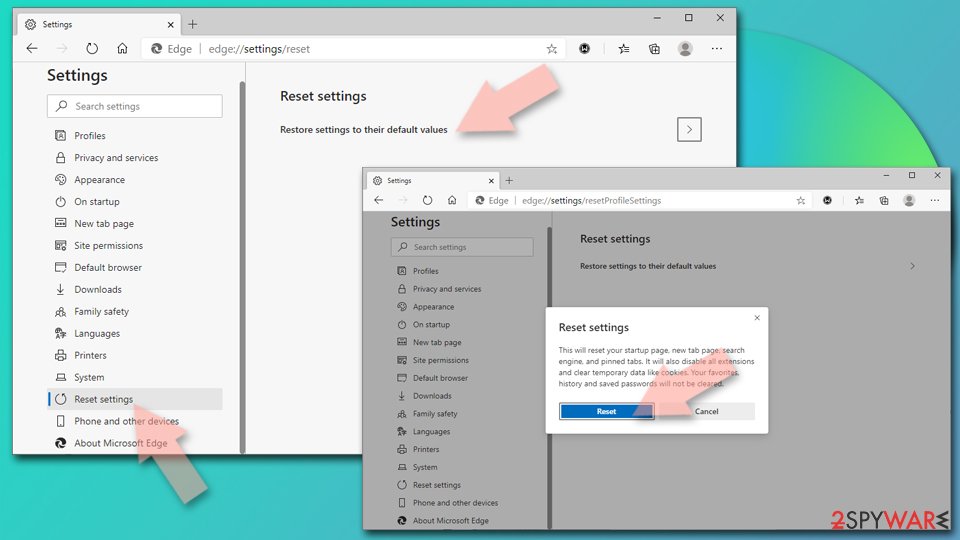
- Click on Menu and select Settings.
- On the left side, pick Reset settings.
- Select Restore settings to their default values.
- Confirm with Reset.
- This will disable extensions and reset startup pages but will not delete bookmarks, saved passwords, or browsing history.
Remove from Mozilla Firefox (FF)
Remove dangerous extensions:
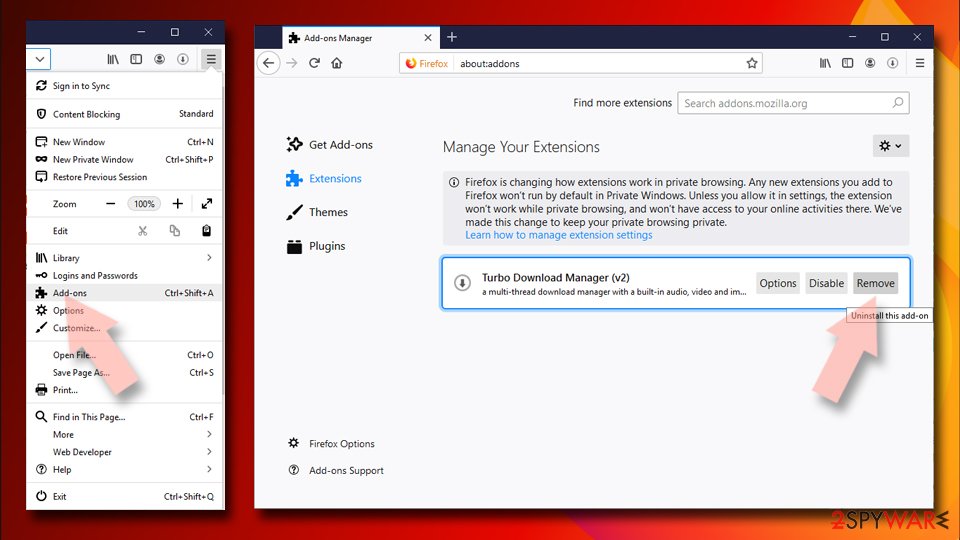
- Open Mozilla Firefox browser and click on the Menu (three horizontal lines at the top-right of the window).
- Select Add-ons.
- In here, select the unwanted extension and click Remove.
Reset the homepage:
- Click three horizontal lines at the top right corner to open the menu.
- Choose Settings.
- Under Home, set your preferred homepage and new tab settings.
Clear cookies and site data:
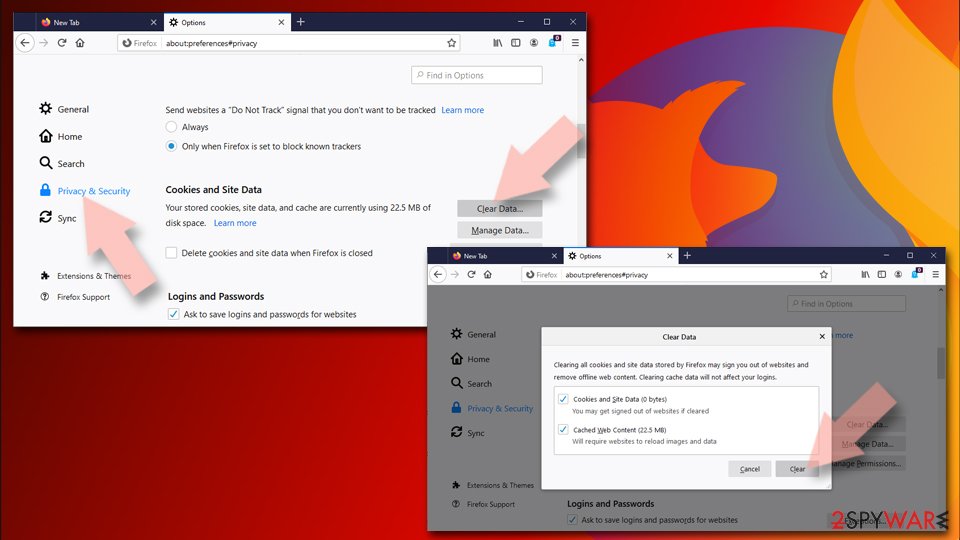
- Click Menu and pick Settings.
- Go to Privacy & Security section.
- Scroll down to locate Cookies and Site Data.
- Click on Clear Data...
- Select Cookies and Site Data and Temporary cached files and pages, then click Clear.
Reset Mozilla Firefox
If clearing the browser as explained above did not help, reset Mozilla Firefox:
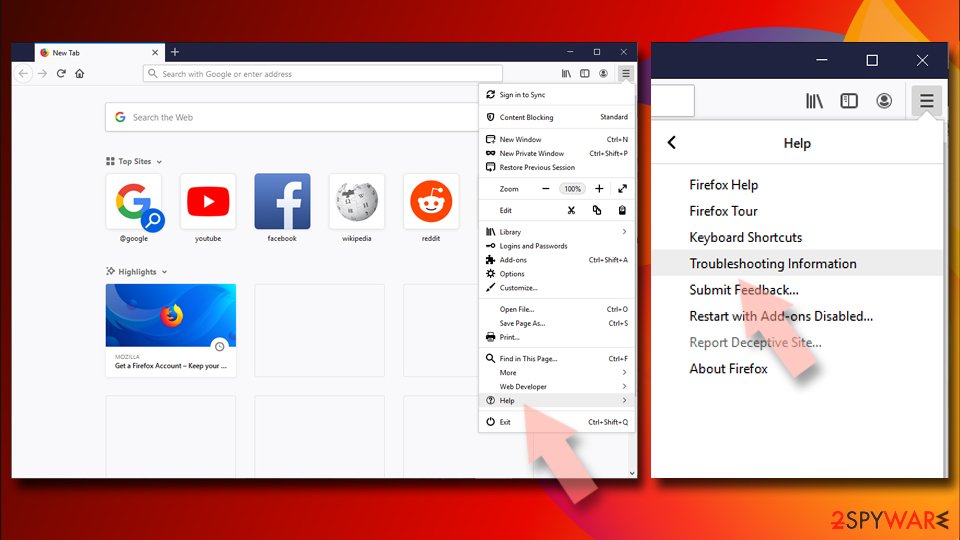
- Open Mozilla Firefox browser and click the Menu.
- Go to Help and then choose Troubleshooting Information.
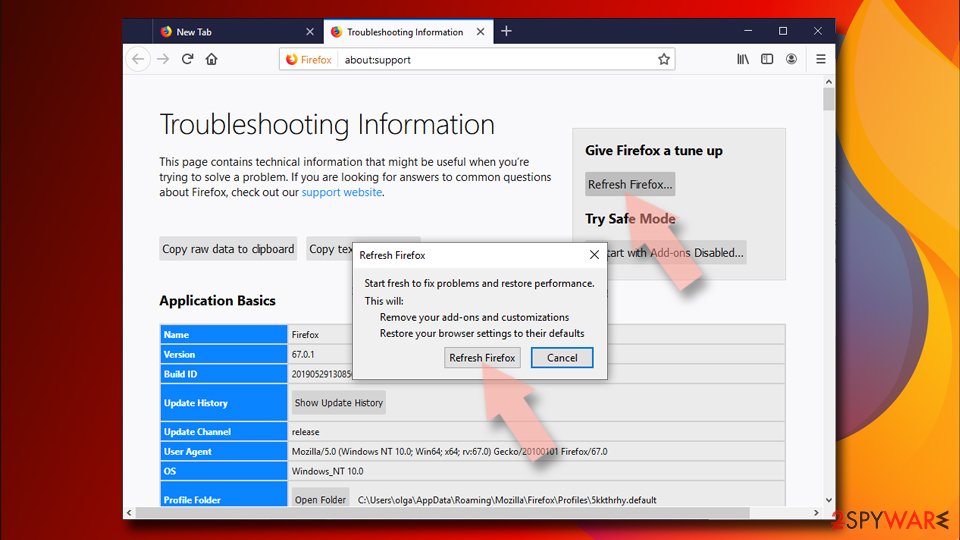
- Under Give Firefox a tune up section, click on Refresh Firefox...
- Once the pop-up shows up, confirm the action by pressing on Refresh Firefox.
Delete from Safari
Remove dangerous extensions:
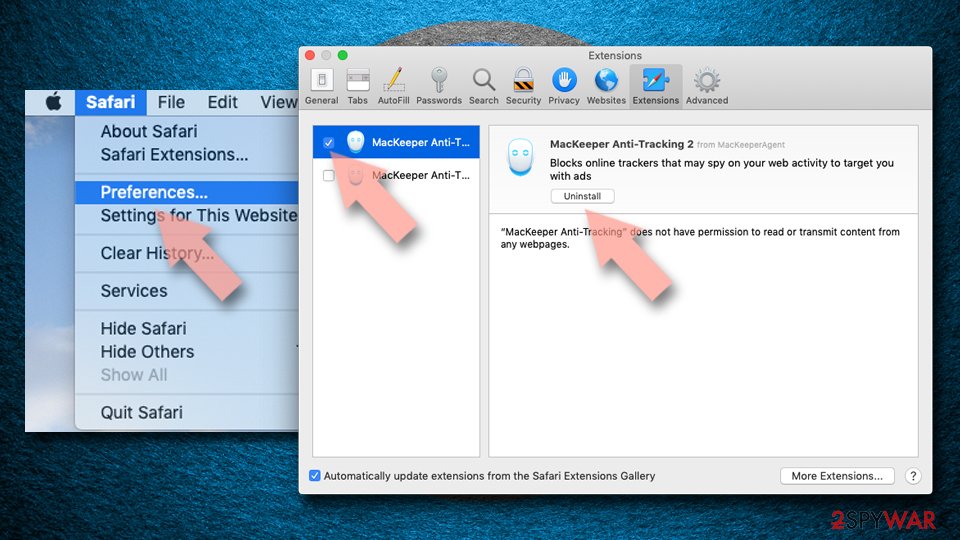
- Open Safari, click Safari in the menu at the top-left of the screen, and select Preferences.
- Go to the Extensions tab, look for any suspicious entries, and click Uninstall to remove them.
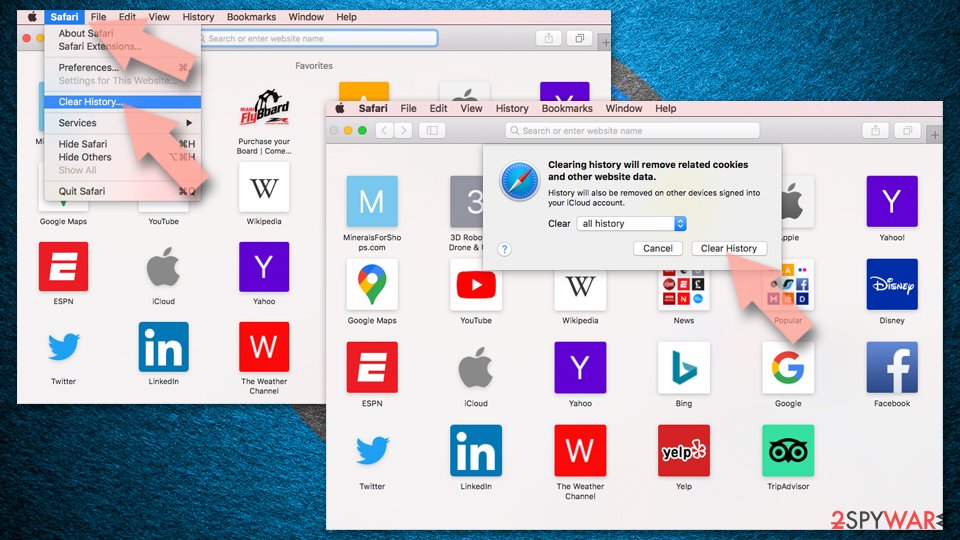
Clear history and website data:
- Click Safari in the menu and pick Clear History.
- Set Clear to all history and confirm with Clear History.
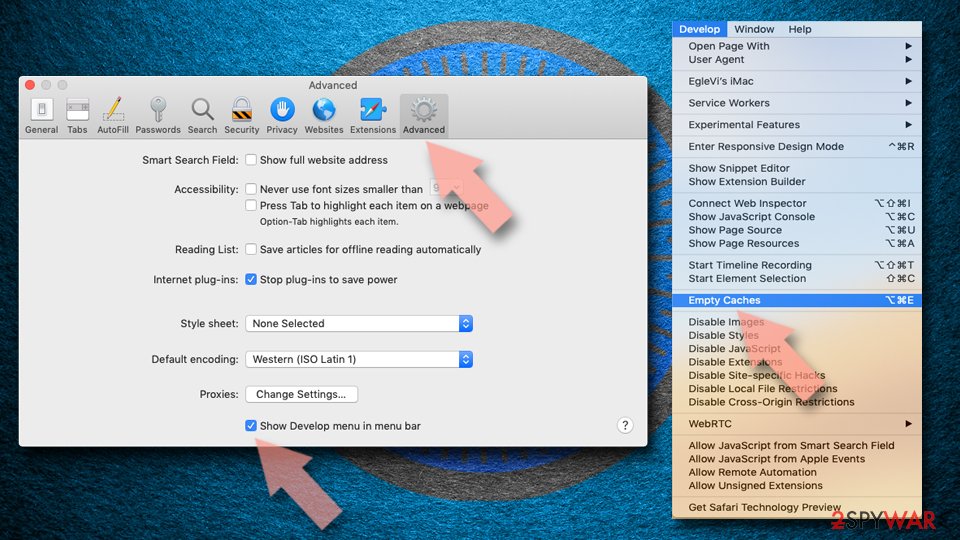
Reset Safari:
- Click Safari in the menu and select Preferences > Advanced.
- Enable Show Develop menu in menu bar.
- From the menu bar, click Develop and select Empty Caches.
Delete from macOS
Though it is highly unlikely that Worldonsearch.com will target Mac OS X, anything can happen. In any case, we present instructions that should help remove Worldonsearch.com from your computer if it is ever infected. Please keep in mind that the PUP might feature a different name, so be careful not to let it slip through.
Remove the unwanted application:
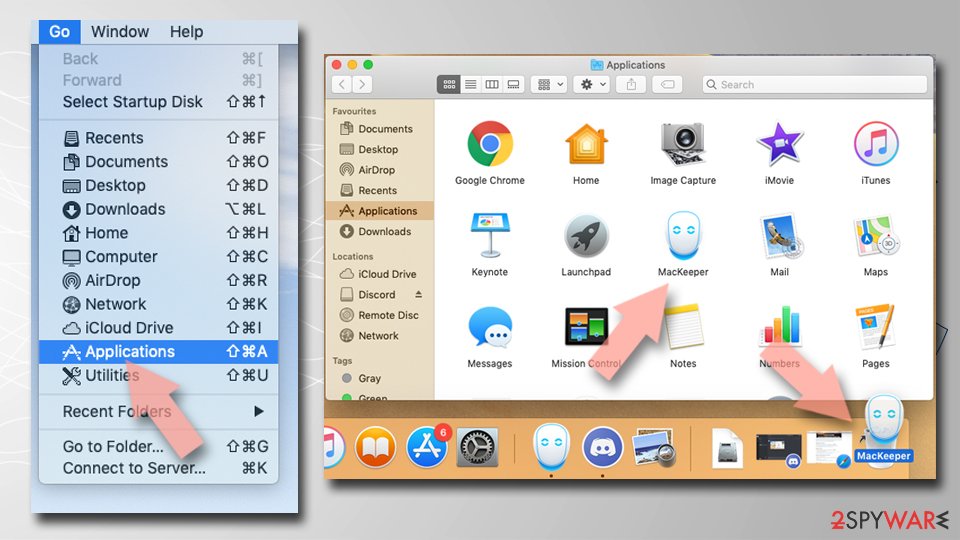
- From the menu bar, select Go > Applications.
- In the Applications folder, look for any suspicious entries, then drag them to Trash (or right-click and pick Move to Trash).
Delete leftover files and folders:
- Select Go > Go to Folder.
- Enter /Library/Application Support and remove any suspicious folders related to the unwanted program.
- Repeat the same check in the /Library/LaunchAgents and /Library/LaunchDaemons folders, deleting any suspicious entries.
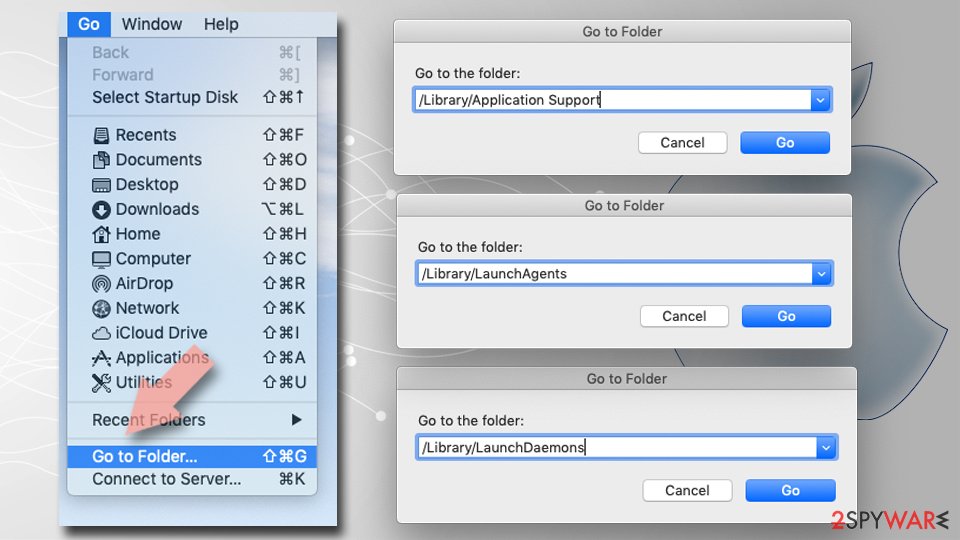
- Finally, empty the Trash to permanently remove the leftovers.
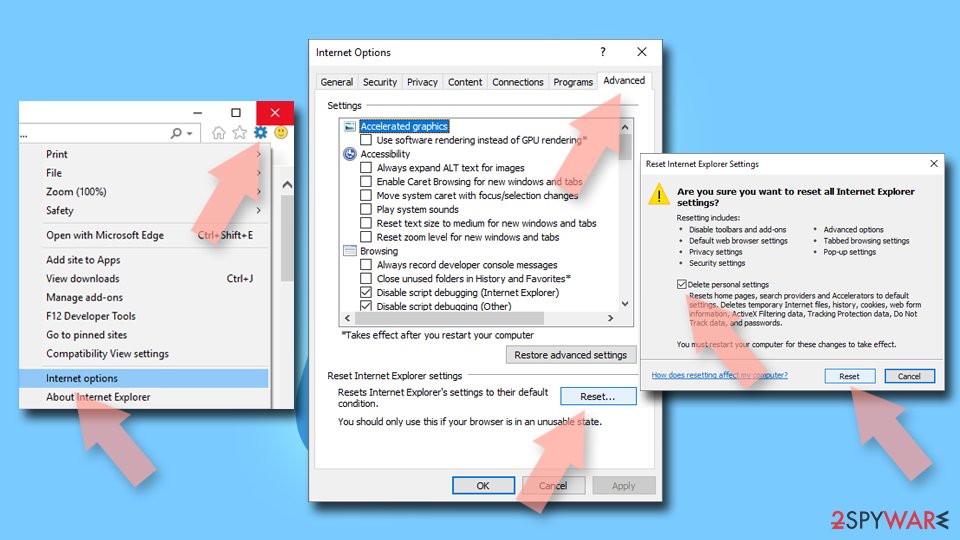
Reset Internet Explorer
Remove dangerous add-ons:
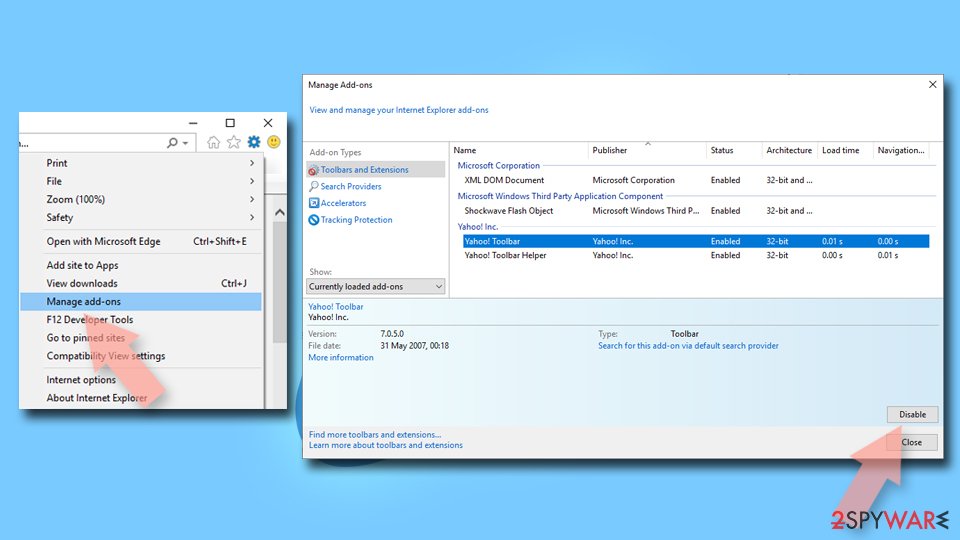
- Open Internet Explorer, click on the Gear icon (IE menu) on the top-right corner of the browser
- Pick Manage Add-ons.
- You will see a Manage Add-ons window. Here, look for suspicious plugins. Click on these entries and select Disable.
Change your homepage if it was altered:
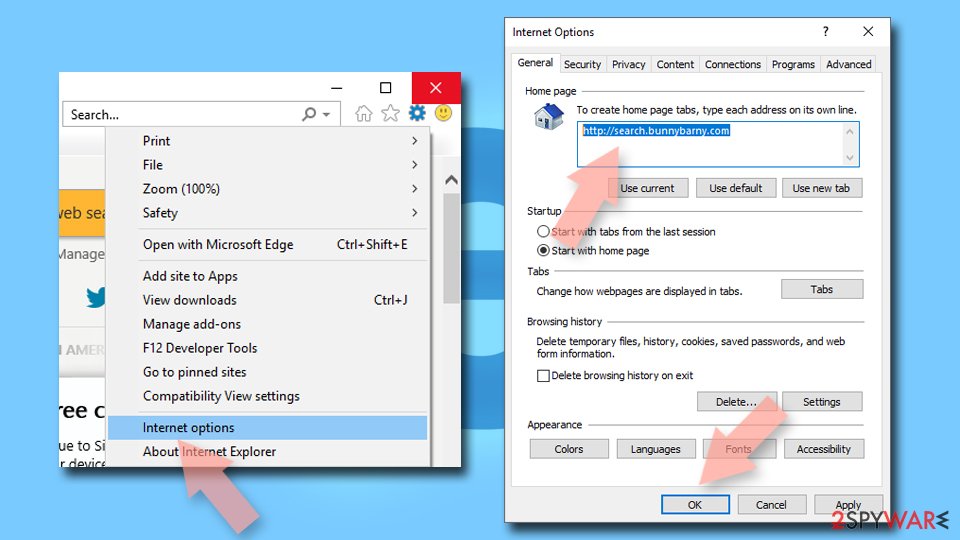
- Open IE and click on the Gear icon.
- Select Internet Options.
- In the General tab, delete the Home page address and replace it by your preferred one (for example, Google.com).
- Click Apply and then select OK.
Delete temporary files:
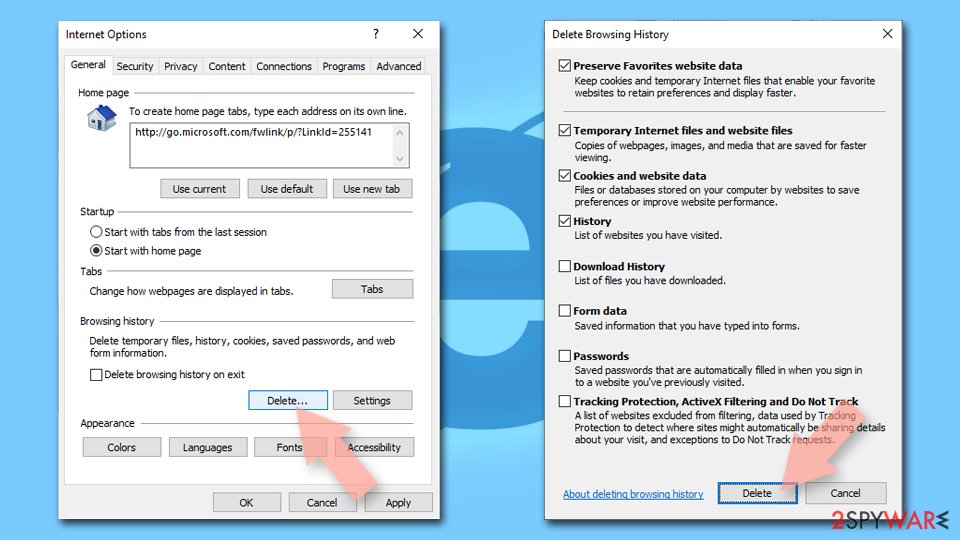
- Press on the Gear icon and select Internet Options.
- Under Browsing history, click Delete...
- Select relevant fields and press Delete.
Reset Internet Explorer:
- Click on Gear icon > Internet options and select Advanced tab.
- Select Reset.
- In the new window, check Delete personal settings and select Reset.
Stream videos without limitations, no matter where you are
There are multiple parties that could find out almost anything about you by checking your online activity.
While this is highly unlikely, advertisers and tech companies are constantly tracking you online. The first step to privacy should be a secure browser that focuses on tracker reduction to a minimum.
Even if you employ a secure browser, you will not be able to access websites that are restricted due to local government laws or other reasons. In other words, you may not be able to stream Disney+ or US-based Netflix in some countries. To bypass these restrictions, you can employ a powerful VPN, which provides dedicated servers for torrenting and streaming, not slowing you down in the process.
Data backups are important - recover your lost files
Ransomware is one of the biggest threats to personal data.
Once it is executed on a machine, it launches a sophisticated encryption algorithm that locks all your files, although it does not destroy them. The most common misconception is that anti-malware software can return files to their previous states. This is not true, however, and data remains locked after the malicious payload is deleted.
While regular data backups are the only secure method to recover your files after a ransomware attack, tools such as can also be effective and restore at least some of your lost data.
From our report of Dec 2020 · not reviewed since
Worldonsearch.com removal instructions
Worldonsearch.com virus is a potentially unwanted program that does not pose direct damage but should not be underestimated either.
Such programs can help other, more vicious viruses like ransomware reach you much easier. Thus, your device should be scanned for them regularly.
If your antivirus manages to remove Worldonsearch.com, it should as well deal with other browser hijackers in the future. Although you should double-check whether your tool is running real-time protection and is up-to-date. In case you wish to try out other Worldonsearch.com removal options, do not hesitate to follow our expert-prepared manual guide.
Questions about Worldonsearch.com
How do I change my search engine back from worldonsearch.com?
Open the browser's search engine settings, choose the search engine you want and set it as default, then remove worldonsearch.com from the list.
If the option is greyed out or a note says it is controlled by an extension, remove that extension first and try again. If the browser says it is managed by your organization, a policy holds the setting, and the policy steps in this guide apply.
When the change will not stick, reset the browser: it restores the default search engine and start page and turns off extensions, but keeps bookmarks and saved passwords. Then check Installed apps for a program that may put worldonsearch.com back.
Did worldonsearch.com come with a program I installed?
Most likely, yes. Search hijackers such as worldonsearch.com usually arrive with free software, where an extra offer is pre-ticked in the installer, or as an extension that promises something useful, such as file conversion, maps, recipes or streaming.
Look at Settings, Apps, Installed apps sorted by install date: whatever was installed just before the search engine changed is the main suspect. Uninstall it, then remove any extension you do not recognise. In future, choose the custom or advanced option in installers and untick extra offers, and install extensions only from the official store pages of publishers you know.
What is worldonsearch.com?
It is the search page used by the browser hijacker Worldonsearch.com. It has no search index of its own: it forwards your queries to another search engine and adds ads and tracking along the way.
People rarely choose it on purpose; it becomes the default search engine, home page or new tab after an extension, program or policy changes the browser settings. The page itself is not malware, but it should not be in your browser if you did not set it. The steps above remove the source and restore your settings.
Is worldonsearch.com dangerous?
It is not designed to infect the PC, but it is not neutral either. It logs searches, adds sponsored results that are hard to tell apart from real ones, and its ad partners are not checked as strictly as those of major search engines.
Some hijacker pages have shown ads for fake updates, tech support scams and unwanted software. The main harm is to privacy. Remove Worldonsearch.com, and if you entered personal data on sites reached through its results, check those sites carefully.
Do I have to fix every browser?
Yes, every one where the search engine or start page changed. In the cases we checked, Worldonsearch.com affected Chrome, Edge and Firefox.
Each browser stores its own search settings and extensions, so fixing one does not fix the others, and Windows-level changes such as shortcuts can affect each browser differently. Work through them one at a time:
- remove the extension
- check the policies
- restore the search engine
- start page
If you sync a browser, stay signed in so the fix spreads to your other computers.
Did worldonsearch.com record my searches?
Almost certainly. Logging is the point of a hijacker search page: each query, with your IP address, browser details and the result you clicked, is valuable to advertisers.
The operators of worldonsearch.com can store and share that data under their own privacy policy, which you never agreed to knowingly. There is no way to delete it from their side. What you can do is stop the flow:
- remove Worldonsearch.com
- clear cookies and site data for worldonsearch.com
- treat sensitive searches made in the meantime as known to a third party
Can I just block worldonsearch.com?
You can, but it treats the symptom. Blocking the domain in a firewall or the hosts file makes searches fail instead of redirecting, while the extension or program that set it keeps running and collecting data.
Hijacker operators also switch to new domains in updates, so a block may stop working within weeks. Remove the source instead, then set your own search engine. If you want extra protection afterwards, turn on Potentially unwanted app blocking in Windows Security, which stops many hijacker installers before they run.
Why can't I change my search engine back?
Because something keeps setting it. If an extension controls the search engine, Chrome and Edge show a note that an extension is controlling this setting, and your change is reverted. If a policy controls it, the field is greyed out and the browser shows Managed by your organization.
Remove the extension first, then the policies, and only then change the search engine; the change will stay. If it still reverts, look for a program in Installed apps or a scheduled task that reinstalls the extension.
Is only one browser affected?
Often not. Programs that install hijackers tend to change every browser they find, and sync can carry the extension to other computers signed in to the same browser account. Check Chrome, Edge and Firefox, even the ones you rarely use, and look at the shortcut targets on the desktop and taskbar for each.
If you use sync, remove the extension while signed in so the removal syncs too. Also check the On startup setting and the new tab page, because hijackers change those as well as the search engine.
Will Fortect remove Worldonsearch.com?
Fortect scans Windows for malware and unwanted programs and repairs the system files and settings they change, and its free scan shows what it finds on your PC before you decide anything.
For Worldonsearch.com, follow the plan above as well: the browser steps take back permissions and settings that no scanner treats as a threat, and uninstalling the program that brought it removes the source.
Run Microsoft Defender's full scan and, if anything was found, its offline scan as a second opinion. If the symptoms are gone after the plan and both scans are clean, there is nothing more to do.
Sources
- FTC: How to recognize, remove and avoid malware (read October 6, 2026)
- Microsoft Learn: Microsoft Defender Offline (read October 6, 2026)
- Microsoft Learn: How Microsoft names malware (read October 6, 2026)