
www2.savemax.store ads: what it is and how to stop the pop-ups
www2.savemax.store is a web address that our 2019 report tied to adware:
- ads
- pop-ups
- redirects on every page the reader opened
In our October 2026 test the address no longer opens; if ads or redirects still appear on your PC, a program or extension is showing them, and the steps below find and remove it.
Facts checked October 6, 2026. Removal steps tested on Windows 11 (26H2) and checked against Microsoft's and the browser makers' current documentation.
Automatic
Get a free scan and check if your PC is infected.
Fortect finds malware, unwanted programs and the Windows damage they leave behind, and repairs it in one pass.
A scan of the PC is a quick way to confirm that nothing installed is behind the www2.savemax.store redirects.
Do it yourself · free Remove www2.savemax.store ads yourself 1 step, about 5 minutes, no software needed.
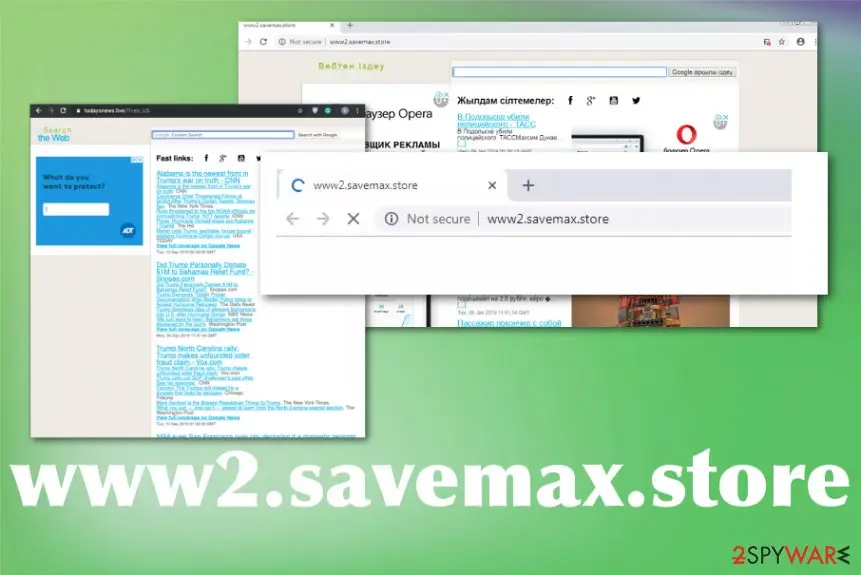
Www2.savemax.store ads: summary
| Type | Website address tied to ads, pop-ups and redirects; not a program. A program or extension on the PC is the risk |
|---|---|
| Risk | Medium: the address installs nothing itself, but the ads it was tied to can lead on to fake downloads and offers that ask for personal or card details |
| Symptoms | Ads, banners and pop-ups on every site, windows and tabs opening on their own, redirects to ad pages, a "Powered by SaveMax Store" line on ads (per the 2019 report), changed browser settings |
| How to get rid of it | Uninstall programs added when the ads began, switch off unknown start-up apps, remove unknown extensions, reset the browser, then run a Microsoft Defender full and offline scan (steps below) |
| Our check (6 October 2026) | The page did not load (no address for www2.savemax.store), so no ads, pop-ups or redirects could be observed; this does not clear it |
| Running since | The main domain savemax.store was registered on 15 May 2026 (registrar VIRTUA DRUG Kutatási Szolgáltató Korlátolt Felelősségű Társaság); the registry does not show who held the name in 2019 |
| Removal | Scan the PC with security software to find and remove the malware and anything installed with it. Fortect scans Windows for malware and repairs the system files and settings it damaged. Remove it nowTo use the full-featured product, you have to purchase a license for Fortect. The scan is free. |
Show 12 more facts
| First reported by us | 10 September 2019 |
|---|---|
| Evidence | Our 2019 pictures, our own browser attempt and name lookup, the registry's record |
| Detection | Microsoft Defender: nothing is installed by the address, so there is no detection name; Defender only reacts to files that come with the ads |
| Installed on the PC | Nothing by visiting; the 2019 report never named a program or file |
| Name | Www2.savemax.store |
| Domains | www2.savemax.store |
| Ads shown as | Redirects through ad pages |
| Browsers | Chrome, Edge and Firefox |
| First seen | 10 September 2019 |
| Distribution | Typically ad scripts on free streaming, file-hosting and adult sites, typo domains and hacked websites |
| Damage | Redirects to scam pages, fake updates and tech support scams |
| Facts checked | 6 October 2026 |
Facts checked on 6 October 2026 against our own attempt to open the address in desktop Chromium from Europe, a name lookup and a header request the same day, and the registry's RDAP record for savemax.store; the ads, pop-ups, redirects and the program behind them are from our 2019 report and were not re-tested.
What www2.savemax.store is and what people saw
www2.savemax.store is a web address, not a program. Our 2019 report tied it to ads and redirects that appeared on every page the reader opened; the address itself installs nothing, and whatever shows the ads sits on the PC or in the browser.
- 1
Ads appear on pages that should not have them
The 2019 report says the adware injects pop-ups, banners and boxes on every website you visit and loads promotional content for other applications. The reader did not choose any of it.
- 2
New windows and tabs keep opening
The report calls the redirecting its most annoying feature: tons of windows, pop-ups and tabs that open one after another and send the browser on to ad-supported pages.
- 3
A line on the ads gives it away
The report says the ads carry the text "Powered by SaveMax Store" or something similar. None of the three pictures we kept from 2019 shows that line, so we cannot confirm the wording; it is the report's marker, and it is useful only if you see it yourself.
- 4
Nobody knows where it came from
The report calls it a silent intruder: readers could not tell where it came from, and it names no program or file. We have not identified one either, and no tool we know of lists a detection name for it.
- Address
- www2.savemax.store, a subdomain of savemax.store
- Other names
- Savemax Store ads, SaveMax: readers named it after what the ads said, not after a file
- What it was linked to
- Pop-ups, banners, new tabs and redirects to ad-supported pages, per the 2019 report
- Main domain registered
- 15 May 2026 for savemax.store, paid until 15 May 2027 (Radix registry record); the registrar listed is VIRTUA DRUG Kutatási Szolgáltató Korlátolt Felelősségű Társaság
- Record last changed
- 20 May 2026
- Where it points now
- Nowhere: www2.savemax.store has no address, so a browser cannot open it (see our test)
The registration date matters: savemax.store was registered in May 2026, seven years after our report. The registry shows only the current registration, so it does not tell us who held the name in 2019, whether the 2019 operator still has anything to do with it, or when the old owner let it go.
Is www2.savemax.store ads dangerous?
Our test on 6 October 2026
We tried to open https://www2.savemax.store/ in a clean desktop Chromium browser from Lithuania. The page did not load, so there was nothing to watch. This is one attempt on one day, and it does not clear the address.
www2.savemax.store · desktop Chromium · Europe · 6 October 2026
- Opening the pageThe browser stopped at once with the error
ERR_NAME_NOT_RESOLVED: it could not find an address for www2.savemax.store. - Our own name lookupA DNS query the same day gave the same picture: savemax.store has addresses, but www2.savemax.store has none. We cannot say when the subdomain stopped answering, because we did not record its state between 2019 and today.
- The main nameA header request to
https://savemax.storewas answered with a 301 redirect to a page about savemax.store on expireddomains.com, a site that lists domain names. That looks like a name that is parked or listed; we did not open that page and did not follow it further. - Redirects, pop-ups, ad networksNot tested: with no page to load, none could be observed. This is not the same as "none".
- Notification requestNot tested for the same reason. The 2019 report never mentioned notifications. If your browser does show notifications from this name or from an ad, they come from the permission you gave the site, not from the page being open, and they continue until you remove the permission.
- Not testedOther countries, phones, a visit that arrives from an ad or another page, a second visit, or a visitor who clicks. Adware pages often show their offer only to some of these, and a page that cannot be opened for us can still behave differently for you or return later.
Do not trust it The address did not load, so the test shows nothing about its behaviour: not in 2019 and not on the next visit. A subdomain without an address today can be given one again, and the name now belongs to a new registration.
What changed since our 2019 report
10 September 2019
Our report: ads, pop-ups and redirects
We published the report on this date. Its text describes adware that floods the browser with advertisements and redirects it to ad-supported pages; it did not name a program, a file or a download source.
10 September 2019
What the pages in the pictures show
The "Search the Web" page on
todaysnews.livehas a Google search box, a blue advert asking "What do you want to protect?" with an ADT logo, and headlines. In the first picture the page behind it is in Kazakh, with a search box, a headline list from January 2019 and a large Russian-language advert for the Opera browser's built-in ad blocker with a green "Try" button. Both look like ad-supported search and news pages of the kind the report describes, but the report does not name them and we have not tested them.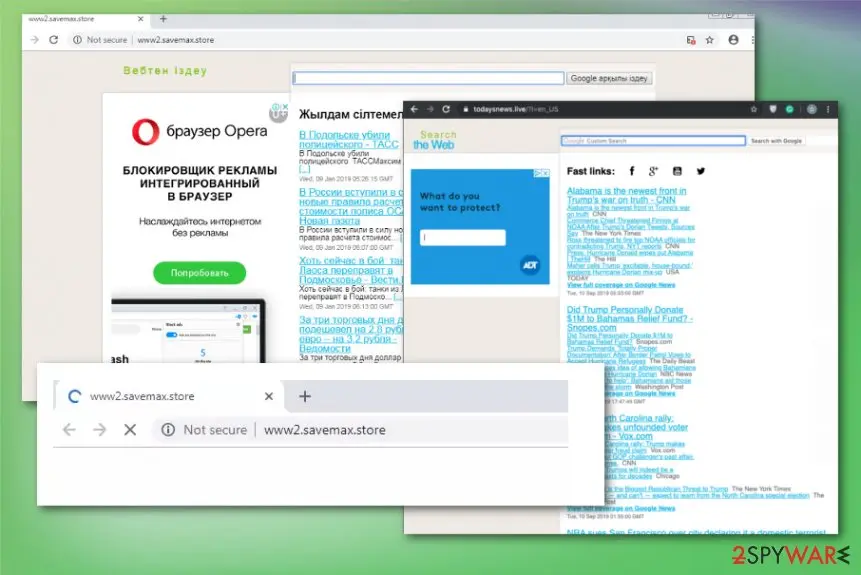
The second 2019 picture, with the Kazakh-language search page in front: the Russian Opera ad-blocker advert and its green "Try" button, and the todaysnews.live page with an ADT advert beside it. 15 May 2026
savemax.store is registered again
The registry shows the current registration of savemax.store starting on this date, with the paid period running to 15 May 2027.
20 May 2026
The registration record is changed
The record was last changed five days after registration. It does not say what changed.
6 October 2026
Our new check: no address for www2
The browser could not find www2.savemax.store, while the main name savemax.store answered with a redirect to a domain-listing page. We saw no pop-ups, notifications or ads on this one attempt, because no page loaded.
Signs the 2019 report listed, and how to check each one
The report lists five signs. None of them proves a particular program by itself; each is a reason to look in a specific place.
| Sign (2019 report) | Where to look on your PC |
|---|---|
| Pop-ups, banners and blinking boxes appearing continuously | Open the same site in a private window with extensions off. If the ads are gone, an extension is adding them. In Chrome also check Settings > Privacy and security > Site settings > Pop-ups and redirects. |
| The line "Powered by SaveMax Store" or similar on the ads | Take a screenshot of the ad with the address bar visible and the page's address. We could not confirm this wording from our own pictures, so such a screenshot is the only proof. |
| Changed settings in the browser or the computer | Check your home page, start-up pages and default search engine in the browser's settings, and your default browser in Settings > Apps > Default apps. |
| Shady processes in Task Manager | Press Ctrl + Shift + Esc and open Processes and Startup apps. Do not end a process on a guess: search its exact name first, and note anything you cannot place. |
| A slower browser and a slower device | Slowness has many causes, so treat it only as a sign when it comes together with the ones above. |
| Other programs and in-browser content you did not install | Open Settings > Apps > Installed apps and sort by install date; open the browser's extension list and look for names you do not know. |
The real risks, from most to least serious
Seeing an ad is not what hurts. The risk is what the ads lead to, and the program or extension that keeps showing them.
- High
Clicking an ad that leads to something worse
The 2019 report warns that all the commercial content exposes the reader to possibly malicious material and can end in more serious malware. A fake download, a prize page or a page asking for card details are the usual next steps; anything typed into such a page should be treated as handed over.
- Medium
Data collected through the ads
The report says ad-supported sites track your data through pop-ups, websites and third-party domains, and that this can lead to privacy or identity issues. We have no test of what this address collected, but ad networks do log the pages you visit.
- Medium
Browser settings changed behind your back
The report says it can alter browser settings or computer preferences. Changed settings are a reason to run the clean-up below: a changed start page or search engine sends your searches somewhere you did not choose.
- Medium
A slow or crashing computer
The report says freezes, crashes and errors get worse the longer the adware stays, and that the machine becomes slow over time. We could not verify the crashes, and a slower browser can also come from a full disk or many extensions, but ads and background programs do use memory.
- Low
The address today
www2.savemax.store has no address, so opening it does nothing. The remaining risk is a new owner pointing it at ads; the report's description of what it did in 2019 is not a description of what it does now.
One thing in the report is worth correcting: it says in one place that such an intruder "is not malicious or damaging" and in others that it is possibly malicious. Both cannot hold. Adware that only shows ads is a nuisance; the harm starts with what an ad leads to and with what else gets installed beside it.
How adware like this gets in, and why it stays
The 2019 report blames free software that carries extra programs, and says the adware is hard to get rid of. Both are common with adware; neither is specific to this address.
- 1
Bundled with free software
The report says unwanted programs are either downloaded on purpose or arrive bundled with other freeware, and that there are many deceptive ways to spread adware and browser hijackers. The common one is an installer that adds programs next to the one you wanted.
- 2
Quick setup installs everything
If you choose Recommended or Quick setup, the report says all pre-bundled programs install alongside the unwanted program. Choose Advanced or Custom: those screens list every included program and let you untick the extras.
- 3
Downloads from the wrong places
The report advises choosing providers and sources for software with care and says torrent and other free download sites hand over unwanted programs without the reader noticing. Download from the maker's own site.
- 4
Why it keeps coming back
The report says the main complaint is persistence: it can change browser settings or computer preferences so that certain programs start when the device restarts, and it says this is done by editing registry keys and startup settings. We have not tested any program tied to this address and cannot confirm the registry claim. What you can check is the list of start-up apps in Settings > Apps > Startup, and the browser's own settings.
- 5
Why the ads exist
The report says the program changes settings to interfere with your time online and earn money for its sponsor. Adware is paid for by showing ads and sending visitors to advertisers; more clicks mean more money, which is why it does not stop by itself.
How to remove www2.savemax.store ads
How to stop the www2.savemax.store redirects
Work in this order and test a few links after each step, so you know which one was the cause.
Which browser shows the ads?
Remove extensions you do not recognise
Paste
chrome://extensionsinto the address bar and click Remove on anything you did not install yourself, especially ad blockers, "search" or PDF helpers added recently.Full procedure with screenshots: Remove a browser extension
Clear the site data
Press Ctrl + Shift + Delete, choose All time, tick Browsing history, Cookies and other site data and Cached images and files, and click Delete data. Cookies track what you do online and the data is often shared with advertisers, so clearing it after removing the cause is part of the clean-up.
Reset Chrome
Open Settings > Reset settings > Restore settings to their original defaults and confirm with Reset settings. This resets the start page, search engine and pinned tabs and turns off extensions; bookmarks and saved passwords stay. To stop notifications after you close Chrome, also turn off Settings > System > Continue running background apps when Google Chrome is closed.
Full procedure with screenshots: Reset a browser and fix a hijacked search engine
Remove extensions you do not recognise
Paste
edge://extensionsinto the address bar and click Remove under anything you did not install yourself.Full procedure with screenshots: Remove a browser extension
Clear the site data
Open Settings > Privacy, search, and services > Delete browsing data > Choose what to clear, set All time, tick Cookies and other site data and Cached images and files, and click Clear now.
Reset Edge
Open Settings > Reset settings > Restore settings to their default values and confirm with Reset. Extensions are turned off and the start page goes back to default; favourites, history and saved passwords stay. To stop notifications after you close Edge, turn off Settings > System and performance > Continue running background extensions and apps when Microsoft Edge is closed.
Full procedure with screenshots: Reset a browser and fix a hijacked search engine
Remove add-ons you do not recognise
Paste
about:addonsinto the address bar, open Extensions, and choose Remove from the three-dot menu of anything you did not install yourself.Full procedure with screenshots: Remove a browser extension
Clear cookies and site data
Open Settings > Privacy & Security > Cookies and Site Data > Clear Data, tick both boxes and click Clear.
Refresh Firefox
Open the menu > Help > More troubleshooting information and click Refresh Firefox. Add-ons and custom settings are removed and the home page goes back to default; bookmarks, history and passwords stay.
Full procedure with screenshots: Reset a browser and fix a hijacked search engine
Check what you allowed
In Safari > Settings > Websites, look at Pop-up Windows and Notifications: set any site you do not recognise to Block or Deny.
Remove extensions you do not recognise
In Safari > Settings > Extensions, select anything you did not install yourself and click Uninstall.
Clear the site data
In Safari > Settings > Privacy > Manage Website Data, remove the site's data, or use History > Clear History > all history. To empty the cache as well, turn on Show features for web developers in Settings > Advanced and choose Develop > Empty Caches.
Check the Mac for apps from the ads
Ads also target Mac users with fake players and "cleaners". In Finder > Applications, move anything unknown to the Bin. In System Settings > General > Login Items & Extensions, remove unknown items. Then use Go > Go to Folder to check
/Library/LaunchAgents,~/Library/LaunchAgents,/Library/LaunchDaemonsand/Library/Application Supportfor folders and files with the same unknown names, and empty the Bin.
Then, whichever browser you use
Step 1: Scan the PC if you downloaded anything from the ads
If you only saw the notifications and clicked nothing, you can stop before this step. If a notification led you to download or run something, delete that file, then scan Windows.
In Windows Security > Virus & threat protection > Scan options, run a Full scan, then choose Microsoft Defender Antivirus (offline scan) and Scan now. The offline scan restarts the PC and takes about 15 minutes on Windows 11 and Windows 10.

Windows 11: Windows Security > Virus & threat protection > Scan options. Full procedure with screenshots: Run a Microsoft Defender Offline scan
After removal: keep the ads from coming back
If the ads keep opening or you clicked one
If you only saw a page and closed it, nothing is installed. If ads and pop-ups keep coming on their own, a program or extension on the PC is opening them: find it, remove it, and then scan. Remove it as soon as you notice the signs, so that it has less time to bring in other programs.
- 1
Find what you added
Open Settings > Apps > Installed apps in Windows 11 (Apps & features in Windows 10), sort by install date and uninstall anything added the day the ads began, then confirm if User Account Control asks. The old Control Panel path (Uninstall a program) does the same on Windows 7 and 8. If you are not sure what belongs, skip the list and run the scan below instead (Uninstall a program or app in Windows On uGetFix).
- 2
Check what starts with Windows
Open Settings > Apps > Startup, or the Startup apps tab in Task Manager, and turn off anything you do not recognise. This does not delete the program, so also uninstall it in the step above.
- 3
Remove extensions you did not choose
Do not forget to check your browsers for extensions or add-ons that may affect performance, and remove them by hand. In Chrome, open More > Extensions > Manage extensions and click Remove under anything you did not install (). The steps for each browser are in the tabs above.
- 4
Scan, then scan offline
Run a Microsoft Defender Full scan, then the Microsoft Defender Antivirus (offline scan) in Windows Security > Virus & threat protection > Scan options. The offline scan restarts the PC and runs before Windows loads, so persistent programs have a harder time hiding. Other unwanted programs can run without you knowing, which is why a full scan beats looking only for the one name.
- 5
Reset the browser, then check what you typed
Use the reset step for your browser above. If you typed a password or a card number into a page an ad opened, change that password now and tell your bank about the card.
On a Mac, moving an app to the Bin is not always enough, because adware leaves files for persistence; the Mac tab above lists the folders to check. Do not try to edit system settings or the registry by hand: the browser reset and the scan above do the same job without the risk of breaking something.
How to keep it from happening again
The 2019 report blamed free software that carries extra programs. These habits cut the chance and the damage.
Do
- When an installer offers Custom or Advanced setup instead of Recommended or Quick, choose it: those screens list each component so you can untick the extras, which is where a bundled program is declined.
- Say no to any offer to change your home page or install an app you do not know.
- Download games, download managers, search tools and other free programs from the maker's own site, not from a page that wrapped them in an installer.
- Install browser extensions only from the extension store's own listing, and read the permissions before you approve.
- Keep Microsoft Defender SmartScreen on, or Chrome's Enhanced protection: both warn about known malicious pages and downloads.
- Keep a current backup of your files (File History or OneDrive), so an infection does not cost you your documents.
- On public networks, a VPN hides your IP address from the sites and ad networks you visit; it does not block ads or malware.
- Keep Microsoft Defender running and up to date.
Don't
- Click through an installer without reading its screens: unwanted programs only get in when nobody looks.
- Download from torrent sites and other free download sites, or install cracked software: they are common sources of unexpected redirects and bundled programs.
- Give your e-mail address, phone number or card details to a prize, survey or shopping page you reached through a redirect.
- Try to fix start-up entries or the registry by hand if you are not sure what each one does.
Questions about www2.savemax.store ads
Is www2.savemax.store a virus?
No, it is a web address, not a virus. Our 2019 report called it adware-type: a page and program that fill the browser with ads and redirects. On 6 October 2026 the address would not open at all, so it cannot infect anything today by itself.
What people mean by "the virus" is whatever on their PC keeps opening the ads: an unwanted program installed with free software, or a browser extension. The report named neither, so the safe approach is the one on this page:
- uninstall what you added when the ads began
- remove unknown extensions
- reset the browser and run a Microsoft Defender full scan
- then an offline scan
Is www2.savemax.store safe?
We do not recommend opening it, although today it cannot be opened. On 6 October 2026 our browser could not find an address for www2.savemax.store, so we saw no pop-up, notification request or redirect, because no page loaded.
That proves nothing about the next day: a subdomain without an address can be given one again, and the main name savemax.store was registered anew in May 2026. In 2019 the address was linked to ads and redirects to ad-supported pages. If you land on it, close the tab and do not click or type anything on the page.
What is "Powered by SaveMax Store"?
It is a line the 2019 report said appears on the ads this adware shows, and the report used it as the marker for telling this adware from others. We could not confirm it: none of the three pictures we kept shows that wording, and we have not seen it ourselves.
If you see it on an ad, take a screenshot that includes the address bar, then treat it as a sign of adware on your PC, not of a problem on the website you were reading. The site you were on is only the place where the ad appeared.
Why do the pop-ups and redirects keep appearing?
Something on your computer is opening them, because the address itself cannot. The 2019 report points to adware that injects pop-ups, banners and boxes on every site, and that restarts with the computer by changing start-up settings, which is why closing the tabs does not help.
Look for the cause in three places: programs installed around the day the ads started (Settings > Apps > Installed apps), start-up entries (Settings > Apps > Startup) and browser extensions. After removing them, reset the browser and scan, because other unwanted programs can run without you knowing.
How do I remove www2.savemax.store?
Remove what shows the ads, because there is no program called www2.savemax.store to delete. Uninstall apps added the day the ads began, switch off unknown start-up apps, remove extensions you did not choose in each browser, then reset the browser. Finish with a Microsoft Defender Full scan and the Microsoft Defender Antivirus (offline scan).
Do not change the registry by hand: the 2019 report says the adware edits registry keys, but we did not test that, and a wrong edit can break Windows. On a Mac, check Applications, Login Items and the LaunchAgents folders listed in the Mac tab.
Does www2.savemax.store still exist?
Not as a page you can open. On 6 October 2026 our browser and a DNS query found no address for www2.savemax.store.
The main name savemax.store does exist: the registry shows it registered on 15 May 2026 and paid until 15 May 2027, and a header request to it was answered with a redirect to a page about it on expireddomains.com.
We do not know who ran the subdomain in 2019 or when it stopped answering, and the new registration may belong to a different owner. If ads that mention SaveMax Store still appear, they come from something on your PC.
Can www2.savemax.store steal my data?
The address cannot, but the ads it was tied to can collect it. The 2019 report says ad-supported sites track data through pop-ups, websites and third-party domains, and warns of privacy or identity issues. We did not test what this address collected, because it did not load.
Ad networks do record which pages you visit and which ads you click, and a fake offer can ask you to type personal or card details. If you typed any, change that password and tell your bank. Passwords saved in your browser are worth changing after a clean-up.
How did this adware get on my computer?
Most likely it arrived with a free program, the way the 2019 report describes. Installers that offer Recommended or Quick setup add extra programs next to the one you chose; Advanced or Custom setup lists them so you can untick each one.
The report adds that torrent sites and other free download sites hand out such programs without the reader noticing. It did not name the program or the download that carried this adware, and we have not identified one, so look at what you installed in the days before the first ads.
What should I do if I clicked an ad or typed my details?
Treat what you typed as handed over, and act on it first. Change the password of any account you typed into a page the ad opened, and use a different password on other sites that shared it. If you typed a card number, tell your bank, which can block the card.
Then close the ad tab, uninstall any program you downloaded from it, and run the removal steps above, finishing with a Microsoft Defender full scan and offline scan. If you ran a downloaded file, scan before you use the PC for banking.
Will Fortect remove www2.savemax.store?
Fortect scans Windows for malware and unwanted programs and repairs the system files and settings they change, and its free scan shows what it finds on your PC before you decide anything.
For www2.savemax.store, follow the plan above as well: the browser steps take back permissions and settings that no scanner treats as a threat, and uninstalling the program that brought it removes the source.
Run Microsoft Defender's full scan and, if anything was found, its offline scan as a second opinion. If the symptoms are gone after the plan and both scans are clean, there is nothing more to do.
Sources
- Radix RDAP: savemax.store registration record (read October 6, 2026)
- Microsoft Support: Configure startup applications in Windows (read October 6, 2026)
- Chrome Web Store Help: Install and manage extensions (no longer online) (read October 6, 2026)
- Microsoft Support: Virus and threat protection in the Windows Security app (read October 6, 2026)