
xmr-stak.exe: what it is and how to remove it
xmr-stak.exe is the threat that creates issues with the system because it causes changes and damages some crucial parts of the computer. This is the file related to the Nicehash and other similar programs used for the users' profit.
Facts checked October 6, 2026. Removal steps tested on Windows 11 (26H2) and checked against Microsoft's and the browser makers' current documentation. Sections marked as our earlier report are the original text: they describe the threat as it was then and have not been reviewed since. The 2026 status, the removal steps and the questions are current.
Automatic
Get a free scan and check if your PC is infected.
Fortect finds malware, unwanted programs and the Windows damage they leave behind, and repairs it in one pass.
If xmr-stak.exe comes back after a restart, a full scan can find the task or service that relaunches it.
Do it yourself · free Remove xmr-stak.exe yourself 6 steps, about 18 minutes, no software needed.
Start the steps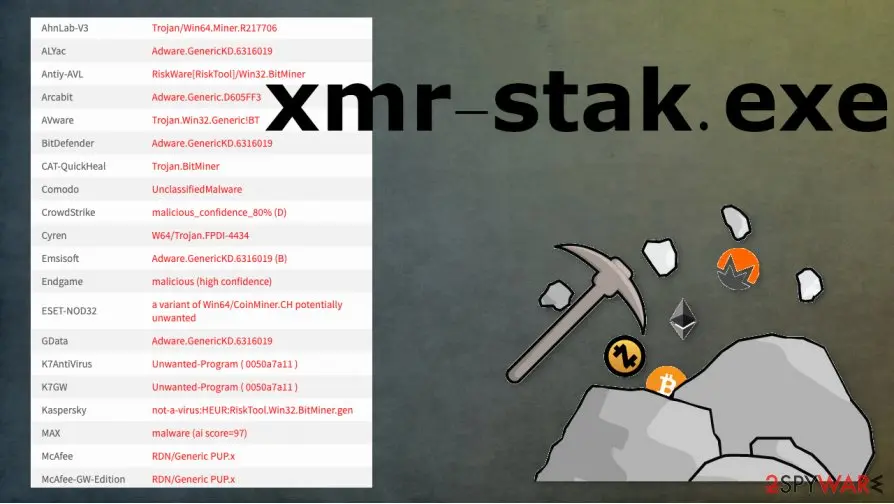
Xmr-stak.exe: summary
| Distribution | This file can be faulty but installed with a particular program that is legitimate and useful. However, the common type of file can be used by malicious actors when the file is spread around with the purpose of infecting machines. This distribution includes malicious links, spam email attachments, and malicious macros[3] |
|---|---|
| Damage | There are many threats that can be installed by this trojan. It may also change crucial settings, affect particular functions and programs like security or antivirus applications |
| Name | xmr-stak.exe |
| Type | Trojan/ Cryptocurrency miner |
| Issues created | The particular threat is triggering processes and programs that run in the background and trigger problems with the speed and performance of an infected machine. It can hide in the background without any symptoms for a while |
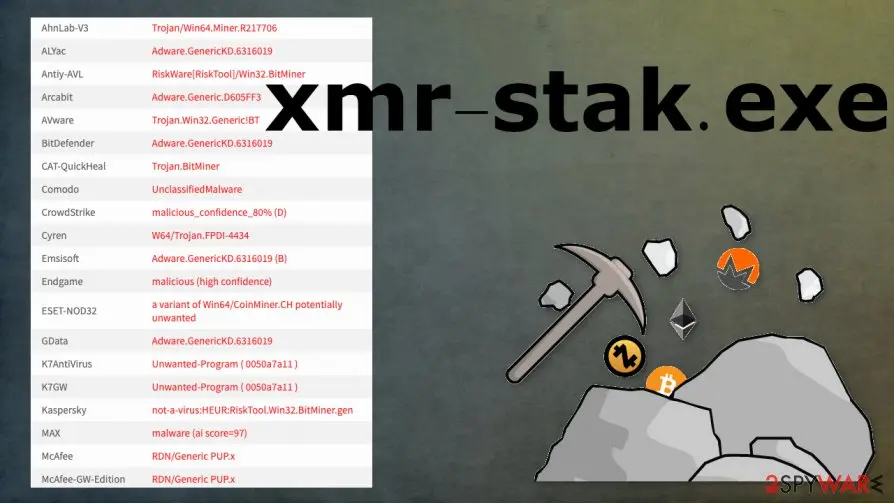
| Detection names | No Microsoft detection name is known |
| Removal | Scan the PC with security software to find and remove the malware and anything installed with it. Fortect scans Windows for malware and repairs the system files and settings it damaged. Remove it nowTo use the full-featured product, you have to purchase a license for Fortect. The scan is free. |
Show 5 more facts
| Symptoms | An unknown process using the processor or graphics card |
|---|---|
| Evidence | 4 write-ups by security sites; details still limited |
| Files | xmr-stak.exe |
| First seen | 16 September 2020 |
| Facts checked | 6 October 2026 |
What xmr-stak.exe does
From our report of Sep 2020 · not reviewed since
xmr-stak.exe is the trojan responsible for extracting Monero and other cryptocurrency running on the CPU of your PC
xmr-stak.exe is the threat that creates issues with the system because it causes changes and damages some crucial parts of the computer.
This is the file related to the Nicehash and other similar programs used for the users' profit. However, it is a known and commonly reported issue regarding malicious purposes and suspicious activities related to the particular executable file. The Task Manager is a place where people notice the background process that triggers high usage of CPU and other resources of the device.
It even gets relaunched and is persistent, so even when people try to remove it they get to experience the same intrusive activities again and again. There might be an issue with some settings or preferences, processes that creates annoying loops.
Unfortunately, the xmr-stak.exe virus still can be the serious Trojan designed to run on those resources and generate cryptocurrency for the malicious actor, not the user. The file itself can be located in the folder belonging to the Hasher or different cryptography program. But there are many reports from users and even researchers that the source code, particular files, and other contents related to this executable have malware.
xmr-stak.exe can affect the machine significantly and cause damage to your device, software, or affect the state of security. You can sometimes notice particular issues and symptoms that indicate the infection, so pay attention to details like:
There are no particular symptoms that could indicate the xmr-stak.exe virus infection, but you need to be cautious of the possibilities to get such malware installed and be suspicious about all the programs and files that occur out of nowhere. A long time on the machine can open many doors for the threat, so the longer it manages to run on the computer, the more issues it can create.
This is why many experts, malware researchers advise removing the threat as soon as it is possible. You may have a difficult time while trying to remove xmr-stak.exe because of the changes already made in the functioning of the machine. This is why you can run the machine in Safe Mode with Networking first. Then launch the AV tool.
When there are many functions that can be possibly designed to run via an xmr-stak.exe trojan, you as a victim of such a virus should react as soon as possible. The best way to remove the threat that infiltrates devices behind the user's back - anti-malware tools. or can work perfectly for the particular diagnosis too.
This is the particular type of program that can determine if your device is affected by a trojan, and do you really need options for the xmr-stak.exe removal.
However, scans using anti-malware or a security tool can help clear other intruders that trigger issues with your machine, so do not hesitate. Also, remain aware of the possible damage and affected system functions or files and run for the general virus damage check.
- high usage of CPU;
- extreme issues with graphic cards in use;
- programs or OS running slower;
- programs running without your knowledge or particular notice;
- the poor performance of the machine generally.

From our report of Sep 2020 · not reviewed since
Malicious files can land on the machine without your notice
It is possible to get such specific malware when you visit compromised sites and do not pay attention to particular issues like file attachments on the emails.
The virus itself and all the symptoms may vanish when the particular goal is achieved. So nor the infiltration nor the infection itself is noticed or avoided.
The best way to keep the machine free of infections is to pay attention to details that can trigger problems with important parts and functions. You need to have the AV tool or security program running more often, so the software can indicate issues and possible intruders for you.
From our report of Sep 2020 · not reviewed since
More from our earlier report on xmr-stak.exe
- You should remove xmr-stak.exe using anti-malware tools or other security programs that can determine the purpose of this file and delete the malicious program if that is needed
Check your PC for xmr-stak.exe
- File:
xmr-stak.exe
How to remove xmr-stak.exe
Miners hide when Task Manager opens and add Defender exclusions.
The steps deal with both, then remove the files.
Step 1: Check where xmr-stak.exe runs from and stop it
xmr-stak.exeis the part you can see, and its location tells you whether it belongs there. Right-click it on the Processes page of Task Manager and choose Open file location, then right-click the file > Properties > Digital Signatures to see who signed it.An unsigned file, or one in a user folder such as
%AppData%, is the one to remove: end the task, then delete the file.Note the folder name, because the same folder usually holds its other files. This is the same in Windows 11 and Windows 10.
Full procedure with screenshots: Close a frozen app (Task Manager, Force Quit) On uGetFix
Step 2: Delete scheduled tasks that bring it back
Open Task Scheduler from the Start menu and click Task Scheduler Library. Select each task you do not recognise and read the Actions tab:
- a task that starts a file in
%AppData%or%Temp% - runs
powershellwith a long encoded line - opens a web address belongs to xmr-stak.exe or a similar program
Right-click such a task and choose Delete, and check the subfolders too. Leave tasks from Microsoft, your PC's maker and programs you use. Task Scheduler is the same in Windows 11 and Windows 10.

Windows 11: Task Scheduler Library, the task selected, the Actions tab shows the file it runs. Full procedure with screenshots: Remove what malware leaves behind in Windows
- a task that starts a file in
Step 3: Remove it from startup
Whatever xmr-stak.exe installed usually starts with Windows. Open Task Manager with Ctrl + Shift + Esc, go to Startup apps in Windows 11 or the Startup tab in Windows 10, and disable what you do not know, starting with entries that have an empty Publisher column.
Open file location on the right-click menu shows the file, which helps you decide and tells you what to delete later. Disabling is safe: if something you need stops working, switch it back on.
Full procedure with screenshots: Stop apps from opening at startup On uGetFix
Step 4: Turn Microsoft Defender back on and remove its exclusions
Xmr-stak.exe turns protection off or adds exclusions so that Defender ignores it. In Windows Security > Virus & threat protection, open Manage settings and switch Real-time protection, Cloud-delivered protection and Tamper Protection back on.
Then open Add or remove exclusions at the bottom of that page and remove whatever you did not add yourself, for example a folder in
%AppData%or an entire drive. These pages look the same in Windows 11 and Windows 10.Full procedure with screenshots: Turn off Microsoft Defender protection for a moment On uGetFix
Step 5: Delete the folders left behind
What the uninstaller leaves behind is usually in the user folders. Open File Explorer, switch on View > Show > Hidden items (in Windows 10 View > Hidden items), and go through
%LocalAppData%,%AppData%, %ProgramData% and the two Program Files folders.Sort by Date modified and delete folders that appeared together with the problem and belong to no program you use. Folders with random names that hold
.exe,.dll, .js or .ps1 files are the strongest sign.Full procedure with screenshots: Remove what malware leaves behind in Windows
Step 6: Scan the PC, then run the offline scan
Open Windows Security > Virus & threat protection > Scan options, run a Full scan and remove everything it finds. Then select Microsoft Defender Antivirus (offline scan) and click Scan now: the PC restarts and scans before Windows loads, which finds files that hide while Windows runs.
Save your work first, because the offline scan takes about 15 minutes. Both scans are built into Windows 11 and Windows 10, and a second scanner from another vendor is a useful extra opinion.

Windows 11: Windows Security > Virus & threat protection > Scan options. Full procedure with screenshots: Run a Microsoft Defender Offline scan
Instructions for each browser and system
The detailed steps for every browser and system this guide covers. Open the one you use.
Manual removal using Safe Mode
Important! →
Manual removal guide might be too complicated for regular computer users. It requires advanced IT knowledge to be performed correctly (if vital system files are removed or damaged, it might result in full Windows compromise), and it also might take hours to complete. Therefore, we highly advise using the automatic method provided above instead.
Step 1. Access Safe Mode with Networking
Manual malware removal should be best performed in the Safe Mode environment.
Windows 7 / Vista / XP
- Click Start > Shutdown > Restart > OK.
- When your computer becomes active, start pressing F8 button (if that does not work, try F2, F12, Del, etc. - it all depends on your motherboard model) multiple times until you see the Advanced Boot Options window.
- Select Safe Mode with Networking from the list.

Windows 10 / Windows 8
- Right-click on Start button and select Settings.

- Scroll down to pick Update & Security.

- On the left side of the window, pick Recovery.
- Now scroll down to find Advanced Startup section.
- Click Restart now.

- Select Troubleshoot.

- Go to Advanced options.

- Select Startup Settings.

- Press Restart.
- Now press 5 or click 5) Enable Safe Mode with Networking.

Step 2. Shut down suspicious processes
Windows Task Manager is a useful tool that shows all the processes running in the background. If malware is running a process, you need to shut it down:
- Press Ctrl + Shift + Esc on your keyboard to open Windows Task Manager.
- Click on More details.

- Scroll down to Background processes section, and look for anything suspicious.
- Right-click and select Open file location.

- Go back to the process, right-click and pick End Task.

- Delete the contents of the malicious folder.
Step 3. Check program Startup
- Press Ctrl + Shift + Esc on your keyboard to open Windows Task Manager.
- Go to Startup tab.
- Right-click on the suspicious program and pick Disable.

Step 4. Delete virus files
Malware-related files can be found in various places within your computer. Here are instructions that could help you find them:
- Type in Disk Cleanup in Windows search and press Enter.

- Select the drive you want to clean (C: is your main drive by default and is likely to be the one that has malicious files in).
- Scroll through the Files to delete list and select the following:
Temporary Internet Files
Downloads
Recycle Bin
Temporary files - Pick Clean up system files.

- You can also look for other malicious files hidden in the following folders (type these entries in Windows Search and press Enter):
%AppData%
%LocalAppData%
%ProgramData%
%WinDir%
After you are finished, reboot the PC in normal mode.
Stream videos without limitations, no matter where you are
There are multiple parties that could find out almost anything about you by checking your online activity.
While this is highly unlikely, advertisers and tech companies are constantly tracking you online. The first step to privacy should be a secure browser that focuses on tracker reduction to a minimum.
Even if you employ a secure browser, you will not be able to access websites that are restricted due to local government laws or other reasons. In other words, you may not be able to stream Disney+ or US-based Netflix in some countries. To bypass these restrictions, you can employ a powerful VPN, which provides dedicated servers for torrenting and streaming, not slowing you down in the process.
Data backups are important - recover your lost files
Ransomware is one of the biggest threats to personal data.
Once it is executed on a machine, it launches a sophisticated encryption algorithm that locks all your files, although it does not destroy them. The most common misconception is that anti-malware software can return files to their previous states. This is not true, however, and data remains locked after the malicious payload is deleted.
While regular data backups are the only secure method to recover your files after a ransomware attack, tools such as can also be effective and restore at least some of your lost data.
From our report of Sep 2020 · not reviewed since
Make sure to determine the state of the security and get rid of the xmr-stak.exe virus if needed
It most cases, when this file and other associated data got reported as dangerous or potentially malicious, people questioned if the file itself os the one related to malware.
To determine if you need to remove xmr-stak.exe or not - run the anti-malware program like or and pay attention to the detection results.
When the application finds this file, or other programs malicious and dangerous, you can run the same program and allow it to clear all the intruders or dangerous applications. After the full xmr-stak.exe removal, you should also go through settings and system function alterations. can do that for you automatically.
[GI=method-1]Try to reboot the machine in Safe Mode with Networking, so you can run the AV tool and properly check the system for malware
[GI=method-2]System Restore feature can also help with such issues as cyber infections. So you can remove xmr-stak.exe by recovering the PC in a previous state
Questions about xmr-stak.exe
Can xmr-stak.exe damage my computer?
A miner does not usually destroy files, but running the processor or graphics card at full load for weeks raises temperatures, wears out fans and shortens laptop batteries. It also makes the PC slower and raises the electricity bill.
The bigger risk is what came with it: miners are often installed by loaders or bundled with cracks that also drop password stealers. That is why removing xmr-stak.exe should be followed by a full offline scan, and, if the PC shows other signs, by changing the passwords saved in your browsers.
How do I make sure xmr-stak.exe is really gone?
Restart the PC, leave it idle for half an hour without opening Task Manager, then check whether the fan is quiet and the processor load is low. Open Task Manager afterwards and look for xmr-stak.exe or a new name with the same behaviour.
Check Task Scheduler and the Startup list again for entries pointing to the old folder. Finally, open Windows Security and confirm that real-time protection is on and that no exclusions were added. A clean offline scan together with a quiet idle PC is a good sign the miner is gone.
Can I just delete xmr-stak.exe?
You can, but it is rarely enough. xmr-stak.exe is the visible part of xmr-stak.exe; a scheduled task, a service or a startup entry usually starts it again, and some versions restore the file within minutes. Deleting it while it runs may also fail.
Run the Microsoft Defender offline scan instead, which removes the file and its startup entries before Windows loads. Then check Task Scheduler and Startup apps for anything still pointing to the old location. Restart afterwards and confirm the file does not return.
Did xmr-stak.exe steal my passwords?
There is no evidence either way yet, because xmr-stak.exe has not been analysed in public. The reported sign, xmr-stak.exe using the processor or graphics card at full load, does not show theft by itself. However, malware of this kind is often installed together with a password stealer, which works in seconds and leaves nothing to see.
The cautious approach costs little: once the PC is clean, change the passwords saved in your browsers from another device, starting with e-mail, then banking and payment accounts. Sign out of all sessions and turn on two-step verification. If a bank card was saved in the browser, ask the bank about a replacement.
How much electricity does a miner use?
It depends on the hardware and how hard the miner runs, so there is no single figure. A miner that keeps a desktop processor or graphics card busy around the clock can noticeably raise a household power bill over a month, and laptops lose battery life fast.
Some miners limit themselves to part of the available power to stay unnoticed, which lowers the cost but also hides the problem longer. Removing it is the only fix. Afterwards, idle use should fall back to a few percent.
Should I scan my other computers too?
It is a good idea, even for malware that does not spread by itself. The same download, USB stick or loader may have been used on other PCs in the household, and shared folders can carry files between them.
Run a full scan followed by the Microsoft Defender offline scan on each Windows PC that shared drives or files with the infected one. Do not copy programs or installers from the infected PC until it is clean, and change Wi-Fi and router passwords if they were saved on it.
How did xmr-stak.exe get on my computer?
The route for xmr-stak.exe is not documented yet. Malware that shows xmr-stak.exe using the processor or graphics card at full load usually arrives with something you ran yourself:
- a cracked program or game cheat
- a free tool from a mirror site
- a fake installer found through a search ad
- a file on a USB drive
Some infections are dropped later by a loader that was already on the PC. To find your source, sort Installed apps by install date and look at the Downloads folder for the days before the sign appeared. Remove that item as well; otherwise the same infection may come back after the clean-up.
Should I reset my PC because of xmr-stak.exe?
Only if the signs point to deeper access. Reset when you see xmr-stak.exe using the processor or graphics card at full load again after removal, when Windows Security cannot start or update, when remote access tools you did not install keep appearing, or when you simply cannot trust the PC any more.
Otherwise, the plan in this guide plus an offline scan is enough. If you do reset, choose Remove everything and Cloud download for a fresh copy of Windows, restore only documents and photos, and reinstall programs from their official sites. Change important passwords from the clean system afterwards.
The PC is still slow after removing xmr-stak.exe. What now?
Restart the PC first; some changes only take effect after a reboot. Then open Task Manager and check the Processes and Startup apps tabs for anything unfamiliar using the processor, disk or network. If something remains, run the Microsoft Defender offline scan once more.
Slowness can also come from a second infection installed alongside xmr-stak.exe, or from programs that were damaged during the clean-up. If nothing helps, back up your files and reset Windows. Copy only documents and photos before a reset, and scan the copies.
Will Fortect remove xmr-stak.exe?
Fortect scans Windows for malware and unwanted programs and repairs the system files and settings they change, and its free scan shows what it finds on your PC before you decide anything.
For xmr-stak.exe, follow the plan above as well: the browser steps take back permissions and settings that no scanner treats as a threat, and uninstalling the program that brought it removes the source.
Run Microsoft Defender's full scan and, if anything was found, its offline scan as a second opinion. If the symptoms are gone after the plan and both scans are clean, there is nothing more to do.
Sources
- Reddit: can't stop xmr-stak.exe (read October 6, 2026)
- Wikipedia: Cryptography (read October 6, 2026)
- Searchsecurity: Macro virus (read October 6, 2026)
- FTC: How to recognize, remove and avoid malware (read October 6, 2026)
- Microsoft Learn: Microsoft Defender Offline (read October 6, 2026)