
Apple.com-Mac-optimizing.live e-mail scam: how to spot it and what to do
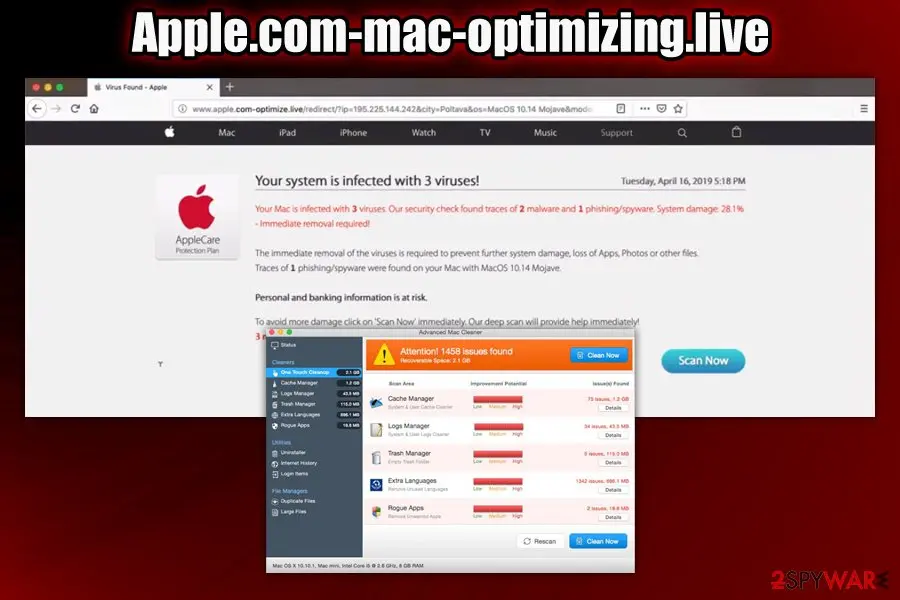
Apple. com-Mac-optimizing. live is a security threat that is mostly encountered by macOS users on Safari, Google Chrome, Mozilla Firefox, or other installed browsers. Once users land on a malicious site, they can see made-up indications of malware infections of such fake threats as Tapsnake CronDNS, Dubfishicv, or e. tre456_worm_osx.
Facts checked October 7, 2026. Removal steps checked against Apple's current documentation and the security vendors' reports. We have not run the malware on a Mac. Sections marked as our earlier report are the original text: they describe the threat as it was then and have not been reviewed since. The 2026 status, the removal steps and the questions are current.
Automatic
Get a free scan and check if your Mac is infected.
Fortect for Mac scans for malware and unwanted programs, and its free scan shows what it finds before you decide anything.
Do it yourself · free Remove Apple.com-mac-optimizing.live e-mail scam yourself 5 steps, about 15 minutes, no software needed.
Start the steps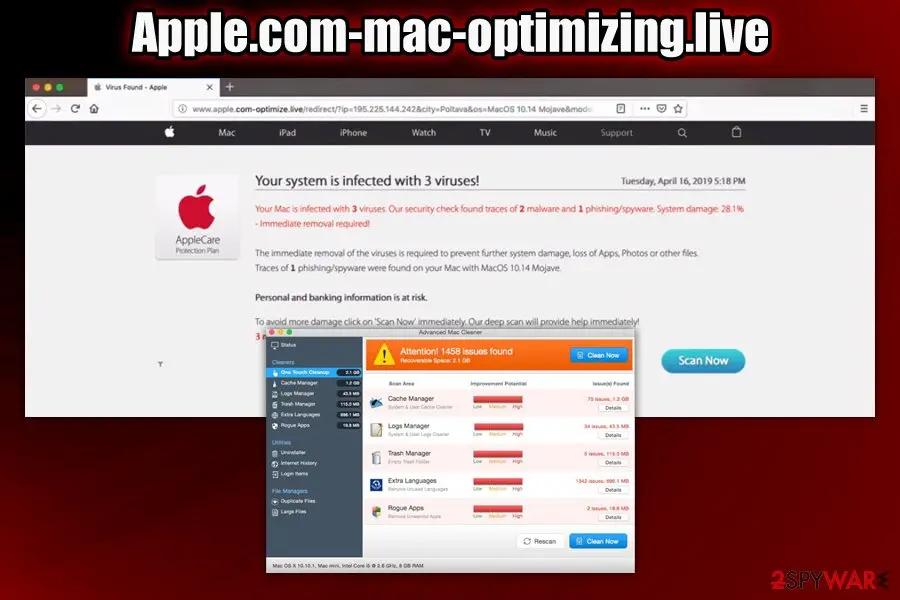
Apple.com-mac-optimizing.live e-mail scam: summary
| Name | Apple.com-mac-optimizing.live |
|---|---|
| Category | Malicious website which is mostly encountered due to adware infection |
| Type | Scam, hoax, phishing |
| Operating system | The scam is aimed at macOS or Mac OS X users |
| Related | The malicious website promotes a now-notorious scam Your system is infected with 3 viruses which claim fake malware infections like Tapsnake CronDNS, Dubfishicv or e.tre456_worm_osx |
| Symptoms | Intrusive pop-ups, deals, offers, coupons, and other commercial content present on each visited website; changed web browser settings; redirects to scam and phishing sites; slow operation of the browser, etc. |
| Removal | Scan the Mac with security software to find the malware and anything installed with it. Fortect for Mac scans for malware and unwanted programs. Remove it nowTo use the full-featured product, you have to purchase a license for Fortect. The scan is free. |
Show 10 more facts
| Promoted tools | Apple.com-mac-optimizing.live might be offering different software for each user. However, most of the times users are suggested to download Advanced Mac Cleaner or Cleanup My Mac to remove the alleged viruses |
|---|---|
| Infiltration | Adware, which is the most likely culprit of users landing on malicious pages, is usually distributed with the help of software bundles downloaded from third-party sites. In other cases, users might download PUPs when tricked by a scam site or a fake update |
| Termination | To stop redirects to scam sites and unwanted pop-up ads, you will have to terminate adware form your computer – rely on security application or check our manual removal guidelines below |
| Evidence | 4 write-ups by security sites; details still limited |
| Arrives as | |
| Pretends to be | UPS |
| Claim | Your account needs urgent attention |
| Asks for | Your password |
| First seen | 5 November 2019 |
| Facts checked | 7 October 2026 |
How to tell the Apple.com-mac-optimizing.live e-mail scam e-mail is fake
From our report of Nov 2019 · not reviewed since
- Optimization software can be extremely valuable for users who are less experienced.
Is Apple.com-mac-optimizing.live e-mail scam dangerous? What the senders want
From our report of Nov 2019 · not reviewed since
Apple.com-mac-optimizing.live is a scam that claims fake virus infections and promotes shady tools for Mac
Apple.com-mac-optimizing.live is a security threat that is mostly encountered by macOS users on Safari, Google Chrome, Mozilla Firefox, or other installed browsers.
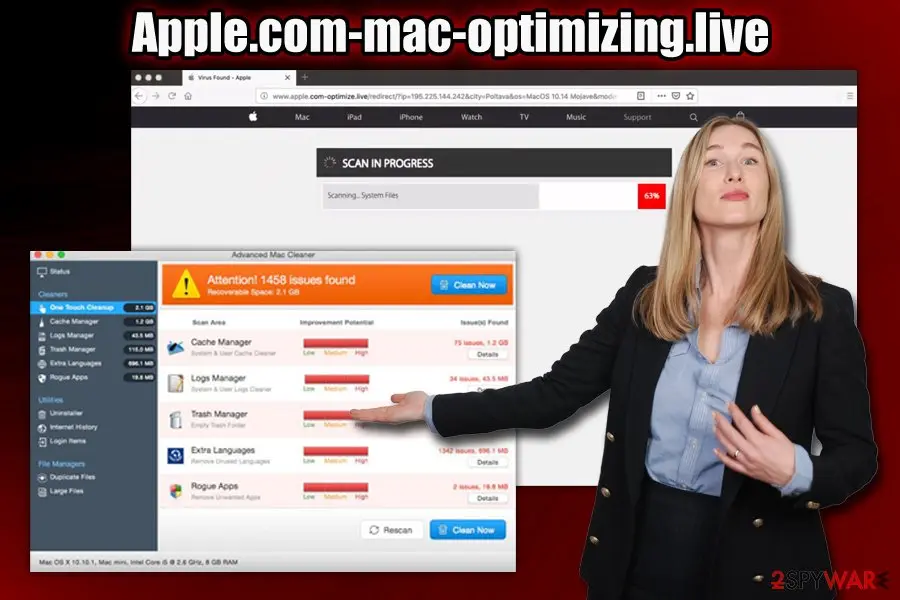
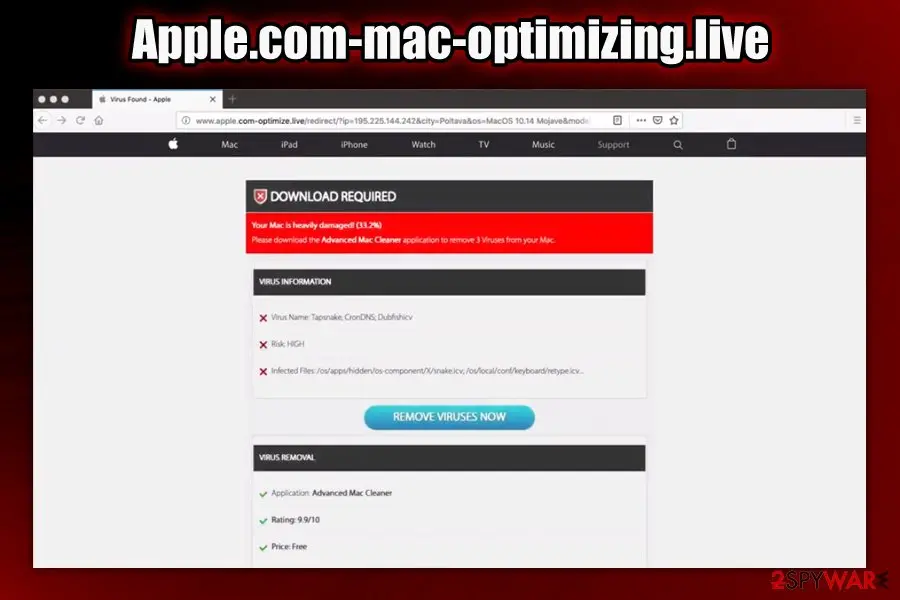
Once users land on a malicious site, they can see made-up indications of malware infections of such fake threats as Tapsnake CronDNS, Dubfishicv, or e.tre456_worm_osx. According to the message, users need to scan their system and download promoted software, which is usually scareware tools like Cleanup My Mac or Advanced Mac Cleaner.
However, do not believe anything that is stated on Apple.com-mac-optimizing.live, as the site only seeks to gain revenue from you installing the recommended tools.
The scheme operated by Apple.com-mac-optimizing.live is very simple: it tries to intimidate users with fake claims and make them install unwanted software (which can actually damage their computers in the first place).
Do not believe any statements rendered on the site, as you might lose money, install potentially unwanted applications, or get tricked into providing sensitive information like credit card details. In other words, Apple.com-mac-optimizing.live is a scam, so do not trust it.
There are two different reasons why users might encounter Apple.com-mac-optimizing.live virus scam: they either visited the site after a malicious redirect or there is adware app installed on their machines. because both scenarios are possible, the affected users should immediately investigate, as Apple.com-mac-optimizing.live removal is mandatory if adware is involved.
Adware is ad-supported software that is usually installed by users unintentionally. In most of the cases, users install PUPs during the installation of freeware from third-party websites. Alternatively, they get tricked by similar online scams like the one promoted by Apple.com-mac-optimizing.live pop-ups. Thus, less experienced users suffer from these type of hoaxes the most, as they are mislead into installing software that is considered to be scareawre by security experts.
Similarly, to scams, scareware's aim is to make users believe that their systems are in huge troubles due to malware infections or similar bogus reasons. They are then offered to fix issues by buy a full licence for Advanced Mac Cleaner, Cleanup My Mac, etc. While these tools are not malware, you should think twice before using them, as they are promoted via such shady methods like Apple.com-mac-optimizing.live scam site.
However, system optimization tools for Macs can be useful, as some (especially older systems) can be riddled with excessive amount of junk files which slow down the the computer tremendously. If you want to make sure your system is in the best shape, use and never trust apps promoted via Apple.com-mac-optimizing.live.
Not installing software from Apple.com-mac-optimizing.live is not enough if your system is already infected with adware, however, as your browsers will keep directing you to phishing, scam, tech support scam, and similar hoax sites. Thus, you need to locate the potentially unwanted program and delete it from your Mac. Only this way you will remove Apple.com-mac-optimizing.live redirects and other unwanted behavior.
How to get rid of Apple.com-mac-optimizing.live on a Mac
Close the page safely and stop it coming back.
If you called, paid or let someone in, the last steps matter most.
Step 1: Close the page without touching its buttons
Do not click anything on the Apple.com-mac-optimizing.live page, not even its Close or OK button. Press Command + Q to quit the browser.
If the page blocks that, press Command + Option + Esc, select the browser and click Force Quit. When you open Safari again, hold Shift while it starts so the old windows are not restored.
Step 2: Remove the site's permission to send notifications
In Safari open Settings > Websites > Notifications and remove any site you do not know, or set it to Deny. In Chrome open
chrome://settings/content/notifications, in Firefox Settings > Privacy & Security > Notifications > Settings. Then check System Settings > Notifications for browser alerts you did not expect.Step 3: Check the browsers for extensions and changed settings
In Safari open Settings > Extensions and General (homepage). In Chrome open
chrome://extensions, in Firefoxabout:addons.Remove any extension you did not add, and reset the homepage and search engine if they changed. Browsers hold saved passwords and cookies, which is why the password step comes first.
Step 4: If you called, paid or gave access
If you called the number on the page, let someone connect to the Mac, or paid, act now. Remove any remote access app they asked you to install from the Applications folder, then change your e-mail and bank passwords from another device.
Call your bank or card issuer, tell them it was a scam and ask to block or dispute the payment. Apple does not show alerts with phone numbers in a browser and does not ask for payment to fix a Mac.
Full procedure with screenshots: Turn on two-step verification / secure a hacked account
Step 5: Report it and watch your accounts
Report the site and the command to the authorities in your country, and tell your bank if any card was saved in a browser or in Keychain.
Over the next weeks watch your e-mail, bank and exchange accounts for sign-ins and transfers you did not make. Keep the notes you made, such as the process names and the file dates, in case a bank or the police ask for them.
Full procedure with screenshots: Report a cyber attack or scam to the authorities
Instructions for each browser and system
The detailed steps for every browser and system this guide covers. Open the one you use.
Remove from Google Chrome
After you remove Apple.com-mac-optimizing.live adware, reset Google Chrome browser to avoid being redirected to unwanted sites in the future:
Delete malicious extensions from Google Chrome:
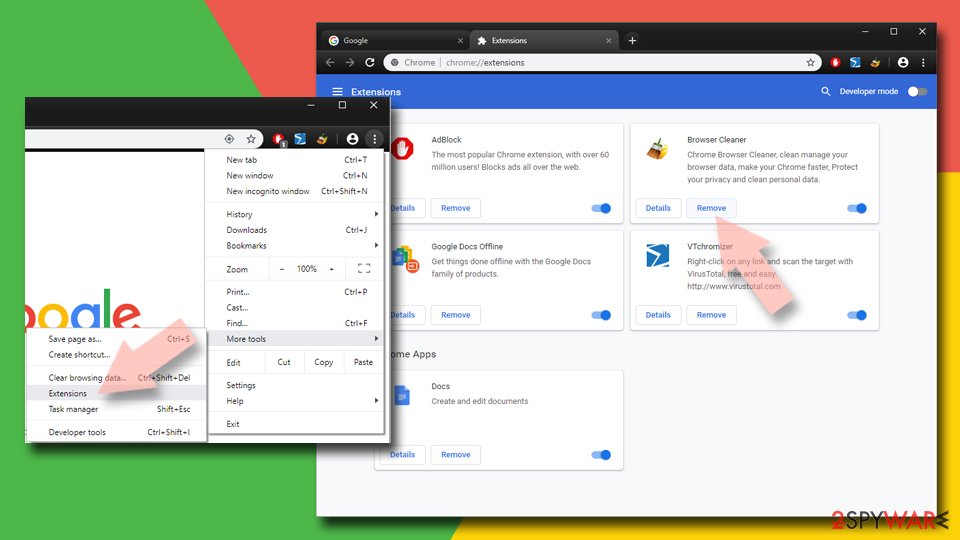
- Open Google Chrome, click on the Menu (three vertical dots at the top-right corner) and select More tools > Extensions.
- In the newly opened window, you will see all the installed extensions. Uninstall all suspicious extensions related to the unwanted program by clicking Remove.
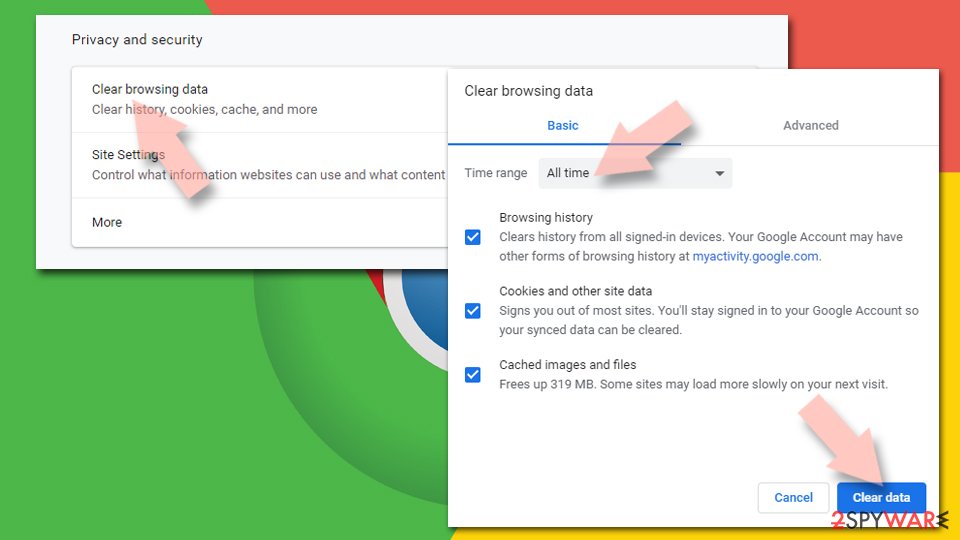
Clear cache and web data from Chrome:
- Click on Menu and pick Settings.
- Under Privacy and security, select Clear browsing data.
- Select Browsing history, Cookies and other site data, as well as Cached images and files.
- Click Clear data.
Change your homepage:
- Click menu and choose Settings.
- Look for a suspicious site in the On startup section.
- Click on Open a specific or set of pages and click on three dots to find the Remove option.
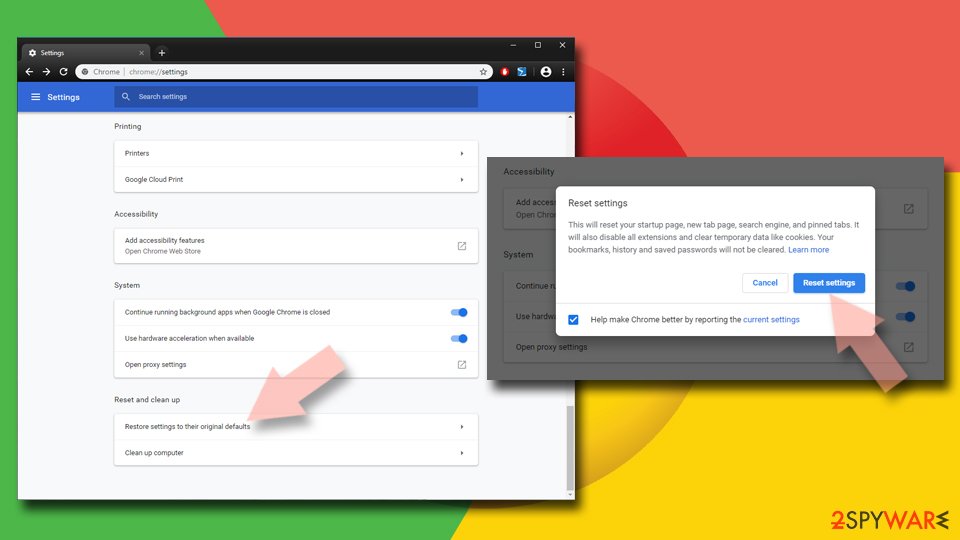
Reset Google Chrome:
If the previous methods did not help you, reset Google Chrome to eliminate all the unwanted components:
- Click on Menu and select Settings.
- In the Settings, scroll down and click Advanced.
- Scroll down and locate Reset and clean up section.
- Now click Restore settings to their original defaults.
- Confirm with Reset settings.
Remove from Microsoft Edge
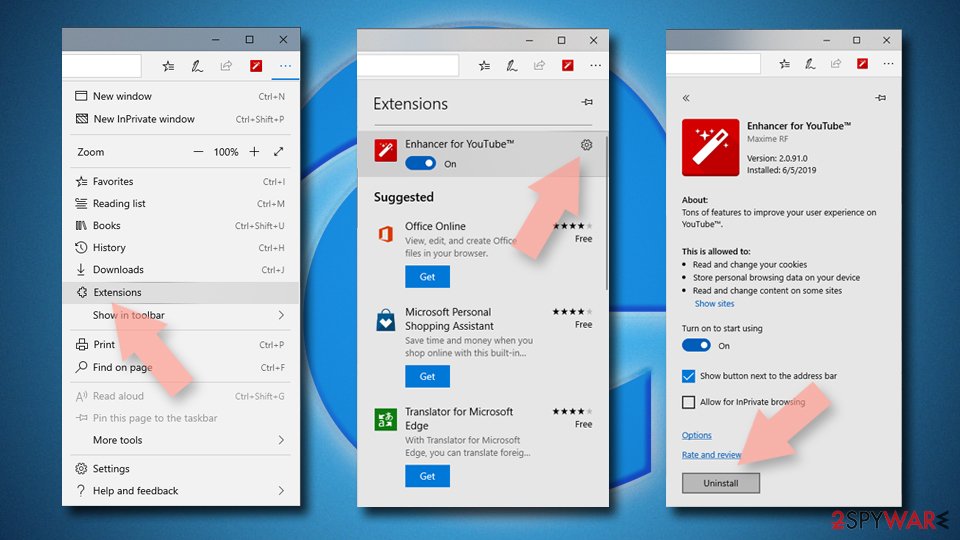
Delete unwanted extensions from MS Edge:
- Select Menu (three horizontal dots at the top-right of the browser window) and pick Extensions.
- From the list, pick the extension and click on the Gear icon.
- Click Remove.
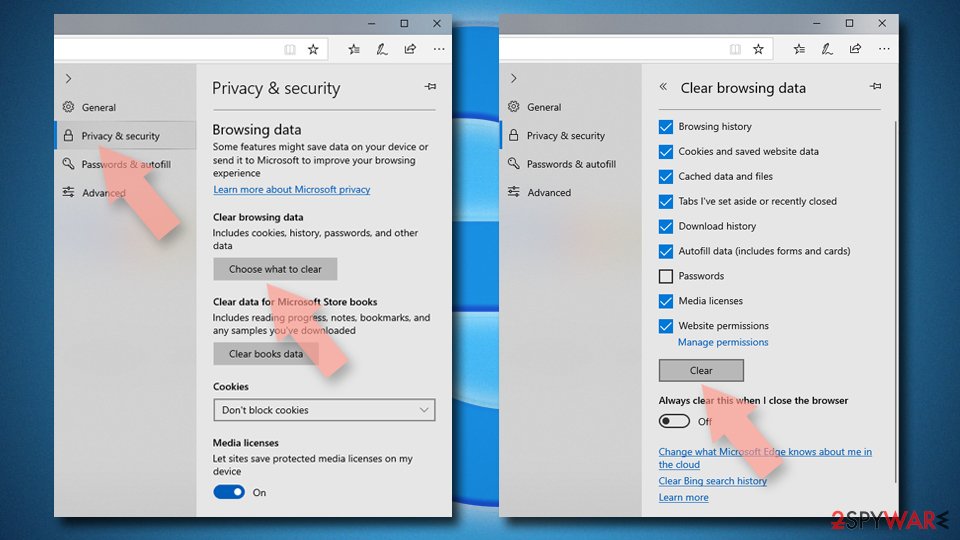
Clear cookies and other browser data:
- Click on the Menu (three horizontal dots at the top-right of the browser window) and select Settings > Privacy, search, and services..
- Under Clear browsing data, pick Choose what to clear.
- Select Cookies and other site data and Cached images and files. (apart from passwords, although you might want to include Media licenses as well, if applicable) and click on Clear.
Restore new tab and homepage settings:
- Click the menu icon and choose Settings.
- Then find On startup section.
- Click Remove next to any suspicious startup page.
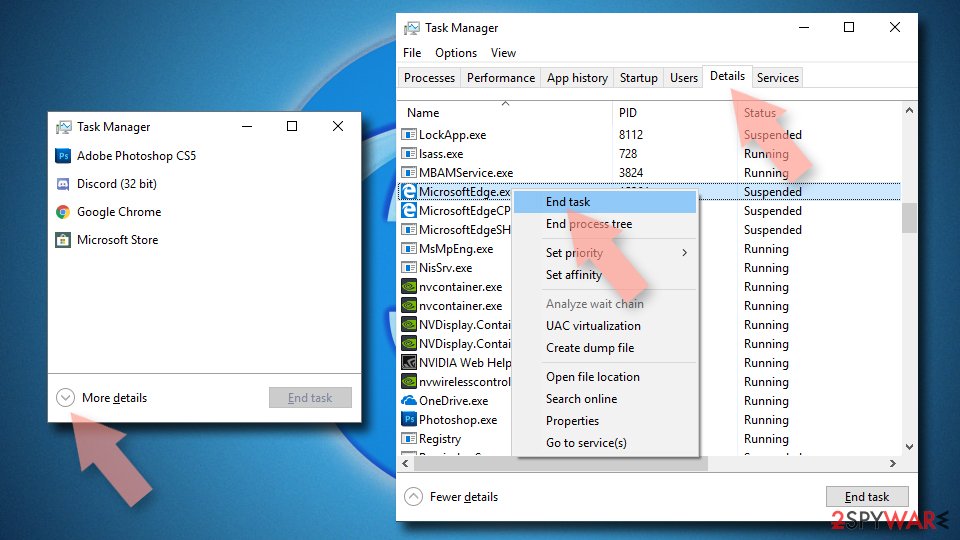
Reset MS Edge if the above steps did not work:
- Press on Ctrl + Shift + Esc to open Task Manager.
- Click on More details arrow at the bottom of the window.
- Select Details tab.
- Now scroll down and locate every entry with Microsoft Edge name in it. Right-click on each of them and select End Task to stop MS Edge from running.
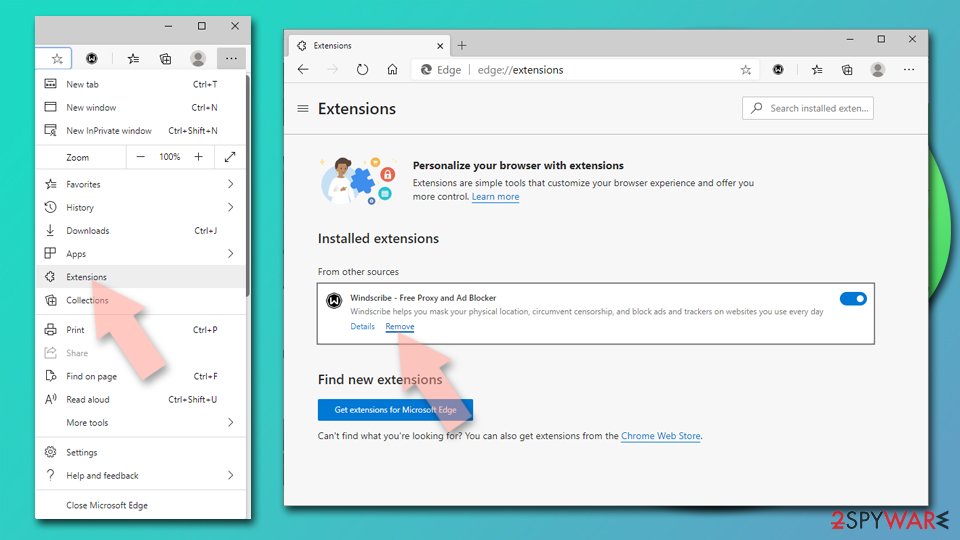
Delete extensions from MS Edge (Chromium):
- Open Edge and click select Settings > Extensions.
- Delete unwanted extensions by clicking Remove.
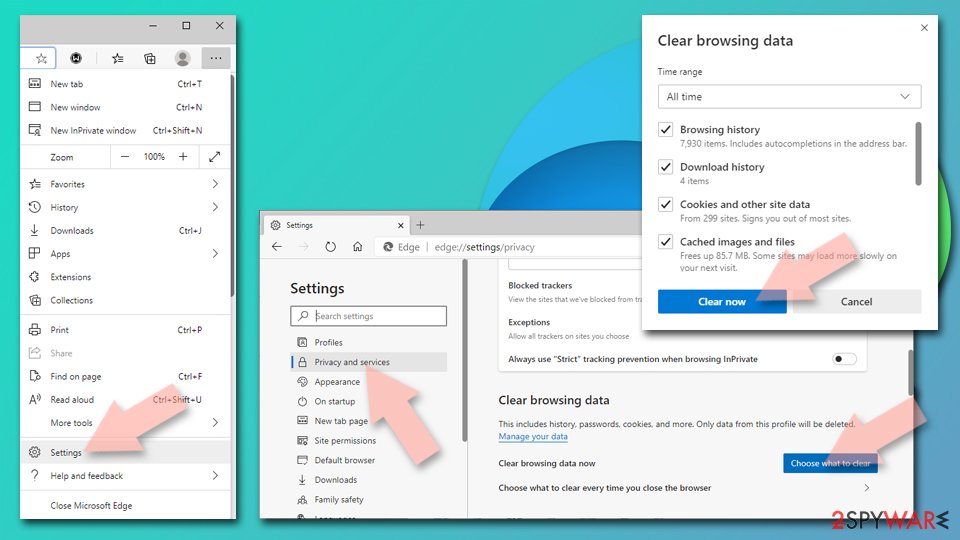
Clear cache and site data:
- Click on Menu and go to Settings.
- Select Privacy, search and services.
- Under Clear browsing data, pick Choose what to clear.
- Under Time range, pick All time.
- Select Clear now.
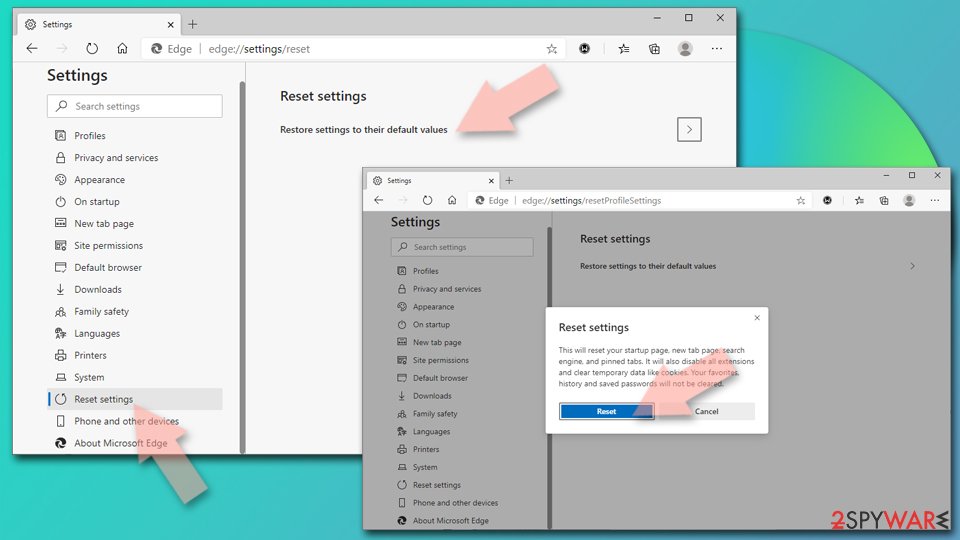
Reset Chromium-based MS Edge:
- Click on Menu and select Settings.
- On the left side, pick Reset settings.
- Select Restore settings to their default values.
- Confirm with Reset.
- This will disable extensions and reset startup pages but will not delete bookmarks, saved passwords, or browsing history.
Remove from Mozilla Firefox (FF)
Remove dangerous extensions:
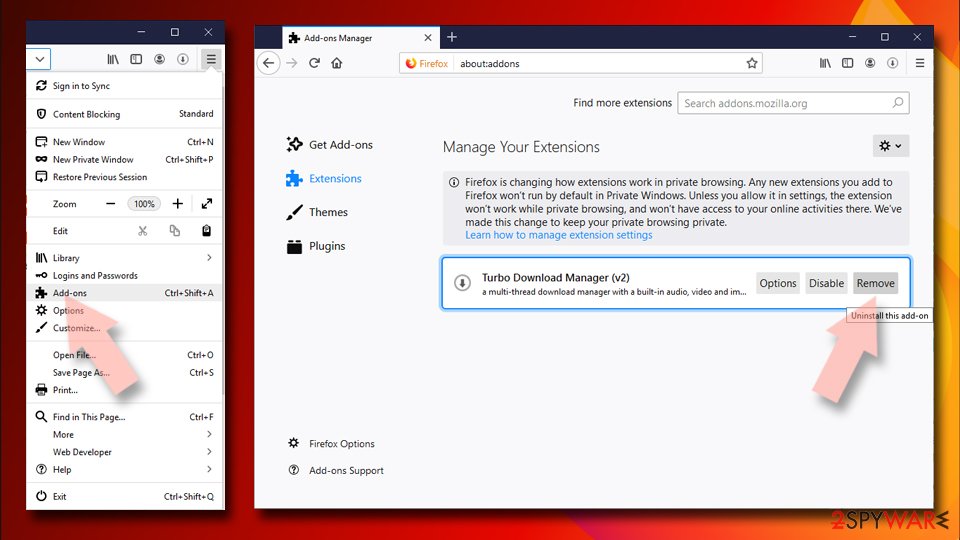
- Open Mozilla Firefox browser and click on the Menu (three horizontal lines at the top-right of the window).
- Select Add-ons.
- In here, select the unwanted extension and click Remove.
Reset the homepage:
- Click three horizontal lines at the top right corner to open the menu.
- Choose Settings.
- Under Home, set your preferred homepage and new tab settings.
Clear cookies and site data:
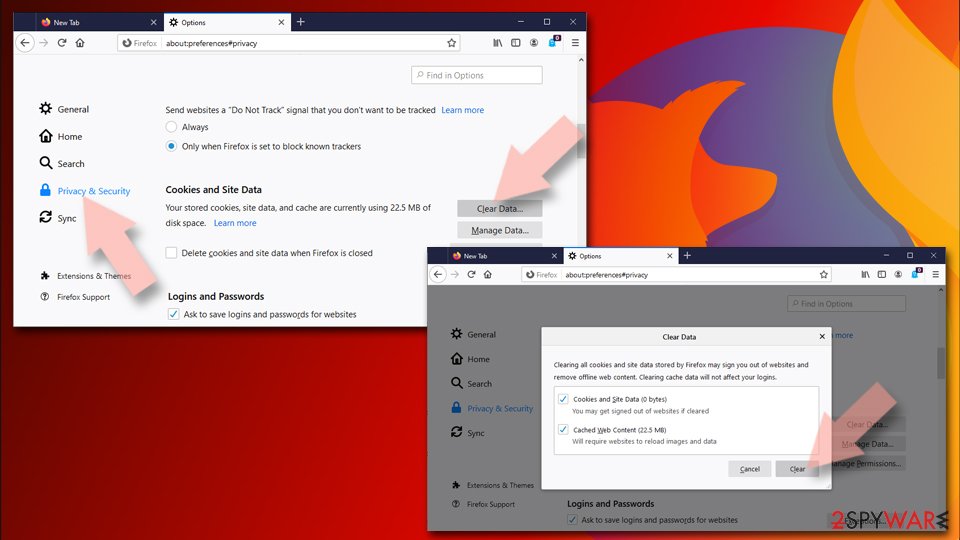
- Click Menu and pick Settings.
- Go to Privacy & Security section.
- Scroll down to locate Cookies and Site Data.
- Click on Clear Data...
- Select Cookies and Site Data and Temporary cached files and pages, then click Clear.
Reset Mozilla Firefox
If clearing the browser as explained above did not help, reset Mozilla Firefox:
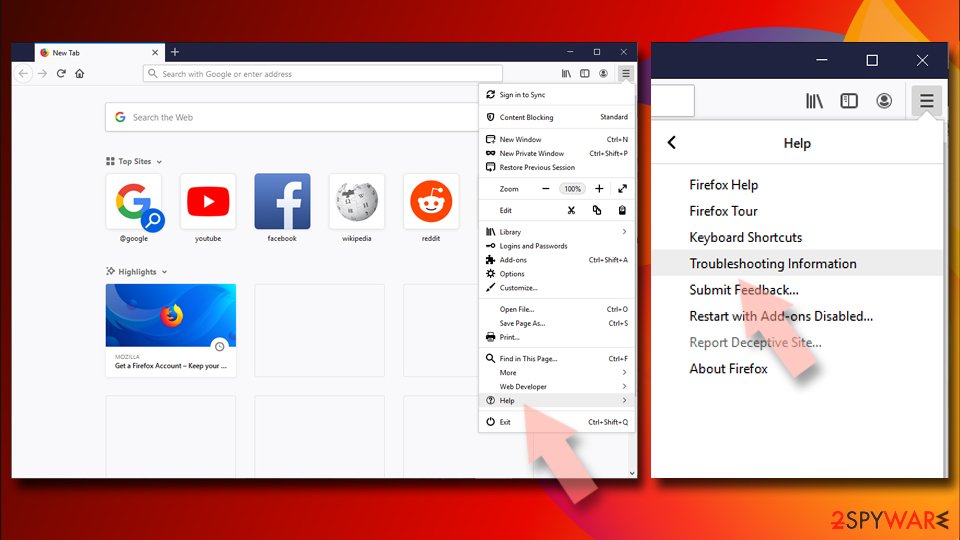
- Open Mozilla Firefox browser and click the Menu.
- Go to Help and then choose Troubleshooting Information.
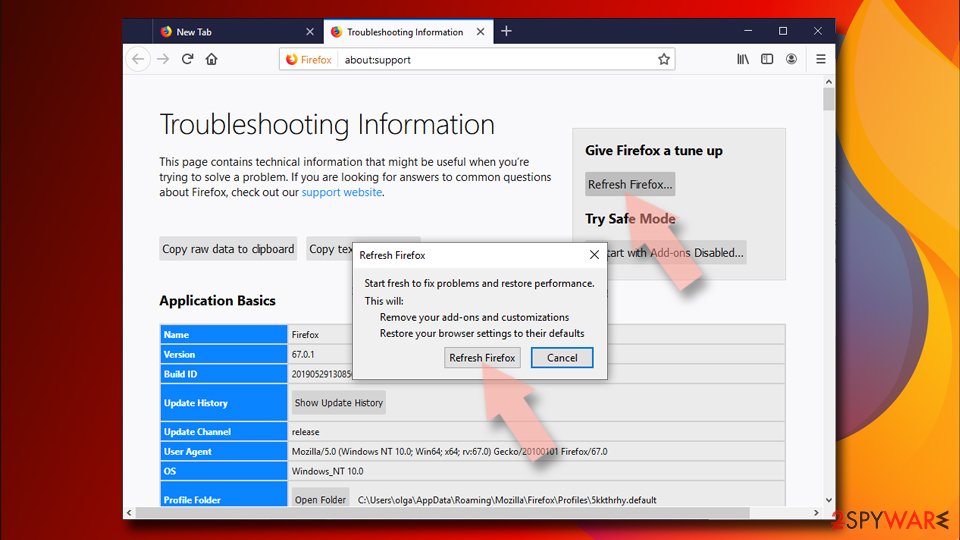
- Under Give Firefox a tune up section, click on Refresh Firefox...
- Once the pop-up shows up, confirm the action by pressing on Refresh Firefox.
Delete from Safari
Remove dangerous extensions:
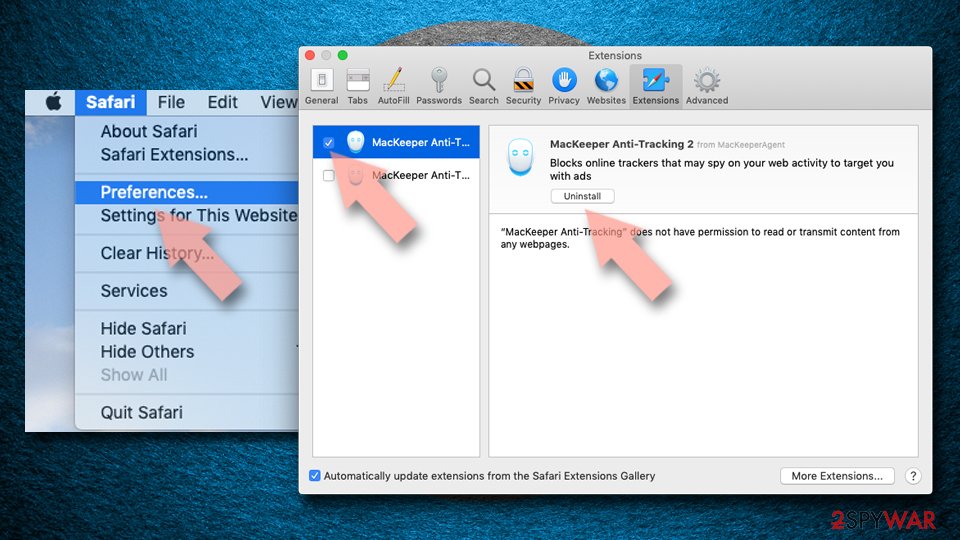
- Open Safari, click Safari in the menu at the top-left of the screen, and select Preferences.
- Go to the Extensions tab, look for any suspicious entries, and click Uninstall to remove them.
Clear history and website data:
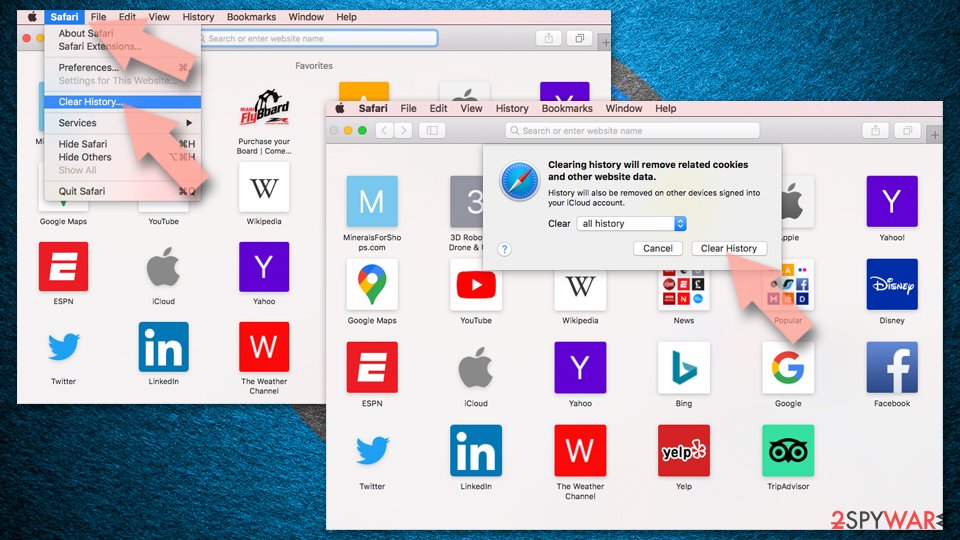
- Click Safari in the menu and pick Clear History.
- Set Clear to all history and confirm with Clear History.
Reset Safari:
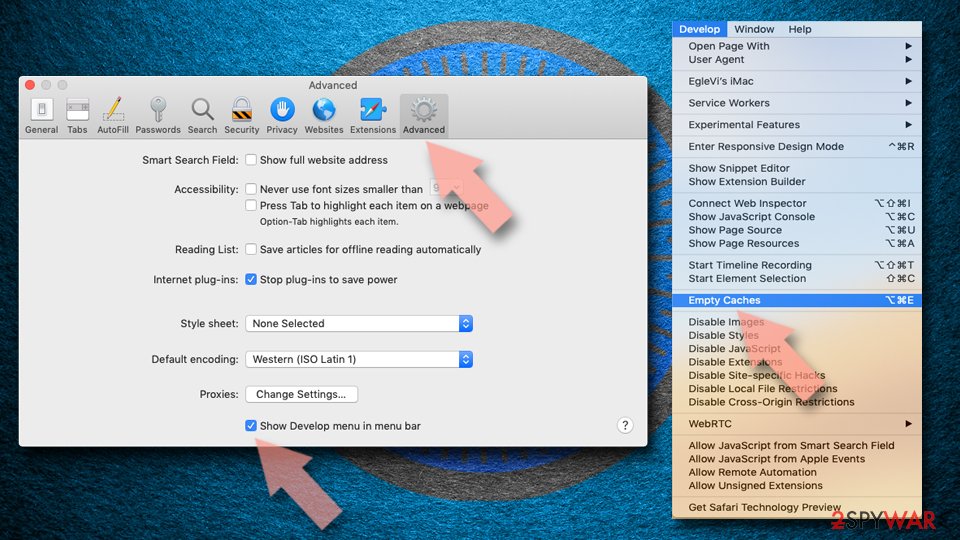
- Click Safari in the menu and select Preferences > Advanced.
- Enable Show Develop menu in menu bar.
- From the menu bar, click Develop and select Empty Caches.
Delete from macOS
To get rid of adware from macOS, proceed with the following steps:
Remove the unwanted application:
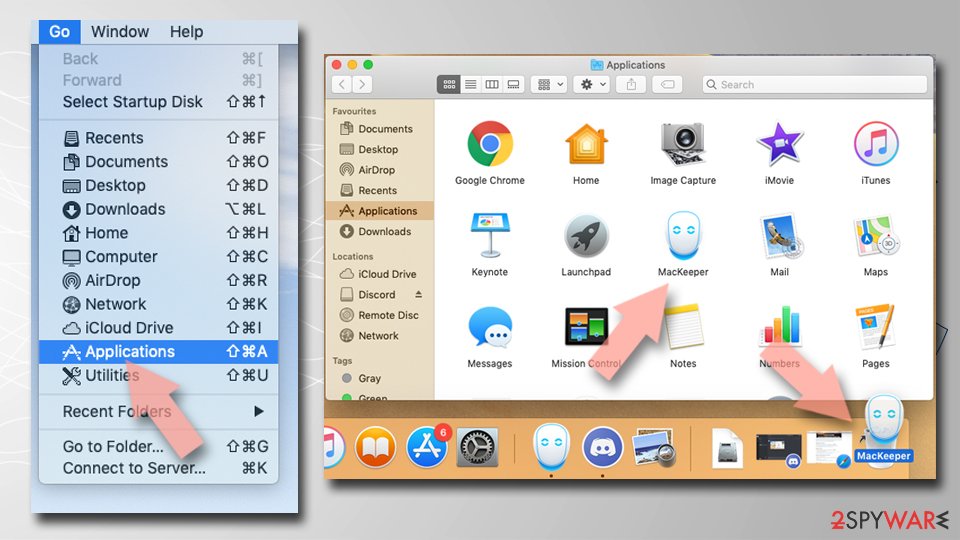
- From the menu bar, select Go > Applications.
- In the Applications folder, look for any suspicious entries, then drag them to Trash (or right-click and pick Move to Trash).
Delete leftover files and folders:
- Select Go > Go to Folder.
- Enter /Library/Application Support and remove any suspicious folders related to the unwanted program.
- Repeat the same check in the /Library/LaunchAgents and /Library/LaunchDaemons folders, deleting any suspicious entries.
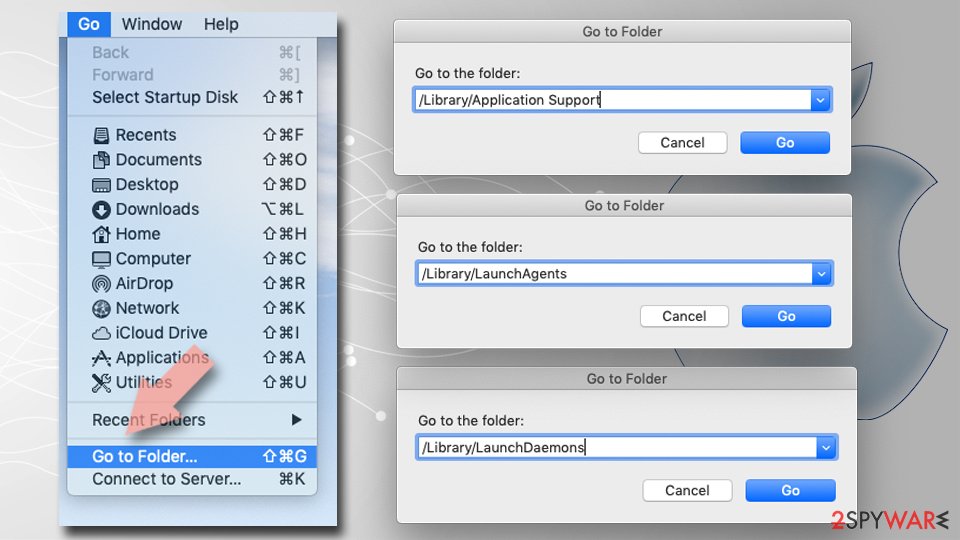
- Finally, empty the Trash to permanently remove the leftovers.
Reset Internet Explorer
Remove dangerous add-ons:
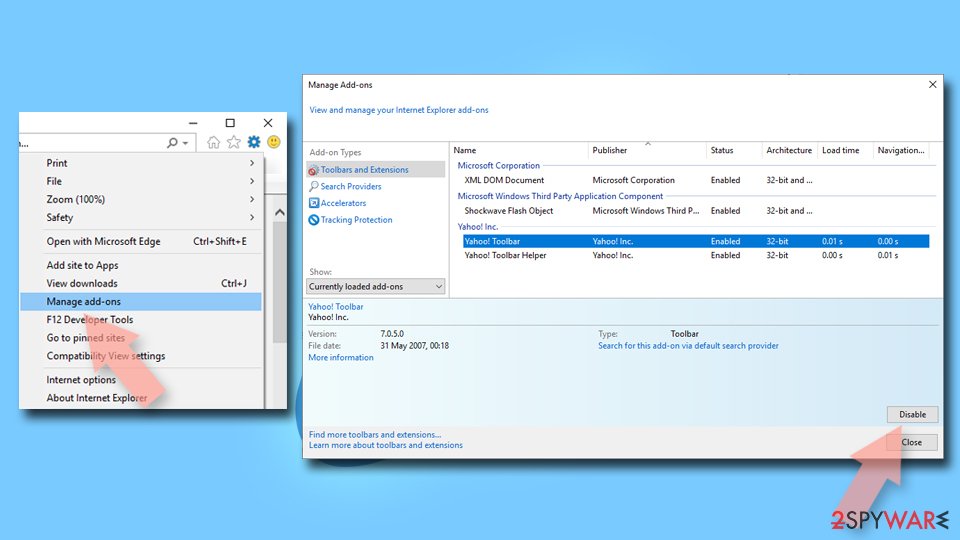
- Open Internet Explorer, click on the Gear icon (IE menu) on the top-right corner of the browser
- Pick Manage Add-ons.
- You will see a Manage Add-ons window. Here, look for suspicious plugins. Click on these entries and select Disable.
Change your homepage if it was altered:
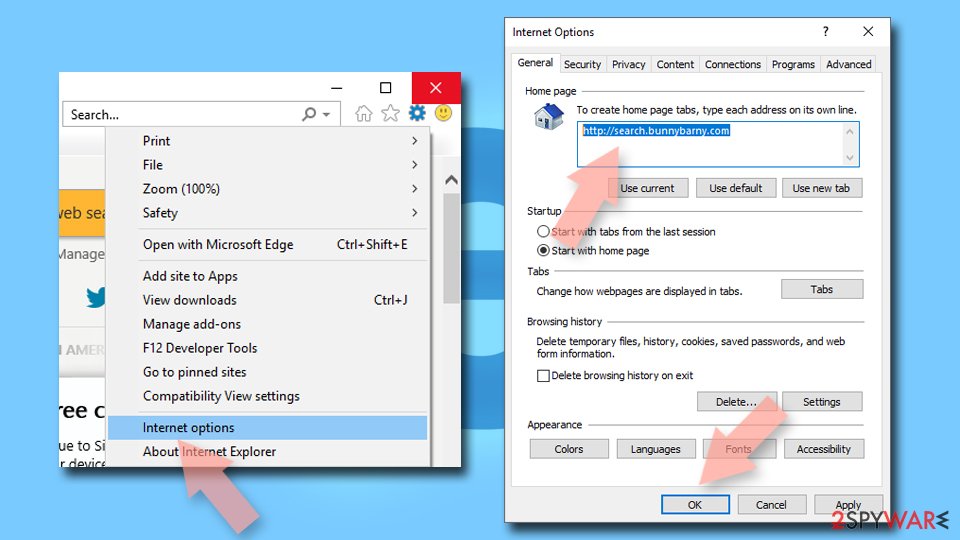
- Open IE and click on the Gear icon.
- Select Internet Options.
- In the General tab, delete the Home page address and replace it by your preferred one (for example, Google.com).
- Click Apply and then select OK.
Delete temporary files:
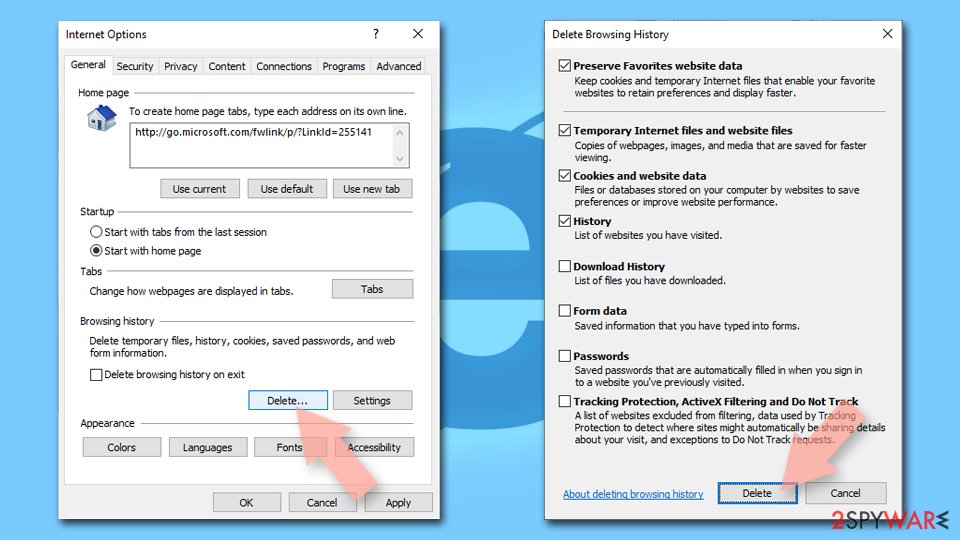
- Press on the Gear icon and select Internet Options.
- Under Browsing history, click Delete...
- Select relevant fields and press Delete.
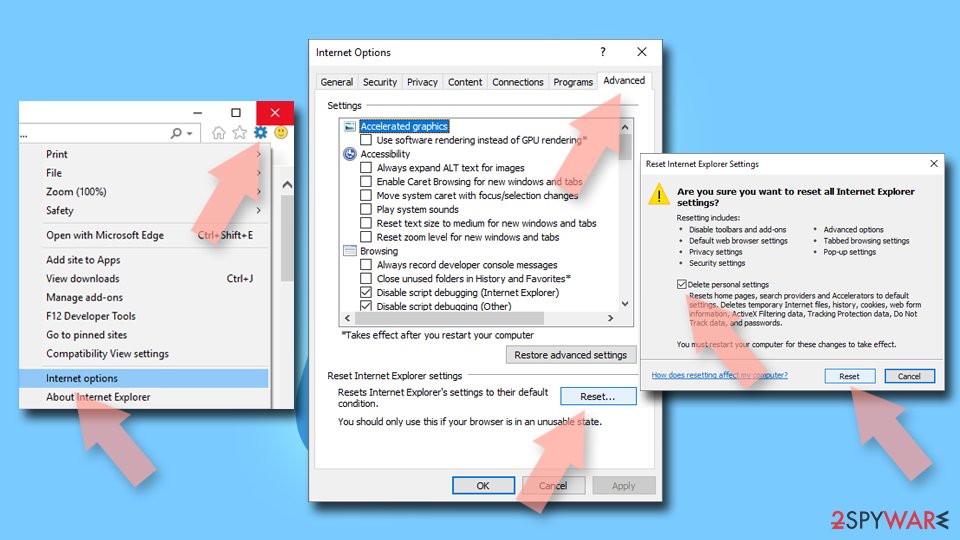
Reset Internet Explorer:
- Click on Gear icon > Internet options and select Advanced tab.
- Select Reset.
- In the new window, check Delete personal settings and select Reset.
Do not let government spy on you
The government has many issues in regards to tracking users' data and spying on citizens, so you should take this into consideration and learn more about shady information gathering practices.
Avoid any unwanted government tracking or spying by going totally anonymous on the internet.
You can choose a different location when you go online and access any material you want without particular content restrictions. You can easily enjoy internet connection without any risks of being hacked by using VPN.
Control the information that can be accessed by government any other unwanted party and surf online without being spied on. Even if you are not involved in illegal activities or trust your selection of services, platforms, be suspicious for your own security and take precautionary measures by using the VPN service.
Backup files for the later use, in case of the malware attack
Computer users can suffer from data losses due to cyber infections or their own faulty doings.
Ransomware can encrypt and hold files hostage, while unforeseen power cuts might cause a loss of important documents. If you have proper up-to-date backups, you can easily recover after such an incident and get back to work. It is also equally important to update backups on a regular basis so that the newest information remains intact - you can set this process to be performed automatically.
When you have the previous version of every important document or project you can avoid frustration and breakdowns. It comes in handy when malware strikes out of nowhere. Use for the data restoration process.
From our report of Nov 2019 · not reviewed since
Prevent adware installation on your machine
Adware is a growing threat to Mac users, as there are still many who believe that Mac malware is a myth.
While Macs are known to be more repellent to infections, they are far from immune - the myth has been debunked multiple times, as such threats like Shlayer trojan, Cookieminer, and other malicious software crafted specifically for this operating system keep emerging additionally, while scareware and adware are less threatening that viruses, they should still be treated as security risk, as these are the most common infections Mac users experience.
Security researchers from Novirus.uk claim that attentiveness and knowledge about adware propagation methods can be a great remedy to keep the machine security from the incoming threats. In most of the cases, Mac users are tricked into installing unwanted software, as they need to enter their usernames and passwords in order to allow a non-Apple approved the installation. Here are a few tips to avoid infections in the future:
- Install anti-malware software that can detect potentially unwanted or malicious .pkg files before they are allowed on the system;
- Try avoiding third-party sites for software downloads and rely on Apple-approved sources instead;
- When downloading a free app from a third-party site, read up reviews on it before proceeding - they often indicate about suspicious behavior;
- During the installation process, decline all the deals and offers;
- Watch out for tricks freeware developers use: pre-ticked boxes, fine print texts, misleading placements of "Agree" buttons, etc.
- When prompted, always opt for Advanced/Custom settings instead of Recommended/Quick ones.
From our report of Nov 2019 · not reviewed since
Do not download software from Apple.com-mac-optimizing.live and get rid of adware from your Mac
As we previously mentioned, Apple.com-mac-optimizing.live removal highly depends on whether your system is infected with adware or another potentially unwanted application.
In some cases, it can detect and eliminate all the unwanted programs along with all its entries from the system automatically. Nevertheless, some adware apps are not designed to be persistent, so you might be able to remove Apple.com-mac-optimizing.live virus manually.
If you opt for manual adware elimination, you should also be aware that components of PUPs might be hiding in the following locations of macOS:
Finally, you should also make sure that you reset all the installed browsers. Note: if not adware was present on your computer, all you have to do is the turn of the scam tab and proceed with your daily browsing activities. Remember, do not download any software from Apple.com-mac-optimizing.live or similar scam sites and ignore all the claims about virus infections.
- /Library/LaunchAgents
- /Library/Application Support
- /Library/LaunchDaemons
Questions about Apple.com-mac-optimizing.live e-mail scam
Could Apple.com-mac-optimizing.live be a genuine message?
We checked it, and it is not. UPS is only the costume. The message exists to get your password, and real companies handle that inside your account, after you sign in normally, not through links, attachments or phone numbers in a message you did not expect.
Scammers copy logos and footers perfectly, so the design proves nothing. The sender address, the link target and the request are the reliable signs, and all three point to a scam here. Delete it, and if you are worried, check your account directly.
Why does Apple.com-mac-optimizing.live say that your account needs urgent attention?
Because that story works. A problem that needs fixing, a deadline and a simple solution make people act before they check.
The claim that your account needs urgent attention is the same for everyone who received Apple.com-mac-optimizing.live; it was written once and sent in bulk. Nothing about your own situation triggered it.
If you are unsure, look at the real account or service the normal way, without using the message. The claim will not be there, which settles the question. Then report the message.
What does Apple.com-mac-optimizing.live want from me?
In the end, your password. Everything else in Apple.com-mac-optimizing.live, from the logo to the deadline, is there to get you to that point without stopping to think. Knowing the goal helps you judge your risk.
If you did not give it, you lost nothing and can delete the message. If you did, the steps in this guide are ordered by what you handed over:
- passwords first
- then card and bank details
- then documents and anything you installed
- ran
Act on the highest item on that list first.
How do I contact the real UPS?
Not through anything in Apple.com-mac-optimizing.live. Type the official website address into the browser yourself, use the app you already have, or use the phone number printed on your card, contract or a previous genuine invoice.
Search results can be risky too, because scammers buy ads for support numbers. Once you reach the real UPS, you can ask whether there is any problem with your account and report the scam message; many companies have a dedicated address for phishing reports on their security page.
I entered my password on the fake page. What should I do?
Change the password on the real site right away, through its own website or app, and sign out of all sessions.
If you use the same password anywhere else, change it there too. Turn on two-step verification with an authenticator app or a passkey. Check the account for changes:
- recovery e-mail
- phone number
- forwarding rules
- recently sent messages
If you can no longer sign in, use the provider's account recovery page. Tell your contacts if the account sent messages in your name.
Why did I receive Apple.com-mac-optimizing.live?
Scam messages go to millions of addresses and numbers collected from data breaches, public websites and simple guessing. Receiving Apple.com-mac-optimizing.live does not mean your PC is infected or that an account of yours was hacked.
If the message includes an old password of yours, it comes from a breach of some website; change that password wherever you still use it. Mark the message as spam or phishing so your provider blocks similar ones. Never reply to ask to be removed from the list: the sender treats a reply as proof that the address works.
Is it worth reporting a scam if I lost nothing?
Yes. Reports from people who did not fall for Apple.com-mac-optimizing.live are how blocklists, mail filters and hosting companies find new scam pages quickly, often before most recipients open the message. Reporting the message as phishing in your mail app is enough for most people.
If the message impersonates a company, its security or abuse team usually accepts forwarded copies too. Police reports matter mainly when money or documents were lost, but national fraud centres also collect reports without losses to spot campaigns.
What is the single best habit against scams like this?
Never act on a message through the message itself. If something claims to be from UPS and asks you to sign in, pay, call or open a file, close it and go to the service the way you always do:
- a bookmark
- the app
- the number on your card
Real problems will be visible there. This one habit defeats almost every phishing, invoice, delivery and account-suspension scam, regardless of how convincing the design is, because the scammers can copy the look but not the real account.
Can I trick the scammers or waste their time?
Better not. Replying to Apple.com-mac-optimizing.live confirms that your address or number is live and puts it on lists that sell for more. Scammers who are teased sometimes switch to harassment or try to use any detail you reveal, such as your name, employer or location.
Playing along also risks a slip, like opening a link or a file they send. Report the message, block the sender and delete it. Your report does more damage to the operation than a conversation would.
Will Fortect remove Apple.com-mac-optimizing.live?
Fortect for Mac scans for malware and unwanted programs, and its free scan shows what it finds on your Mac before you decide anything.
For Apple.com-mac-optimizing.live, follow the plan on this page as well: removing a launch item or an app is done in macOS itself, and a scanner cannot undo what was typed or entered on the infected Mac, such as saved passwords that were copied.
Change your passwords from another device first, and if the page tells you to erase the Mac, a scan is not a substitute. The free scan costs nothing and the full-featured product needs a license.
Sources
- WhatIs: Scareware (read October 7, 2026)
- Wikipedia: Adware (read October 7, 2026)
- FTC: How to recognize and avoid phishing scams (read October 7, 2026)
- CISA: Recognize and report phishing (read October 7, 2026)
- Microsoft Support: Protect yourself from phishing (read October 7, 2026)