

AppleCare And Warranty is a scam that causes a fake popup promoting rogue tech support
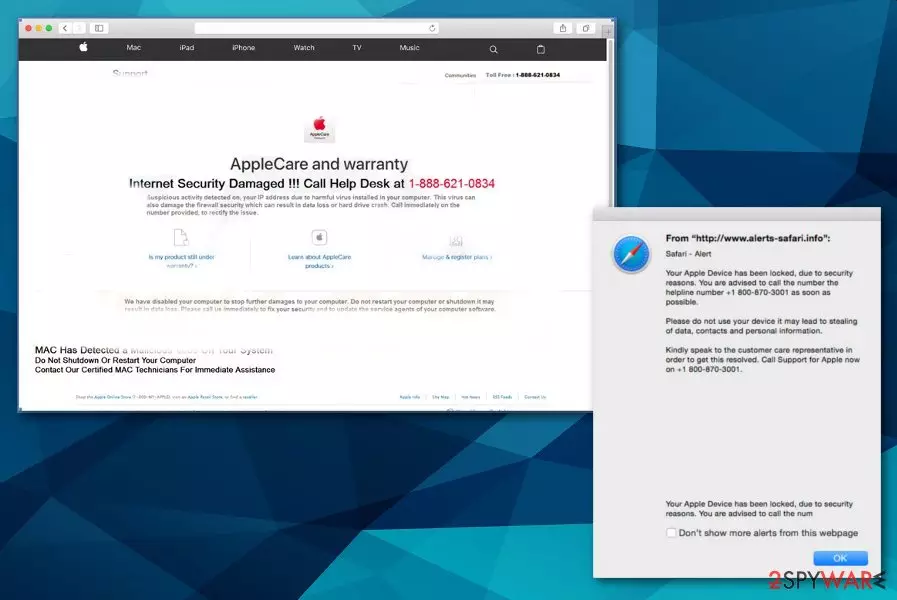
AppleCare And Warranty is a tech support scam which displays a fake alert message tricking people into thinking their system is highly affected. This fake message and its appearance are closely related to a potentially unwanted program, in fact, adware which is typically spread via bundling. Once inside the system, such program occupies web browsers and starts delivering pop-up ads, banners and such scams as this one. After convincing its victims into believing that they are seriously infected, AppleCare And Warranty virus suggests reaching for advanced tech experts via 1-888-621-0834 number. However, you shouldn't be dialing this number because these “technicians” are hackers who are seeking to steal users' personal information, swindle their money or install malware.
| Name | AppleCare And Warranty |
|---|---|
| Type | Tech support scam/a fake warning message |
| Sub-type | Potentially unwanted program |
| Similar to | Apple Support scam |
| Symptoms | Delivers fake alert messages, causes redirects, intrusive ads |
| main danger | Calling fake support team may lead to money or personal information loss or further malware damage |
| Distribution | Bundling technique |
| Affected OS | Mac |
| Elimination | Use FortectIntego for eliminating fake warning messages |
AppleCare And Warranty virus has mostly been targeting Mac OS X users who have been interrupted by a message claiming that the system is infected. To fix the issue, scammers have been pushing their victims into dialing the provided 1-888-621-0834 number to contact certified technicians. Supposedly, they are the only ones capable of helping victims with malware removal and system issues.
Unfortunately, these claims are more than fake. In reality, you are dealing with scammers who are willing to trick you into falling for the money extortion.[1] This alert has nothing to do with the Apple company and all these threats or issues are fake. The only threat on your device is the PUP that is causing the AppleCare And Warranty fake alert.
These messages may vary since the scam has been spreading for almost a year or so. However, the idea stays the same:
AppleCare and warranty
Internet Security Damaged !!!
Call Help Desk at 1-888-621-0834
Suspicious activation detected on, your IP address due to harmful virus installed in your computer.
This virus can also damage the firewall security which can result in data loss or hard drive crash.
Call immediately on the number provided, to rectify the issue.We have disabled your computer to stop further damages to your computer. Do not restart your computer or shutdown. It may result in data loss. Please call us immediately to fix your security and to update the service agents of your computer software.
MAC Has Detected a Malicious Virus On Your System
Do Not Shutdown Or Restart Your Computer
Contact Our Certified MAC Technicians For Immediate Assistance.
Adware which is hiding behind AppleCare and Warranty pop-up can misuse system resources for various background activities, and, in this way, cause poor performance of the device. Also, adware-type programs like this gather various information about your online activity, browsing preferences and even location, IP address[2]. This means that the fake security error message targeting devices with the Mac operating system is not the only security-related issue you need to worry about.
Often, when a victim calls the provided number, suspicious people on the other side of the phone encourage him or her to provide them the remote access to the device. Once they gain this access, they can try to install malware, change system settings, steal your personal data or other information from the computer.

To protect yourself, remove AppleCare And Warranty virus and other related programs or files that are considered malicious. Otherwise, you can not only be left with useless services causing the money loss each month. You can also end up with more potentially unwanted programs or even malware on your computer. Beware that “Mac technicians” who are hiding behind this scam can trick you into installing any “recommended” software they want.
This so-called malware removal may cost you a lot of money, so researchers[3] are not advising to contact any support number from the pop-up or suspicious website. You need to perform an AppleCare And Warranty removal instead. Use anti-malware programs like FortectIntego for the job. This tool helps to end all the processes that may be running in the background and remove all malware-related programs or files.

A new Apple Support scam has been tricking users
Apple Support scam, also known as Please Call Apple Support scam, is just another potentially unwanted program[4] which has a purpose to trick gullible users. This type of program is also making attempts against Mac users by providing fake alerts about dubious Mac infections. Apple Support virus announces about numerous threats found in the Mac OS and tries to convince users to call via 1-877-695-0922 phone number to solve the problem.
Be aware as this is a way to trick naive users into calling the developers of this program. Such activity brings the owners sometimes great revenue if the user is convinced to pay for the fake help. Have in mind that all errors that are produced by Apple Support scam are fake and created only for negative beneficial reasons. If you want to check your computer system, you should get a reliable antivirus and perform a scan with this software.
If you ever encounter Apple Support scam[5], be careful and do not fall for its tricks. Nevertheless, as a potentially unwanted program, it has other negative features like browsing-related data collecting or even displaying numerous intrusive advertisements. This type of activity can also bring revenue for the developers as gathered information is often shared with third parties and ads are used to gain income from the pay-per-click method[6].

Software bundling is used for spreading PUPs
This potentially unwanted program can install additional applications that may appear running in the background. But the program itself is installed silently too, with the help of software bundling. Virus developers and software providers use this technique that allows them to pack various products together. Later on, unwanted programs can be installed on your computer without permission or your knowledge.
However, if you choose Advanced or Custom options during the freeware installation process, you can avoid these cyber infections. This step is allowing you to see the full list of bundled programs and de-select additional pieces that you don't want. This is an easy step, which you need to repeat each time you get programs or applications from the internet, from now on.
Moreover, for further and stronger computer protection we advise installing a reliable and expert-tested antivirus program. Such computer security software will protect your computer system from various threats and detect any infections possible. However, make sure that you regularly perform all recommended updates. This is necessary for the security tool to function properly.
Anti-malware tools are required in AppleCare And Warranty elimination
To remove AppleCare And Warranty virus from your device, you should use trustworthy anti-malware. Since this is a cyber infection that can easily install other threats without a warning, a full system scan is essential. The only way to detect all possible intruders is by doing a system scan and malware removal. Anti-malware programs can identify various types of malware and corrupted or malicious files, even system vulnerabilities.
A manual AppleCare And Warranty removal requires specific knowledge, so using anti-malware tools can help you save some time. Programs that were selected by our experts will fix your system, clean malicious components and improve the overall state of the computer. However, you can feel free to use any antivirus tool of your own.
If you still want to eliminate the virus damage manually, you will need to take careful actions on your own and pay all of your attention while proceeding with the cyber threat deletion. We have provided manual elimination instructions below this text which should help you get rid of the scam and all unwanted components.
Delete from macOS
Remove the unwanted application:
- From the menu bar, select Go > Applications.
- In the Applications folder, look for any suspicious entries, then drag them to Trash (or right-click and pick Move to Trash).


Delete leftover files and folders:
- Select Go > Go to Folder.
- Enter /Library/Application Support and remove any suspicious folders related to the unwanted program.
- Repeat the same check in the /Library/LaunchAgents and /Library/LaunchDaemons folders, deleting any suspicious entries.

- Finally, empty the Trash to permanently remove the leftovers.

Reset Internet Explorer
Remove dangerous add-ons:
- Open Internet Explorer, click on the Gear icon (IE menu) on the top-right corner of the browser
- Pick Manage Add-ons.
- You will see a Manage Add-ons window. Here, look for suspicious plugins. Click on these entries and select Disable.


Change your homepage if it was altered:
- Open IE and click on the Gear icon.
- Select Internet Options.
- In the General tab, delete the Home page address and replace it by your preferred one (for example, Google.com).
- Click Apply and then select OK.


Delete temporary files:
- Press on the Gear icon and select Internet Options.
- Under Browsing history, click Delete...
- Select relevant fields and press Delete.


Reset Internet Explorer:
- Click on Gear icon > Internet options and select Advanced tab.
- Select Reset.
- In the new window, check Delete personal settings and select Reset.


Remove from Mozilla Firefox (FF)
Remove dangerous extensions:
- Open Mozilla Firefox browser and click on the Menu (three horizontal lines at the top-right of the window).
- Select Add-ons.
- In here, select the unwanted extension and click Remove.


Reset the homepage:
- Click three horizontal lines at the top right corner to open the menu.
- Choose Settings.
- Under Home, set your preferred homepage and new tab settings.
Clear cookies and site data:
- Click Menu and pick Settings.
- Go to Privacy & Security section.
- Scroll down to locate Cookies and Site Data.
- Click on Clear Data...
- Select Cookies and Site Data and Temporary cached files and pages, then click Clear.


Reset Mozilla Firefox
If clearing the browser as explained above did not help, reset Mozilla Firefox:
- Open Mozilla Firefox browser and click the Menu.
- Go to Help and then choose Troubleshooting Information.

- Under Give Firefox a tune up section, click on Refresh Firefox...
- Once the pop-up shows up, confirm the action by pressing on Refresh Firefox.



Remove from Google Chrome
Delete malicious extensions from Google Chrome:
- Open Google Chrome, click on the Menu (three vertical dots at the top-right corner) and select More tools > Extensions.
- In the newly opened window, you will see all the installed extensions. Uninstall all suspicious extensions related to the unwanted program by clicking Remove.


Clear cache and web data from Chrome:
- Click on Menu and pick Settings.
- Under Privacy and security, select Clear browsing data.
- Select Browsing history, Cookies and other site data, as well as Cached images and files.
- Click Clear data.


Change your homepage:
- Click menu and choose Settings.
- Look for a suspicious site in the On startup section.
- Click on Open a specific or set of pages and click on three dots to find the Remove option.
Reset Google Chrome:
If the previous methods did not help you, reset Google Chrome to eliminate all the unwanted components:
- Click on Menu and select Settings.
- In the Settings, scroll down and click Advanced.
- Scroll down and locate Reset and clean up section.
- Now click Restore settings to their original defaults.
- Confirm with Reset settings.


Delete from Safari
Remove dangerous extensions:
- Open Safari, click Safari in the menu at the top-left of the screen, and select Preferences.
- Go to the Extensions tab, look for any suspicious entries, and click Uninstall to remove them.


Clear history and website data:
- Click Safari in the menu and pick Clear History.
- Set Clear to all history and confirm with Clear History.


Reset Safari:
- Click Safari in the menu and select Preferences > Advanced.
- Enable Show Develop menu in menu bar.
- From the menu bar, click Develop and select Empty Caches.


Did this guide help?
Be the first to comment