
ConnectionOptimizer on Mac: what it is and how to remove it
ConnectionOptimizer is a Mac virus that belongs to the Adload malware family. It has adware and hijacking capabilities which results in pop-ups, banners, redirects, and changed browser settings.
Facts checked October 7, 2026. Removal steps checked against Apple's current documentation and the security vendors' reports. We have not run the malware on a Mac. Sections marked as our earlier report are the original text: they describe the threat as it was then and have not been reviewed since. The 2026 status, the removal steps and the questions are current.
Automatic
Get a free scan and check if your Mac is infected.
Fortect for Mac scans for malware and unwanted programs, and its free scan shows what it finds before you decide anything.
If ConnectionOptimizer keeps coming back after uninstalling, a scan can find what reinstalls it.
Do it yourself · free Remove ConnectionOptimizer yourself 4 steps, about 12 minutes, no software needed.
Start the steps
ConnectionOptimizer: summary
| Distribution | Fake software updates, deceptive ads, torrent websites |
|---|---|
| NAME | ConnectionOptimizer |
| TYPE | Adware, browser hijacker, mac virus |
| MALWARE FAMILY | Adload |
| SYMPTOMS | Changed homepage, new tab address, and search engine; redirects to shady websites; an increase of commercial content; decrease in performance |
| DANGERS | Altered search results can lead to dangerous websites; pop-up ads might be promoting scams; the virus can install other PUPs or even malware without the users' knowledge |
| Removal | Scan the Mac with security software to find the malware and anything installed with it. Fortect for Mac scans for malware and unwanted programs. Remove it nowTo use the full-featured product, you have to purchase a license for Fortect. The scan is free. |
Show 9 more facts
| Detection names | No Microsoft detection name is known |
|---|---|
| Damage | Not recorded in the old report |
| Name | ConnectionOptimizer |
| Type | Search hijacker extension |
| Symptoms | An unknown program in Installed apps |
| Evidence | 5 write-ups by security sites; details still limited |
| Program | ConnectionOptimizer |
| First seen | 31 December 2021 |
| Facts checked | 7 October 2026 |
Is ConnectionOptimizer dangerous? What it collects
From our report of Dec 2021 · not reviewed since
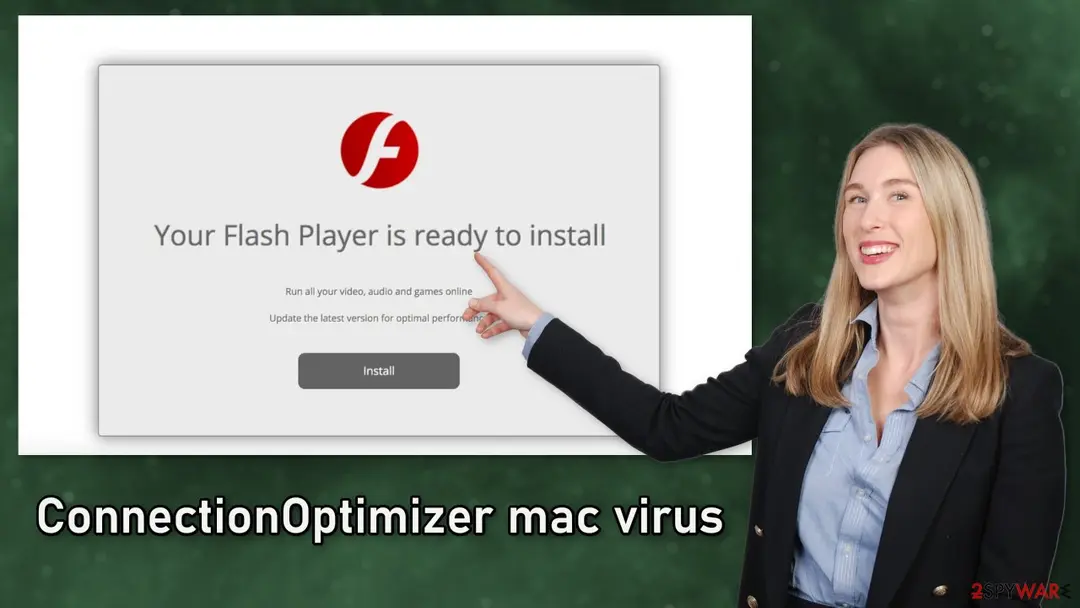
ConnectionOptimizer is an aggressive form of adware targeting mac machines through fake Flash Player installers
ConnectionOptimizer is a mac virus that belongs to the Adload malware family.
It has adware and hijacking capabilities which results in pop-ups, banners, redirects, and changed browser settings. The behavior that users start to experience is not only annoying but dangerous. Adware created for Mac machines is much more aggressive than adware targeting Windows users.
Many Mac lovers say that they just do not get viruses but that has not been true for a long time. Malware developers are constantly coming up with new ways to bypass Apple's security system XProtect and Adload is not an exception.
All they had to do was not include a single strand in their code. We have previously written about different versions of this virus, like EdgeManagement, ConnectedPlatform, and Latest Structured.
The most noticeable similarity between them is the same icon - a magnifying glass inside a green or teal-colored circle. If you see this icon in your "Applications" folder, that is definitely the reason why you get redirected to questionable websites and get bombarded with ads.
Adload is way more aggressive than adware created for Windows machines because it can install other PUPs (potentially unwanted programs) and malware without the users' knowledge.
What makes this mac virus particularly dangerous is the fact that most users notice it when it has already started to perform its malicious tasks. The malware can collect user data and steal the administrator password. It does this by creating a prompt that looks exactly like a real system prompt asking users to enter their administrator password.
Once the malicious program requires this information it can do a lot of damage to your system. It can initiate malicious scripts, and install other malware without your knowledge. If you do not catch this infection on time you may have a lot of different intruders hiding in your machine, like spyware, other adware, hijackers, and crypto miners.
It is also very difficult for the average user to completely remove Adload from the machine. The virus can scatter its' files across the system making each of them hard to locate. That is why professional security tools are so important.
A device without an antivirus is like a house without a door. It is clear that Apple's native security system is falling behind and users now have to take extra security measures to keep themselves safe.
From our report of Dec 2021 · not reviewed since
More from our earlier report on ConnectionOptimizer
- Eliminating an adload virus manually can be quite complicated if you do not have experience.
- should be used to completely wipe out any data left and fix the remaining damage
How ConnectionOptimizer got into your browser
From our report of Dec 2021 · not reviewed since
Most often users infect themselves with Adload-type viruses because they are reckless when surfing the web.
The misconception that Apple devices do not get infected, makes users browse carelessly, click on random links and visit shady websites. One of the biggest tools that fraudsters use to get people infected is fake Flash Player installations.
The scam works by telling users that their Flash Player is outdated and they need to install the newest version or they will not be able to access some kind of content. Many people do not think twice about it and click install. The truth is, Flash Player does not exist anymore. It was discontinued in 2020 and replaced by HTML5.
Many users still do not know that and end up putting their systems in danger. If you land on a page that says you need a new Flash Player, it is definitely fake. Another way that you could have been infected with ConnectionOptimizer is by installing "cracked" software from a torrent website.
These platforms are unregulated because they engage in illegal activities. There are no entities that review the listed programs and verify if they are safe. That is why peer-to-peer file-sharing platforms are breeding grounds for PUAs and malware. That is why you should use official web stores and developer websites for getting the software you want.
Even though it can get costly, the programs that get listed on online marketplaces go through an extensive review process. You might save in the long run by keeping your system safe from intruders and having to pay for repairs.
Always do your research and do not install anything from random websites. Read the reviews, and look for press releases. You will find that most of the time there are no search results about rogue applications.
How to remove ConnectionOptimizer
How to remove ConnectionOptimizer from a Mac
Remove the app and what starts it, then check the browsers.
Step 1: Delete apps and downloads you did not intend to install
Open the Applications folder and your Downloads folder. Drag any app you did not install, and any disk image (
.dmg), installer (.pkg) or archive (.zip) that came from ConnectionOptimizer or a site you do not trust, to the Bin, then empty the Bin.Also check
~/Library/Application Supportfor a folder with the same name as the app you removed.Step 2: Remove unknown login items and background items
Open System Settings > General > Login Items & Extensions. Under Open at Login and Allow in the Background, switch off or remove anything you do not recognize, especially items whose developer is shown as an unknown name or that appeared on the day you ran the command.
Then open Finder, choose Go > Go to Folder and check
~/Library/LaunchAgents,/Library/LaunchAgentsand /Library/LaunchDaemons for property list (.plist) files you did not add. Drag suspicious ones to the Bin, then restart the Mac.Step 3: Check the browsers for extensions and changed settings
In Safari open Settings > Extensions and General (homepage). In Chrome open
chrome://extensions, in Firefoxabout:addons.Remove any extension you did not add, and reset the homepage and search engine if they changed. Browsers hold saved passwords and cookies, which is why the password step comes first.
Step 4: Quit what is running that you do not recognize
Open Activity Monitor (in Applications > Utilities, or search for it with Command + Space).
In the CPU or Network tab, look for a process you did not install or whose name is random, select it, click the stop button (the octagon with an X) and choose Quit or Force Quit.
Note the name first: you will look for the same name in the next steps. Malware that comes back after a restart is handled in the next two steps.
Instructions for each browser and system
The detailed steps for every browser and system this guide covers. Open the one you use.
Remove from Google Chrome
Delete malicious extensions from Google Chrome:
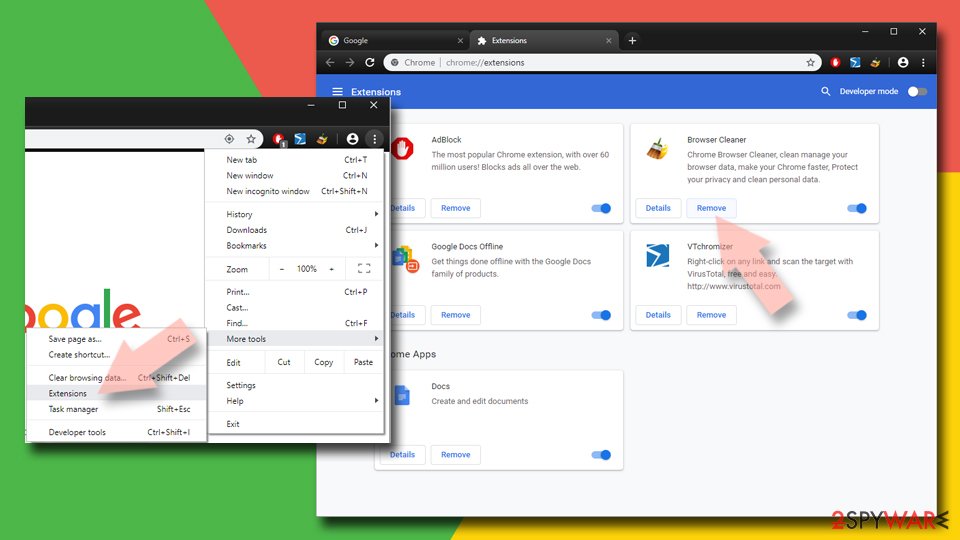
- Open Google Chrome, click on the Menu (three vertical dots at the top-right corner) and select More tools > Extensions.
- In the newly opened window, you will see all the installed extensions. Uninstall all suspicious extensions related to the unwanted program by clicking Remove.
Clear cache and web data from Chrome:
- Click on Menu and pick Settings.
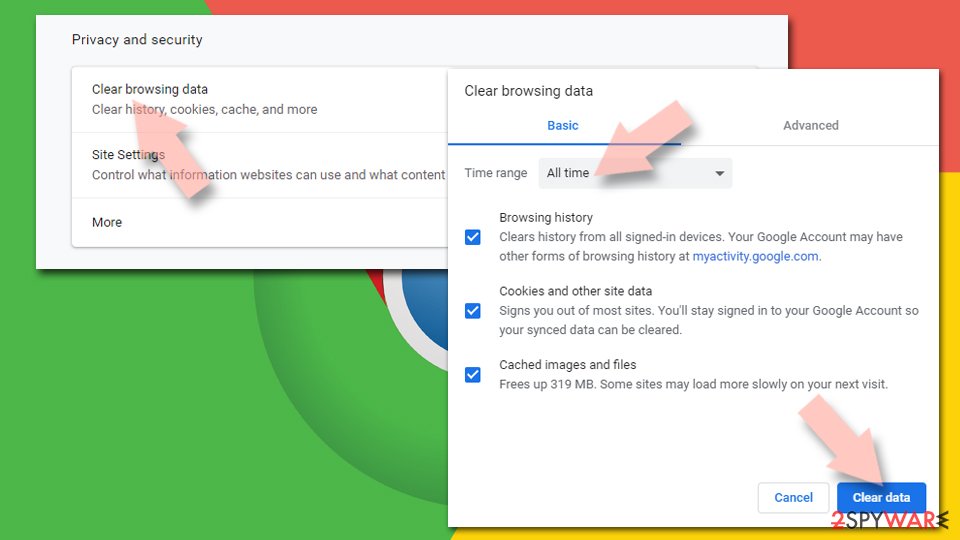
- Under Privacy and security, select Clear browsing data.
- Select Browsing history, Cookies and other site data, as well as Cached images and files.
- Click Clear data.
Change your homepage:
- Click menu and choose Settings.
- Look for a suspicious site in the On startup section.
- Click on Open a specific or set of pages and click on three dots to find the Remove option.
Reset Google Chrome:
If the previous methods did not help you, reset Google Chrome to eliminate all the unwanted components:
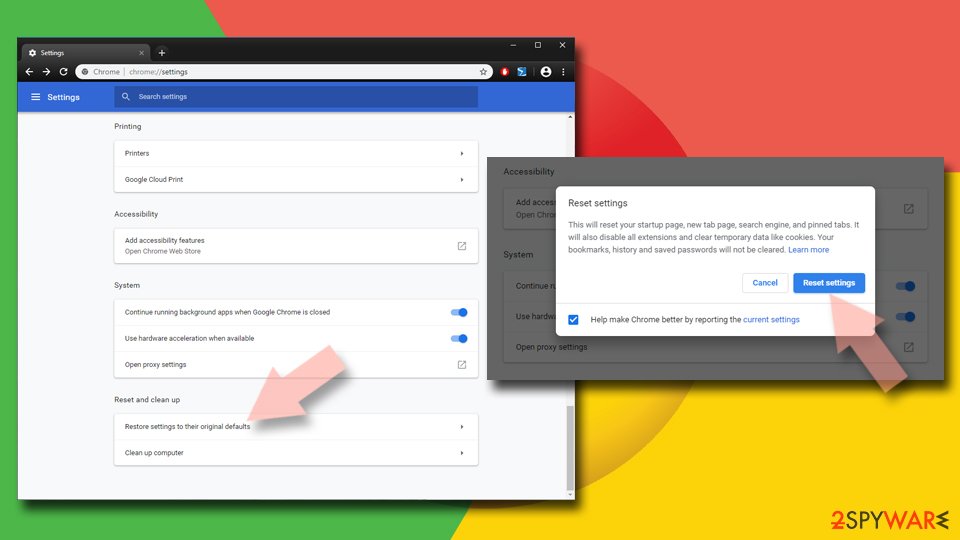
- Click on Menu and select Settings.
- In the Settings, scroll down and click Advanced.
- Scroll down and locate Reset and clean up section.
- Now click Restore settings to their original defaults.
- Confirm with Reset settings.
Remove from Mozilla Firefox (FF)
Remove dangerous extensions:
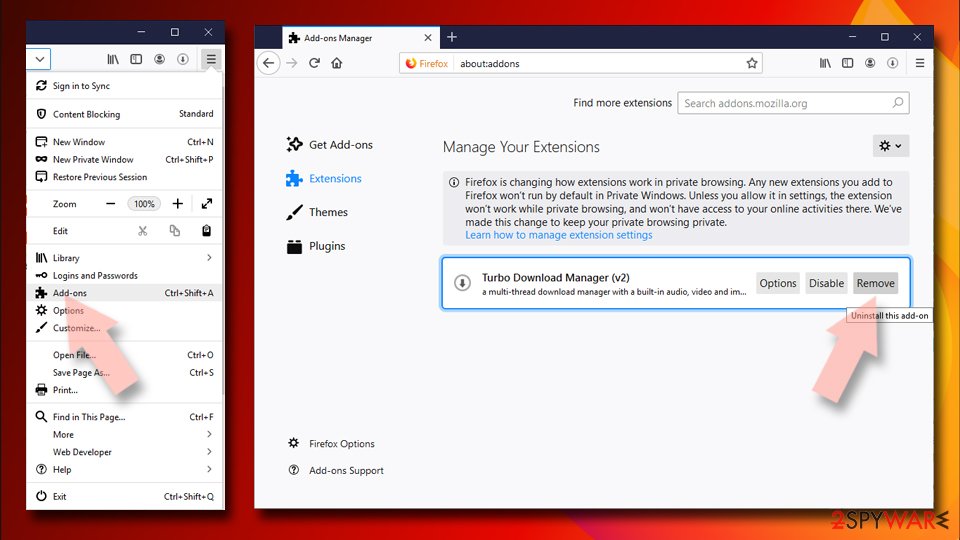
- Open Mozilla Firefox browser and click on the Menu (three horizontal lines at the top-right of the window).
- Select Add-ons.
- In here, select the unwanted extension and click Remove.
Reset the homepage:
- Click three horizontal lines at the top right corner to open the menu.
- Choose Settings.
- Under Home, set your preferred homepage and new tab settings.
Clear cookies and site data:
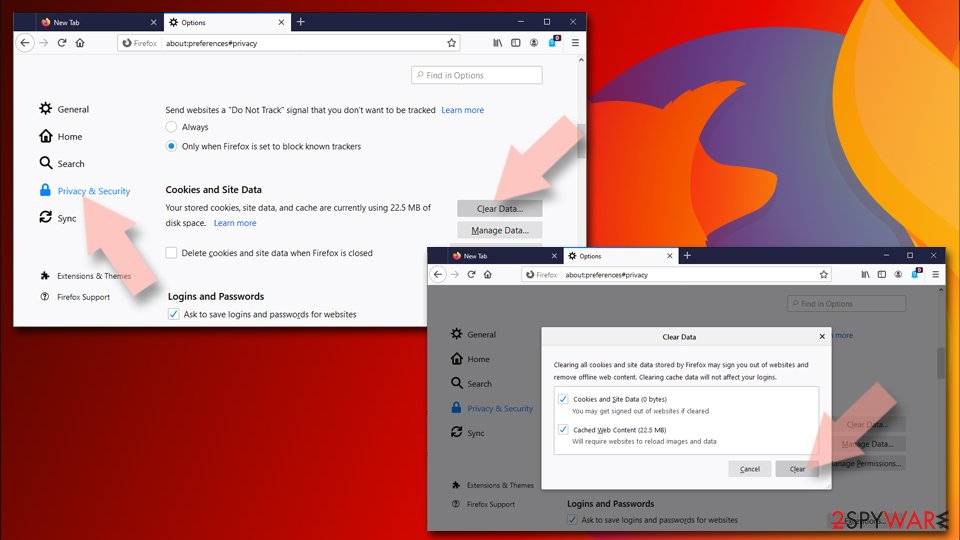
- Click Menu and pick Settings.
- Go to Privacy & Security section.
- Scroll down to locate Cookies and Site Data.
- Click on Clear Data...
- Select Cookies and Site Data and Temporary cached files and pages, then click Clear.
Reset Mozilla Firefox
If clearing the browser as explained above did not help, reset Mozilla Firefox:
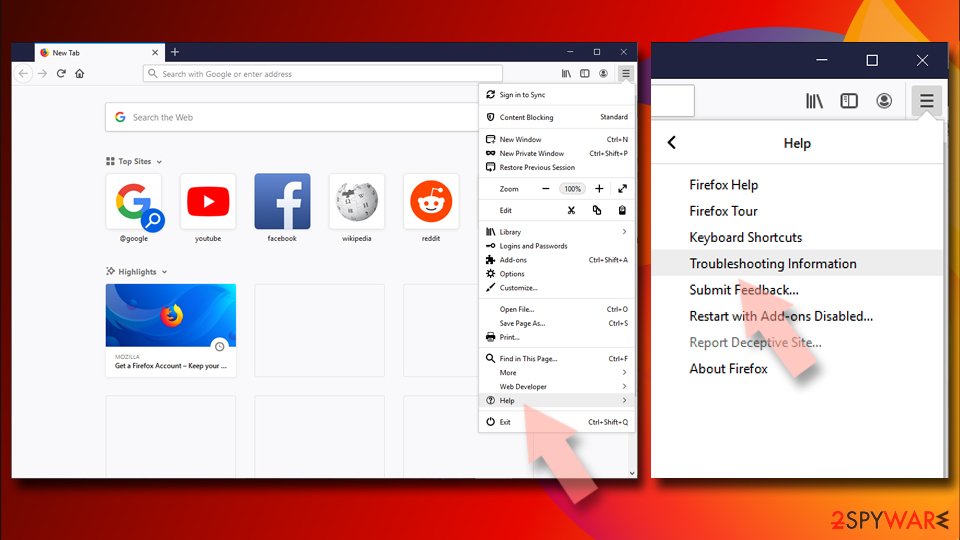
- Open Mozilla Firefox browser and click the Menu.
- Go to Help and then choose Troubleshooting Information.
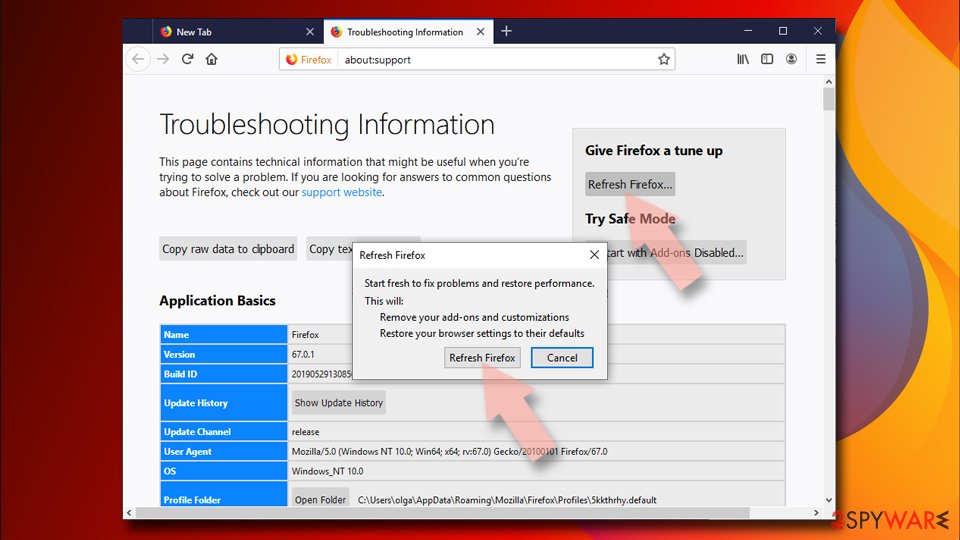
- Under Give Firefox a tune up section, click on Refresh Firefox...
- Once the pop-up shows up, confirm the action by pressing on Refresh Firefox.
Choose a proper web browser and improve your safety with a VPN tool
Online spying has got momentum in recent years and people are getting more and more interested in how to protect their privacy online.
One of the basic means to add a layer of security - choose the most private and secure web browser. Although web browsers can't grant full privacy protection and security, some of them are much better at sandboxing, HTTPS upgrading, active content blocking, tracking blocking, phishing protection, and similar privacy-oriented features.
However, if you want true anonymity, we suggest you employ a powerful VPN - it can encrypt all the traffic that comes and goes out of your computer, preventing tracking completely.
Lost your files? Use data recovery software
While some files located on any computer are replaceable or useless, others can be extremely valuable.
Family photos, work documents, school projects - these are types of files that we don't want to lose. Unfortunately, there are many ways how unexpected data loss can occur:
- power cuts
- Blue Screen of Death errors
- hardware failures
- crypto-malware attack
- even accidental deletion
To ensure that all the files remain intact, you should prepare regular data backups. You can choose cloud-based or physical copies you could restore from later in case of a disaster. If your backups were lost as well or you never bothered to prepare any, can be your only hope to retrieve your invaluable files.
From our report of Dec 2021 · not reviewed since
Removal of ConnectionOptimizer Mac virus
You should not do this yourself unless you know what you are doing and what kind of files you need to delete.
Some of the files can have a .plist extension which is a normal settings' file, also known as a "properties file," used by macOS applications. It contains properties and configuration settings for various programs. The app also uses various persistence techniques and drops many files across the system, making browser extension and application removal difficult.
You also do not know if the virus installed any additional malicious programs, so this is the safest way to ensure the system is clean.
If you still want to try and delete it manually, proceed with these steps:
If you are unable to shut down the related processes or can't move the app to Trash, you should look for malicious profiles and login items:
There are likely to be more .plist files hiding in the following locations - delete them all:
The manual elimination process might not always result in full virus removal.
- Open Applications folder
- Select Utilities
- Double-click Activity Monitor
- Here, look for suspicious processes related to adware and use Force Quit command to shut them down
- Go back to the Applications folder
- Find ConnectionOptimizer in the list and move it to Trash.
- Go to Preferences and select Accounts
- Click Login items and delete everything suspicious
- Next, pick System Preferences > Users & Groups
- Find Profiles and remove unwanted profiles from the list.
- Select Go > Go to Folder.
- Enter /Library/Application Support and click Go or press Enter.
- In the Application Support folder, look for any dubious entries and then delete them.
- Now enter /Library/LaunchAgents and /Library/LaunchDaemons folders the same way and terminate all the related .plist files.
From our report of Dec 2021 · not reviewed since
Remove the extension
An extension to your browser is also added by ConnectionOptimizer that starts performing all sorts of unwanted tasks.
It possibly collects sensitive data and sends it to tracking servers. Some of the data that could be exposed is - IP address, user name, macOS version, browser versions, computer ID, items in the "Applications" folder, a list of agents, daemons, and system configuration profiles.
You should eliminate the add-on as soon as possible after the dangerous files are eliminated from your system. You can delete cookies and cache automatically with the help of . It will also fix any damaged files and system errors, so you should notice an improvement in the machine's performance.
If you prefer doing this yourself without additional help, here are the instructions. You will find guides for Google Chrome and Mozilla Firefox at the bottom of this article:
Cookies and website data:
The simplest and quickest solution to this is completely resetting Safari:
- Click Safari > Preferences...
- In the new window, pick Extensions.
- Select the unwanted extension and select Uninstall.
- Click Safari > Clear History...
- From the drop-down menu under Clear, pick all history.
- Confirm with Clear History.
- Click Safari > Preferences...
- Go to Advanced tab.
- Tick the Show Develop menu in menu bar.
- From the menu bar, click Develop, and then select Empty Caches.
Questions about ConnectionOptimizer
Can I safely uninstall ConnectionOptimizer?
If you did not install ConnectionOptimizer yourself and it is not part of your hardware or a program you rely on, yes. Uninstalling an unwanted program does not harm Windows. Before you do, search the exact name and publisher to be sure it is not a driver tool, a printer utility or a game launcher with an odd name.
Then remove it from Settings, Apps, Installed apps. Ignore any offers or warnings in its uninstaller about losing protection or performance. Afterwards check Startup apps and your browsers for leftovers, and restart once to confirm that it does not reinstall itself.
ConnectionOptimizer came back after I uninstalled it. Why?
Something else is reinstalling it. Common causes are a second program from the same publisher, a scheduled task that downloads it again, or a browser extension that keeps prompting for it. Sort Installed apps by install date and uninstall each entry from the same day that you did not choose.
Then open Task Scheduler and look in the Task Scheduler Library for tasks with updater-style names that you do not recognise. Check Startup apps in Task Manager too. If ConnectionOptimizer still returns, start Windows in Safe Mode, uninstall it there and run a Microsoft Defender offline scan, which looks for loaders that ordinary scans can miss.
Why can't I change my search engine back?
Because something keeps setting it. If an extension controls the search engine, Chrome and Edge show a note that an extension is controlling this setting, and your change is reverted. If a policy controls it, the field is greyed out and the browser shows Managed by your organization.
Remove the extension first, then the policies, and only then change the search engine; the change will stay. If it still reverts, look for a program in Installed apps or a scheduled task that reinstalls the extension.
Is only one browser affected?
Often not. Programs that install hijackers tend to change every browser they find, and sync can carry the extension to other computers signed in to the same browser account. Check Chrome, Edge and Firefox, even the ones you rarely use, and look at the shortcut targets on the desktop and taskbar for each.
If you use sync, remove the extension while signed in so the removal syncs too. Also check the On startup setting and the new tab page, because hijackers change those as well as the search engine.
What do I lose if I reset Chrome or Edge?
Less than you might think. A reset turns off all extensions, which you can turn back on one by one, restores the default search engine, home page, new tab and pinned tabs, and clears cookies, so you are signed out of most sites.
Bookmarks, history, saved passwords and autofill data stay. Firefox's equivalent, Refresh Firefox, keeps the same essentials but removes add-ons completely. Before you reset, make sure you know your main passwords or have them saved, since you will need to sign in again.
What is ConnectionOptimizer?
ConnectionOptimizer is a Mac virus that belongs to the Adload malware family. It has adware and hijacking capabilities which results in pop-ups, banners, redirects, and changed browser settings. The summary table at the top of this guide lists the type, the detection names, the symptoms and the damage of ConnectionOptimizer.
Reading it first helps you decide whether your computer shows the same signs. The removal plan below it works in order, from the safest step to the more thorough ones.
Is ConnectionOptimizer a virus?
Not in the strict sense: ConnectionOptimizer is unwanted software, classed here as a search hijacker extension, not a self-copying virus. Security programs often label such software as adware, a potentially unwanted program or a browser hijacker.
It still needs removal, because it changes browser settings, shows ads and can lead you to unsafe pages. The larger risk is clicking an ad that leads to a fake update or scam page.
How did ConnectionOptimizer get on my computer?
Our report lists the distribution as fake software updates, deceptive ads, torrent websites. Software of this kind often comes bundled with free programs, fake updates or downloads from unofficial sites.
It can also arrive through a browser extension or a notification you allowed on a spam page. Think back to what you installed or allowed just before the first ad or redirect appeared.
Will Fortect remove ConnectionOptimizer?
Fortect for Mac scans for malware and unwanted programs, and its free scan shows what it finds on your Mac before you decide anything.
For ConnectionOptimizer, follow the plan on this page as well: removing a launch item or an app is done in macOS itself, and a scanner cannot undo what was typed or entered on the infected Mac, such as saved passwords that were copied.
Change your passwords from another device first, and if the page tells you to erase the Mac, a scan is not a substitute. The free scan costs nothing and the full-featured product needs a license.
Sources
- Apple: Protecting against malware in macOS (read October 7, 2026)
- TrendMicro: Potentially Unwanted Application (read October 7, 2026)
- Wikipedia: HTML5 (read October 7, 2026)
- FTC: How to recognize, remove and avoid malware (read October 7, 2026)
- Microsoft Learn: Microsoft Defender Offline (read October 7, 2026)