

Should you beware of Dnssignal.com?
If you wonder why your browser loads the indicated web address immediately after startup, you should know that your computer has been affected by Dnssignal.com virus. Although it is not a severe virus and it cannot damage your files or computer system, it can significantly diminish your browsing experience by causing redirects to third-party websites all of a sudden. That is the main reason why computer security experts recommend users to remove Dnssignal.com software from their computer as soon as browser changes related to the indicated URL occur. Below, you can find a comprehensive report about this browser hijacker type infection and learn how to clean your computer from it.
The aforementioned site presents a search engine, which gathers regular-looking search results. Sadly, it is not advisable to click on them since some of them can reroute you to shady third-party websites. Such search results are sponsored, but keep in mind that they might not necessarily take you to secure Internet sites. You might be redirected to sites that advertise rogue security software, bogus software updates, and all sorts of insecure files that can cause damage to your computer system or at least carry out bothersome activities, for instance, display pop-up ads or banners during your browsing sessions. That is why we do not recommend you to wander through unknown websites, especially if you enter them after clicking on an altered search result.
It seems that the indicated search engine aims to drive web traffic to pre-determined places on world wide web to generate pay-per-click revenue, but not to deliver relevant information to the user. Therefore, we suggest you to consider risks related to this search engine and if you want to, remove Dnssignal.com from your computer. Only then you will be able to adjust your homepage, new tab, and default search engine settings and set different values for these parameters. Dnssignal.com removal can be completed using spyware removal software, for instance, FortectIntego, or any other reputable security software.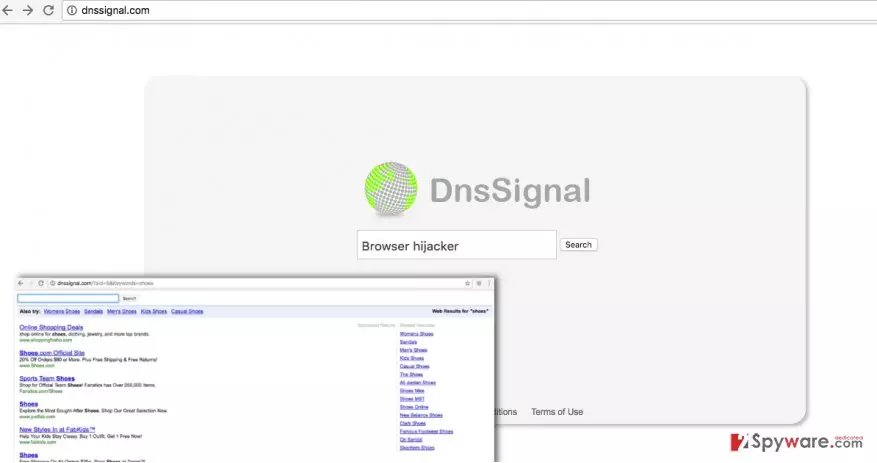
How does this hijacker spread?
Dnssignal.com hijack is a phenomenon that happens quite frequently because computer users still tend to think that computer programs can be installed in a few minutes by continuously clicking “Next” button on their installers. Wrong! If you used to think like that, we ask you to change your mind and rethink what you are doing. See, the majority of programs that can be found and downloaded from the Internet for free commonly demand to try “recommended” programs, which can be installed alongside them. These suggestions are hidden within Advanced or Custom settings, which are often ignored by the users. We highly recommend you to opt for these installation settings at all times and deselect all bonus programs added to your download, as they typically tend to be meaningless ad-supported pieces of software that can bring you nothing but annoyance.
How to remove Dnssignal.com?
It seems that Dnssignal.com redirect virus lacks of beneficial features, besides, its activity is annoying, so in our opinion, such program should not be kept on the computer system. The best way to remove Dnssignal.com virus is to scan the system using automatic dangerous software removal tool, but if you do not have one, then you can install one from the list of programs that we recommend. In case you are not looking to get such program, then you might want to take a look at these Dnssignal.com removal instruction prepared by 2-Spyware team:
Uninstall from Windows
Uninstall from Windows 10/8:
- Type Control Panel into the Windows search box and open the result.
- Under Programs, select Uninstall a program.


Uninstall from Windows 7/XP:
- Click on Windows Start > Control Panel (Windows XP users should click on Add/Remove Programs).
- In Control Panel, select Programs > Uninstall a program.


Remove the unwanted program:
- In the Programs and Features window, look for any recently installed suspicious entries, select them, and click Uninstall.
- If User Account Control appears, click Yes to confirm, then complete the removal.


Delete from macOS
Remove the unwanted application:
- From the menu bar, select Go > Applications.
- In the Applications folder, look for any suspicious entries, then drag them to Trash (or right-click and pick Move to Trash).


Delete leftover files and folders:
- Select Go > Go to Folder.
- Enter /Library/Application Support and remove any suspicious folders related to the unwanted program.
- Repeat the same check in the /Library/LaunchAgents and /Library/LaunchDaemons folders, deleting any suspicious entries.

- Finally, empty the Trash to permanently remove the leftovers.

Reset Internet Explorer
Remove dangerous add-ons:
- Open Internet Explorer, click on the Gear icon (IE menu) on the top-right corner of the browser
- Pick Manage Add-ons.
- You will see a Manage Add-ons window. Here, look for suspicious plugins. Click on these entries and select Disable.


Change your homepage if it was altered:
- Open IE and click on the Gear icon.
- Select Internet Options.
- In the General tab, delete the Home page address and replace it by your preferred one (for example, Google.com).
- Click Apply and then select OK.


Delete temporary files:
- Press on the Gear icon and select Internet Options.
- Under Browsing history, click Delete...
- Select relevant fields and press Delete.


Reset Internet Explorer:
- Click on Gear icon > Internet options and select Advanced tab.
- Select Reset.
- In the new window, check Delete personal settings and select Reset.


Remove from Mozilla Firefox (FF)
Remove dangerous extensions:
- Open Mozilla Firefox browser and click on the Menu (three horizontal lines at the top-right of the window).
- Select Add-ons.
- In here, select the unwanted extension and click Remove.


Reset the homepage:
- Click three horizontal lines at the top right corner to open the menu.
- Choose Settings.
- Under Home, set your preferred homepage and new tab settings.
Clear cookies and site data:
- Click Menu and pick Settings.
- Go to Privacy & Security section.
- Scroll down to locate Cookies and Site Data.
- Click on Clear Data...
- Select Cookies and Site Data and Temporary cached files and pages, then click Clear.


Reset Mozilla Firefox
If clearing the browser as explained above did not help, reset Mozilla Firefox:
- Open Mozilla Firefox browser and click the Menu.
- Go to Help and then choose Troubleshooting Information.

- Under Give Firefox a tune up section, click on Refresh Firefox...
- Once the pop-up shows up, confirm the action by pressing on Refresh Firefox.



Remove from Google Chrome
Delete malicious extensions from Google Chrome:
- Open Google Chrome, click on the Menu (three vertical dots at the top-right corner) and select More tools > Extensions.
- In the newly opened window, you will see all the installed extensions. Uninstall all suspicious extensions related to the unwanted program by clicking Remove.


Clear cache and web data from Chrome:
- Click on Menu and pick Settings.
- Under Privacy and security, select Clear browsing data.
- Select Browsing history, Cookies and other site data, as well as Cached images and files.
- Click Clear data.


Change your homepage:
- Click menu and choose Settings.
- Look for a suspicious site in the On startup section.
- Click on Open a specific or set of pages and click on three dots to find the Remove option.
Reset Google Chrome:
If the previous methods did not help you, reset Google Chrome to eliminate all the unwanted components:
- Click on Menu and select Settings.
- In the Settings, scroll down and click Advanced.
- Scroll down and locate Reset and clean up section.
- Now click Restore settings to their original defaults.
- Confirm with Reset settings.


Delete from Safari
Remove dangerous extensions:
- Open Safari, click Safari in the menu at the top-left of the screen, and select Preferences.
- Go to the Extensions tab, look for any suspicious entries, and click Uninstall to remove them.


Clear history and website data:
- Click Safari in the menu and pick Clear History.
- Set Clear to all history and confirm with Clear History.


Reset Safari:
- Click Safari in the menu and select Preferences > Advanced.
- Enable Show Develop menu in menu bar.
- From the menu bar, click Develop and select Empty Caches.


Did this guide help?
4 comments
airwaves_0
Always the best information. Thanks, 2-spyware, for making such computer problems easier to solve!
dnssignalsucks
I honestly was going nuts because I could not uninstall this. Thanks for helping me out!
Lorren
oh, thank you, thank you thank you very much! this was a nightmare! I could not remove this virus from my PC, because I didnt know how to do it properly :) but now it is gone, so everything is fine again.
Ramazotti
Thank you. If I didnt find this tutorial, who knows how long this virus would continue to function on my PC?