

EmailBeautifier virus asks for incredibly intrusive privacy-related permissions
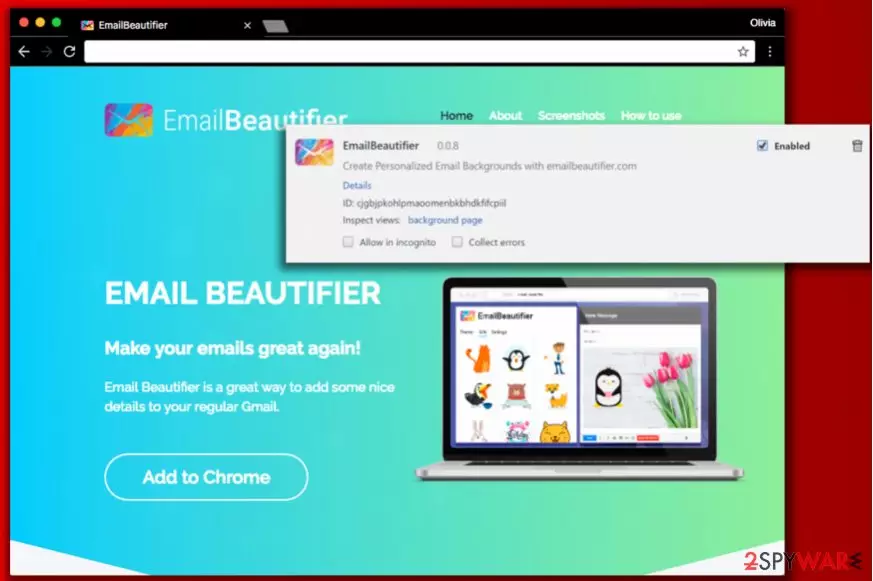
EmailBeautifier virus is a dangerous browser extension that computer users can install unknowingly. It suggests adding GIFs and background images to your emails. However, this extension falls into the potentially unwanted programs (PUP) category as it asks for extremely intrusive permissions and can possibly pose a threat to your privacy.[1]
EmailBeautifier extension is compatible with Google Chrome only. However, it is also possible that this browser-hijacking program will be improved to affect other web browsers such as Chrome or Safari as well. If you visited its official website and clicked on “Add to Chrome” button, you would receive a pop-up providing a list of permissions that EmailBeautifier virus asks to provide. We provided these statements below:
- Read and Change all your data on websites you visit;
- Display notifications;
- Change your settings that control websites’ access to features such as cookies, JavaScript[2], plugins, geolocation, microphone, camera, etc.
The described extension is capable of controlling user’s microphone and camera, which clearly means that it can spy on you without your knowledge. For this reason, we STRONGLY recommend you to remove EmailBeautifier from your browser using tutorial provided by 2-Spyware professionals (below the article).
Also, to ensure that your computer gets cleaned from all spyware and malware type components, we recommend performing EmailBeautifier removal automatically. Even if you are sure that your computer is safe, you can check your system for free. We recommend using FortectIntego or SpyHunterCombo Cleaner software.

Besides, Usunwirusa.pl experts warn[3] that the described browser extension might start initiating other aggressive activities such as display never-ending ads or change your browser’s settings to force you to use an unknown search engine that might be collecting all of your search queries and browsing history. In such situation, you might have to deal with EmailBeautifier New Tab problem.
In short, the described browser add-on causes a variety of problems that should be avoided. To protect your privacy and prevent EmailBeautifier from causing you a headache, uninstall it from your device ASAP.
Ways to install dangerous programs unknowingly
Questionable programs that pose a threat to computer user’s privacy and cause problems such as pop-up ads or browser redirects can be installed alongside popular free programs. Therefore, it is important to monitor installation of any free program you decide to set up on your PC.
After launching the installer of the program you downloaded, make sure to read legal documents provided by it. You might notice some suspicious statements about unknown programs that will be added to the system alongside your preferred software.
If you can’t find any statements about extras, you shouldn’t relax that quickly. The next step is to check what statements hide behind installation settings. You should never rely on settings that are suggested to you automatically. Therefore, instead of picking Standard or Default option, choose Custom or Advanced instead.
Picking these settings helps to see the list of programs that normally shouldn’t come with your chosen program. We suggest deselecting the additions as they can prevent you from using your computer by causing various problems.
Remove EmailBeautifier and protect your privacy
It is vital to clean your computer from rogue applications such as Email Beautifier. To completely remove EmailBeautifier virus and prevent it from tracking your online activities, use the tutorial provided below the article. The provided instructions explain how to get rid of this virtual threat manually.
If you’re looking for a faster way to complete EmailBeautifier removal, consider using an anti-spyware or anti-malware software. You can choose one of the selections recommended by the 2-Spyware team.
Uninstall from Windows
Uninstall from Windows 10/8:
- Type Control Panel into the Windows search box and open the result.
- Under Programs, select Uninstall a program.


Uninstall from Windows 7/XP:
- Click on Windows Start > Control Panel (Windows XP users should click on Add/Remove Programs).
- In Control Panel, select Programs > Uninstall a program.


Remove the unwanted program:
- In the Programs and Features window, look for any recently installed suspicious entries, select them, and click Uninstall.
- If User Account Control appears, click Yes to confirm, then complete the removal.


Delete from macOS
Remove the unwanted application:
- From the menu bar, select Go > Applications.
- In the Applications folder, look for any suspicious entries, then drag them to Trash (or right-click and pick Move to Trash).


Delete leftover files and folders:
- Select Go > Go to Folder.
- Enter /Library/Application Support and remove any suspicious folders related to the unwanted program.
- Repeat the same check in the /Library/LaunchAgents and /Library/LaunchDaemons folders, deleting any suspicious entries.

- Finally, empty the Trash to permanently remove the leftovers.

Remove from Microsoft Edge
Delete unwanted extensions from MS Edge:
- Select Menu (three horizontal dots at the top-right of the browser window) and pick Extensions.
- From the list, pick the extension and click on the Gear icon.
- Click Remove.


Clear cookies and other browser data:
- Click on the Menu (three horizontal dots at the top-right of the browser window) and select Settings > Privacy, search, and services..
- Under Clear browsing data, pick Choose what to clear.
- Select Cookies and other site data and Cached images and files. (apart from passwords, although you might want to include Media licenses as well, if applicable) and click on Clear.


Restore new tab and homepage settings:
- Click the menu icon and choose Settings.
- Then find On startup section.
- Click Remove next to any suspicious startup page.
Reset MS Edge if the above steps did not work:
- Press on Ctrl + Shift + Esc to open Task Manager.
- Click on More details arrow at the bottom of the window.
- Select Details tab.
- Now scroll down and locate every entry with Microsoft Edge name in it. Right-click on each of them and select End Task to stop MS Edge from running.


Instructions for Chromium-based Edge
Delete extensions from MS Edge (Chromium):
- Open Edge and click select Settings > Extensions.
- Delete unwanted extensions by clicking Remove.


Clear cache and site data:
- Click on Menu and go to Settings.
- Select Privacy, search and services.
- Under Clear browsing data, pick Choose what to clear.
- Under Time range, pick All time.
- Select Clear now.


Reset Chromium-based MS Edge:
- Click on Menu and select Settings.
- On the left side, pick Reset settings.
- Select Restore settings to their default values.
- Confirm with Reset.
- This will disable extensions and reset startup pages but will not delete bookmarks, saved passwords, or browsing history.


Remove from Google Chrome
Delete malicious extensions from Google Chrome:
- Open Google Chrome, click on the Menu (three vertical dots at the top-right corner) and select More tools > Extensions.
- In the newly opened window, you will see all the installed extensions. Uninstall all suspicious extensions related to the unwanted program by clicking Remove.


Clear cache and web data from Chrome:
- Click on Menu and pick Settings.
- Under Privacy and security, select Clear browsing data.
- Select Browsing history, Cookies and other site data, as well as Cached images and files.
- Click Clear data.


Change your homepage:
- Click menu and choose Settings.
- Look for a suspicious site in the On startup section.
- Click on Open a specific or set of pages and click on three dots to find the Remove option.
Reset Google Chrome:
If the previous methods did not help you, reset Google Chrome to eliminate all the unwanted components:
- Click on Menu and select Settings.
- In the Settings, scroll down and click Advanced.
- Scroll down and locate Reset and clean up section.
- Now click Restore settings to their original defaults.
- Confirm with Reset settings.


Delete from Safari
Remove dangerous extensions:
- Open Safari, click Safari in the menu at the top-left of the screen, and select Preferences.
- Go to the Extensions tab, look for any suspicious entries, and click Uninstall to remove them.


Clear history and website data:
- Click Safari in the menu and pick Clear History.
- Set Clear to all history and confirm with Clear History.


Reset Safari:
- Click Safari in the menu and select Preferences > Advanced.
- Enable Show Develop menu in menu bar.
- From the menu bar, click Develop and select Empty Caches.


Did this guide help?
Be the first to comment