

“Error code # MS-6F0EXFE” is a fake notification that might lead you to scammers
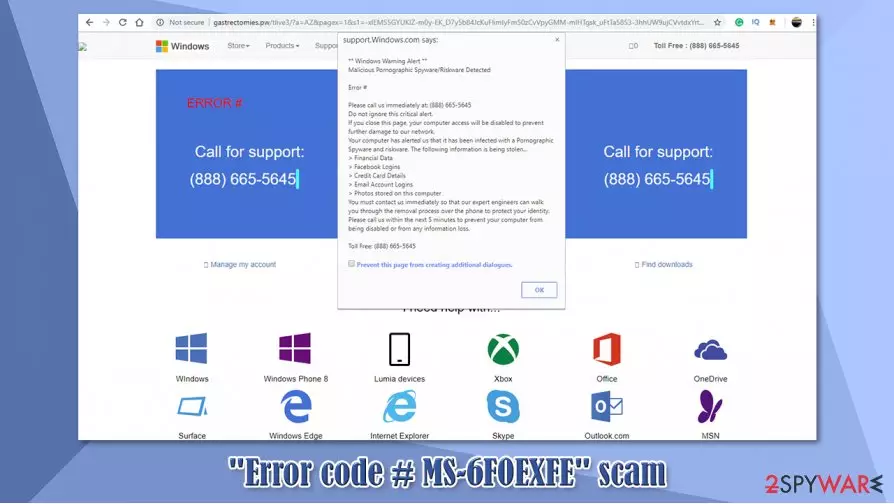
“Error code # MS-6F0EXFE” is a technical support scam that might come up during various circumstances while browsing the web, regardless of which web browser is used – MS Edge, Google Chrome, or Mozilla Firefox. As soon as visitors land on a malicious page, they are met with a popup, which can be described as a typical attempt to greatly mislead the users about their computer security state by claiming various malware infections. Additionally, to scare the users even more, malicious actors also claim that credit card, a Facebook password, and other sensitive information has been stolen.
“Error code # MS-6F0EXFE” scam then proceeds with an alleged remediation scheme: all victims have to do is to call the alleged Microsoft technicians, and they will “happily” help with removal and recovery. This is followed by a small reminder that the call needs to be performed within five minutes, or the computer will be locked and “full damage” attained. Without a doubt, this is a hoax and should never be trusted, so check out below on what to do next.
| Name | “Error code # MS-6F0EXFE” scam |
| Type | Tech support scam, fake alert, online hoax |
| Distribution | Can be encountered due to adware redirects, or after being rerouted from another malicious site (for example, after clicking on a deceptive link) |
| Claims | The message claims that the alleged error # MS-6F0EXFE was encountered by the visitor due to a “virus and spyware” infection. As a result, personal information is being stolen, and the computer is locked. To resolve this, users are asked to call the fake Microsoft technicians |
| Dangers | Installation of malware, financial losses, identity theft |
| Contact number | 0466 90 17 99, although the number can vary from site to site |
| Solution | Never call the provided number, and leave the site immediately. Additionally, you should check your machine for adware – uninstall all suspicious programs as explained below |
| Further checks | If you contacted the fake tech support, you should immediately change all your passwords, scan your computer with anti-malware, and then fix possible virus damage with FortectIntego or similar repair software |
Tech support scams such as “Error code # MS-6F0EXFE” are surprisingly common and can be encountered on numerous websites. The messages are usually localized, which means that users get to read it in their language. For example, this particular scam is common among Dutch users, although it can be encountered virtually anywhere.
“ERROR # 0x6a4-0xf9fx3999,” “Windows Error Code: DLL011150,” and “ERROR # ER36dx9832(3)” are just a few examples or almost identical scams being spread around the web. In some cases, the contents of the fake alert are virtually identical; the crooks just come up with new fake error codes.
Speaking of which, “Error code # MS-6F0EXFE” is completely fake – it is not a legitimate Microsoft code. This social engineering[1] tactic is used to confuse Windows users and make them believe that the alert is actually coming from the tech giant Microsoft. While in most cases, you might end up on a malicious page by accident, adware[2] might sometimes be the culprit of the redirects.
“Error code # MS-6F0EXFE” scam removal might sometimes be only performed after adware is eliminated from the computer. Adware, otherwise known as ad-supported software, is known to redirect users to malicious websites that show fraudulent messages or attempt to make visitors download malicious software. That being said, just because you encountered a scam, chances are your computer is not infected, and you were simply unlucky to end up on a malicious page.

In most cases, you can delete such apps manually, as we explain below. If you want a quick solution, however, you should perform a full system scan with security software, such as SpyHunterCombo Cleaner or MalwarebytesMalwarebytes. Experts[3] also advise checking the system with FortectIntego if something was detected by anti-malware to fix virus damage if such occurred during the infection.
How crooks exploit less IT-savvy individuals for their own financial gain
We can assure you that “Error code # MS-6F0EXFE” has nothing to do with the real Microsoft company, and there are several factors that would confirm it immediately. Here's the full message that users receive (although there are plenty of different scam versions around the web):
Error code # MS-6F0EXFE
Call us immediately on: 0466 90 17 99
Do not ignore this important warning.
Closing this page will disable access to your Computer to prevent further damage to our network.Your Computer has warned us that it is infected with a virus and spyware. The following data has been stolen.
1. Facebook login
2. Credit Card Information
3. Log in to the email account
4. Photos stored on PC.Our technicians will be happy to help you with the removal and recovery.
Call us within 5 minutes to avoid complete damageCall Microsoft immediately free of charge on: 0466 90 17 99
One of the main pointers that “Error code # MS-6F0EXFE” is a scam is that it uses several claims that simply can not be true. The fake alert uses Microsoft attributes, such as the company logo and the error code similar to those legitimate ones that users should have encountered before. Microsoft, however, would never provide a phone number within their warnings/alerts, so please only contact support by calling the number from the official website.
Second, since the “Error code # MS-6F0EXFE” virus alert is shown within the web browser, it makes it automatically fake. None of the web browsers can diagnose your computer security health unless they use malware to break into your system – which is also illegal.
Finally, all the tech support scammers always rely on some type of threat. They either claim that the logins and passwords, credit card details, and other sensitive information is compromised or that the computer will be locked/personal files deleted.
Unfortunately for those who do contact the fake “Error code # MS-6F0EXFE” virus authors might be subjected to further bogus claims about computer health. In most cases, crooks ask victims to allow them remote access (they might implant malware during this time) or make purchases of fake security software.
The best thing to do is remove “Error code # MS-6F0EXFE” popup by closing down the browser tab immediately and never contacting the fake technicians. Otherwise, you might suffer from serious financial losses, malware infections, or even identity theft.

Adequate ways to deal with “Error code # MS-6F0EXFE” scam
As previously mentioned, the “Error code # MS-6F0EXFE” popup or redirect surely does not mean that your computer is infected or that your passwords are being leaked. If you were among the unlucky ones who was tricked into calling criminals and paying them money or allowing them to access your device remotely, you should:
- Change passwords for all your accounts that were saved on your computer/browser;
- Contact your bank – it should be possible to revert the transaction in case of fraud;
- Scan the machine with powerful security software to ensure no malware was installed during a remote access session.
If you have not called the number, you should be safe. In an unrelated case, however, you might have adware on your system installed, so a full “Error code # MS-6F0EXFE” virus removal can only be accomplished after this potentially unwanted software is deleted from the system – you can either follow the manual guide below or employ security software that would find and eliminate all the malicious components automatically.
Uninstall from Windows
Uninstall from Windows 10/8:
- Type Control Panel into the Windows search box and open the result.
- Under Programs, select Uninstall a program.


Uninstall from Windows 7/XP:
- Click on Windows Start > Control Panel (Windows XP users should click on Add/Remove Programs).
- In Control Panel, select Programs > Uninstall a program.


Remove the unwanted program:
- In the Programs and Features window, look for any recently installed suspicious entries, select them, and click Uninstall.
- If User Account Control appears, click Yes to confirm, then complete the removal.


Delete from macOS
Remove the unwanted application:
- From the menu bar, select Go > Applications.
- In the Applications folder, look for any suspicious entries, then drag them to Trash (or right-click and pick Move to Trash).


Delete leftover files and folders:
- Select Go > Go to Folder.
- Enter /Library/Application Support and remove any suspicious folders related to the unwanted program.
- Repeat the same check in the /Library/LaunchAgents and /Library/LaunchDaemons folders, deleting any suspicious entries.

- Finally, empty the Trash to permanently remove the leftovers.

Reset Internet Explorer
Remove dangerous add-ons:
- Open Internet Explorer, click on the Gear icon (IE menu) on the top-right corner of the browser
- Pick Manage Add-ons.
- You will see a Manage Add-ons window. Here, look for suspicious plugins. Click on these entries and select Disable.


Change your homepage if it was altered:
- Open IE and click on the Gear icon.
- Select Internet Options.
- In the General tab, delete the Home page address and replace it by your preferred one (for example, Google.com).
- Click Apply and then select OK.


Delete temporary files:
- Press on the Gear icon and select Internet Options.
- Under Browsing history, click Delete...
- Select relevant fields and press Delete.


Reset Internet Explorer:
- Click on Gear icon > Internet options and select Advanced tab.
- Select Reset.
- In the new window, check Delete personal settings and select Reset.


Remove from Microsoft Edge
Delete unwanted extensions from MS Edge:
- Select Menu (three horizontal dots at the top-right of the browser window) and pick Extensions.
- From the list, pick the extension and click on the Gear icon.
- Click Remove.


Clear cookies and other browser data:
- Click on the Menu (three horizontal dots at the top-right of the browser window) and select Settings > Privacy, search, and services..
- Under Clear browsing data, pick Choose what to clear.
- Select Cookies and other site data and Cached images and files. (apart from passwords, although you might want to include Media licenses as well, if applicable) and click on Clear.


Restore new tab and homepage settings:
- Click the menu icon and choose Settings.
- Then find On startup section.
- Click Remove next to any suspicious startup page.
Reset MS Edge if the above steps did not work:
- Press on Ctrl + Shift + Esc to open Task Manager.
- Click on More details arrow at the bottom of the window.
- Select Details tab.
- Now scroll down and locate every entry with Microsoft Edge name in it. Right-click on each of them and select End Task to stop MS Edge from running.


Instructions for Chromium-based Edge
Delete extensions from MS Edge (Chromium):
- Open Edge and click select Settings > Extensions.
- Delete unwanted extensions by clicking Remove.


Clear cache and site data:
- Click on Menu and go to Settings.
- Select Privacy, search and services.
- Under Clear browsing data, pick Choose what to clear.
- Under Time range, pick All time.
- Select Clear now.


Reset Chromium-based MS Edge:
- Click on Menu and select Settings.
- On the left side, pick Reset settings.
- Select Restore settings to their default values.
- Confirm with Reset.
- This will disable extensions and reset startup pages but will not delete bookmarks, saved passwords, or browsing history.


Remove from Mozilla Firefox (FF)
Remove dangerous extensions:
- Open Mozilla Firefox browser and click on the Menu (three horizontal lines at the top-right of the window).
- Select Add-ons.
- In here, select the unwanted extension and click Remove.


Reset the homepage:
- Click three horizontal lines at the top right corner to open the menu.
- Choose Settings.
- Under Home, set your preferred homepage and new tab settings.
Clear cookies and site data:
- Click Menu and pick Settings.
- Go to Privacy & Security section.
- Scroll down to locate Cookies and Site Data.
- Click on Clear Data...
- Select Cookies and Site Data and Temporary cached files and pages, then click Clear.


Reset Mozilla Firefox
If clearing the browser as explained above did not help, reset Mozilla Firefox:
- Open Mozilla Firefox browser and click the Menu.
- Go to Help and then choose Troubleshooting Information.

- Under Give Firefox a tune up section, click on Refresh Firefox...
- Once the pop-up shows up, confirm the action by pressing on Refresh Firefox.



Remove from Google Chrome
Delete malicious extensions from Google Chrome:
- Open Google Chrome, click on the Menu (three vertical dots at the top-right corner) and select More tools > Extensions.
- In the newly opened window, you will see all the installed extensions. Uninstall all suspicious extensions related to the unwanted program by clicking Remove.


Clear cache and web data from Chrome:
- Click on Menu and pick Settings.
- Under Privacy and security, select Clear browsing data.
- Select Browsing history, Cookies and other site data, as well as Cached images and files.
- Click Clear data.


Change your homepage:
- Click menu and choose Settings.
- Look for a suspicious site in the On startup section.
- Click on Open a specific or set of pages and click on three dots to find the Remove option.
Reset Google Chrome:
If the previous methods did not help you, reset Google Chrome to eliminate all the unwanted components:
- Click on Menu and select Settings.
- In the Settings, scroll down and click Advanced.
- Scroll down and locate Reset and clean up section.
- Now click Restore settings to their original defaults.
- Confirm with Reset settings.


Delete from Safari
Remove dangerous extensions:
- Open Safari, click Safari in the menu at the top-left of the screen, and select Preferences.
- Go to the Extensions tab, look for any suspicious entries, and click Uninstall to remove them.


Clear history and website data:
- Click Safari in the menu and pick Clear History.
- Set Clear to all history and confirm with Clear History.


Reset Safari:
- Click Safari in the menu and select Preferences > Advanced.
- Enable Show Develop menu in menu bar.
- From the menu bar, click Develop and select Empty Caches.


Did this guide help?
Be the first to comment