

Govtsearches.com takes over browsers and insists on using it
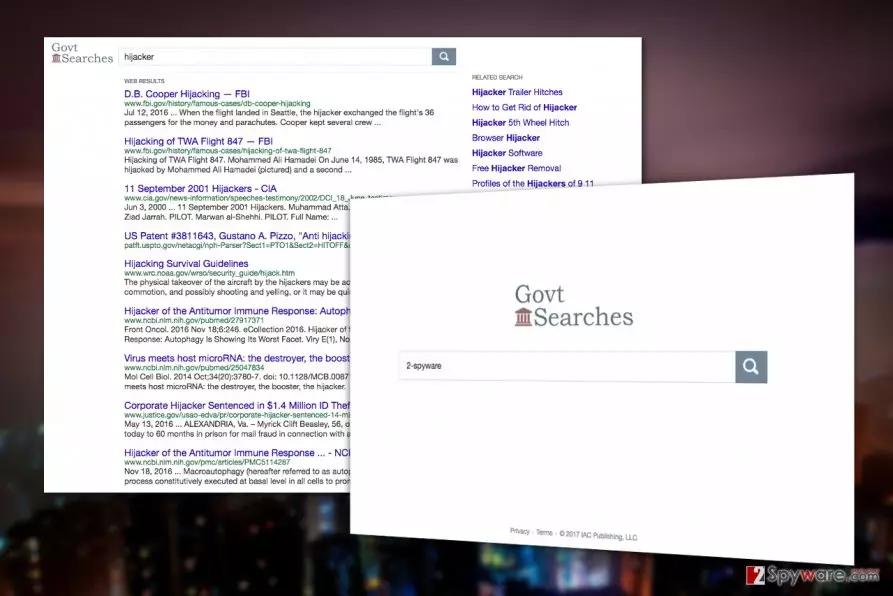
Govtsearches.com is a search-oriented website hosted by a California-based company called IACpublishing. Interestingly enough, within the site’s Privacy Policy we found a mention of another actor — Mindspark Interactive.
You may have heard the name of this company before in a different context, most likely related to questionable computer programs, browser helper objects or applications.
Normally, the company products are not malicious or capable of damaging computers like, say, a ransomware virus [1] would do. Nevertheless, they can be annoying and quite intrusive due to their unauthorized appearance and behavior on the computers.
Govtsearches is a good example of such a program. It shows up on the computer without user’s permission and tries to remain installed for as long as possible. The Govt search engine also replaces your default search engine and will redirect you to this search page every time you launch your web browser, open a new tab or browser window.
We can assure you that there is no need to refrain from Govtsearches.com removal or the elimination of any other unwanted program [2] you find on your computer. You should remove them manually (using the guidelines below the article) or automatically (using FortectIntego or similar security software) without hesitation.
Besides, upon further investigation of the website’s Privacy Policy, we’ve found even more evidence which may easily become reasons not to rely on the software a full 100 %.

All the negative traits of this service primarily boil down to two things: data collection and advertising.
The site owners admit to collecting a number of different pieces of information including computer’s IP address or mobile device’s identifier, technical data about your PC of mobile device (platform type, browser and connection-related information), Internet provider, URLs of the visited websites, geo-location of the computer’s of mobile device’s whereabouts and more.
On top of it all, the developers claim that by using the software, users:
[…] acknowledge, consent, and agree that IACP may access, preserve, and disclose your account information and/or any content you submit or make available for inclusion on the Site and/or Services, if required to do so by law or in a good faith belief that such access, preservation, or disclosure is reasonably necessary for any of the following reasons: (1) to comply with legal process; (2) to enforce these Terms of Service; (3) to respond to claims that any content violates the rights of third parties; (4) to protect the rights, property, or personal safety of IACP, its users, and the public; or (5) to respond to your requests for customer service.
If you don’t agree with these terms which basically state that the service providers may do anything they want with the data collected about you, please remove Govtsearches.com right away.
Malware distribution works like a clockwork mechanism
Have you ever thought why potentially unwanted programs are so widespread? The main reason probably related to their well-developed distribution strategies.
Of course, one of the most obvious one is the direct distribution via official websites. This means that you can come across the website while browsing online yourself and set it as your default search engine voluntarily.
What the program developers decide to keep undisclosed is that Govtsearches.com also travels bundled inside freeware and shareware packages, so you can agree to install it on your computer completely unknowingly. You can protect yourself from accidental installs in three steps:
- Keeping away from unreputable websites and avoiding suspicious downloads
- Taking time to scan the downloaded software package with trusted antivirus utility.
- Opting for the Advanced or Custom modes to disclose additional software package components.
Suggestions on completing Govtsearches.com removal
Govtsearches.com removal is relatively easy, and you should not worry much about it. The procedure does not take too long to perform both manually and automatically, thus it purely relies on your own preference which of these methods you are going to choose.
Either way, the PUP cannot stay on the computer for too long. If you choose to remove Govtsearches.com manually, there is no quicker way to do it than scrolling below this article and following the provided instructions.
Uninstall from Windows
Uninstall from Windows 10/8:
- Type Control Panel into the Windows search box and open the result.
- Under Programs, select Uninstall a program.


Uninstall from Windows 7/XP:
- Click on Windows Start > Control Panel (Windows XP users should click on Add/Remove Programs).
- In Control Panel, select Programs > Uninstall a program.


Remove the unwanted program:
- In the Programs and Features window, look for any recently installed suspicious entries, select them, and click Uninstall.
- If User Account Control appears, click Yes to confirm, then complete the removal.


Delete from macOS
Remove the unwanted application:
- From the menu bar, select Go > Applications.
- In the Applications folder, look for any suspicious entries, then drag them to Trash (or right-click and pick Move to Trash).


Delete leftover files and folders:
- Select Go > Go to Folder.
- Enter /Library/Application Support and remove any suspicious folders related to the unwanted program.
- Repeat the same check in the /Library/LaunchAgents and /Library/LaunchDaemons folders, deleting any suspicious entries.

- Finally, empty the Trash to permanently remove the leftovers.

Reset Internet Explorer
Remove dangerous add-ons:
- Open Internet Explorer, click on the Gear icon (IE menu) on the top-right corner of the browser
- Pick Manage Add-ons.
- You will see a Manage Add-ons window. Here, look for suspicious plugins. Click on these entries and select Disable.


Change your homepage if it was altered:
- Open IE and click on the Gear icon.
- Select Internet Options.
- In the General tab, delete the Home page address and replace it by your preferred one (for example, Google.com).
- Click Apply and then select OK.


Delete temporary files:
- Press on the Gear icon and select Internet Options.
- Under Browsing history, click Delete...
- Select relevant fields and press Delete.


Reset Internet Explorer:
- Click on Gear icon > Internet options and select Advanced tab.
- Select Reset.
- In the new window, check Delete personal settings and select Reset.


Remove from Microsoft Edge
Delete unwanted extensions from MS Edge:
- Select Menu (three horizontal dots at the top-right of the browser window) and pick Extensions.
- From the list, pick the extension and click on the Gear icon.
- Click Remove.


Clear cookies and other browser data:
- Click on the Menu (three horizontal dots at the top-right of the browser window) and select Settings > Privacy, search, and services..
- Under Clear browsing data, pick Choose what to clear.
- Select Cookies and other site data and Cached images and files. (apart from passwords, although you might want to include Media licenses as well, if applicable) and click on Clear.


Restore new tab and homepage settings:
- Click the menu icon and choose Settings.
- Then find On startup section.
- Click Remove next to any suspicious startup page.
Reset MS Edge if the above steps did not work:
- Press on Ctrl + Shift + Esc to open Task Manager.
- Click on More details arrow at the bottom of the window.
- Select Details tab.
- Now scroll down and locate every entry with Microsoft Edge name in it. Right-click on each of them and select End Task to stop MS Edge from running.


Instructions for Chromium-based Edge
Delete extensions from MS Edge (Chromium):
- Open Edge and click select Settings > Extensions.
- Delete unwanted extensions by clicking Remove.


Clear cache and site data:
- Click on Menu and go to Settings.
- Select Privacy, search and services.
- Under Clear browsing data, pick Choose what to clear.
- Under Time range, pick All time.
- Select Clear now.


Reset Chromium-based MS Edge:
- Click on Menu and select Settings.
- On the left side, pick Reset settings.
- Select Restore settings to their default values.
- Confirm with Reset.
- This will disable extensions and reset startup pages but will not delete bookmarks, saved passwords, or browsing history.


Remove from Mozilla Firefox (FF)
Remove dangerous extensions:
- Open Mozilla Firefox browser and click on the Menu (three horizontal lines at the top-right of the window).
- Select Add-ons.
- In here, select the unwanted extension and click Remove.


Reset the homepage:
- Click three horizontal lines at the top right corner to open the menu.
- Choose Settings.
- Under Home, set your preferred homepage and new tab settings.
Clear cookies and site data:
- Click Menu and pick Settings.
- Go to Privacy & Security section.
- Scroll down to locate Cookies and Site Data.
- Click on Clear Data...
- Select Cookies and Site Data and Temporary cached files and pages, then click Clear.


Reset Mozilla Firefox
If clearing the browser as explained above did not help, reset Mozilla Firefox:
- Open Mozilla Firefox browser and click the Menu.
- Go to Help and then choose Troubleshooting Information.

- Under Give Firefox a tune up section, click on Refresh Firefox...
- Once the pop-up shows up, confirm the action by pressing on Refresh Firefox.



Remove from Google Chrome
Delete malicious extensions from Google Chrome:
- Open Google Chrome, click on the Menu (three vertical dots at the top-right corner) and select More tools > Extensions.
- In the newly opened window, you will see all the installed extensions. Uninstall all suspicious extensions related to the unwanted program by clicking Remove.


Clear cache and web data from Chrome:
- Click on Menu and pick Settings.
- Under Privacy and security, select Clear browsing data.
- Select Browsing history, Cookies and other site data, as well as Cached images and files.
- Click Clear data.


Change your homepage:
- Click menu and choose Settings.
- Look for a suspicious site in the On startup section.
- Click on Open a specific or set of pages and click on three dots to find the Remove option.
Reset Google Chrome:
If the previous methods did not help you, reset Google Chrome to eliminate all the unwanted components:
- Click on Menu and select Settings.
- In the Settings, scroll down and click Advanced.
- Scroll down and locate Reset and clean up section.
- Now click Restore settings to their original defaults.
- Confirm with Reset settings.


Delete from Safari
Remove dangerous extensions:
- Open Safari, click Safari in the menu at the top-left of the screen, and select Preferences.
- Go to the Extensions tab, look for any suspicious entries, and click Uninstall to remove them.


Clear history and website data:
- Click Safari in the menu and pick Clear History.
- Set Clear to all history and confirm with Clear History.


Reset Safari:
- Click Safari in the menu and select Preferences > Advanced.
- Enable Show Develop menu in menu bar.
- From the menu bar, click Develop and select Empty Caches.


Did this guide help?
Be the first to comment