
MacRapidizer ads on Mac: what it is and how to remove it
MacRapidizer is a false optimization tool created to allegedly improve the functionality of MacOS. However, this system tool is considered to be a potentially unwanted program as it infiltrates the system thru a deceptive marketing technique called "bundling" and then displays exaggerated alerts to sell its license. This page covers it on macOS.
Facts checked October 7, 2026. Removal steps checked against Apple's current documentation and the security vendors' reports. We have not run the malware on a Mac. Sections marked as our earlier report are the original text: they describe the threat as it was then and have not been reviewed since. The 2026 status, the removal steps and the questions are current.
Automatic
Get a free scan and check if your Mac is infected.
Fortect for Mac scans for malware and unwanted programs, and its free scan shows what it finds before you decide anything.
If redirects to novirus.uk keep coming back, a free scan can check extensions, programs and browser settings in one pass.
Do it yourself · free Remove MacRapidizer ads yourself 4 steps, about 12 minutes, no software needed.
Start the steps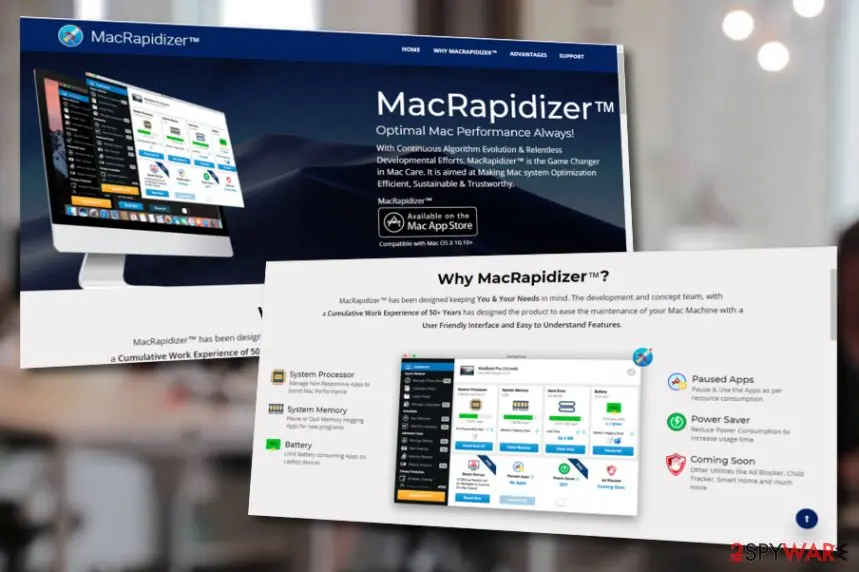
MacRapidizer ads: summary
| Distribution | "Bundling" technique and the official page are the main ways used to spread this tool |
|---|---|
| Name | MacRapidizer |
| Type | System tool |
| Sub-type | PUP/Mac virus |
| Operating system | MacOS |
| Similar programs | Mac Auto Fixer Mac Cleanup Pro; Similar Photo Cleaner; Mac Tonic; Advanced Mac Cleaner |
| Removal | Scan the Mac with security software to find the malware and anything installed with it. Fortect for Mac scans for malware and unwanted programs. Remove it nowTo use the full-featured product, you have to purchase a license for Fortect. The scan is free. |
Show 11 more facts
| Main aim | To convince people into buying the full version |
|---|---|
| Possible dangers | Although this program is not dangerous itself, it might trick you into buying the licensed version which is a useless app |
| Symptoms | Displays false warnings about system issues; Interrupts with sponsored pop-ups; Redirects to its purchase page |
| Detection names | No Microsoft detection name is known |
| Damage | Not recorded in the old report |
| Evidence | 5 write-ups by security sites; details still limited |
| Domains | novirus.uk |
| Ads shown as | Redirects through ad pages |
| Browsers | Chrome, Edge and Firefox |
| First seen | 12 November 2018 |
| Facts checked | 7 October 2026 |
What the MacRapidizer ads ads look like
35 startup item(s) can be Managed to improve the Mac Speed
Is MacRapidizer ads dangerous?
From our report of Nov 2018 · not reviewed since
MacRapidizer - a fake system optimization tool which provides numerous advantages to trick users into buying license
MacRapidizer is a false optimization tool created to allegedly improve the functionality of MacOS.
However, this system tool is considered to be a potentially unwanted program as it infiltrates the system thru a deceptive marketing technique called "bundling" and then displays exaggerated alerts to sell its license. As a result, people sometimes do not notice how the unwanted app got into their computer system.
However, if you spot this fake optimizer, you should remove MacRapidizer as it will only try to trick you. This program offers a "wide range of abilities" - cleaning browser history, taking care of some computer issues, and so on. In reality, these "powers" are used just to trick users into buying the full version.
Make sure you are careful and do not fall for these fake errors as their elimination won't improve your Mac's functionality. Even more, the tool will try to convince you to buy the full version in order to "take care of the problems". Make sure you deny this suggestion too.
Fake system tools such as MacRapidizer virus are created only to bring profit for the developers. You can test its usefulness by installing a reputable anti-malware tool.
Once you do so, perform a full computer system scan and measure the results with the ones provided by the fake system optimization tool. We are sure that you will see a big difference here and all the errors that were shown by the fake app appear to be truly false.
Nevertheless, MacRapidizer can also display annoying advertising posts which promote the unwanted application itself. This way, developers seek to gain the users' attention and get them interested in the offered product. However, in most of the cases, ads from this tool read the following:
As a result, because of its ability to scare people that their computers have many system issues which can only be fixed by the purchased full version of the software, this system tool can also be called "scareware."
Due to all beforementioned reasons, you should get rid of MacRapidizer from your computer system with all its components permanently. Even though this Mac optimization tool promotes itself as "the best Mac cleaning tool", this is all just one big lie. Get rid of the potentially unwanted program by using reliable antivirus programs. If you are looking for the repair and optimization software, use instead.
We have provided them for you so that the elimination process would be easier to carry out. However, you need to make sure that the PUP does not leave any components on your web browser. If it did - pay big attention and delete all browser extension and add-ons that were added by the cyber threat.

From our report of Nov 2018 · not reviewed since
Avoid secret PUP infiltration and do not install the app manually
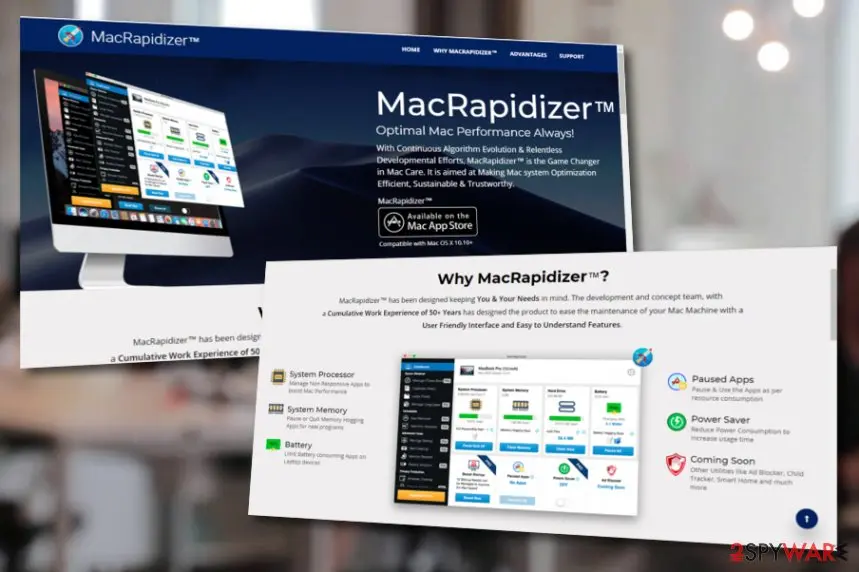
According to cybersecurity specialists from NoVirus.uk , fake system tools can be promoted by their own original websites.
Developers create official sites for their products and try to present them as useful as they can. However, if you enter such site, try not to get tricked by the nice appearance and the following features:
Moreover, potentially unwanted applications, including fake system optimizers, can enter the system thru "bundling". The rogue application comes together will regular software that you download and install from the Internet. Good news, you can take some actions against this unwanted installation. All you have to do is choose the Custom/Advanced installation mode and you will be able to control all incoming downloads.
- System Processor;
- System memory;
- Battery;
- Paused apps;
- Power saver;
- Ad Blocker;
- Child tracker;
- Smart Home.
From our report of Nov 2018 · not reviewed since
More from our earlier report on MacRapidizer
- Install to detect all unwanted content on your Mac
Check your browser and PC
- Address:
novirus.uk
How to remove MacRapidizer ads
How to remove MacRapidizer from a Mac
Remove the app and what starts it, then check the browsers.
Step 1: Delete apps and downloads you did not intend to install
Open the Applications folder and your Downloads folder. Drag any app you did not install, and any disk image (
.dmg), installer (.pkg) or archive (.zip) that came from MacRapidizer or a site you do not trust, to the Bin, then empty the Bin.Also check
~/Library/Application Supportfor a folder with the same name as the app you removed.Step 2: Remove unknown login items and background items
Open System Settings > General > Login Items & Extensions. Under Open at Login and Allow in the Background, switch off or remove anything you do not recognize, especially items whose developer is shown as an unknown name or that appeared on the day you ran the command.
Then open Finder, choose Go > Go to Folder and check
~/Library/LaunchAgents,/Library/LaunchAgentsand /Library/LaunchDaemons for property list (.plist) files you did not add. Drag suspicious ones to the Bin, then restart the Mac.Step 3: Check the browsers for extensions and changed settings
In Safari open Settings > Extensions and General (homepage). In Chrome open
chrome://extensions, in Firefoxabout:addons.Remove any extension you did not add, and reset the homepage and search engine if they changed. Browsers hold saved passwords and cookies, which is why the password step comes first.
Step 4: Quit what is running that you do not recognize
Open Activity Monitor (in Applications > Utilities, or search for it with Command + Space).
In the CPU or Network tab, look for a process you did not install or whose name is random, select it, click the stop button (the octagon with an X) and choose Quit or Force Quit.
Note the name first: you will look for the same name in the next steps. Malware that comes back after a restart is handled in the next two steps.
Instructions for each browser and system
The detailed steps for every browser and system this guide covers. Open the one you use.
Delete from macOS
To delete MacRapidizer from Mac OS, follow these guidelines. Before that, make sure you terminate randomly named executable files in your computer's Activity Monitor:
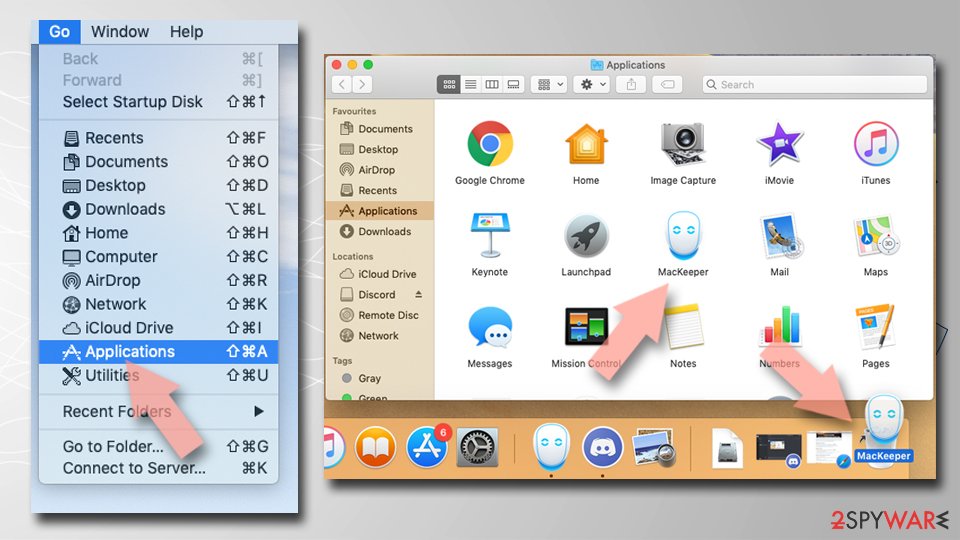
Remove the unwanted application:
- From the menu bar, select Go > Applications.
- In the Applications folder, look for any suspicious entries, then drag them to Trash (or right-click and pick Move to Trash).
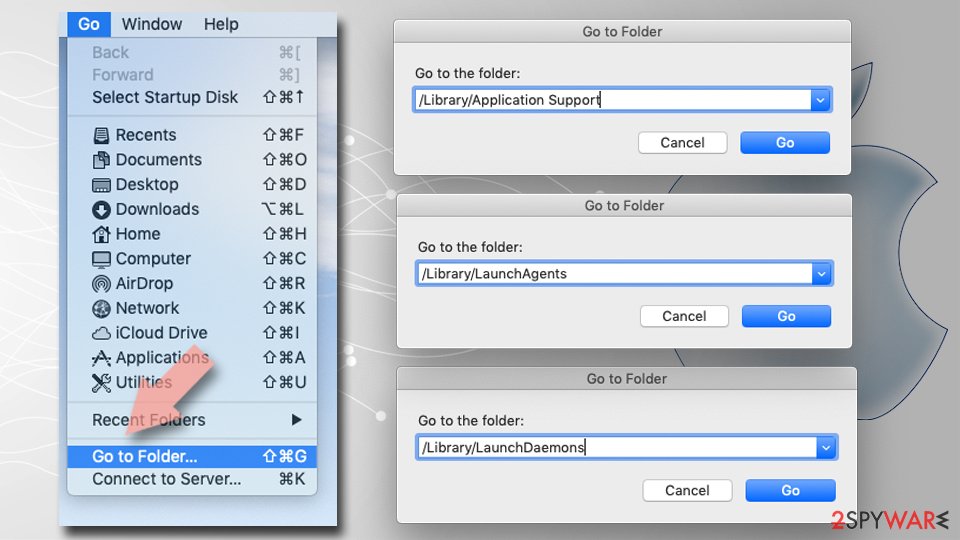
Delete leftover files and folders:
- Select Go > Go to Folder.
- Enter /Library/Application Support and remove any suspicious folders related to the unwanted program.
- Repeat the same check in the /Library/LaunchAgents and /Library/LaunchDaemons folders, deleting any suspicious entries.
- Finally, empty the Trash to permanently remove the leftovers.
Protect your privacy - employ a VPN
There are several ways how to make your online time more private - you can access an incognito tab.
However, there is no secret that even in this mode, you are tracked for advertising purposes. There is a way to add an extra layer of protection and create a completely anonymous web browsing practice with the help of VPN. This software reroutes traffic through different servers, thus leaving your IP address and geolocation in disguise.
Besides, it is based on a strict no-log policy, meaning that no data will be recorded, leaked, and available for both first and third parties. The combination of a secure web browser and VPN will let you browse the Internet without a feeling of being spied or targeted by criminals.
No backups? No problem. Use a data recovery tool
If you wonder how data loss can occur, you should not look any further for answers - human errors, malware attacks, hardware failures, power cuts, natural disasters, or even simple negligence.
In some cases, lost files are extremely important, and many straight out panic when such an unfortunate course of events happen. Due to this, you should always ensure that you prepare proper data backups on a regular basis.
If you were caught by surprise and did not have any backups to restore your files from, not everything is lost. is one of the leading file recovery solutions you can find on the market - it is likely to restore even lost emails or data located on an external device.
From our report of Nov 2018 · not reviewed since
Remove MacRapidizer to truly improve your Mac's speed
You can remove MacRapidizer virus by using anti-malware software.
These programs will ensure you that the entire process will be completed safely and effectively. However, if you decide to get rid of the cyber threat on your own, make sure you delete all rogue components from all infected web browsers such as Google Chrome, Mozilla Firefox, Microsoft Edge, Internet Explorer, and Safari by resetting these web browsers.
Performing the MacRapidizer removal is necessary if you want to get rid of all the annoying pop-ups and pop-unders that show because you have this potentially unwanted program installed on your system. If you are keen on protecting your computer system from various infections or taking care of system-related issues, make sure you download and install a trustworthy tool which will help you fix all problems.
Questions about MacRapidizer ads
How do I stop novirus.uk from opening?
Find and remove whatever opens it. Start with the browser's extensions page and remove anything you do not remember adding. Next, open the notification settings and take away permission from sites you do not recognise.
Then check Settings > Apps > Installed apps for programs added around the day the redirects began, and uninstall those. Restart the browser and test a few links after each step.
If novirus.uk still appears, reset the browser, which restores the default search engine, start page and permissions without deleting bookmarks or saved passwords. Redirects that survive a reset in every browser point to a program in Windows, and a full scan is the next step.
Should I worry about redirects to novirus.uk?
Worry less about novirus.uk itself and more about what keeps sending you there. A single redirect from a free streaming or download site is normal and harmless once the tab is closed.
Repeated redirects on sites that used to work fine mean something in the browser or in Windows changed, often an extension or program installed alongside other software. It may also collect the pages you visit. Remove the cause with the steps in this guide, and do not act on anything the redirected pages ask:
- no Allow clicks
- no downloads
- no calls
If you already did one of those, the matching section of this guide explains what to do next.
Why does MacRapidizer show me ads?
Because that is its whole purpose. MacRapidizer is an adware extension, and its operators are paid for every ad it displays and every click it gets. In this case the ads take the form of redirects through ad pages.
They are chosen by ad networks that accept almost any advertiser, which is why so many look like warnings or prizes. The ads are not a sign that your PC is broken or infected with something worse; they are a sign that something on it, or in the browser, has permission to advertise. Removing that permission or program stops them.
Do I have to clean every browser?
Yes, if you use more than one. We saw MacRapidizer in Chrome, Edge and Firefox, and each browser keeps its own extensions, notification permissions and settings. Chrome and Edge share the same extension format, so one installer can add the same adware to both, while Firefox has its own add-ons.
Check every browser on the PC, including ones you rarely open. If you sync a browser with an account, clean it while signed in, so that the removal reaches your other computers rather than the adware returning from them.
How do I know the ads come from MacRapidizer?
Look for redirects to novirus.uk. That is the trace MacRapidizer leaves, and it shows up as redirects through ad pages. Ads that appear on every site, including ones that never carried ads before, point to something on your PC or in the browser rather than to the sites themselves.
A quick test is a private window, where extensions are off by default: if the ads disappear there, an extension is responsible. If they appear even with the browser closed, the source is a notification permission or a program in Windows.
Can adware slow down my PC?
Yes. Adware runs in the background, loads ad scripts, opens extra tabs and contacts its servers, all of which use processor time, memory and bandwidth. Ad-heavy extensions also slow down every page, because they inspect and change it before you see it.
The effect is strongest on older PCs and when several adware programs arrived together. After removal, restart the PC and check Task Manager for anything still using a lot of resources that you do not recognise. Speed usually returns to normal once the ads stop.
Does adware steal passwords?
Ordinary adware is built to show ads, not to steal logins, and most of it never touches saved passwords. The line is blurry, though. Extensions that can read every page could capture what you type, and adware ads sometimes lead to phishing pages that ask for passwords directly.
If you entered credentials on a page reached through an ad, change that password from a clean device and turn on two-step verification. Otherwise, removing adware extension and clearing cookies is usually enough.
An ad showed a phone number and I called it. What now?
The number belongs to scammers, not to Microsoft or an antivirus company. If you only talked, hang up and do not call back. If you let them connect to the PC, disconnect it from the internet, uninstall the remote access program they used, such as AnyDesk, TeamViewer, ScreenConnect or UltraViewer, and run a full and offline scan.
If you paid or gave bank details, call your bank at once on the number printed on your card. Change any passwords you typed while they were connected, and report the call.
I clicked on one of the ads. Am I infected?
Probably not. Clicking an ad usually only opens a page, and a page cannot install programs on an up-to-date Windows PC without your help.
You are at risk only if you then downloaded and ran a file, allowed notifications, entered card or login details, or called a phone number shown on the page. Delete any download and run a full and offline scan.
Change passwords you typed, from a clean device. Call your bank if you gave card details. If you called a number or allowed remote access, see the next question.
Will Fortect remove MacRapidizer?
Fortect for Mac scans for malware and unwanted programs, and its free scan shows what it finds on your Mac before you decide anything.
For MacRapidizer, follow the plan on this page as well: removing a launch item or an app is done in macOS itself, and a scanner cannot undo what was typed or entered on the infected Mac, such as saved passwords that were copied.
Change your passwords from another device first, and if the page tells you to erase the Mac, a scan is not a substitute. The free scan costs nothing and the full-featured product needs a license.
Sources
- Digital Unit: What is a Mac? (read October 7, 2026)
- Wikipedia: Scareware (read October 7, 2026)
- Search Security: PUP (potentially unwanted program) (read October 7, 2026)
- Google Chrome Help: Use notifications to get alerts (no longer online) (read October 7, 2026)
- FTC: How to recognize, remove and avoid malware (read October 7, 2026)