
MyMacUpdater: what it is and how to remove it
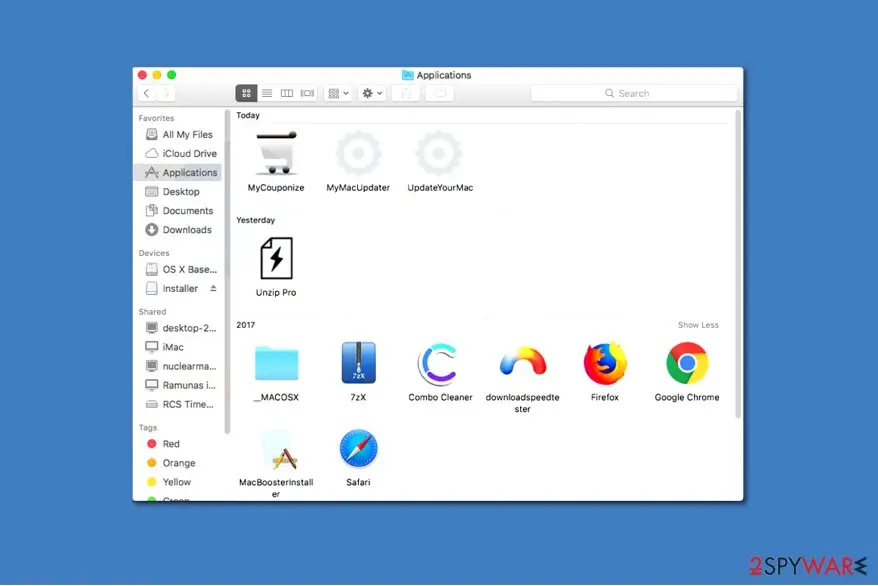
MyMacUpdater is a Mac virus that users typically install on their systems unintentionally while allowing apps from unofficial sources. While many security solutions mark it as a potentially unwanted program or adware, it has multiple characteristics that are common in malware.
Facts checked October 6, 2026. Removal steps checked against Apple's current documentation and the security vendors' reports. We have not run the malware on a Mac. Sections marked as our earlier report are the original text: they describe the threat as it was then and have not been reviewed since. The 2026 status, the removal steps and the questions are current.
Automatic
Get a free scan and check if your Mac is infected.
Fortect for Mac scans for malware and unwanted programs, and its free scan shows what it finds before you decide anything.
Programs like MyMacUpdater usually arrive in groups; a free scan lists the companions that are easy to miss.
Do it yourself · free Remove MyMacUpdater yourself 4 steps, about 12 minutes, no software needed.
Start the steps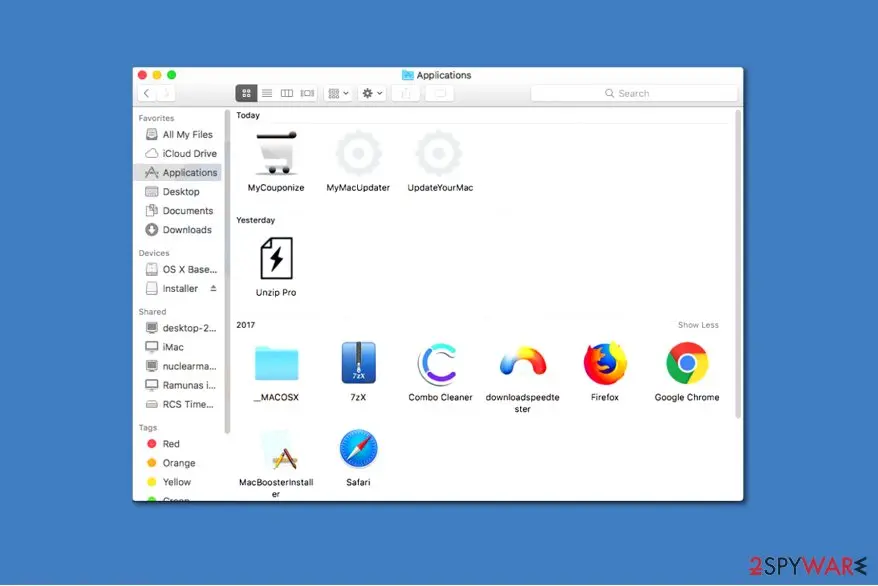
MyMacUpdater: summary
| Distribution | The unwanted app was found packaged along with other apps into a standalone installer – these are usually acquired from unapproved sources. MyMacUpdater is also known to be distributed with the help of fake Flash Player installers |
|---|---|
| Name | MyMacUpdater |
| Also known as | MacUpdater |
| Type | Potentially unwanted program, Mac virus |
| Related files | com.MyMacUpdater.agent.plist |
| Similar PUPs | Shopperify virus; My ShopMate ads; etc. |
| Removal | Scan the Mac with security software to find the malware and anything installed with it. Fortect for Mac scans for malware and unwanted programs. Remove it nowTo use the full-featured product, you have to purchase a license for Fortect. The scan is free. |
Show 7 more facts
| Symptoms | Changes a new tab URL, homepage and the search engine to www.weknow.ac Displays intrusive pop-ups asking to pay for the licenced version of the app Downloads and installs other potentially unwanted programs, such as OptiBuy Establishes background processes and connects to a remote server Slows down macOS signisficantly |
|---|---|
| Detection names | No Microsoft detection name is known |
| Damage | Not recorded in the old report |
| Evidence | 6 write-ups by security sites; details still limited |
| Program | MyMacUpdater |
| First seen | 14 February 2020 |
| Facts checked | 6 October 2026 |
Is MyMacUpdater safe? Why it is flagged
From our report of Feb 2020 · not reviewed since
MyMacUpdater is a potentially unwanted application that sets all web browser search engines to WeKnow.ac
MyMacUpdater is a Mac virus that users typically install on their systems unintentionally while allowing apps from unofficial sources.
While many security solutions mark it as a potentially unwanted program or adware, it has multiple characteristics that are common in malware. For example, MyMacUpdater changes web browser settings on Google Chrome, Safari, Mozilla Firefox, or another browser and applies weknow.ac as the main search engine and homepage. While typically this behavior is acceptable, MyMacUpdater virus prevents users from removing the search engine by applying malicious settings within the Mac.
Besides altering web browser settings, MyMacUpdater virus will also download other potentially unwanted programs on the system, such as Shopperify or OptiBuy. These crapware apps do not benefit users in any way but instead, fill their web browsers and Macs with obnoxious advertisements and offers to upgrade the software, cluttering and slowing down computers in the process.
Besides, automatic download and installation of PUAs on the system might indicate a far bigger problem - such as Shlayer Trojan infection. You should not delay MyMacUpdater removal, as you might compromise your online safety.
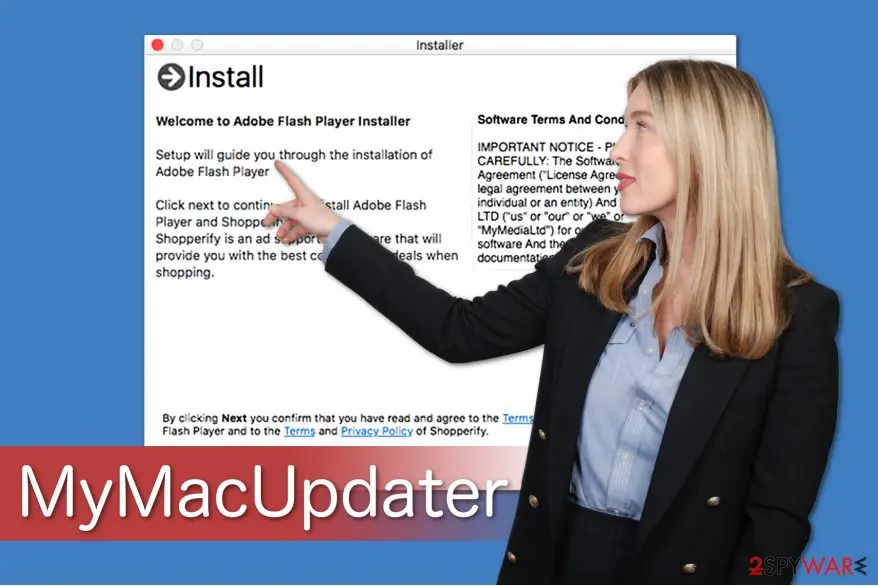
MyMacUpdater is borderline malware, so there is no surprise there that it is distributed with the help of unfair techniques, including software bundles and fake Flash Player installers. The latter is extremely popular among cybercriminals, as it works wonders when it comes to users who don't know anything about the software itself - it was so popularized throughout the years that they now associate Flash logo with a legitimate app.
However, it is far from the truth - stay away from MyMacUpdater and similar malware, as well as Adobe Flash (the latter is not malicious, but is fundamentally flawed and is about to be discontinued anyway).
Once inside the system, MyMacUpdater virus escalates its privileges by adding com.MyMacUpdater.agent.plist entry into the LaunchDaemons folder inside the Library - this allows the PUP to take over the Mac and manage its background processes. As a result, users may find suspicious applications installed on their systems without approval.
All the actions performed by MyMacUpdater to accomplish the main goal - help the developers to gain pay-per-click revenue from the user traffic brought to the affiliate pages. Unfortunately, the only party which benefits from such activity is the contrivers.
Besides portraying as a useful addition to any macOS, MyMacUpdater is designed to track its users and gather information about their browsing habits. However, some of that data might personally identify you and lead to serious privacy issues or even identity theft.
Some of the MyMacUpdater virus collected information may include:
This information is later used to alter the delivered ads to suit your interests. This way, developers are sure that you will be more attracted to click on the displayed commercial content and generate them revenue.
Sadly, they are not responsible for the content of the pages where MyMacUpdater redirect tendency leads you, so by clicking on those ads, you risk to end up on a suspicious page or malware distribution source. Likewise, this program is potentially dangerous, and you should get rid of it right away.
You can learn how to remove MyMacUpdater from Mac by following the instructions given below. However, ad-supported programs are inextricably linked to other PUPs, so you must uninstall them all. Thus, manual elimination is neither the safest nor the most convenient option.
Instead, get or another powerful security software for MyMacUpdater removal. If you suffer from stability or speed issues even after malware's termination, you can fix these problems with .
- IP address
- Geolocation
- ISP
- Search queries
- Links clicked
- Timestamp
- Cookies, etc.
From our report of Feb 2020 · not reviewed since
More from our earlier report on MyMacUpdater
- Due to possible MyMacUpdater connections to other malware, as well as erratic behavior and obfuscation, we highly recommend scanning the computer with anti-malware software, such as
- In case your Mac is still slow even after malware removal, you can clean it up with tools like
From our report of Feb 2020 · not reviewed since
The PUP infiltrates computers using very stealthy methods
All potentially unwanted programs have one common feature — they are distributed the same way.
Their developers spread the products via a marketing scheme called bundling, which hides the information about the PUP during the installation of free applications. Likewise, people do not notice when it sneaks into the system.
Experts report that people should not only wonder how to get rid of this PUP, but also take into account the precautionary measures to protect their computers in the future. For that, we suggest paying close attention during the installation of third-party software.
You must choose Custom or Advanced settings and de-select all marks which grand your permission to let the potentially unwanted program in your system. Additionally, you can use a robust antivirus to help you fight them automatically. If anything, the best choice for security would be staying away from third-party sites and opting for official sources like Apple Store - it holds more than two million apps for your disposal.
Additionally, please watch out for online scams, such as those that claim your system is outdated, infected by malware, or that it needs Flash Player. None of these are true; you should ignore these statements and close down such pages immediately without downloading anything.
How to uninstall MyMacUpdater
How to remove MyMacUpdater from a Mac
Remove the app and what starts it, then check the browsers.
Step 1: Delete apps and downloads you did not intend to install
Open the Applications folder and your Downloads folder. Drag any app you did not install, and any disk image (
.dmg), installer (.pkg) or archive (.zip) that came from MyMacUpdater or a site you do not trust, to the Bin, then empty the Bin.Also check
~/Library/Application Supportfor a folder with the same name as the app you removed.Step 2: Remove unknown login items and background items
Open System Settings > General > Login Items & Extensions. Under Open at Login and Allow in the Background, switch off or remove anything you do not recognize, especially items whose developer is shown as an unknown name or that appeared on the day you ran the command.
Then open Finder, choose Go > Go to Folder and check
~/Library/LaunchAgents,/Library/LaunchAgentsand /Library/LaunchDaemons for property list (.plist) files you did not add. Drag suspicious ones to the Bin, then restart the Mac.Step 3: Check the browsers for extensions and changed settings
In Safari open Settings > Extensions and General (homepage). In Chrome open
chrome://extensions, in Firefoxabout:addons.Remove any extension you did not add, and reset the homepage and search engine if they changed. Browsers hold saved passwords and cookies, which is why the password step comes first.
Step 4: Quit what is running that you do not recognize
Open Activity Monitor (in Applications > Utilities, or search for it with Command + Space).
In the CPU or Network tab, look for a process you did not install or whose name is random, select it, click the stop button (the octagon with an X) and choose Quit or Force Quit.
Note the name first: you will look for the same name in the next steps. Malware that comes back after a restart is handled in the next two steps.
Instructions for each browser and system
The detailed steps for every browser and system this guide covers. Open the one you use.
Remove from Google Chrome
Once you uninstall the adware, delete its adware-related components and reset Chrome.
Delete malicious extensions from Google Chrome:
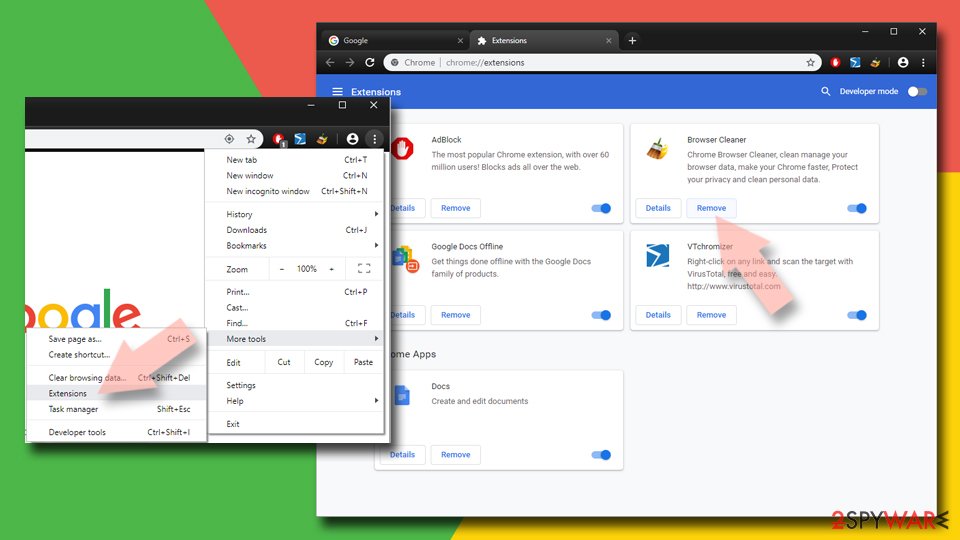
- Open Google Chrome, click on the Menu (three vertical dots at the top-right corner) and select More tools > Extensions.
- In the newly opened window, you will see all the installed extensions. Uninstall all suspicious extensions related to the unwanted program by clicking Remove.
Clear cache and web data from Chrome:
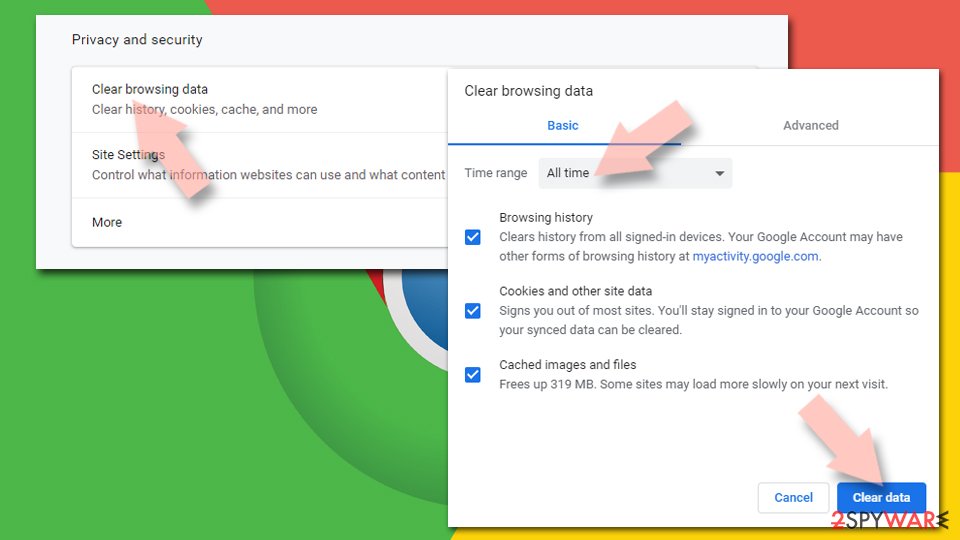
- Click on Menu and pick Settings.
- Under Privacy and security, select Clear browsing data.
- Select Browsing history, Cookies and other site data, as well as Cached images and files.
- Click Clear data.
Change your homepage:
- Click menu and choose Settings.
- Look for a suspicious site in the On startup section.
- Click on Open a specific or set of pages and click on three dots to find the Remove option.
Reset Google Chrome:
If the previous methods did not help you, reset Google Chrome to eliminate all the unwanted components:
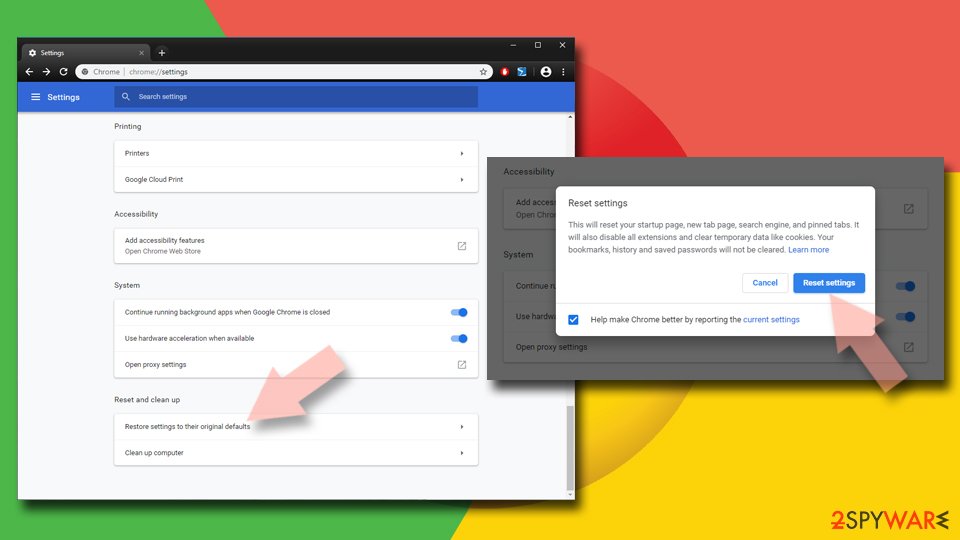
- Click on Menu and select Settings.
- In the Settings, scroll down and click Advanced.
- Scroll down and locate Reset and clean up section.
- Now click Restore settings to their original defaults.
- Confirm with Reset settings.
Remove from Mozilla Firefox (FF)
You can get rid of intrusive ads from Mozilla by deleting suspicious entries, like Shopperify and MyMacUpdater.
Remove dangerous extensions:
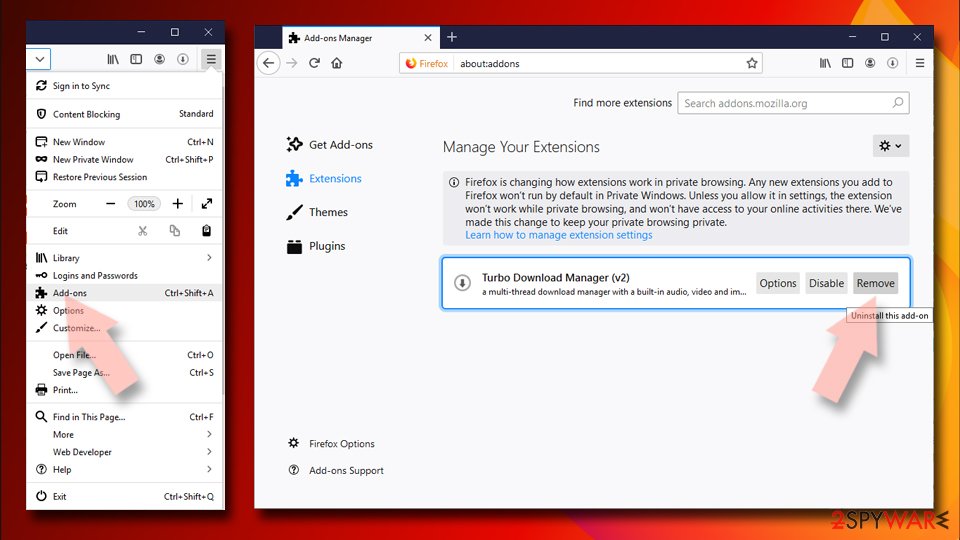
- Open Mozilla Firefox browser and click on the Menu (three horizontal lines at the top-right of the window).
- Select Add-ons.
- In here, select the unwanted extension and click Remove.
Reset the homepage:
- Click three horizontal lines at the top right corner to open the menu.
- Choose Settings.
- Under Home, set your preferred homepage and new tab settings.
Clear cookies and site data:
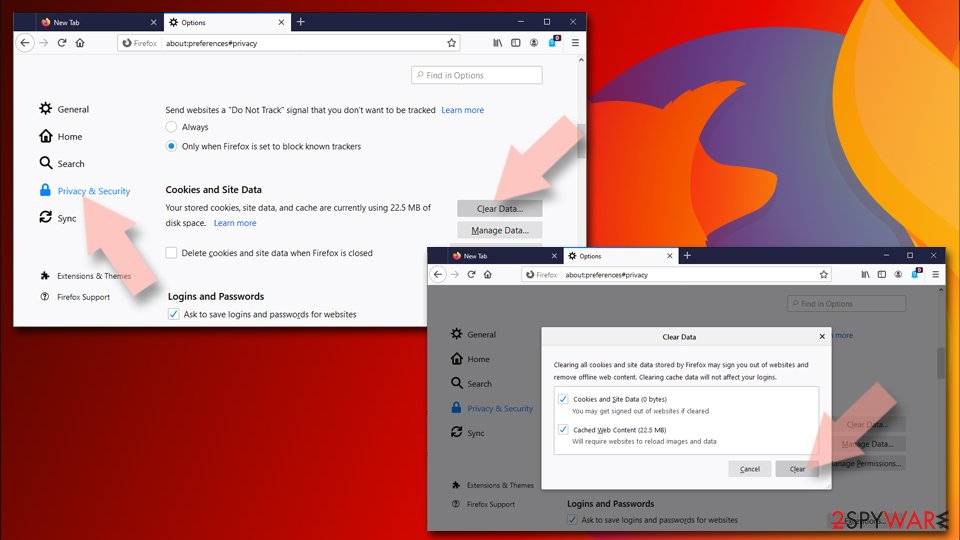
- Click Menu and pick Settings.
- Go to Privacy & Security section.
- Scroll down to locate Cookies and Site Data.
- Click on Clear Data...
- Select Cookies and Site Data and Temporary cached files and pages, then click Clear.
Reset Mozilla Firefox
If clearing the browser as explained above did not help, reset Mozilla Firefox:
- Open Mozilla Firefox browser and click the Menu.
- Go to Help and then choose Troubleshooting Information.
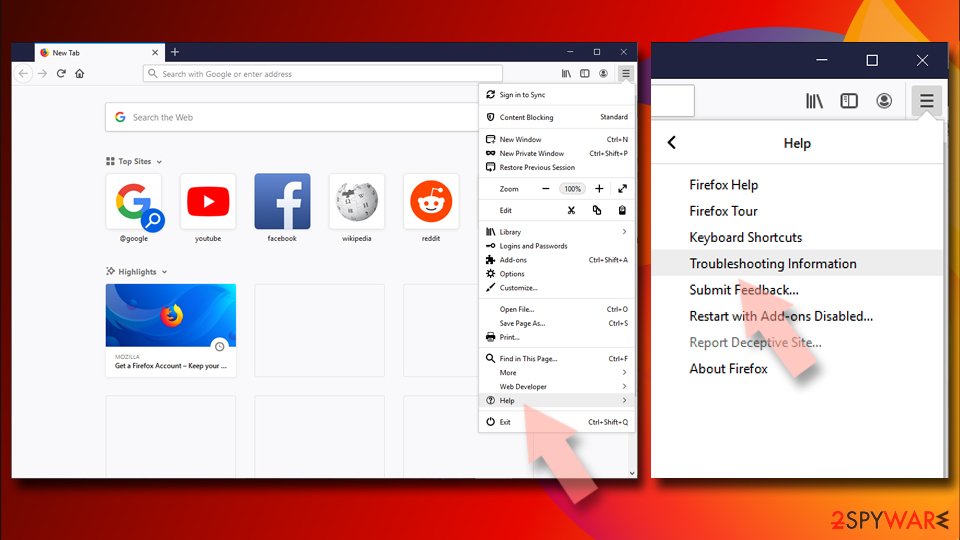
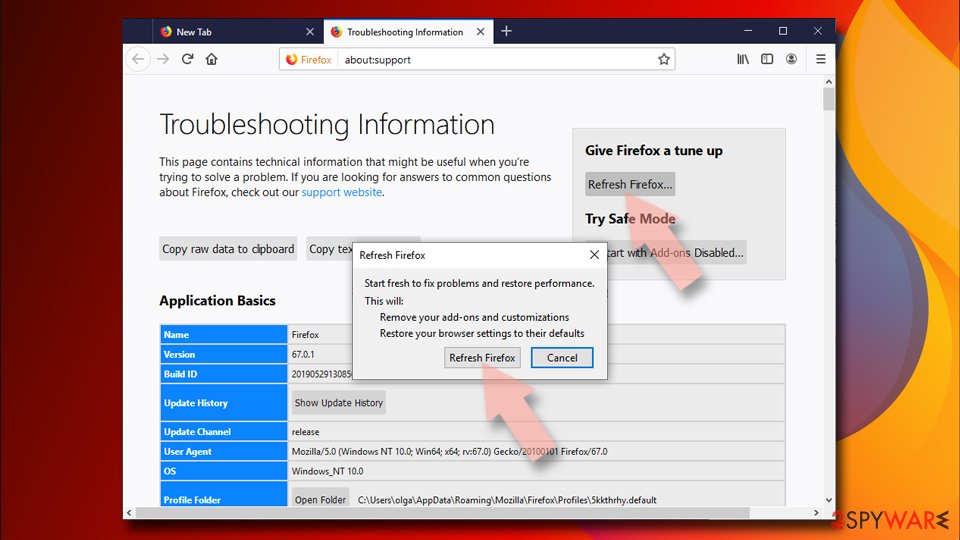
- Under Give Firefox a tune up section, click on Refresh Firefox...
- Once the pop-up shows up, confirm the action by pressing on Refresh Firefox.
Delete from Safari
Remove dangerous extensions:
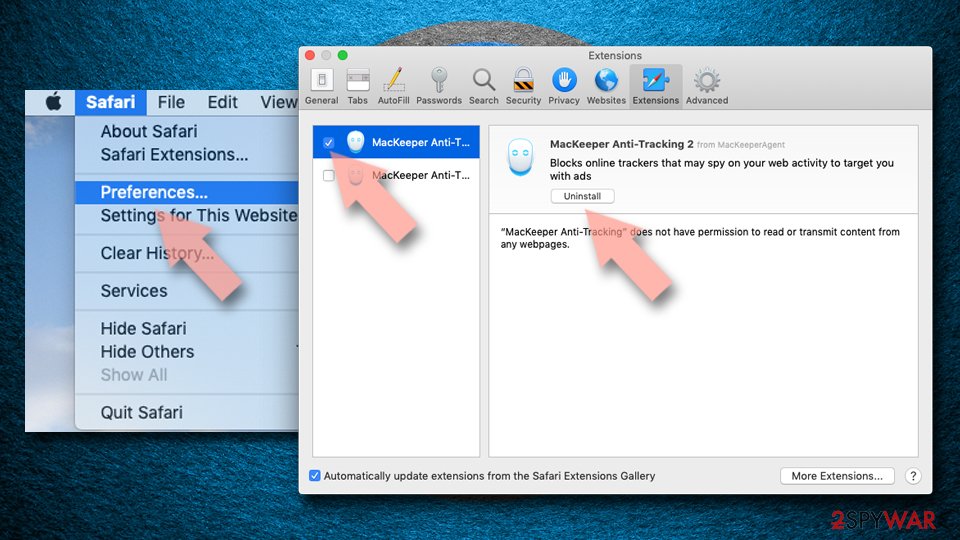
- Open Safari, click Safari in the menu at the top-left of the screen, and select Preferences.
- Go to the Extensions tab, look for any suspicious entries, and click Uninstall to remove them.
Clear history and website data:
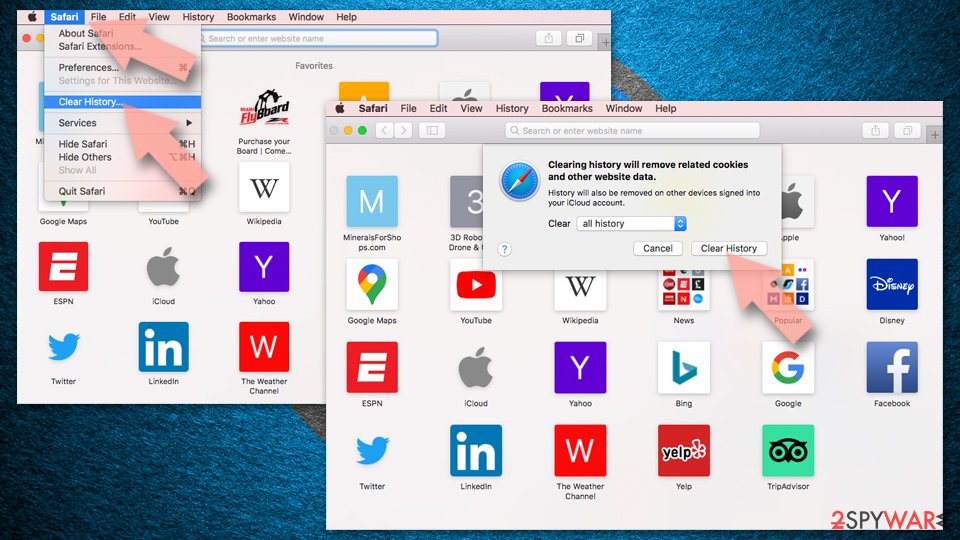
- Click Safari in the menu and pick Clear History.
- Set Clear to all history and confirm with Clear History.
Reset Safari:
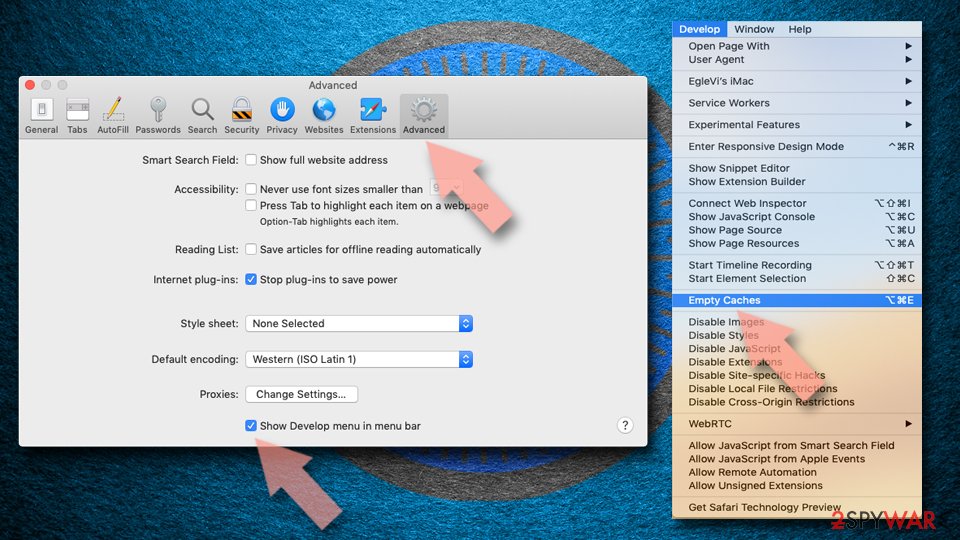
- Click Safari in the menu and select Preferences > Advanced.
- Enable Show Develop menu in menu bar.
- From the menu bar, click Develop and select Empty Caches.
Delete from macOS
MyMacUpdater is linked to other adware-related components that might be hidden under different names on your Mac. Thus, make sure that you will delete them as well. if you choose the manual elimination method, don't forget to get rid of malicious files like com.MyMacUpdater.agent.plist or com.Shopperify.agent.plist
Remove the unwanted application:
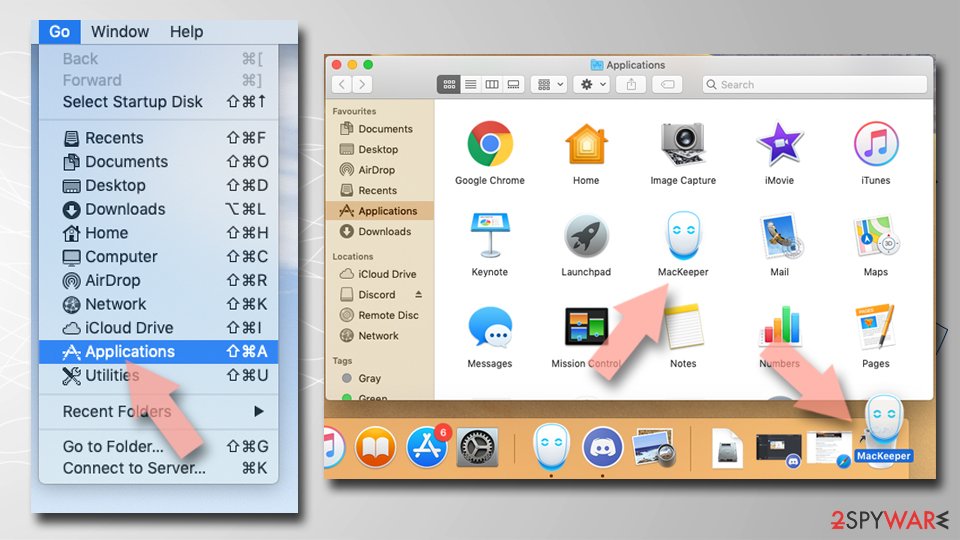
- From the menu bar, select Go > Applications.
- In the Applications folder, look for any suspicious entries, then drag them to Trash (or right-click and pick Move to Trash).
Delete leftover files and folders:
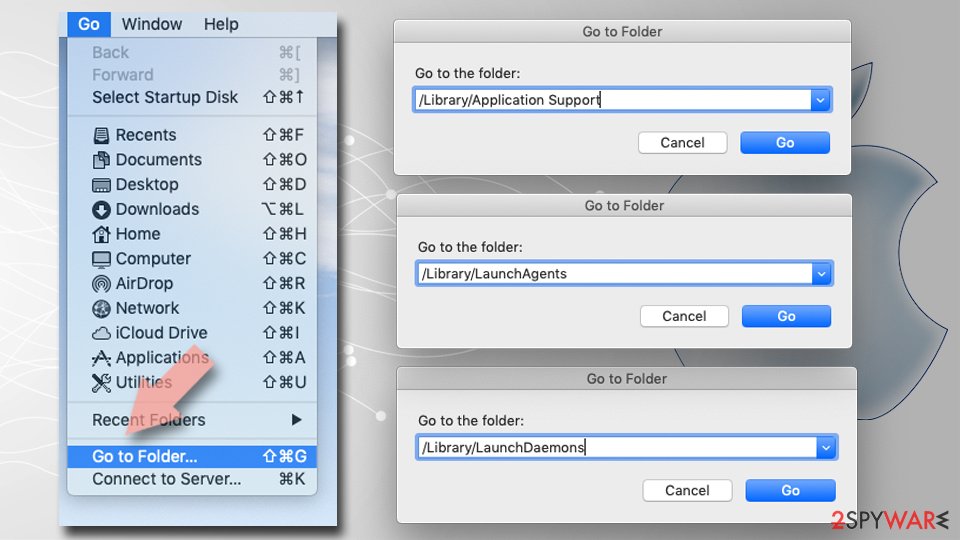
- Select Go > Go to Folder.
- Enter /Library/Application Support and remove any suspicious folders related to the unwanted program.
- Repeat the same check in the /Library/LaunchAgents and /Library/LaunchDaemons folders, deleting any suspicious entries.
- Finally, empty the Trash to permanently remove the leftovers.
Stream videos without limitations, no matter where you are
There are multiple parties that could find out almost anything about you by checking your online activity.
While this is highly unlikely, advertisers and tech companies are constantly tracking you online. The first step to privacy should be a secure browser that focuses on tracker reduction to a minimum.
Even if you employ a secure browser, you will not be able to access websites that are restricted due to local government laws or other reasons. In other words, you may not be able to stream Disney+ or US-based Netflix in some countries. To bypass these restrictions, you can employ a powerful VPN, which provides dedicated servers for torrenting and streaming, not slowing you down in the process.
Data backups are important - recover your lost files
Ransomware is one of the biggest threats to personal data.
Once it is executed on a machine, it launches a sophisticated encryption algorithm that locks all your files, although it does not destroy them. The most common misconception is that anti-malware software can return files to their previous states. This is not true, however, and data remains locked after the malicious payload is deleted.
While regular data backups are the only secure method to recover your files after a ransomware attack, tools such as can also be effective and restore at least some of your lost data.
From our report of Feb 2020 · not reviewed since
Learn how to remove MyMacUpdater from Mac
We have received numerous questions asking how do I remove the MyMacUpdater virus?
Likewise, we have prepared two options to get rid of this cyber threat. The first one is to eliminate the adware automatically by installing professional security software and running an entire system scan.
Another one is to complete MyMacUpdater removal manually. However, Lesvirus.fr team says that this PUP is linked to other potentially unwanted programs that are installed together. Thus, you must get rid of them all to stop seeing annoying ads. Besides, it is important to reset all the installed web browsers in order to prevent unwanted ads and redirects.
Taking this warning into account, we have attached guidelines showing how to uninstall MyMacUpdater Mac at the end of this article. They should help you to complete the elimination process safely.
Questions about MyMacUpdater
What is MyMacUpdater and why is it on my PC?
MyMacUpdater is a program that was installed on the PC, most likely together with something else you downloaded. Free software sites and many installers add extra programs on setup pages with pre-ticked boxes, so the extra install looks like your choice even though nobody read the page.
Check the install date in Settings, Apps, Installed apps: the program you installed that day is the probable carrier. If you do not need MyMacUpdater, uninstall it. If it belongs to your hardware or to a program you use, search its exact name and publisher first, because drivers and their tools can have unfamiliar names.
MyMacUpdater came back after I uninstalled it. Why?
Something else is reinstalling it. Common causes are a second program from the same publisher, a scheduled task that downloads it again, or a browser extension that keeps prompting for it. Sort Installed apps by install date and uninstall each entry from the same day that you did not choose.
Then open Task Scheduler and look in the Task Scheduler Library for tasks with updater-style names that you do not recognise. Check Startup apps in Task Manager too. If MyMacUpdater still returns, start Windows in Safe Mode, uninstall it there and run a Microsoft Defender offline scan, which looks for loaders that ordinary scans can miss.
Is my privacy at risk because of MyMacUpdater?
A little, not dramatically. Unwanted programs tend to report what you install, which sites you visit or how you use the program back to their publisher. That data is sold or used for ads.
The sign people noticed, myMacUpdater in the list of installed apps, is consistent with such a program, and nothing reported suggests access to your files, camera or passwords.
Remove it, delete its leftovers and clear the browser data if it touched the browser. From then on, keep Potentially unwanted app blocking switched on in Windows Security, which stops many of these programs before they install.
Can Windows block unwanted programs automatically?
Yes, with one setting. Windows Security has Potentially unwanted app blocking under App & browser control > Reputation-based protection settings. Block apps stops flagged programs from installing, and Block downloads works in Microsoft Edge.
On some PCs this was not switched on, which is how programs like MyMacUpdater got through. It does not catch everything, so read installer screens, choose Custom setup and decline offers. Removing free tools you no longer use also helps, because their updates are a common route for new bundles.
Do I need special software to remove MyMacUpdater?
No. Windows has everything needed:
- Installed apps for the uninstall
- the Startup list and Task Scheduler for what restarts it
- Windows Security for a scan afterwards
The steps in this guide take about fifteen minutes. A dedicated tool is a convenience when you would rather not check each place yourself or when the program keeps coming back.
Whatever you use, finish by confirming that myMacUpdater in the list of installed apps is gone after a restart, and avoid downloading removal tools from pages that promote them through scary warnings.
Why can't I uninstall MyMacUpdater?
Usually because it is still running or because a helper reinstalls it. Close it from the notification area first, then end its process in Task Manager and try Settings > Apps > Installed apps again. If there is no uninstall entry, look for a folder under Program Files or AppData with the same name and an uninstaller inside.
If the program comes back after removal, the cause of myMacUpdater in the list of installed apps is a scheduled task, a startup entry or the program it was bundled with. Remove those, restart and check again. Starting Windows in Safe Mode stops most helpers and makes stubborn programs easier to remove.
Is MyMacUpdater harmful?
It is unwelcome rather than destructive, based on what has been reported: myMacUpdater in the list of installed apps. Unwanted programs like this slow Windows down, use your connection, show offers or change settings, and they make money for their publisher at your expense. The bigger concern is what arrived with them.
Bundled installers often add two or three programs at once, and some of those change the browser or install updaters that fetch more software later. Remove MyMacUpdater, then sort Installed apps by date and remove anything else from the same day. A full scan in Windows Security afterwards confirms that nothing more serious came along.
How do I know if I need MyMacUpdater?
Ask three questions. Did you install it on purpose? Have you ever opened it?
Does anything you use depend on it? If the answers are no, you do not need it. The sign that brought you here, myMacUpdater in the list of installed apps, suggests it arrived without a clear choice.
Programs bundled with free software rarely do anything their host program needs. Uninstall it, restart, and see whether anything you rely on stops working. If nothing does, which is the usual outcome, you can forget about it.
Why does my antivirus call MyMacUpdater a PUA or PUP?
These labels mean potentially unwanted application or program. They are used for software that is legal but uses deceptive distribution, aggressive ads, misleading claims or a hard removal. Microsoft's PUA categories include advertising software, bundlers, download managers, torrent clients, marketing software and miners.
A PUA detection is a warning, not proof of infection, and you decide whether to keep MyMacUpdater. Other vendors use their own labels for the same idea, such as PUP.Optional or not-a-virus. Read more in our guide to potentially unwanted programs.
Will Fortect remove MyMacUpdater?
Fortect for Mac scans for malware and unwanted programs, and its free scan shows what it finds on your Mac before you decide anything.
For MyMacUpdater, follow the plan on this page as well: removing a launch item or an app is done in macOS itself, and a scanner cannot undo what was typed or entered on the infected Mac, such as saved passwords that were copied.
Change your passwords from another device first, and if the page tells you to erase the Mac, a scan is not a substitute. The free scan costs nothing and the full-featured product needs a license.
Sources
- Intego: New OSX/Shlayer Malware Variant Found Using a Dirty New Trick (read October 6, 2026)
- Wikipedia: Pay-per-click (read October 6, 2026)
- Statista: Number of apps available in leading app stores as of 4th quarter 2019 (read October 6, 2026)
- Lesvirus: Lesvirus (read October 6, 2026)
- FTC: How to recognize, remove and avoid malware (read October 6, 2026)