

OnlyMP3.net is full of sneaky redirects that put users at risk

OnlyMP3.net is a site that offers users to convert Youtube videos to MP3 files they can download to their PC. In the United States, the law forbids you to download content without permission from the copyright[1] owner, which makes the usage of such a site illegal. Putting that aside, the site raises many privacy and security concerns for those who use it.
After using the site and converting a few videos, some users report that they started noticing that the amount of commercial content they receive has increased. This can be ads in the form of pop-ups, banners, redirects, and others. It is unclear whether they have downloaded a virus together with the MP3s and did not notice it or caused by the ads that open unexpectedly when you click somewhere on the page.
Whatever the case, we suggest you pay attention to the symptoms you experience because it is entirely possible that you installed a potentially unwanted program that performs various tasks in the background without your knowledge. Below you will find various recommendations on how to ensure your digital space is safe.
| NAME | OnlyMP3.net |
| TYPE | Redirect virus, push notification spam, adware |
| SYMPTOMS | Increase in commercial content, pop-ups, push notifications |
| DISTRIBUTION | The official sites, deceptive ads, bundled software |
| DANGERS | The ads that this page leads to can be dangerous; some of them can lead to gambling sites; users are at risk of installing PUPs or malware |
| ELIMINATION | Scan your device for a virus infection with professional security tools |
| FURTHER STEPS | Use FortectIntego to restore your PC and optimize it |
The usage of cookies by such websites should make you uncomfortable
Cookies[2] are used by almost every website you visit to collect different types of information. This can include your IP address, the links you click on, what you search for ad things you purchase. This can be a good thing and help sites customize the users' experience. But there are sites that should not be trusted with such information because they can sell it to advertising networks that later use it to send you custom ads to make you more likely to buy.

Because when you interact with OnlyMP3.net, new tabs open randomly, and shady pages get opened, your activity might be tracked with third-party cookies, which is also worrying. The Privacy Policy written on the website states the following:
Third-party ad servers or ad networks uses technologies like cookies, JavaScript, or Web Beacons that are used in their respective advertisements and links that appear on OnlyMP3, which are sent directly to users' browser. They automatically receive your IP address when this occurs. These technologies are used to measure the effectiveness of their advertising campaigns and/or to personalize the advertising content that you see on websites that you visit.
Note that OnlyMP3 has no access to or control over these cookies that are used by third-party advertisers.
As you can see, if you would suffer any type of consequences because of the other pages that this site leads to, it cannot be held accountable. It is essential to keep track of which websites you grant permission to use cookies. If you browse a lot, all of it can add up and even cause your system to get slower. You can use FortectIntego to clear your browsers automatically. This powerful tool can also fix various system errors, corrupted files, registry issues and improve the overall performance of the device.
If you want to listen to music, we would recommend doing it the legitimate way. There are plenty of online music stores where you can buy songs. It does not cost much, and you will support the artists you like. There are also streaming platforms where you can pay a small monthly subscription fee and listen to music legally without any limitations.
Disable push notifications
You should start locating the problem by checking if you do not have push notifications turned on for any questionable websites. Very often push notification function in browsers is used to deliver ads straight to users' screens. Because push notifications are based on a subscription model, users can opt-out anytime they want. You can do that by going to your browser settings.
Below you can find instructions for Google Chrome. Guides for Mozilla Firefox, MS Edge, Internet Explorer, and Safari can be found at the end of the article.
Google Chrome (desktop):
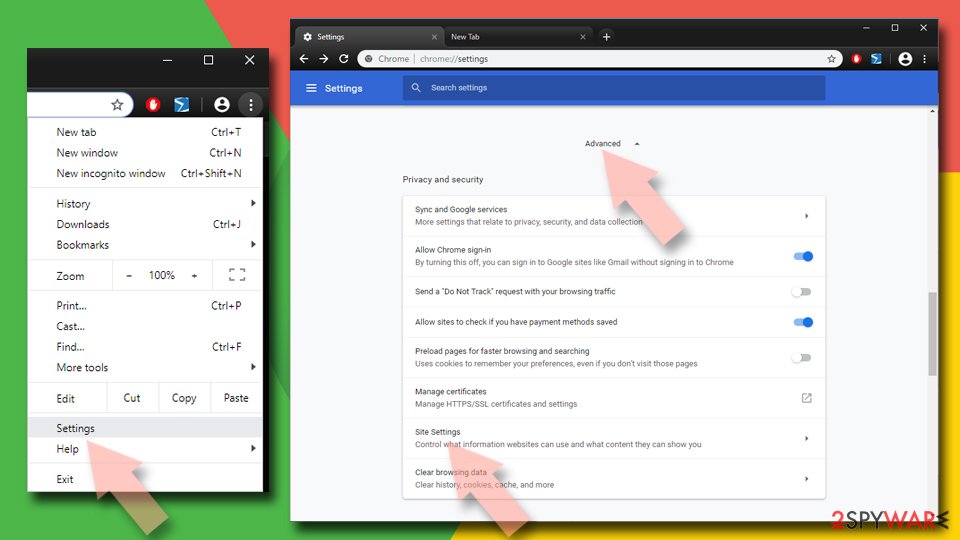
- Open Google Chrome browser and go to Menu > Settings.
- Scroll down and click on Advanced.
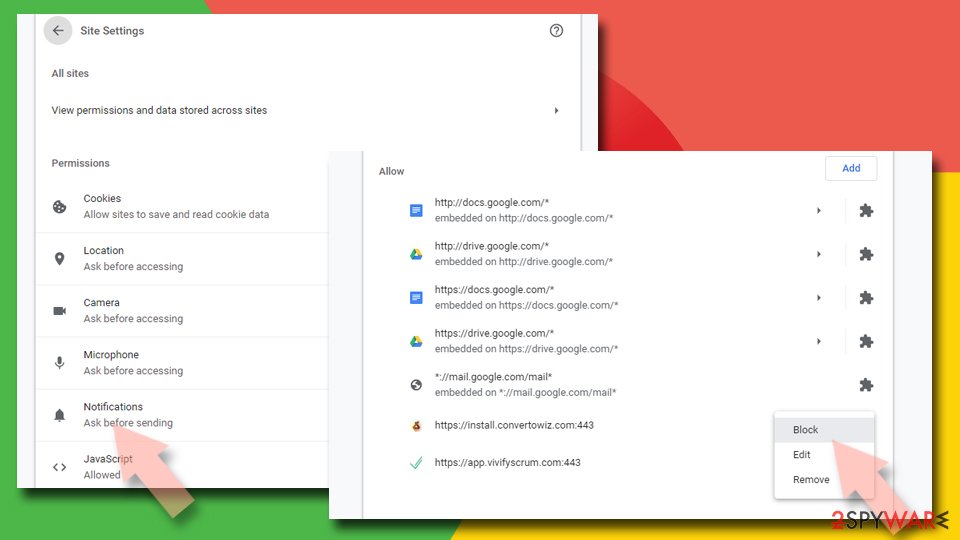
- Locate the Privacy and security section and pick Site Settings > Notifications.
- Look at the Allow section and look for a suspicious URL.
- Click the three vertical dots next to it and pick Block. This should remove unwanted notifications from Google Chrome.


Google Chrome (Android):
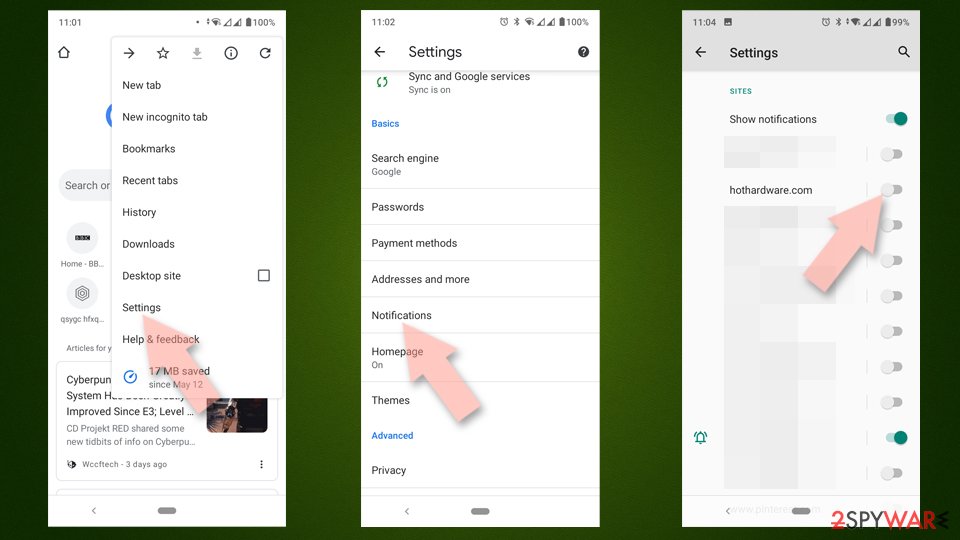
- Open Google Chrome and tap on Settings (three vertical dots).
- Select Notifications.
- Scroll down to Sites section.
- Locate the unwanted URL and toggle the button to the left (Off setting).

Check if you do not have suspicious extensions
The other thing you should do is go to your browser settings and check if there are any in the list that you do not remember adding. You might have added the extension by accident or because you saw a deceptive ad for it, and you thought it will be useful. Browser plugins can cause various issues, like the changes of the main settings – homepage, new tab address, and search engine. It can also cause ads to appear in the corners of the screen and inaccurate search results:
Google Chrome
- Open Google Chrome, click on the Menu (three vertical dots at the top-right corner) and select More tools > Extensions.
- In the newly opened window, you will see all the installed extensions. Uninstall all the suspicious plugins that might be related to the unwanted program by clicking Remove.


Scan your system with anti-malware tools
After using OnlyMP3.net, you should definitely see if there are no PUPs[3] in your system. You can do that automatically by deploying SpyHunterCombo Cleaner or MalwarebytesMalwarebytes. The other option is to just go through your program list and look at them one by one and uninstall them manually. However, we want to warn you that manual removal may not always work. PUAs can be disguised as “handy” tools that do not look malicious at first sight.
Professional security tools can scan your machine and detect suspicious processes running in your device. You cannot determine this if you do not have any experience and do not know any signs. If you still want to do this yourself, we have step-by-step instructions for Windows and Mac machines:
Windows 10/8:
- Enter Control Panel into Windows search box and hit Enter or click on the search result.
- Under Programs, select Uninstall a program.

- From the list, find the entry of the suspicious program.
- Right-click on the application and select Uninstall.
- If User Account Control shows up, click Yes.
- Wait till uninstallation process is complete and click OK.



Windows 7/XP:
- Click on Windows Start > Control Panel located on the right pane (if you are Windows XP user, click on Add/Remove Programs).
- In Control Panel, select Programs > Uninstall a program.

- Pick the unwanted application by clicking on it once.
- At the top, click Uninstall/Change.
- In the confirmation prompt, pick Yes.
- Click OK once the removal process is finished.

Mac:
- From the menu bar, select Go > Applications.
- In the Applications folder, look for all related entries.
- Click on the app and drag it to Trash (or right-click and pick Move to Trash)


To fully remove an unwanted app, you need to access Application Support, LaunchAgents, and LaunchDaemons folders and delete relevant files:
- Select Go > Go to Folder.
- Enter /Library/Application Support and click Go or press Enter.
- In the Application Support folder, look for any dubious entries and then delete them.
- Now enter /Library/LaunchAgents and /Library/LaunchDaemons folders the same way and terminate all the related .plist files.


Remove from Microsoft Edge
Delete unwanted extensions from MS Edge:
- Select Menu (three horizontal dots at the top-right of the browser window) and pick Extensions.
- From the list, pick the extension and click on the Gear icon.
- Click Remove.


Clear cookies and other browser data:
- Click on the Menu (three horizontal dots at the top-right of the browser window) and select Settings > Privacy, search, and services..
- Under Clear browsing data, pick Choose what to clear.
- Select Cookies and other site data and Cached images and files. (apart from passwords, although you might want to include Media licenses as well, if applicable) and click on Clear.


Restore new tab and homepage settings:
- Click the menu icon and choose Settings.
- Then find On startup section.
- Click Remove next to any suspicious startup page.
Reset MS Edge if the above steps did not work:
- Press on Ctrl + Shift + Esc to open Task Manager.
- Click on More details arrow at the bottom of the window.
- Select Details tab.
- Now scroll down and locate every entry with Microsoft Edge name in it. Right-click on each of them and select End Task to stop MS Edge from running.


Instructions for Chromium-based Edge
Delete extensions from MS Edge (Chromium):
- Open Edge and click select Settings > Extensions.
- Delete unwanted extensions by clicking Remove.


Clear cache and site data:
- Click on Menu and go to Settings.
- Select Privacy, search and services.
- Under Clear browsing data, pick Choose what to clear.
- Under Time range, pick All time.
- Select Clear now.


Reset Chromium-based MS Edge:
- Click on Menu and select Settings.
- On the left side, pick Reset settings.
- Select Restore settings to their default values.
- Confirm with Reset.
- This will disable extensions and reset startup pages but will not delete bookmarks, saved passwords, or browsing history.


Remove from Mozilla Firefox (FF)
Remove dangerous extensions:
- Open Mozilla Firefox browser and click on the Menu (three horizontal lines at the top-right of the window).
- Select Add-ons.
- In here, select the unwanted extension and click Remove.


Reset the homepage:
- Click three horizontal lines at the top right corner to open the menu.
- Choose Settings.
- Under Home, set your preferred homepage and new tab settings.
Clear cookies and site data:
- Click Menu and pick Settings.
- Go to Privacy & Security section.
- Scroll down to locate Cookies and Site Data.
- Click on Clear Data...
- Select Cookies and Site Data and Temporary cached files and pages, then click Clear.


Reset Mozilla Firefox
If clearing the browser as explained above did not help, reset Mozilla Firefox:
- Open Mozilla Firefox browser and click the Menu.
- Go to Help and then choose Troubleshooting Information.

- Under Give Firefox a tune up section, click on Refresh Firefox...
- Once the pop-up shows up, confirm the action by pressing on Refresh Firefox.



Delete from Safari
Remove dangerous extensions:
- Open Safari, click Safari in the menu at the top-left of the screen, and select Preferences.
- Go to the Extensions tab, look for any suspicious entries, and click Uninstall to remove them.


Clear history and website data:
- Click Safari in the menu and pick Clear History.
- Set Clear to all history and confirm with Clear History.


Reset Safari:
- Click Safari in the menu and select Preferences > Advanced.
- Enable Show Develop menu in menu bar.
- From the menu bar, click Develop and select Empty Caches.


Did this guide help?
Be the first to comment