

Optimum Search is an intrusive browser hijacker that might take over Chrome and even change its policy
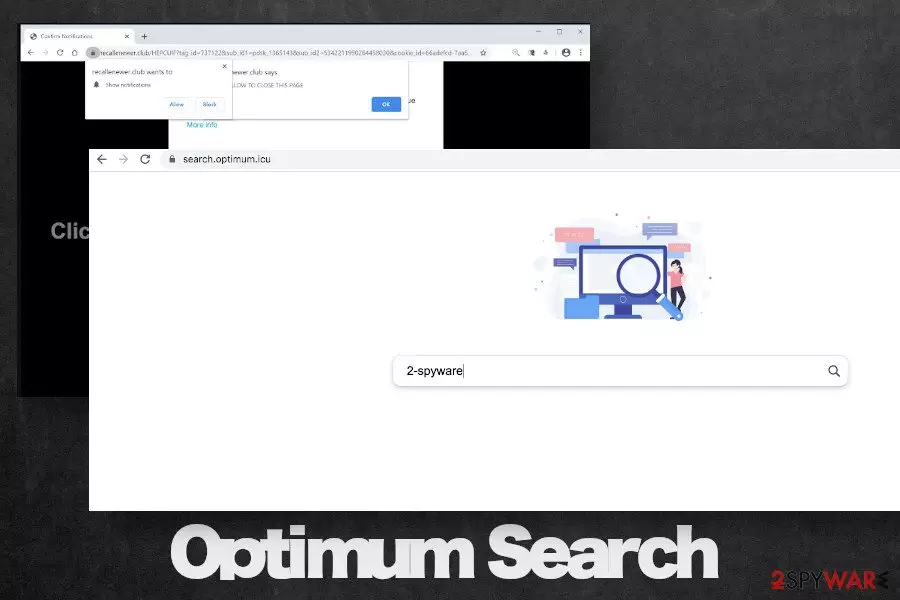
Optimum Search is an unwanted search engine that settles down on Google Chrome, Mozilla Firefox, Internet Explorer, Safari, Microsoft Edge, and others without asking for the user's permission. Upon infiltration, it changes a default start page to search.optimum.icu, search provider to Yahoo[1] and installs two types of tracking cookies. These traits allow classifying Optimum Search as a potentially unwanted program (PUP) and browser hijacker.
In most cases, it is distributed in the form of a plug-in or searchoptimum extension appended to freeware downloads available on torrent sharing websites or third-party download sites infamous for software bundling. Optimum Search may be disguised under the Quick installation option and pre-checked by default. In this way, freeware users end up installing this hijacker without realizing it.
| Name | Optimum Search |
| Related | search.optimum.icu, search.yahoo.com |
| Type of malware | Potentially unwanted program (PUP) and browser hijacker |
| Compatible web browsers | There is no proof that this search hijacker is bound to a specific web browser. Therefore, Google Chrome, Mozilla Firefox, Internet Explorer, Safari, etc. can be affected |
| Distribution | Typically, it spreads bundled with free applications. Nonetheless, there is a risk of downloading a browser hijacker after clicking on suspicious pop-ups, using software cracks or rogue software updates |
| Symptoms | The Search Optimum virus directly affects the web browser's settings. It replaces the start page, search provider, new tab window, and initiates redirects to predetermined websites. In addition, it installs two types of cookies that track and leak non-personally identifiable information |
| Is it dangerous? | It is not dangerous. However, it may trigger redirects to suspicious websites and display intrusive advertisements that may lead to malware infiltration |
| Removal | Search Optimum removal can be initiated manually by disabling the extension in the affected web browser and eliminating related freeware. Nevertheless, sometimes browser hijackers are more persistent due to a strong relationship with freeware. Therefore, an AV scan may be required |
| System damage | Even though this hijacker does not harm the system, the bundle that it spreads with may initiate alterations on Windows registries and processes, which may later cause errors and another malfunctioning. To fix any damage, use FortectIntego tool |
At the initial inspection, the Optimum Search virus does not deviate much from the other hijackers that promote the sponsored Yahoo search engine. It features a simple search bar and Privacy Policy terms at the bottom of the page.
Although developers claim that the search is going to “detect, prevent, or otherwise address fraud, security, or technical issues,” the Optimum Search browser hijacker can hardly improve the web browser's performance or, even more, ensure security. In contrast, once installed it drops an extension that is set to display sponsored search results and third-party advertisements. One of its main purposes is to collect clicks and monetize traffic[2] to shady third-party websites.
When using the services provided by Optimum Search malware people have to be cautious when clicking on any links and shortcuts. PUPs are usually filled with a database of third party advertisers, who may not only seek to promote their websites but also spread other questionable programs. The biggest risk of malware infection is to click on ads offering an online virus scan service or software updates.
The most annoying feature of the search.optimum.icu virus is redirecting to predetermined websites. No matter which website the user wants to visit, the hijacker automatically redirects to a sponsored Yahoo search results. Besides, before showing the targeted website, the malware may display a new tab window or full-page advertisement that covers the content and prevents the user from web browsing normally.
Nevertheless, Optimum Search removal is recommended to protect one's privacy. As stated in the Privacy Policy of this search, it drops two types of tracking cookies and continuously monitor non-personally identifiable information about its users. The gathered information, as pointed out, can further be transmitted to affiliated parties:
We may disclose or share this information with third parties as specified below and solely if applicable. We collect the following Non-Personal Information from you when you access or use the Services: the type of browser you are using as well as operating system, your time zone, the date and time you access the Service, screen resolution, browser and operating system language, default search, country, etc. […]
The second type of information is individually identifiable information, namely information that identifies an individual or entity or may with reasonable effort identify an individual (” Personal Information”).
The information about the user's browsing habits subsequently allows advertisers to prepare individual ads. To prevent such and similar activities on the web, people should remove Optimum Search from Chrome or another web browser with a delay.
Cybersecurity researchers from dieviren.de[3] claim that this malware may be closely related to Optimum Search Chromium web browser. It's an open-source web project, which is often misused by malware developers and distributed along with Optimum Search extension and similar PUPs.
Therefore, if you noticed that Chrome does not look like an ordinary Chrome, double-check if the OptimumSearch virus did not change your default browser to a bogus version of Chromium[4]. Even if Chromium is not there, you might notice an interesting feature in your browser. Recent widely spread hijackers like CapitaSearch and Optimum Search extension have added the “Managed by your organization” Chrome policy. This way the browser hijacker tries to hide and trick the user. You might need some additional steps to get rid of all damage made by Optimum Search extension and reset your Chrome to get the previously used browser.

Optimum Search removal is not a difficult task to perform if the main installer appears in the Programs and Features list properly. In many cases, PUPs like this disguise under different names to make them difficult to detect. Therefore, if you cannot find the related malware, we recommend using a professional anti-malware tool to perform Optimum Search remove completely. If you need a detailed guide explaining all possible elimination procedures, scroll down to the end of this post.
“Managed by your organization” policy won't let users delete Optimum Search
As long as “Managed by your organization” settings will be enabled on Chrome, you will not be allowed to remove the Optimum Search virus. This dubious third-party search site is misusing Chrome's Policy Management feature that has been developed by Chrome's team and launched with Chrome 73 version with an intention to help Enterprises control Chrome's performance.
Unfortunately, developers left a flaw, which allows third-party extensions and malware to enable the “Managed by your organization” to maintain persistence. Therefore, if you see search.optimum.icu as a start page, search.yahoo.com – search engine, Optimum Search extension, or other third-party plug-ins in Chrome that are managed by the supposed organization, you will have to disable Chrome's policy settings in order to get the permission to remove malware.

If you are dealing with Optimum Search Extension virus on your machine, try to perform the following steps to get rid of it:
- Press Windows key + R, type regedit, and press Enter to open Registry Editor.
- While on Registry Editor, you'll have to find the following locations:
\HKEY_LOCAL_MACHINE\SOFTWARE\Google
\HKEY_LOCAL_MACHINE\SOFTWARE\Google\Chrome
\HKEY_LOCAL_MACHINE\SOFTWARE\Policies\Chromium
\HKEY_LOCAL_MACHINE\SOFTWARE\Policies\Google\Chrome - Eliminate all entries that are marked with a 1.
- Look for the file called ExtensionInstallForceList folder under the \HKEY_LOCAL_MACHINE\SOFTWARE\Policies\Google\Chrome directory. Delete all files marked 1 in it.
- After that, try to remove any unwanted extensions from Chrome or reset its settings.
- Scan the machine with an anti-malware tool.
Browser hijackers disguise under Quick installation option of freeware
Shady marketing techniques are implemented with the help of adware and browser hijackers, which unitedly are called potentially unwanted programs (PUPs). Even though it is possible to download such programs from Google Store, Play Store, and other legitimate sources, the bulk of PUPs find their users on torrent sharing websites or third-party download websites, such as Cnet or Download.
Since PUPs are not built on the base of malicious codes, they cannot inject the extension without the user's permission. That's why they typically spread as pre-selected additional components. When the user selects Quick installation and simply hits the Next button, he or she inadvertently gives permission to install the whole bundle.
To prevent this from happening, Advanced or Custom installation setups can be helpful. These options extract the bundle into separate setup windows and allow the potential user to remove checkmarks standing as an agreement next to additional apps.
Automatic and manual Optimum Search removal options
The presence of the OptimumSearch virus of the system can be related to a web browser's extension, add-on, or plug-in. Besides, a recently installed freeware may be programmed to enable the extension on the web browser reopening the browser. It means that the removal of search.optimum.icu virus from Chrome or another browser will not solve the problem.
To remove Optimum Search completely, it's a must to get rid of the related freeware. The problem is that it may be difficult to find out which application changed the web browser's settings. Although the developer of this dubious search claim that the OptimumSetup is the main installer that has to be deleted, there is evidence that programs like PDF converters or download managers can also be related.
You can try to remove Optimum Search from the system manually with the help of instructions positioned below. Carefully follow each step and you should successfully get rid of this malware. If, however, it returns each time you reload a web browser, it's a clear sign that malware has not been removed completely. In this case, we recommend using a professional anti-malware utility, such as SpyHunterCombo Cleaner.
Uninstall from Windows
Uninstall from Windows 10/8:
- Type Control Panel into the Windows search box and open the result.
- Under Programs, select Uninstall a program.


Uninstall from Windows 7/XP:
- Click on Windows Start > Control Panel (Windows XP users should click on Add/Remove Programs).
- In Control Panel, select Programs > Uninstall a program.


Remove the unwanted program:
- In the Programs and Features window, look for any recently installed suspicious entries, select them, and click Uninstall.
- If User Account Control appears, click Yes to confirm, then complete the removal.


Delete from macOS
Remove the unwanted application:
- From the menu bar, select Go > Applications.
- In the Applications folder, look for any suspicious entries, then drag them to Trash (or right-click and pick Move to Trash).


Delete leftover files and folders:
- Select Go > Go to Folder.
- Enter /Library/Application Support and remove any suspicious folders related to the unwanted program.
- Repeat the same check in the /Library/LaunchAgents and /Library/LaunchDaemons folders, deleting any suspicious entries.

- Finally, empty the Trash to permanently remove the leftovers.

Reset Internet Explorer
Remove dangerous add-ons:
- Open Internet Explorer, click on the Gear icon (IE menu) on the top-right corner of the browser
- Pick Manage Add-ons.
- You will see a Manage Add-ons window. Here, look for suspicious plugins. Click on these entries and select Disable.


Change your homepage if it was altered:
- Open IE and click on the Gear icon.
- Select Internet Options.
- In the General tab, delete the Home page address and replace it by your preferred one (for example, Google.com).
- Click Apply and then select OK.


Delete temporary files:
- Press on the Gear icon and select Internet Options.
- Under Browsing history, click Delete...
- Select relevant fields and press Delete.


Reset Internet Explorer:
- Click on Gear icon > Internet options and select Advanced tab.
- Select Reset.
- In the new window, check Delete personal settings and select Reset.


Remove from Microsoft Edge
Delete unwanted extensions from MS Edge:
- Select Menu (three horizontal dots at the top-right of the browser window) and pick Extensions.
- From the list, pick the extension and click on the Gear icon.
- Click Remove.


Clear cookies and other browser data:
- Click on the Menu (three horizontal dots at the top-right of the browser window) and select Settings > Privacy, search, and services..
- Under Clear browsing data, pick Choose what to clear.
- Select Cookies and other site data and Cached images and files. (apart from passwords, although you might want to include Media licenses as well, if applicable) and click on Clear.


Restore new tab and homepage settings:
- Click the menu icon and choose Settings.
- Then find On startup section.
- Click Remove next to any suspicious startup page.
Reset MS Edge if the above steps did not work:
- Press on Ctrl + Shift + Esc to open Task Manager.
- Click on More details arrow at the bottom of the window.
- Select Details tab.
- Now scroll down and locate every entry with Microsoft Edge name in it. Right-click on each of them and select End Task to stop MS Edge from running.


Instructions for Chromium-based Edge
Delete extensions from MS Edge (Chromium):
- Open Edge and click select Settings > Extensions.
- Delete unwanted extensions by clicking Remove.


Clear cache and site data:
- Click on Menu and go to Settings.
- Select Privacy, search and services.
- Under Clear browsing data, pick Choose what to clear.
- Under Time range, pick All time.
- Select Clear now.


Reset Chromium-based MS Edge:
- Click on Menu and select Settings.
- On the left side, pick Reset settings.
- Select Restore settings to their default values.
- Confirm with Reset.
- This will disable extensions and reset startup pages but will not delete bookmarks, saved passwords, or browsing history.


Remove from Mozilla Firefox (FF)
Remove dangerous extensions:
- Open Mozilla Firefox browser and click on the Menu (three horizontal lines at the top-right of the window).
- Select Add-ons.
- In here, select the unwanted extension and click Remove.


Reset the homepage:
- Click three horizontal lines at the top right corner to open the menu.
- Choose Settings.
- Under Home, set your preferred homepage and new tab settings.
Clear cookies and site data:
- Click Menu and pick Settings.
- Go to Privacy & Security section.
- Scroll down to locate Cookies and Site Data.
- Click on Clear Data...
- Select Cookies and Site Data and Temporary cached files and pages, then click Clear.


Reset Mozilla Firefox
If clearing the browser as explained above did not help, reset Mozilla Firefox:
- Open Mozilla Firefox browser and click the Menu.
- Go to Help and then choose Troubleshooting Information.

- Under Give Firefox a tune up section, click on Refresh Firefox...
- Once the pop-up shows up, confirm the action by pressing on Refresh Firefox.



Remove from Google Chrome
Delete malicious extensions from Google Chrome:
- Open Google Chrome, click on the Menu (three vertical dots at the top-right corner) and select More tools > Extensions.
- In the newly opened window, you will see all the installed extensions. Uninstall all suspicious extensions related to the unwanted program by clicking Remove.


Clear cache and web data from Chrome:
- Click on Menu and pick Settings.
- Under Privacy and security, select Clear browsing data.
- Select Browsing history, Cookies and other site data, as well as Cached images and files.
- Click Clear data.


Change your homepage:
- Click menu and choose Settings.
- Look for a suspicious site in the On startup section.
- Click on Open a specific or set of pages and click on three dots to find the Remove option.
Reset Google Chrome:
If the previous methods did not help you, reset Google Chrome to eliminate all the unwanted components:
- Click on Menu and select Settings.
- In the Settings, scroll down and click Advanced.
- Scroll down and locate Reset and clean up section.
- Now click Restore settings to their original defaults.
- Confirm with Reset settings.


Delete from Safari
Remove dangerous extensions:
- Open Safari, click Safari in the menu at the top-left of the screen, and select Preferences.
- Go to the Extensions tab, look for any suspicious entries, and click Uninstall to remove them.


Clear history and website data:
- Click Safari in the menu and pick Clear History.
- Set Clear to all history and confirm with Clear History.


Reset Safari:
- Click Safari in the menu and select Preferences > Advanced.
- Enable Show Develop menu in menu bar.
- From the menu bar, click Develop and select Empty Caches.


Did this guide help?
Be the first to comment