
Repp ransomware: what it is and how to remove it
Repp ransomware, discovered by Michael Gillespie, appears to be one of the newest Djvu ransomware versions that have emerged at the start of 2020. This malicious variant acts exactly the same as its other siblings and aims to target English-speaking people who are using Windows computers.
Facts checked October 6, 2026. Removal steps tested on Windows 11 (26H2) and checked against Microsoft's and the browser makers' current documentation. Sections marked as our earlier report are the original text: they describe the threat as it was then and have not been reviewed since. The 2026 status, the removal steps and the questions are current.
Automatic
Get a free scan and check if your PC is infected.
Fortect finds malware, unwanted programs and the Windows damage they leave behind, and repairs it in one pass.
Before you restore backups, a full scan can confirm the program that added .repp is gone.
Do it yourself · free Remove Repp ransomware yourself 6 steps, about 18 minutes, no software needed.
Start the steps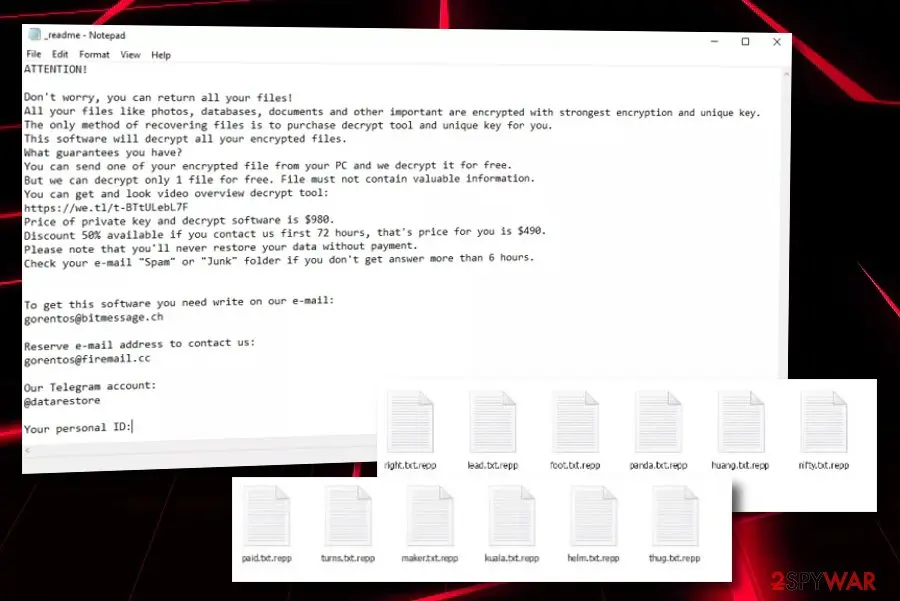
Repp ransomware: summary
| Name | Repp ransomware |
|---|---|
| Type | Ransomware/malware |
| Family | Djvu virus |
| Appearance | This cyber threat has emerged at the start of 2020, in January |
| Target | Regarding the language in which the ransom note is written, the ransomware infection points its target at English people and English-speaking users |
| Danger level | This infection carries the danger level of "high". Besides encrypting valuable files and demanding a big ransom price, it also can plant other malware onto the Windows computer |
| Removal | Scan the PC with security software to find and remove the malware and anything installed with it. Fortect scans Windows for malware and repairs the system files and settings it damaged. Remove it nowTo use the full-featured product, you have to purchase a license for Fortect. The scan is free. |
Show 16 more facts
| Appendix | When files are locked with the AES-256 encryption cipher, all of the filenames receive the .repp appendix |
|---|---|
| Ransom note | The cybercriminals provide all of the ransom demands and required payment conditions in the _readme.txt ransom note that is the same for all Djvu ransomware variants |
| Ransom price | At first, the crooks urge for $490 as a 50% discount from $980. If the payment is not transferred in 72 hours, the hackers will double the price again to $980 |
| Crooks' contacts | The ransom message provides gorentos@bitmessage.ch, gorentos@firemail.cc email addresses, and @datarestore telegram account |
| Detection names | No Microsoft detection name is known |
| Encrypted file extension | .repp |
| Decryptor | No free decryptor is known for this variant; check No More Ransom (nomoreransom.org) for updates |
| Distribution | Not recorded in the old report |
| Damage | Not recorded in the old report |
| Symptoms | Files renamed with a new extension and a ransom note left in folders |
| Evidence | 6 write-ups by security sites; no sample analysed yet |
| Encrypted files | .repp |
| Attacker contacts | gorentos@bitmessage.ch |
| Free decryptor | No free decryptor is known (checked 6 October 2026) |
| First seen | 2 February 2020 |
| Facts checked | 6 October 2026 |
- File extension:
.repp - Note file:
_readme.txt - Contact:
gorentos@bitmessage.ch
From our report of Feb 2020 · not reviewed since
More from our earlier report on Repp ransomware
- If you have been dealing with this ransomware virus lately, you should remove the malware ASAP.
- For this task, employ only reliable antimalware software that is capable of detecting and eliminating such dangerous cyber threats
How Repp ransomware behaves
From our report of Feb 2020 · not reviewed since
Repp ransomware - the 203rd version of Djvu ransomware that is currently undecryptable
Repp ransomware, discovered by Michael Gillespie, appears to be one of the newest Djvu ransomware versions that have emerged at the start of 2020.
This malicious variant acts exactly the same as its other siblings and aims to target English-speaking people who are using Windows computers. The extension that the ransomware virus appends is .repp and is added to each file's name after the AES-256 cipher performs its encryption task.
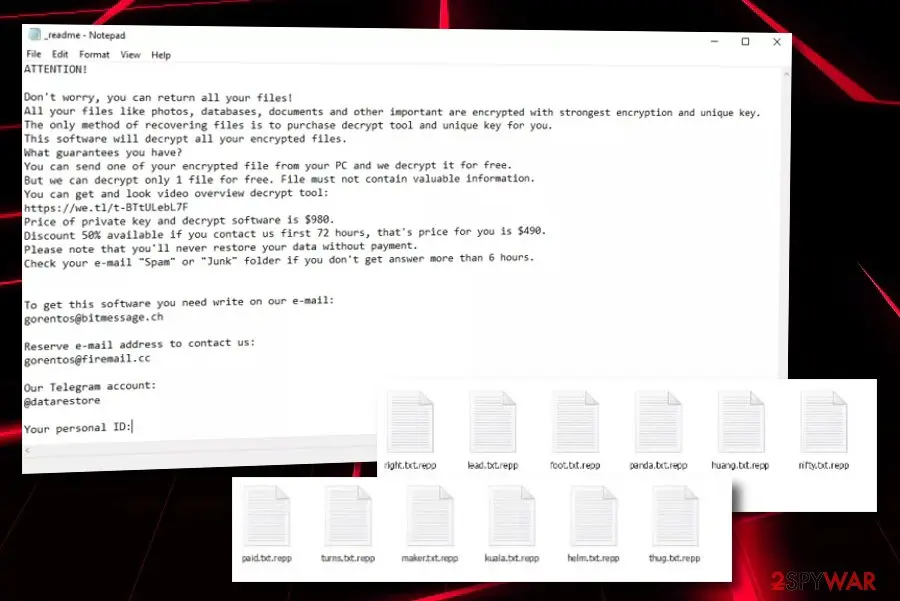
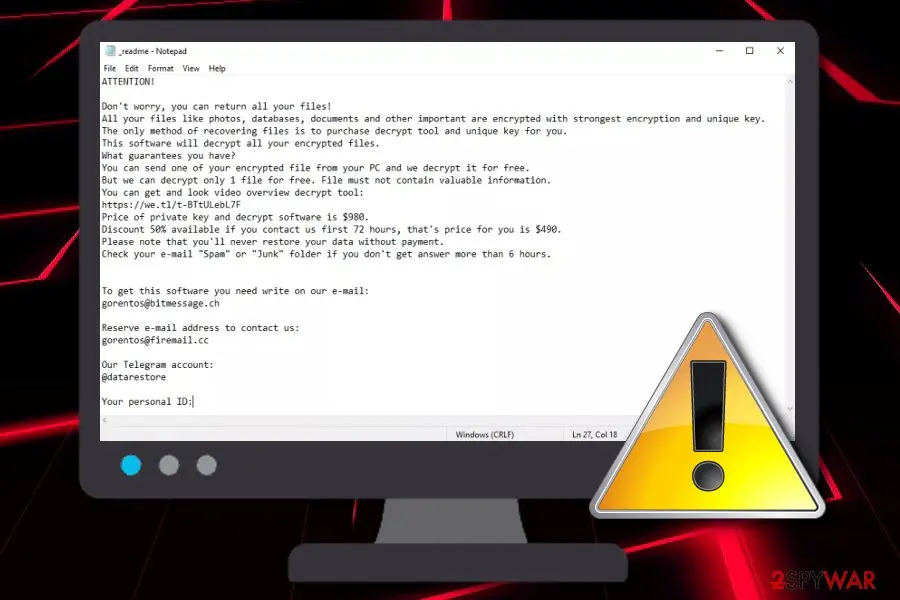
Furthermore, Repp ransomware drops the _readme.txt message in a Notepad blank that is placed on the desktop and in each folder that holds encrypted documents and files.
Repp ransomware developers claim that they are the only ones who are capable of recovering encrypted files. These people provide ransom demands that vary from $490 to $980. The first price is the starter amount that needs to be paid in a 72 hour period.
If the ransom is not transferred during that time, the money amount will double to $980. The criminals provide the gorentos@bitmessage.ch, gorentos@firemail.cc email addresses, and @datarestore telegram account as a way to initiate contact with them.
Repp virus is a dangerous infection that does not get installed intentionally but still requires the user's interaction. Most of the time, users lose carefulness while opening email spam attachments, visiting third-party websites, or clicking on various ads and this way they create the perfect conditions for a ransomware attack to emerge.
Ransomware infections such as Repp ransomware are developed to target Windows operating systems. Mostly, these cyber threats target English-speaking users as the biggest variety of people is speaking this language and the criminals can infect as many users as possible.
Furthermore, the ransomware developers are likely to urge for cryptocurrency such as Bitcoin as such transfers allow the process to stay untracked and completely anonymous. The same also goes for Repp ransomware spreaders. These people are interested in receiving a fine amount of income, according to the ransom note:
Repp ransomware is a malicious parasite that can include malware-laden components all over the system, including the desktop, User's folder, AppData folder, Task Manager, and Windows Registry. The malware can camouflage itself as a well-known process and run undetected in the Task Manager for a while.
Furthermore, Repp ransomware can aim to delete the Shadow Volume Copies of encrypted files to harden the decryption process for the users. Nevertheless, the virus permanently damages the Windows hosts file in order to prevent the users from accessing security-related websites where they could receive valuable information on the virus removal and data recovery processes.
Keep in mind that once you are completing the Repp ransomware removal process, you should delete the hosts file too, otherwise, the access to security websites will remain blocked. Besides all the mentioned activities, this malware can distribute the AZORult Trojan virus as it is also related to the STOP ransomware family which spreads this current threat.
If Repp ransomware brings you a trojan infection, it can get hidden anywhere on your computer system and start monitoring malicious processes in the background. For example, the malware will likely start overusing your CPU's power, recording personal, information, swindling money, mining cryptocurrency, or injecting other more advanced threats.
You should remove Repp ransomware from your Windows computer system before it is too late and the damage is too big to recover from. Employing a trustworthy antivirus product should help you to deal with the entire process. Also, if you have already found some alterings on your computer system, try repairing them with .
When you uninstall Repp ransomware, you can start thinking about data recovery possibilities. Note that it is not worth to pay the cybercriminals as they can easily scam you by taking your money and just running off without giving you any key. Even though the Djvu Emsisoft decrypter is available for versions that have been released before August 2019, there are other alternatives that you could try for file restoring.
If you are looking for something that would help you to recover the files that have been touched by Repp ransomware, we have provided some software solutions at the end of this article. Also, you can try using DrWeb's Rescue pack for $150 that includes decryption software and 2 years of system protection.
From our report of Feb 2020 · not reviewed since
The most common distribution tactics of ransomware payload
Cybersecurity experts from LosVirus.es claim that ransomware infections are most commonly spread through email spam.
The crooks often pretend to be from reliable companies such as FedEx and DHL and deliver legitimate-looking attachments that come in forms of executables, word documents, and other formats.
Once the user opens the infected file, he/she receives the malicious payload straight on the Windows operating system. you should be aware of email messages that fall in the Spam section and avoid opening any emails that look questionable to you.
Always identify the sender, check the letter's text for grammar mistakes and do not open any attachments that look suspicious to you. If you have already downloaded the file, scan it with an antivirus product.
Furthermore, file-encrypting cyber threats are delivered through cracked software that is included in peer-to-peer networks such as The Pirate Bay, eMule, and BitTorrent. You should use only original downloading sources for your wanted products and services. P2P sites and other untrusted websites should be avoided as they lack the required security and can easily be misused by malware developers for their own malicious purposes.
However, this is still not all that you should know about ransomware spreading. These cyber threats can also be brought to the computer system through malvertising ads that appear on third-party websites, infected hyperlinks, exploit kits, and fake software updates that offer to upgrade your Flash Player or JavaScript.
Always employ reliable antimalware software that will protect you from unexpected infections and alert if something suspicious is waiting for you ahead.
The Repp ransomware note
ATTENTION!
Don't worry, you can return all your files!
All your files like photos, databases, documents and other important are encrypted with strongest encryption and unique key.
The only method of recovering files is to purchase decrypt tool and unique key for you.
This software will decrypt all your encrypted files.
What guarantees you have?
You can send one of your encrypted file from your PC and we decrypt it for free.
But we can decrypt only 1 file for free. File must not contain valuable information.
You can get and look video overview decrypt tool:
https://we.tl/t-2P5WrE5b9f
Price of private key and decrypt software is $980.
Discount 50% available if you contact us first 72 hours, that's price for you is $490.
Please note that you'll never restore your data without payment.
Check your e-mail "Spam" or "Junk" folder if you don't get answer more than 6 hours.
To get this software you need write on our e-mail:
restorealldata@firemail.cc
Reserve e-mail address to contact us:
gorentos@bitmessage.ch
Our Telegram account:
@datarestore
How to remove Repp ransomware
Tools you'll need
All of these are free except where noted. Download them on a clean device if the infected PC is offline.
- A USB stick: to keep the ransom note, two or three encrypted files and screenshots off the infected PC.
- Microsoft Defender Offline: built into Windows 11 and Windows 10; scans before Windows starts, so running malware cannot hide.
- Microsoft Safety Scanner: a second, portable scanner with current signatures; each download works for 10 days.
- ID Ransomware: identifies the family from the note and one encrypted file and says whether a decryptor exists.
- No More Ransom: the free decryptors from police and security companies; check it again every few months.
- Fortect (optional): scans Windows for malware and repairs the system files and settings it damaged. The free scan is in the box above.
How to remove Repp ransomware and get your files back
Work in this order.
Disconnecting comes first, removal comes before any restore, and nothing here asks you to contact the attackers.
Step 1: Disconnect the PC and unplug backup drives
Repp ransomware encrypts everything it can reach, including drives and shares you connect later. Cut the network first: cable out, or Wi-Fi off from the taskbar.
Then unplug every USB stick and backup disk and pause cloud sync, so the encrypted versions do not replace your online copies. Do not reconnect any of them until the ransomware is removed from the Windows 11 or Windows 10 PC.
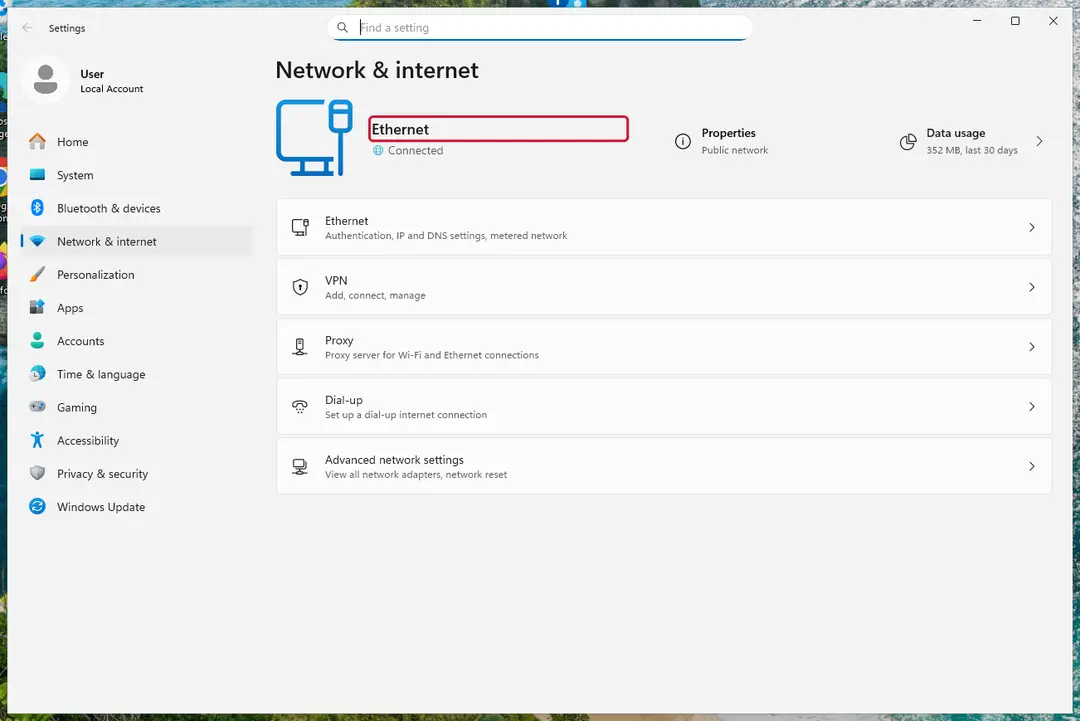
Windows 11: turn off Wi-Fi to take the PC offline. Full procedure with screenshots: Ransomware: first steps, finding a decryptor and recovering files
Step 2: Save the ransom note and confirm the family
Copy
_readme.txtand one or two files ending in.reppto a USB stick, and leave the originals where they are.From another device, upload the note and a sample file to ID Ransomware or No More Ransom's Crypto Sheriff, which name the family from the note, the extension and the file structure.
Write down the contact address and your personal ID from the note, because a decryptor or the police may ask for them.
Warning: Never contact the attackers from the infected Windows 11 or Windows 10 PC.
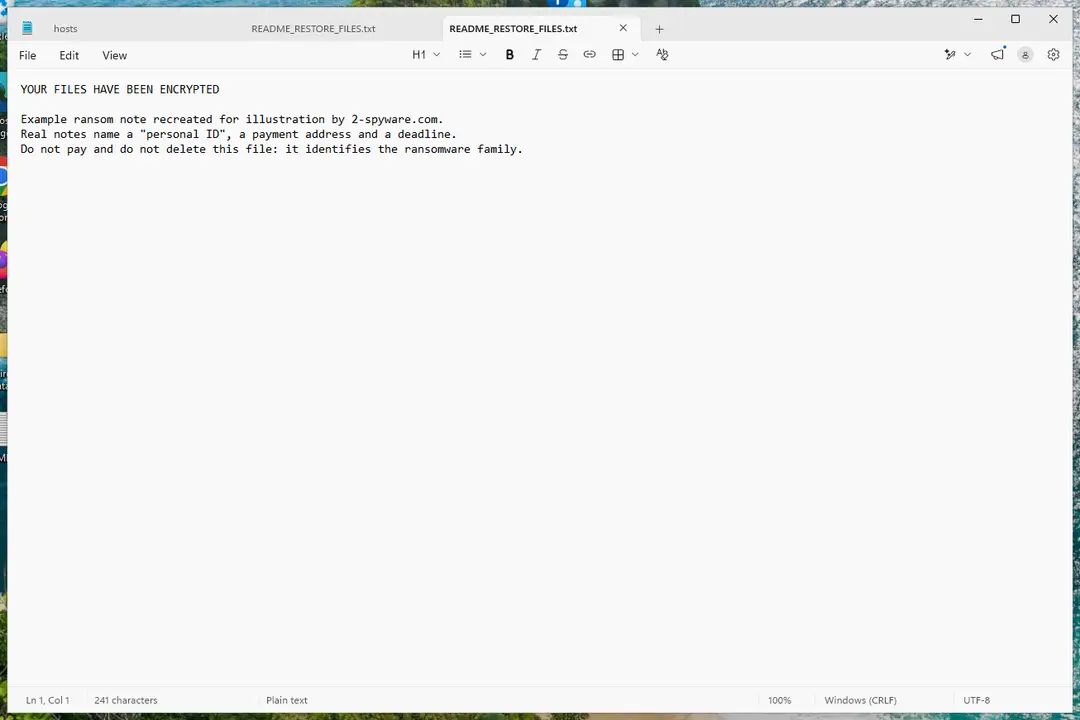
Windows 11: the ransom note and encrypted files to copy for identification. Full procedure with screenshots: Ransomware: first steps, finding a decryptor and recovering files
Step 3: Check for a free decryptor
For Repp ransomware, no free decryptor is known (checked 6 October 2026). Search the family name in the No More Ransom decryption tools list and in the free decryptors of Emsisoft, Avast and Kaspersky, because new tools appear years after an attack.
Important: Keep the encrypted files even if nothing works today, and do not pay before every free option is ruled out: payment does not guarantee a working key.
Decryptors run on Windows 11 and Windows 10, but only after the ransomware itself is removed.
Full procedure with screenshots: Ransomware: first steps, finding a decryptor and recovering files
Step 4: Remove the ransomware before you restore or decrypt
Restoring or decrypting files while Repp ransomware still runs lets it encrypt them again. Run a Full scan in Windows Security > Virus & threat protection > Scan options, then the Microsoft Defender Antivirus (offline scan).
If the ransomware blocks Windows Security, start Safe Mode with Networking and scan from there. Some families install a password stealer as well, so let both scans finish on Windows 11 or Windows 10.
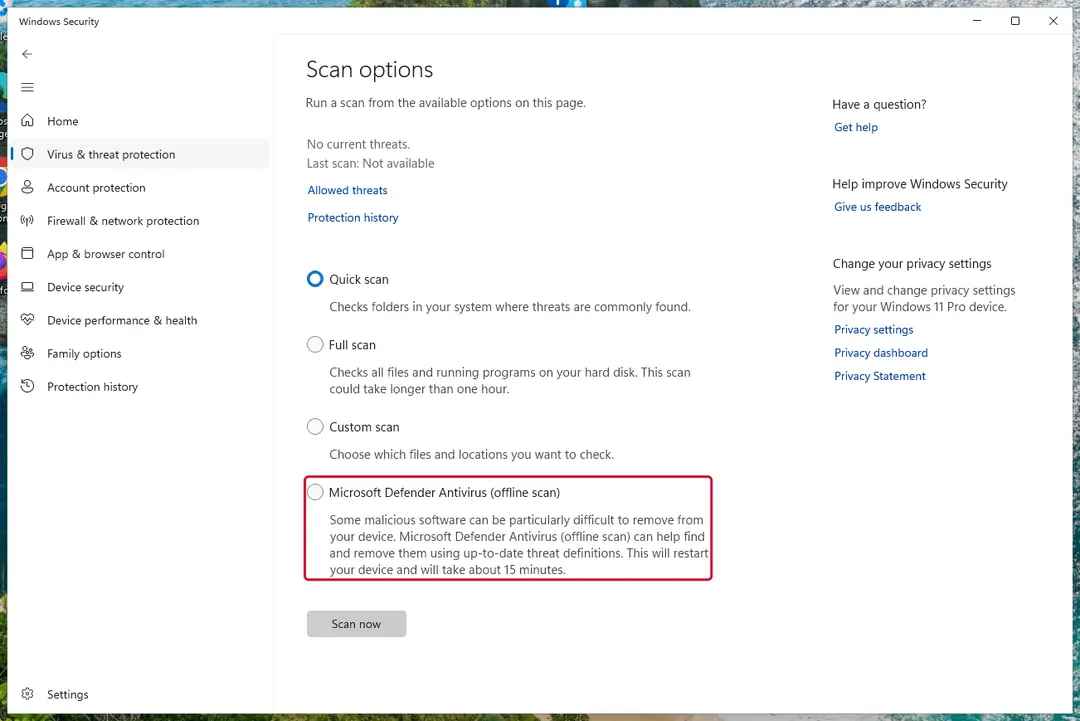
Windows 11: Windows Security > Virus & threat protection > Scan options. Full procedure with screenshots: Run a Microsoft Defender Offline scan
Step 5: Look for shadow copies of the files
Open Command Prompt as administrator and run
vssadmin list shadows. If it lists copies dated before the attack, right-click a folder with encrypted files in File Explorer, choose Properties > Previous Versions, and open or restore a version from before that date.ShadowExplorer, a free tool, shows the same copies when the tab is empty or hidden. Most current families delete shadow copies, so an empty list is normal, but the check takes two minutes on Windows 11 or Windows 10.
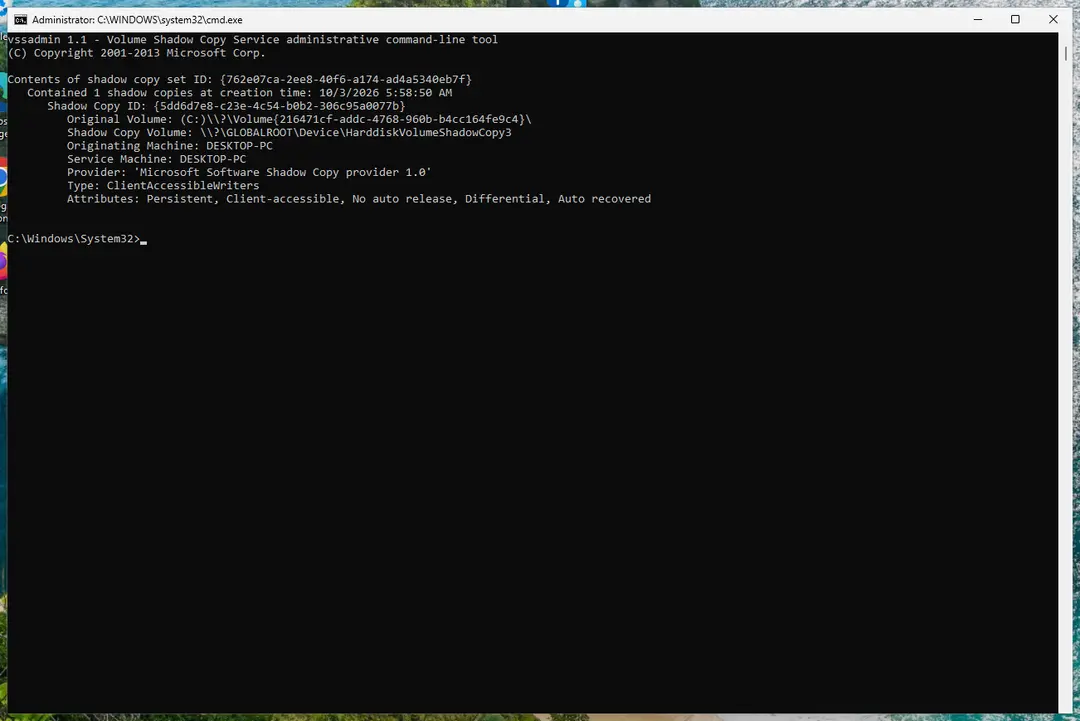
Windows 11: vssadmin list shadows shows whether shadow copies exist. Full procedure with screenshots: Ransomware: first steps, finding a decryptor and recovering files
Step 6: Restore the files from a backup or recover deleted originals
Restore from an external backup, File History or OneDrive's version history, choosing a date before the attack. Connect the backup drive only after the scans are clean, or the ransomware encrypts it too.
If there is no backup, file recovery software can sometimes find the deleted originals, because some ransomware writes an encrypted copy and deletes the original file.
Stop writing to the drive and try recovery on Windows 11 or Windows 10 before new files overwrite the space.
Full procedure with screenshots: Recover deleted files (Recycle Bin, backups, OneDrive) On uGetFix
Instructions for each browser and system
The detailed steps for every browser and system this guide covers. Open the one you use.
Manual removal using Safe Mode
Important! →
Manual removal guide might be too complicated for regular computer users. It requires advanced IT knowledge to be performed correctly (if vital system files are removed or damaged, it might result in full Windows compromise), and it also might take hours to complete. Therefore, we highly advise using the automatic method provided above instead.
Step 1. Access Safe Mode with Networking
Manual malware removal should be best performed in the Safe Mode environment.
Windows 7 / Vista / XP
- Click Start > Shutdown > Restart > OK.
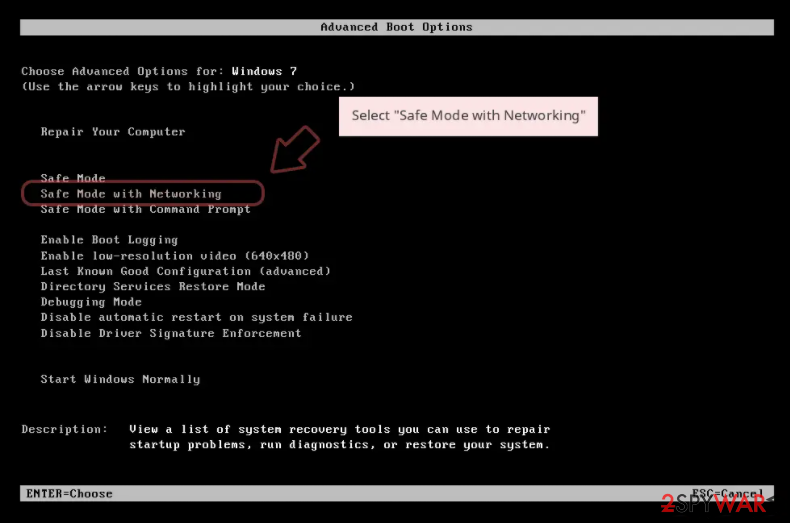
- When your computer becomes active, start pressing F8 button (if that does not work, try F2, F12, Del, etc. - it all depends on your motherboard model) multiple times until you see the Advanced Boot Options window.
- Select Safe Mode with Networking from the list.
Windows 10 / Windows 8
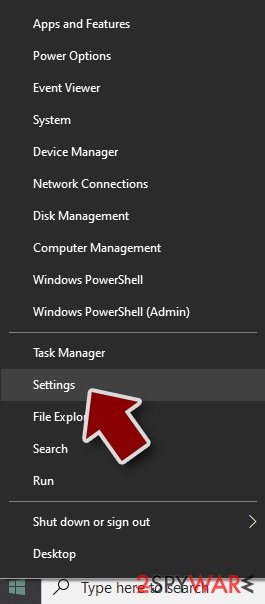
- Right-click on Start button and select Settings.
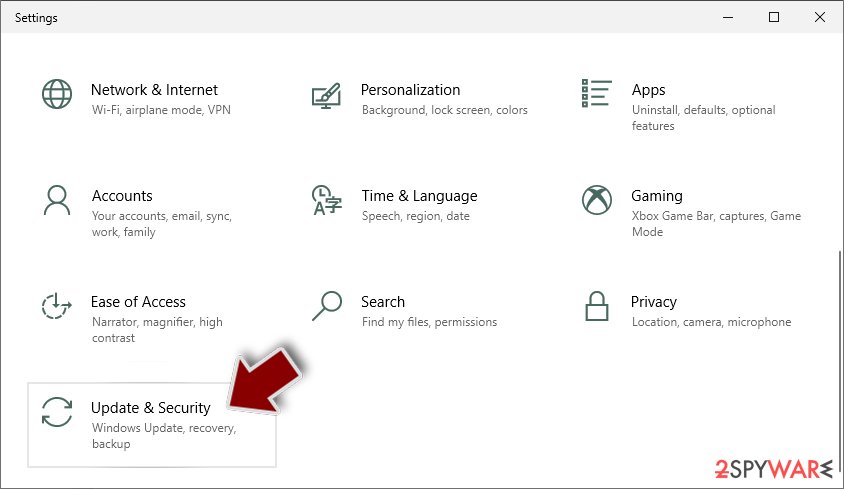
- Scroll down to pick Update & Security.
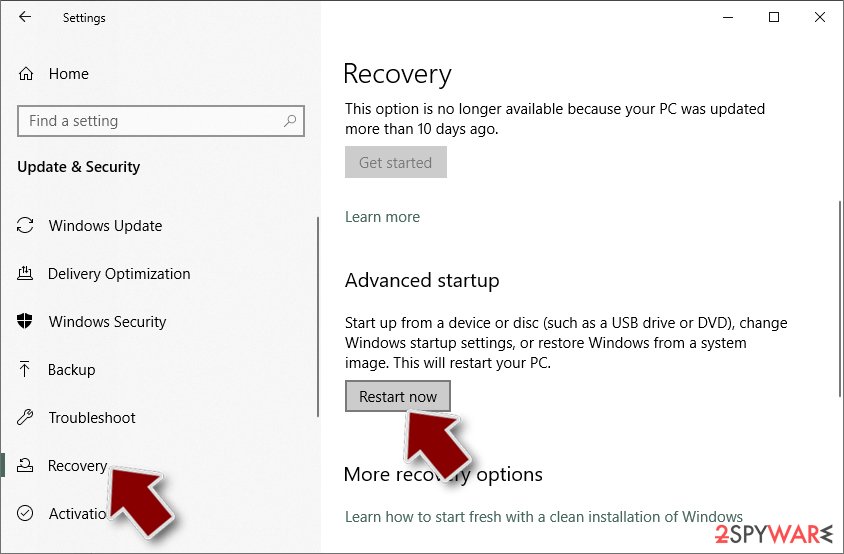
- On the left side of the window, pick Recovery.
- Now scroll down to find Advanced Startup section.
- Click Restart now.
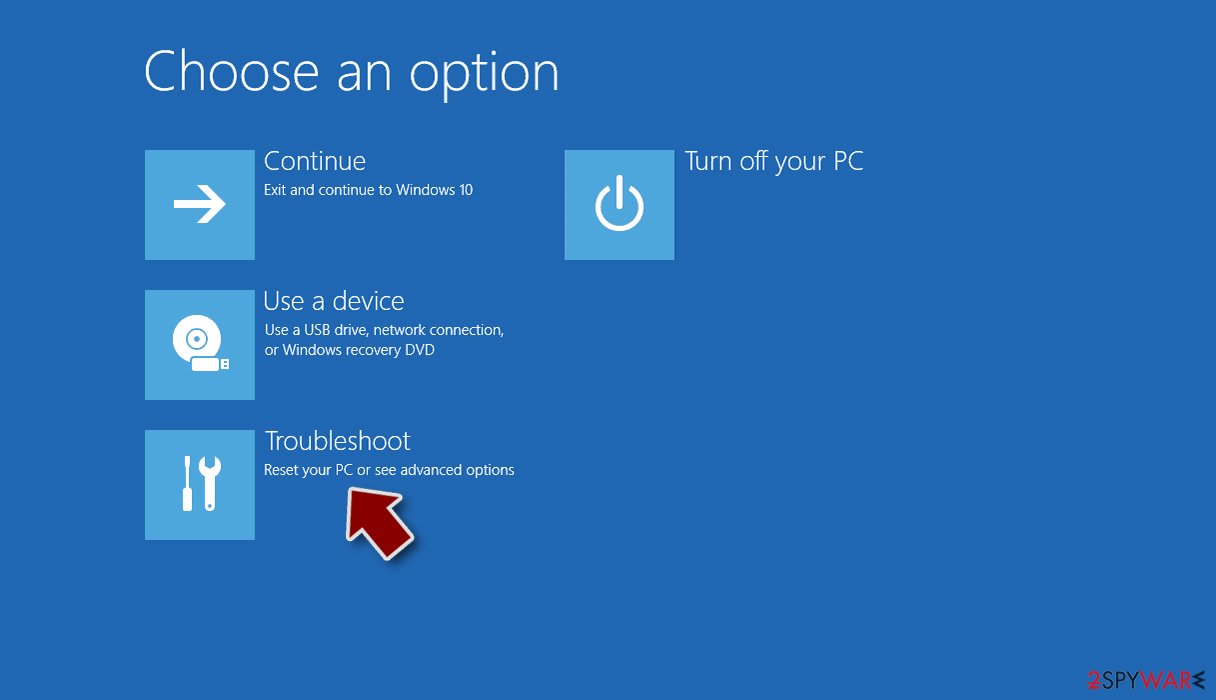
- Select Troubleshoot.
- Go to Advanced options.
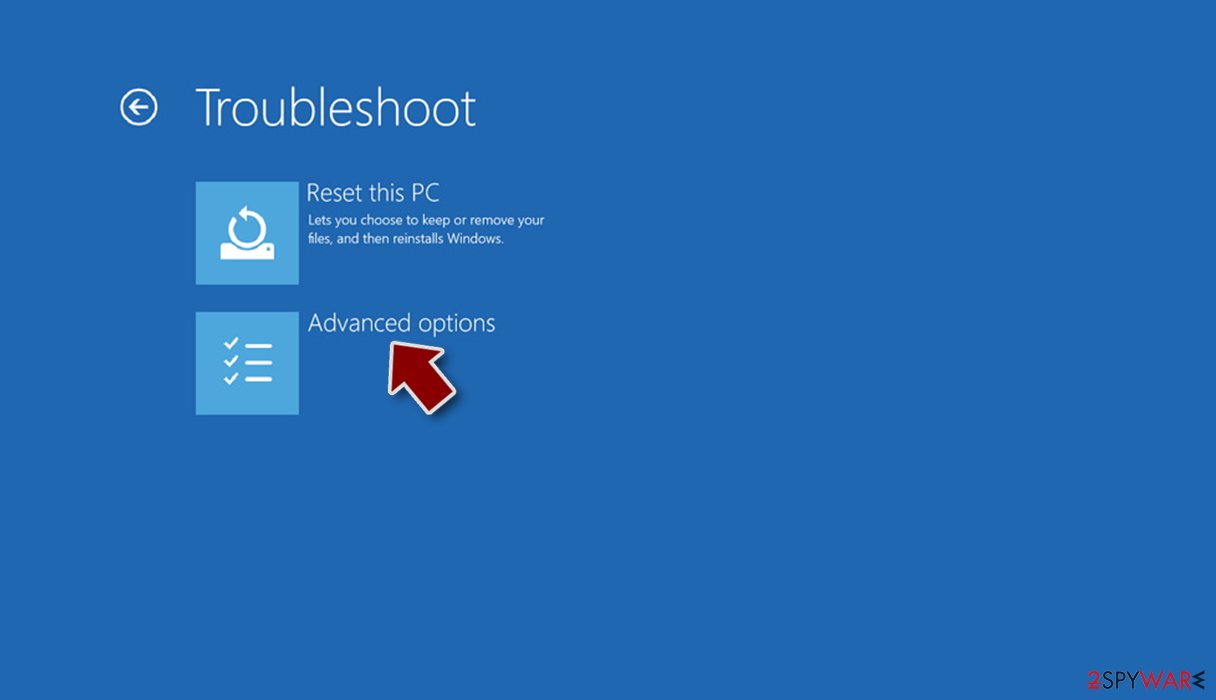
- Select Startup Settings.
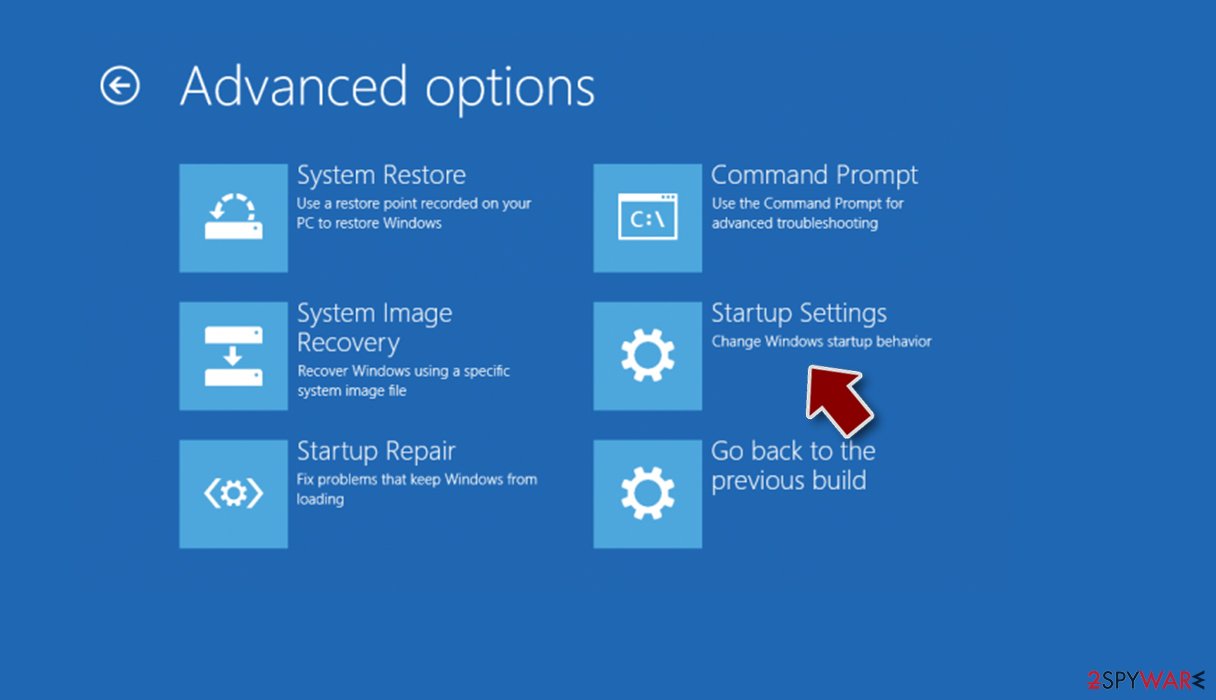
- Press Restart.
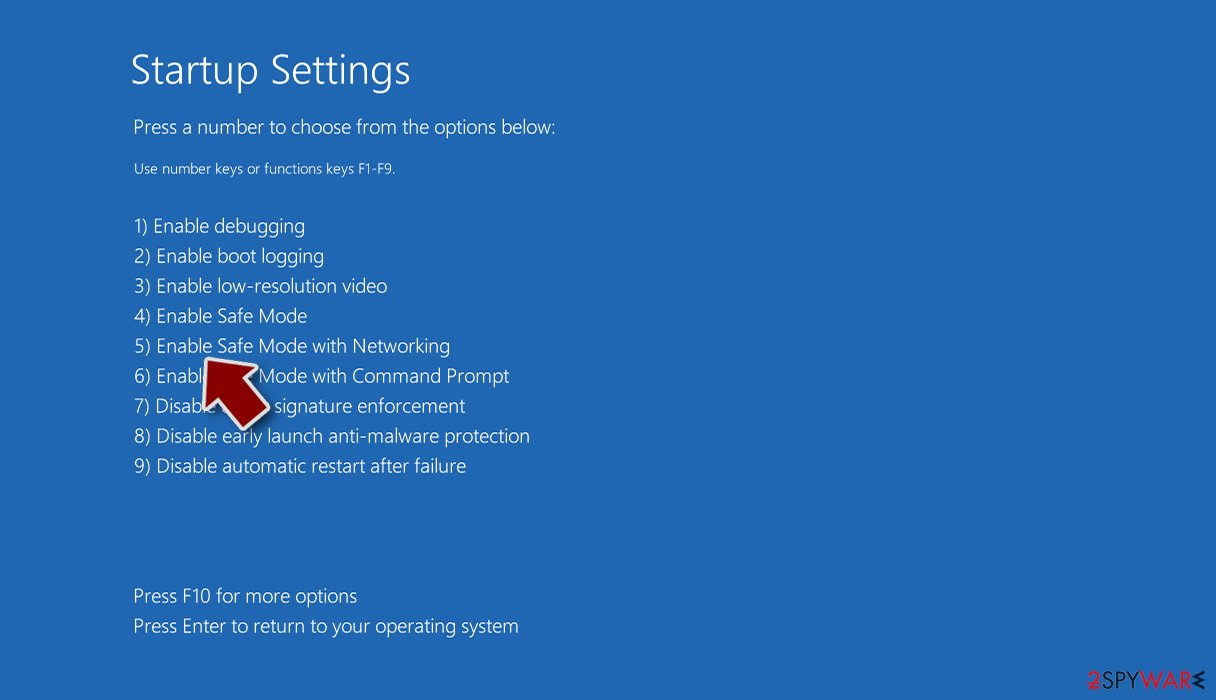
- Now press 5 or click 5) Enable Safe Mode with Networking.
Step 2. Shut down suspicious processes
Windows Task Manager is a useful tool that shows all the processes running in the background. If malware is running a process, you need to shut it down:
- Press Ctrl + Shift + Esc on your keyboard to open Windows Task Manager.
- Click on More details.
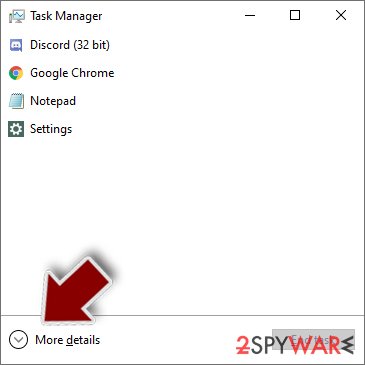
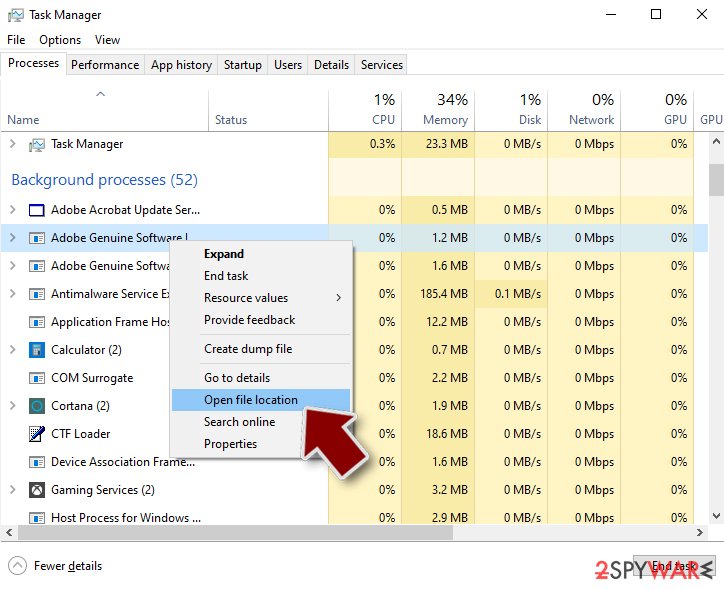
- Scroll down to Background processes section, and look for anything suspicious.
- Right-click and select Open file location.
- Go back to the process, right-click and pick End Task.
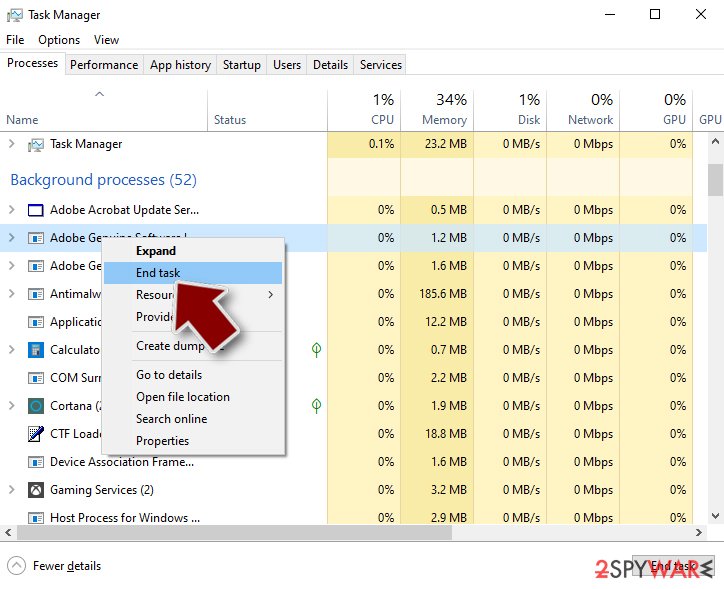
- Delete the contents of the malicious folder.
Step 3. Check program Startup
- Press Ctrl + Shift + Esc on your keyboard to open Windows Task Manager.
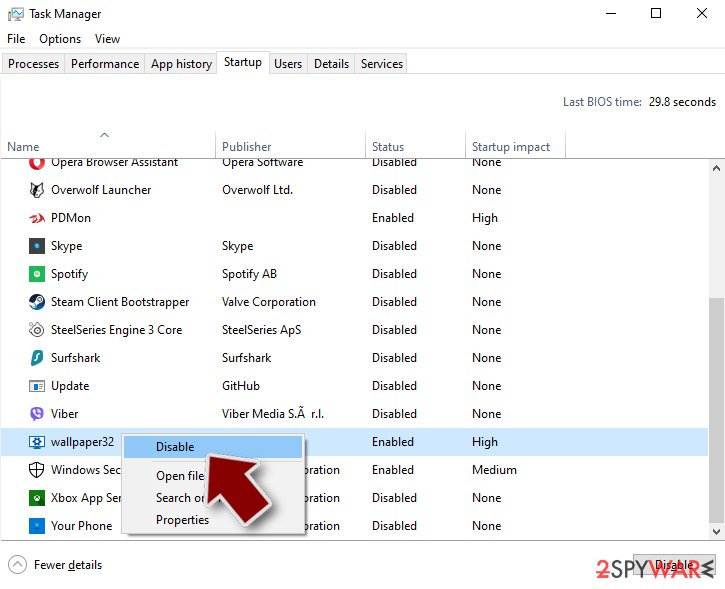
- Go to Startup tab.
- Right-click on the suspicious program and pick Disable.
Step 4. Delete virus files
Malware-related files can be found in various places within your computer. Here are instructions that could help you find them:
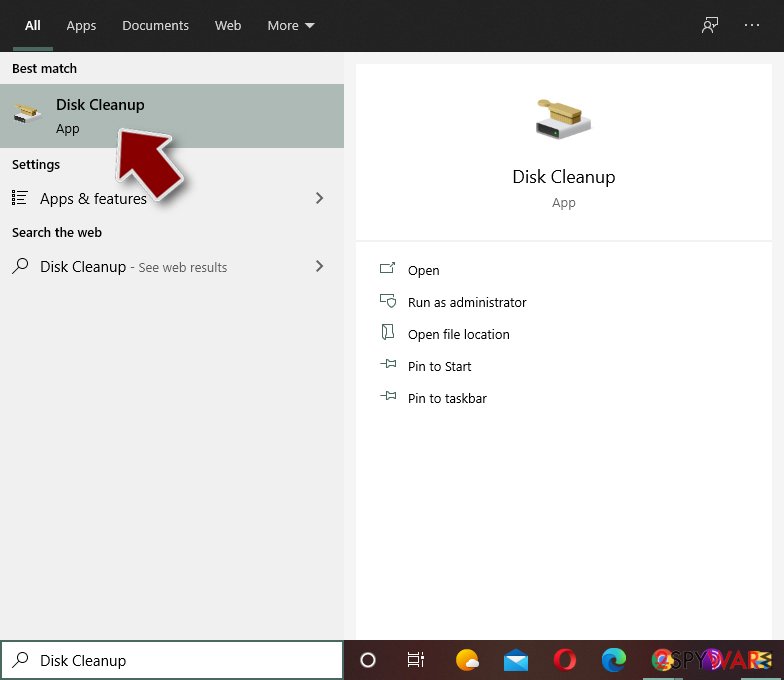
- Type in Disk Cleanup in Windows search and press Enter.
- Select the drive you want to clean (C: is your main drive by default and is likely to be the one that has malicious files in).
- Scroll through the Files to delete list and select the following:
Temporary Internet Files
Downloads
Recycle Bin
Temporary files - Pick Clean up system files.
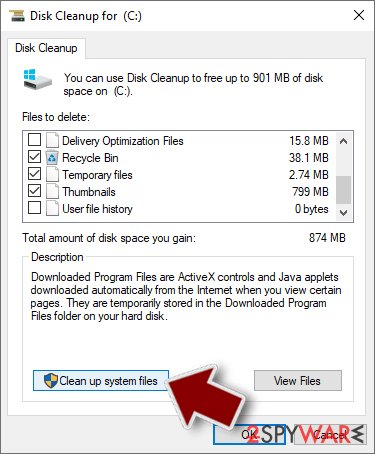
- You can also look for other malicious files hidden in the following folders (type these entries in Windows Search and press Enter):
%AppData%
%LocalAppData%
%ProgramData%
%WinDir%
After you are finished, reboot the PC in normal mode.
From our report of Feb 2020 · not reviewed since
Removal steps for Repp ransomware from Windows OS
If you have been dealing with Repp ransomware lately, you should eliminate the malware with no hesitation.
The process requires employing trustworthy malware removal software that is capable of deleting all the malicious components that were brought by the ransomware virus to the Windows computer system.
Do not try to remove Repp ransomware on your own, especially if you are an inexperienced computer user as you can make some mistakes that might bring permanent damage to the system.
Also, if you think that your machine might have been corrupted in one way or another, you can check such speculation with or . If this software shows any damaged areas, you might have a chance of repairing them with .
After Repp ransomware removal and damage fix, you can start thinking about data recovery strategies. Remember that rushing to pay the cybercriminals is not the best thing to do as you can get easily scammed. Alternatively, travel to the end of this web page where you will find some data recovery methods.
[GI=method-1]To deactivate the ransomware virus on your Windows computer and diminish all malicious settings, you should apply the following steps to set the Safe Mode with Networking feature on your device.
[GI=method-2]To diminish all malware-laden changes and reverse your computer system back to its previous state, you should follow the below-provided guidelines and opt for System Restore.
Try using this software if the ransomware virus has encrypted your files and documents. Complete all of the steps as required in order to reach the best results possible.
Using Windows Previous Versions feature might allow you to restore some data.
If the ransomware virus has affected your valuable files, you can try restoring some of them with the help of this software. However, make sure that you have enabled the System Restore feature before.
Shadow Explorer might be a handy tool for data recovery.
If the ransomware virus did not permanently damage or delete the Shadow Volume Copies of your encrypted files, you have a chance of restoring some of your individual documents.
Currently, the cybersecurity experts are working on the official decryption tool.
Report it and recover your files
Report it
Report the attack even if you do not expect the files back: insurers and banks ask for the report number, and police use the contacts in the note to link cases.
- United States
- FBI IC3 · FTC ReportFraud
- United Kingdom
- Report Fraud (formerly Action Fraud) · NCSC
- Australia
- ReportCyber (ASD)
- EU countries
- Europol: national reporting sites
Give the victim ID, the note and the date the files were encrypted. A business that holds personal data may also have to notify its data protection authority, in the EU within 72 hours.
Make the next attack harmless
Repp ransomware could only hurt the files that had no second copy, and the signs (files that end in .repp and no longer open) showed exactly which ones those were.
The 3-2-1 rule fixes that:
- three copies
- two media
- one disconnected
A practical version for a home PC: OneDrive or another cloud backup with version history, plus an external disk that you plug in once a week for File History and then unplug. Test a restore now and then by opening a few files from the backup on another device.
Details, schedules and what not to back up are in our 3-2-1 backup guide for Windows.
Choose a proper web browser and improve your safety with a VPN tool
Online spying has got momentum in recent years and people are getting more and more interested in how to protect their privacy online.
One of the basic means to add a layer of security - choose the most private and secure web browser. Although web browsers can't grant full privacy protection and security, some of them are much better at sandboxing, HTTPS upgrading, active content blocking, tracking blocking, phishing protection, and similar privacy-oriented features.
However, if you want true anonymity, we suggest you employ a powerful VPN - it can encrypt all the traffic that comes and goes out of your computer, preventing tracking completely.
Lost your files? Use data recovery software
While some files located on any computer are replaceable or useless, others can be extremely valuable.
Family photos, work documents, school projects - these are types of files that we don't want to lose. Unfortunately, there are many ways how unexpected data loss can occur:
- power cuts
- Blue Screen of Death errors
- hardware failures
- crypto-malware attack
- even accidental deletion
To ensure that all the files remain intact, you should prepare regular data backups. You can choose cloud-based or physical copies you could restore from later in case of a disaster. If your backups were lost as well or you never bothered to prepare any, can be your only hope to retrieve your invaluable files.
Questions about Repp ransomware
Is there a decryptor for .repp files?
That depends on the family behind the .repp extension, which this guide cannot confirm yet from the reports alone. Check No More Ransom and ID Ransomware with your ransom note and one encrypted file; they list families with free tools.
If none exists today, keep the encrypted files and a copy of the note on a separate drive, because decryptors are sometimes published months later after flaws are found or servers are seized. Never buy a decryptor from a website that is not the security company that made it.
How do I open .repp files?
You cannot open them by renaming or by choosing another program. The .repp ending shows that Repp ransomware encrypted the content, and only the matching key can reverse it. Renaming a file back to .docx or .jpg changes nothing except the icon, and it can confuse a future decryptor, so leave the names as they are.
To get the content back, use a backup, an unencrypted copy elsewhere, or a decryptor listed on No More Ransom if one exists for Repp ransomware. Store the encrypted files on an external disk until then.
Should I pay the ransom?
We advise against it, and so do the FBI, Europol and national cyber agencies. Payment does not guarantee a working tool: some attackers never reply, some tools damage files, and some variants have no decryptor at all. Paying also funds further attacks and can make you a target again.
Before considering payment, try every recovery option in this guide and report the attack. Companies must involve their legal adviser and insurer, because payments to sanctioned groups can be illegal. If files are truly irreplaceable, store the encrypted copies and wait; decryptors sometimes appear later.
Can a data-recovery company decrypt my files for a fee?
Only if a decryptor already exists or the company pays the attackers for you. Some "ransomware recovery" services advertise that they can decrypt families with no known flaw; in practice they negotiate with the attackers and add their own fee. Others use the same free tools listed on No More Ransom.
Before you hire anyone, ask in writing how they will recover the files, whether they will contact the attackers and what happens if they fail. A legitimate service answers clearly. If a free decryptor exists for your family, you can run it yourself.
How did Repp ransomware get on my computer?
The way Repp ransomware spreads has not been documented yet, so look at your own recent activity. On home PCs, ransomware most often comes with cracked programs, game cheats, key generators and fake updates, or with an e-mail attachment that was opened. On business networks, attackers usually log in through Remote Desktop with a stolen or guessed password.
Think back to what was downloaded or installed in the days before files that end in .repp and no longer open, and check the Downloads folder and Installed apps sorted by date. Keep anything suspicious for your report, but do not run it again.
Did Repp ransomware steal my files or passwords?
We do not know yet. Nothing published so far shows data theft by Repp ransomware, but the only confirmed sign is files that end in .repp and no longer open, which says nothing about what happened before. Many current ransomware attacks copy files or run a password stealer first, so it is wise to act as if they did.
From a clean device, change the passwords that were saved in the browsers on this PC, starting with e-mail and banking, sign out of all sessions and turn on two-step verification. Watch bank statements and account activity for the next few weeks.
Is Repp ransomware the same as other ransomware with a similar name?
Not necessarily. Ransomware names come from the file extension, the note or a word in the code, so unrelated families often end up with similar names, and one family can appear under several names. The difference matters: a decryptor or advice for one family does not fit another and can damage files.
Compare the ending added to your files and the exact name of the note with the summary table at the top of this guide, then upload the note and one encrypted file to ID Ransomware from a clean device. If the result names another family, follow the guide for that family instead.
What does _readme.txt tell me about the ransomware?
Quite a lot. The file name _readme.txt, the wording, the contact addresses and the format of the personal ID are typical for each family. Uploading the note together with one encrypted file to ID Ransomware or No More Ransom's Crypto Sheriff usually names the family within seconds.
That name decides your options: some families have free decryptors, some can be partially recovered, and some cannot be decrypted at all. The note's claims about stolen data should be taken seriously but not at face value.
My files got .repp overnight. What happened?
Ransomware often runs at night or when the PC is idle, so the encryption finishes before anyone notices. It usually entered earlier through a cracked program, a fake installer, an e-mail attachment or remote desktop with a weak password.
The .repp extension marks every file it reached. Start by disconnecting the PC from the network, then identify the family from the ransom note and one encrypted file, check for a decryptor, and look for copies in backups and OneDrive before you consider anything else.
Will Fortect remove Repp ransomware?
Fortect scans Windows for malware and unwanted programs and repairs the system files and settings they change, and its free scan shows what it finds on your PC before you decide anything.
For Repp ransomware, follow the plan above as well: the browser steps take back permissions and settings that no scanner treats as a threat, and uninstalling the program that brought it removes the source.
Run Microsoft Defender's full scan and, if anything was found, its offline scan as a second opinion. If the symptoms are gone after the plan and both scans are clean, there is nothing more to do.
Sources
- Twitter: #STOP #Djvu #Ransomware (read October 6, 2026)
- Wikipedia: Advanced Encryption Standard (read October 6, 2026)
- Emsisoft: Emsisoft Decryptor for STOP Djvu (read October 6, 2026)
- Dr Web products: Dr.Web Rescue Pack (read October 6, 2026)
- LosVirus: LosVirus.es (read October 6, 2026)