

Essential information about Search.coldorhottoday.com virus:
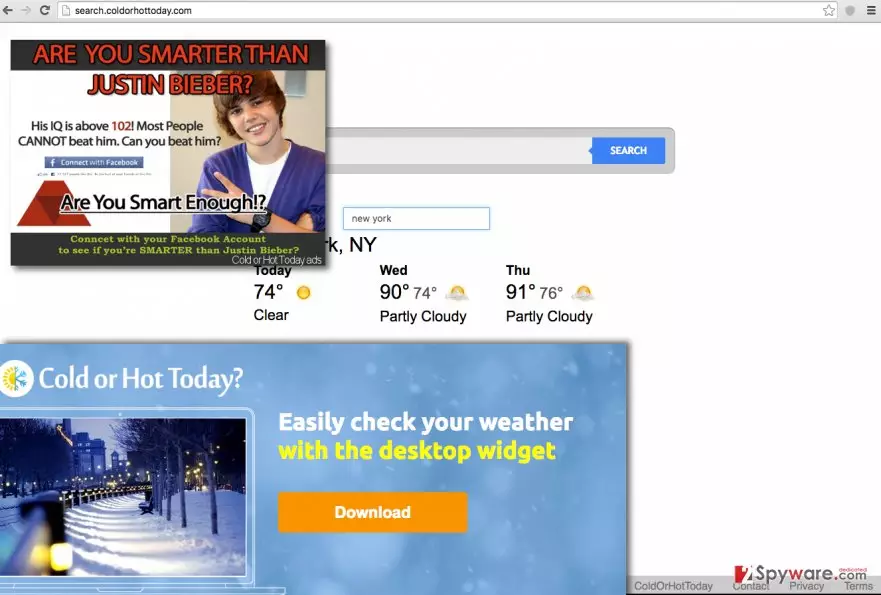
If you’re wondering whether it will be cold or hot today,Search.coldorhottoday.com page might seem like a useful site to set as your homepage. It suggests weather forecasts for the upcoming week and provides a search engine as well. However, if this site has replaced your previous homepage without your knowledge, you should know that it was done by Search.coldorhottoday.com browser hijacker. It is widely known among spyware researchers, and it falls into potentially unwanted programs’ (PUP) category. On its official website, developers (Popollo Media LLC) present it as a useful desktop widget, but in reality, it doesn’t seem so helpful. The ability to show forecasts does not exceed its disadvantages that eventually come to the surface, and if you have already encountered them, you probably want to remove Search.coldorhottoday.com right now. You can do that with FortectIntego software or manually (see information below).
The list of problems that this browser hijacker can cause you is quite long. First of all, this so-called desktop widget slows down the computer system. Second, it changes browser’s settings without telling the computer user first. To be precise, it modifies the home, new tab page, and default search engine settings. Of course, it inputs the Cold or Hot site URL into these settings. Then this browser hijacker starts gathering data about user’s browsing habits and makes decisions on what ads to deliver. You will soon notice how annoying these ads are, as they are going to show up very frequently in pop-up windows and new tabs. However, probably the worst thing is the search engine that the indicated website provides. Some of its search results might appear to be forged, and if you clicked on them, you would be forced to experience Search.coldorhottoday.com redirects to vague third-party Internet sites.
Redirects are used to drive traffic to websites and make them more popular, however, keep in mind that not only secure websites want to promote themselves. Redirects can also direct you to sites that are highly dangerous, promote malware, or urge to disclose sensitive data. Keep that in mind while browsing the Internet. Ideally, use a well-known and trustworthy search engine, and let this browser hijacker go. According to spyware researchers, it is not safe to keep potentially unwanted apps on the computer system.
How did you install this browser hijacker?
Wondering what is this hijacker doing on your computer system, although you did not do anything to invite it there? In fact, you do not need to do much in order to permit PUPs to enter your computer system and place their files there. PUPs travel around the web along with other programs, so we advise you to stay cautious while installing any new program on your PC. Chances are, it can be bundled with some other free pieces of software that you might not be willing to install by your choice. The permissions to install these programs are commonly hidden behind Default/Standard installation options, so always switch them to either Custom or Advanced mode instead, and then deselect these permissions.
How to remove Search.coldorhottoday.com?
No matter if you have installed Search.coldorhottoday.com virus by your choice or if you were convinced to install it alongside another app, you should not keep such suspicious piece of software on your computer nor use services that it provides. Luckily, you can easily remove this hijacker from your computer system without experiencing any sad consequences. You can do it manually by following Search.coldorhottoday.com removal instructions, which are presented down below, or by running an anti-spyware software like FortectIntego. Automatic problem-solving program can detect and delete all computer programs that are dangerous or raise suspicion at once.
Uninstall from Windows
Uninstall from Windows 10/8:
- Type Control Panel into the Windows search box and open the result.
- Under Programs, select Uninstall a program.


Uninstall from Windows 7/XP:
- Click on Windows Start > Control Panel (Windows XP users should click on Add/Remove Programs).
- In Control Panel, select Programs > Uninstall a program.


Remove the unwanted program:
- In the Programs and Features window, look for any recently installed suspicious entries, select them, and click Uninstall.
- If User Account Control appears, click Yes to confirm, then complete the removal.


Delete from macOS
Remove the unwanted application:
- From the menu bar, select Go > Applications.
- In the Applications folder, look for any suspicious entries, then drag them to Trash (or right-click and pick Move to Trash).


Delete leftover files and folders:
- Select Go > Go to Folder.
- Enter /Library/Application Support and remove any suspicious folders related to the unwanted program.
- Repeat the same check in the /Library/LaunchAgents and /Library/LaunchDaemons folders, deleting any suspicious entries.

- Finally, empty the Trash to permanently remove the leftovers.

Remove from Microsoft Edge
Delete unwanted extensions from MS Edge:
- Select Menu (three horizontal dots at the top-right of the browser window) and pick Extensions.
- From the list, pick the extension and click on the Gear icon.
- Click Remove.


Clear cookies and other browser data:
- Click on the Menu (three horizontal dots at the top-right of the browser window) and select Settings > Privacy, search, and services..
- Under Clear browsing data, pick Choose what to clear.
- Select Cookies and other site data and Cached images and files. (apart from passwords, although you might want to include Media licenses as well, if applicable) and click on Clear.


Restore new tab and homepage settings:
- Click the menu icon and choose Settings.
- Then find On startup section.
- Click Remove next to any suspicious startup page.
Reset MS Edge if the above steps did not work:
- Press on Ctrl + Shift + Esc to open Task Manager.
- Click on More details arrow at the bottom of the window.
- Select Details tab.
- Now scroll down and locate every entry with Microsoft Edge name in it. Right-click on each of them and select End Task to stop MS Edge from running.


Instructions for Chromium-based Edge
Delete extensions from MS Edge (Chromium):
- Open Edge and click select Settings > Extensions.
- Delete unwanted extensions by clicking Remove.


Clear cache and site data:
- Click on Menu and go to Settings.
- Select Privacy, search and services.
- Under Clear browsing data, pick Choose what to clear.
- Under Time range, pick All time.
- Select Clear now.


Reset Chromium-based MS Edge:
- Click on Menu and select Settings.
- On the left side, pick Reset settings.
- Select Restore settings to their default values.
- Confirm with Reset.
- This will disable extensions and reset startup pages but will not delete bookmarks, saved passwords, or browsing history.


Remove from Mozilla Firefox (FF)
Remove dangerous extensions:
- Open Mozilla Firefox browser and click on the Menu (three horizontal lines at the top-right of the window).
- Select Add-ons.
- In here, select the unwanted extension and click Remove.


Reset the homepage:
- Click three horizontal lines at the top right corner to open the menu.
- Choose Settings.
- Under Home, set your preferred homepage and new tab settings.
Clear cookies and site data:
- Click Menu and pick Settings.
- Go to Privacy & Security section.
- Scroll down to locate Cookies and Site Data.
- Click on Clear Data...
- Select Cookies and Site Data and Temporary cached files and pages, then click Clear.


Reset Mozilla Firefox
If clearing the browser as explained above did not help, reset Mozilla Firefox:
- Open Mozilla Firefox browser and click the Menu.
- Go to Help and then choose Troubleshooting Information.

- Under Give Firefox a tune up section, click on Refresh Firefox...
- Once the pop-up shows up, confirm the action by pressing on Refresh Firefox.



Remove from Google Chrome
Delete malicious extensions from Google Chrome:
- Open Google Chrome, click on the Menu (three vertical dots at the top-right corner) and select More tools > Extensions.
- In the newly opened window, you will see all the installed extensions. Uninstall all suspicious extensions related to the unwanted program by clicking Remove.


Clear cache and web data from Chrome:
- Click on Menu and pick Settings.
- Under Privacy and security, select Clear browsing data.
- Select Browsing history, Cookies and other site data, as well as Cached images and files.
- Click Clear data.


Change your homepage:
- Click menu and choose Settings.
- Look for a suspicious site in the On startup section.
- Click on Open a specific or set of pages and click on three dots to find the Remove option.
Reset Google Chrome:
If the previous methods did not help you, reset Google Chrome to eliminate all the unwanted components:
- Click on Menu and select Settings.
- In the Settings, scroll down and click Advanced.
- Scroll down and locate Reset and clean up section.
- Now click Restore settings to their original defaults.
- Confirm with Reset settings.


Delete from Safari
Remove dangerous extensions:
- Open Safari, click Safari in the menu at the top-left of the screen, and select Preferences.
- Go to the Extensions tab, look for any suspicious entries, and click Uninstall to remove them.


Clear history and website data:
- Click Safari in the menu and pick Clear History.
- Set Clear to all history and confirm with Clear History.


Reset Safari:
- Click Safari in the menu and select Preferences > Advanced.
- Enable Show Develop menu in menu bar.
- From the menu bar, click Develop and select Empty Caches.


Did this guide help?
4 comments
Trevoir
I am so glad to finally be free of Search.coldorhottoday.com virus! Thank you guys so much for helping me.
Theresa
cant be more happy. this stupid browser virus was ruining my life.
olly
thanks a million! finally removed it :)
sapphire
I cannot understand how to delete this, so Ill try to install anti-malware app. It seems that I do better in installing than in uninstalling programs...