

All you need to know about Search.polebeary.com virus:
If you use a computer on a daily basis, you for sure use one or another web search engine. However, if you ever come across Search.polebeary.com search engine, you should not even consider an idea of using it. This search engine can suddenly take the place of your homepage in Google Chrome, Mozilla Firefox, Safari, and other web browsers, and also be set as a default search engine. If it has appeared in your browser, it indicates that your computer has been hijacked by Search.polebeary.com browser hijacker. This hijacker is known among security researchers as a potentially unwanted program (PUP), that targets Mac users. Without asking user’s permission, it changes browser settings in order to promote the search engine that was mentioned before and attempts to convince the computer user to use it. If the user fails to identify a browser hijacker, he/she might start using this search engine, thinking that it is a legitimate one. However, it doesn’t take long to notice that this search engine acts suspicious and that it is not possible to change browser settings in the usual manner.
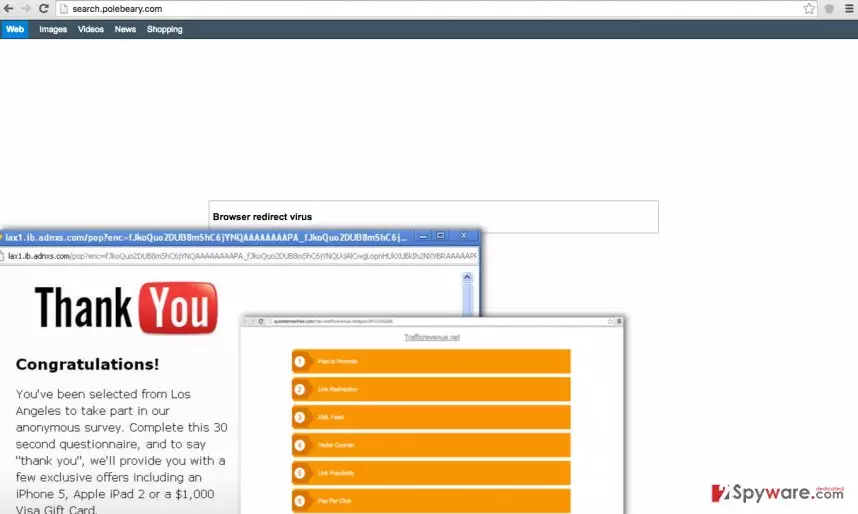
The indicated search engine presents regular search results, so at the first sight, nothing seems suspicious. However, if the user starts clicking on them in order to visit particular websites, strange things start to happen. The user might notice that these search results open websites that are not related to the search term that the user has entered, or that they trigger pop-ups and new tabs with promotional content. Not only such occurrences are unpleasant and annoying, but they can lead to security-related problems as well. These Search.polebeary.com redirects might direct you to insecure web pages, so be cautious. If you ever encounter an offer to participate in a lottery or giveaway, avoid providing your personal information. What is more, it is essential to avoid installing any unknown programs or software updates from such ads and unknown websites, as they can be dangerous. If you are not satisfied with these redirects and if you would like to get rid of them, remove Search.polebeary.com from your computer. If you are not looking for a manual removal guide, you should run a powerful anti-malware software and let it scan your PC system for you. If you do not have such program, download FortectIntego software.
How does this program spread over the Internet?
Although this possibly dangerous program has an official web page, you won’t find a download link on it. It is so because this shady piece of software is distributed via “bundling” technique, or, in other words, alongside freeware and shareware. Many people do not realize how dangerous it is to install free programs in a rush, and as a result, they install various adware, browser hijackers, and other useless programs unintentionally. Now, let us explain how you can protect your computer from PUPs.
When you install any type of a computer program, remember that it can be bundled with some additional apps you might not be willing to install. To check whether it has some additions or not, open Custom or Advanced settings. If after selecting these options the menu expands and provides a list of “recommended” downloads, deselect them all. Then continue and finish the installation of your preferred software.
How to remove Search.polebeary.com?
So you have already installed Search.polebeary.com virus, and now you wonder how you can remove it. As we have stated before, you can go the easy way and use the anti-malware program. Alternatively, if you are ready to spend some more time, you can follow these Search.polebeary.com removal instructions and delete this hijacker by yourself.
Delete from macOS
Remove the unwanted application:
- From the menu bar, select Go > Applications.
- In the Applications folder, look for any suspicious entries, then drag them to Trash (or right-click and pick Move to Trash).


Delete leftover files and folders:
- Select Go > Go to Folder.
- Enter /Library/Application Support and remove any suspicious folders related to the unwanted program.
- Repeat the same check in the /Library/LaunchAgents and /Library/LaunchDaemons folders, deleting any suspicious entries.

- Finally, empty the Trash to permanently remove the leftovers.

Reset Internet Explorer
Remove dangerous add-ons:
- Open Internet Explorer, click on the Gear icon (IE menu) on the top-right corner of the browser
- Pick Manage Add-ons.
- You will see a Manage Add-ons window. Here, look for suspicious plugins. Click on these entries and select Disable.


Change your homepage if it was altered:
- Open IE and click on the Gear icon.
- Select Internet Options.
- In the General tab, delete the Home page address and replace it by your preferred one (for example, Google.com).
- Click Apply and then select OK.


Delete temporary files:
- Press on the Gear icon and select Internet Options.
- Under Browsing history, click Delete...
- Select relevant fields and press Delete.


Reset Internet Explorer:
- Click on Gear icon > Internet options and select Advanced tab.
- Select Reset.
- In the new window, check Delete personal settings and select Reset.


Remove from Mozilla Firefox (FF)
Remove dangerous extensions:
- Open Mozilla Firefox browser and click on the Menu (three horizontal lines at the top-right of the window).
- Select Add-ons.
- In here, select the unwanted extension and click Remove.


Reset the homepage:
- Click three horizontal lines at the top right corner to open the menu.
- Choose Settings.
- Under Home, set your preferred homepage and new tab settings.
Clear cookies and site data:
- Click Menu and pick Settings.
- Go to Privacy & Security section.
- Scroll down to locate Cookies and Site Data.
- Click on Clear Data...
- Select Cookies and Site Data and Temporary cached files and pages, then click Clear.


Reset Mozilla Firefox
If clearing the browser as explained above did not help, reset Mozilla Firefox:
- Open Mozilla Firefox browser and click the Menu.
- Go to Help and then choose Troubleshooting Information.

- Under Give Firefox a tune up section, click on Refresh Firefox...
- Once the pop-up shows up, confirm the action by pressing on Refresh Firefox.



Remove from Google Chrome
Delete malicious extensions from Google Chrome:
- Open Google Chrome, click on the Menu (three vertical dots at the top-right corner) and select More tools > Extensions.
- In the newly opened window, you will see all the installed extensions. Uninstall all suspicious extensions related to the unwanted program by clicking Remove.


Clear cache and web data from Chrome:
- Click on Menu and pick Settings.
- Under Privacy and security, select Clear browsing data.
- Select Browsing history, Cookies and other site data, as well as Cached images and files.
- Click Clear data.


Change your homepage:
- Click menu and choose Settings.
- Look for a suspicious site in the On startup section.
- Click on Open a specific or set of pages and click on three dots to find the Remove option.
Reset Google Chrome:
If the previous methods did not help you, reset Google Chrome to eliminate all the unwanted components:
- Click on Menu and select Settings.
- In the Settings, scroll down and click Advanced.
- Scroll down and locate Reset and clean up section.
- Now click Restore settings to their original defaults.
- Confirm with Reset settings.


Delete from Safari
Remove dangerous extensions:
- Open Safari, click Safari in the menu at the top-left of the screen, and select Preferences.
- Go to the Extensions tab, look for any suspicious entries, and click Uninstall to remove them.


Clear history and website data:
- Click Safari in the menu and pick Clear History.
- Set Clear to all history and confirm with Clear History.


Reset Safari:
- Click Safari in the menu and select Preferences > Advanced.
- Enable Show Develop menu in menu bar.
- From the menu bar, click Develop and select Empty Caches.


Did this guide help?
4 comments
scenekiddo
I have no clue how did this virus land on my pc.
agness87
I hate this search engine. I cant remove it from my browser. It seems that automatic removal option is the only way to get rid of this virus...
Margharetta
Thank you for helping me improve the performance of my Mac. My browser shut down a few times unexpectedly while it was controlled by this hijacker!
StepUp
How did it even hijack.. MY MAC? I am shocked, really