
Todiscuassy.top ads: what it is and how to remove it
Todiscuassy.top is a fake page that uses deceptive tactics to fool people into allowing it to send notifications. There have been a couple of appearances recorded of this website.
Facts checked October 6, 2026. Removal steps tested on Windows 11 (26H2) and checked against Microsoft's and the browser makers' current documentation. Sections marked as our earlier report are the original text: they describe the threat as it was then and have not been reviewed since. The 2026 status, the removal steps and the questions are current.
Automatic
Get a free scan and check if your PC is infected.
Fortect finds malware, unwanted programs and the Windows damage they leave behind, and repairs it in one pass.
A quick scan confirms that the todiscuassy.top notifications did not lead to anything being installed.
Do it yourself · free Remove Todiscuassy.top ads yourself 2 steps, about 6 minutes, no software needed.
Todiscuassy.top ads: summary
| Distribution | Shady website redirects; freeware installation |
|---|---|
| NAME | Todiscuassy.top |
| TYPE | Push notification spam, potentially unwanted program; adware |
| SYMPTOMS | Pop-up ads appear on the screen even when the browser is closed, redirects to suspicious pages |
| DANGERS | Users are at risk of clicking dangerous links inserted in the pop-up windows and becoming victims of social engineering attacks |
| Detection names | No Microsoft detection name is known |
| Removal | Scan the PC with security software to find and remove the malware and anything installed with it. Fortect scans Windows for malware and repairs the system files and settings it damaged. Remove it nowTo use the full-featured product, you have to purchase a license for Fortect. The scan is free. |
Show 11 more facts
| Damage | Not recorded in the old report |
|---|---|
| Name | Todiscuassy.top |
| Type | Push-notification spam site |
| Symptoms | Notification spam from a website |
| Evidence | 4 write-ups by security sites; details still limited |
| Domains | todiscuassy.top |
| Ads shown as | Desktop notifications |
| Browsers | Chrome, Edge and Firefox |
| Installed on the PC | Nothing; a browser notification permission only |
| First seen | 18 August 2021 |
| Facts checked | 6 October 2026 |
What the Todiscuassy.top ads ads look like
Celebsupdates may use third-party service providers who help Celebsupdates operate its business or administer activities on our behalf, such as sending out newsletters or surveys. Celebsupdates may share user's information with these third parties for those limited purposes provided that the user has given Celebsupdates user's permission. However Celebsupdates does not control such third parties practices and is not liable or responsible for any practices used by these third parties.
Is Todiscuassy.top ads dangerous?
From our report of Aug 2021 · not reviewed since
Todiscuassy.top is a rogue website that tricks users into subscribing to its push notifications
Todiscuassy.top is a fake page that uses deceptive tactics to fool people into allowing it to send notifications.
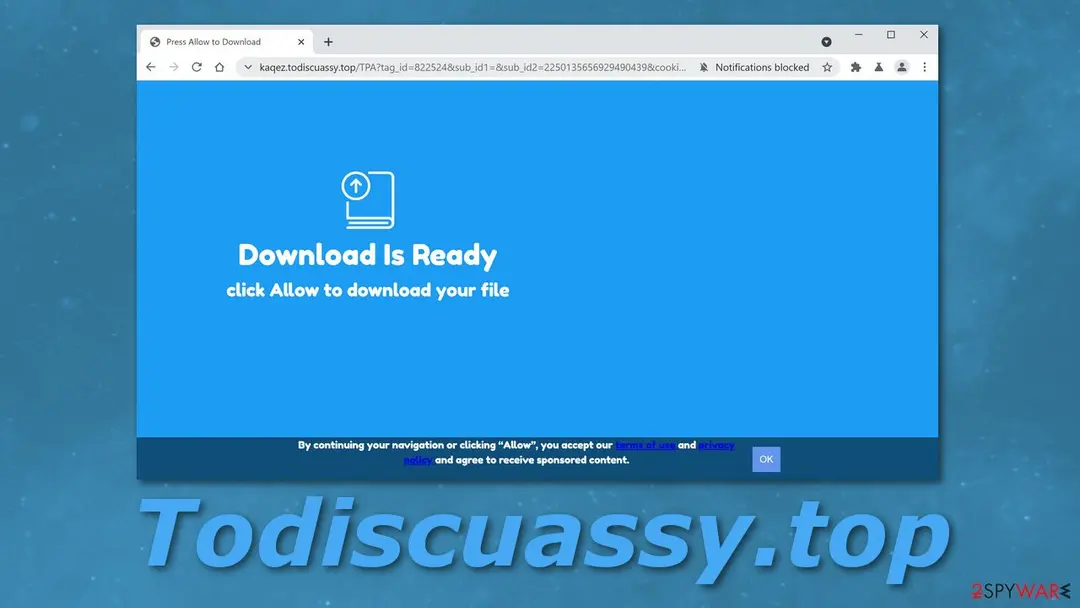
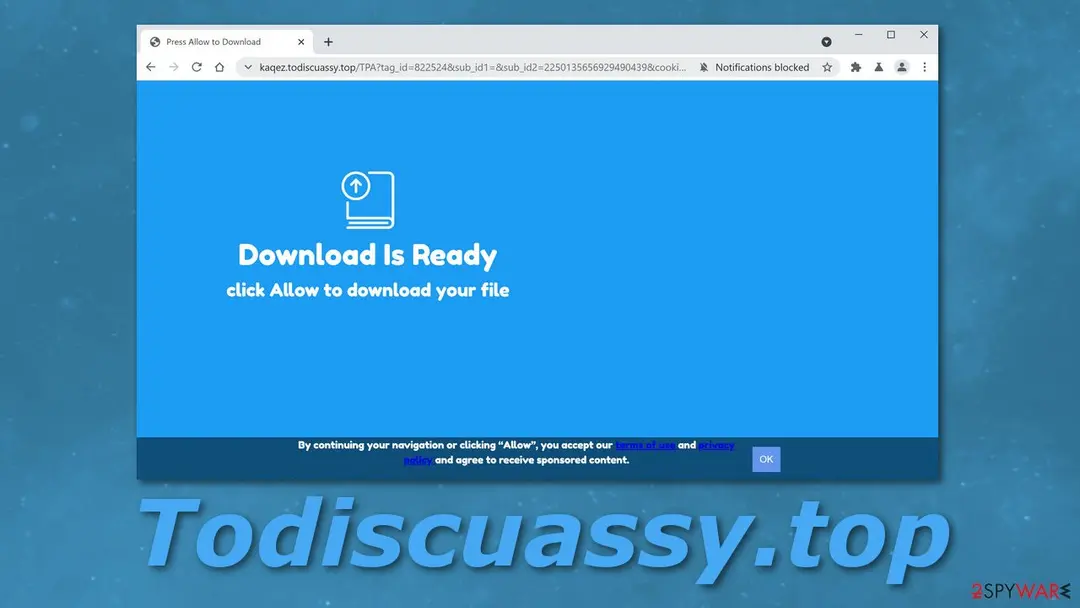
There have been a couple of appearances recorded of this website. As you can see in the top picture, a website displays a message which says, "Download Is Ready click Allow to download your file." But at the bottom of the page, in fine print, it is written, "By continuing your navigation or clicking "Allow," you accept our terms of use and privacy policy and agree to receive sponsored content."
After clicking allow, you will not receive anything you expected but will start receiving promotional content in the form of pop-ups, banners, redirects, etc. You probably got exposed to this site because you already were on a shady website and wanted to install something (without realizing that the button is not real but rather an ad) and got redirected to MovieSearch.org.
The page you started receiving notifications from is most likely completely unrelated to the one you were on in the first place.
These techniques are known as social engineering attacks and are used to fool not so technologically-savvy people into making fraudsters money by pay-per-click advertising. Every time you click on an ad, the owners of the site receive a commission from the advertiser.
In nature, this method is not malicious, rather a cost-effective way for business owners to promote their products. It gets really annoying when websites do not filter who is allowed to promote through their page.
Among legitimate sources, you might receive deceptive ads that are designed to fool you and hide their true intentions. This includes various fake errors and warning messages that use scare tactics to make you act before you think.
The "IP address & personal information might be exposed" scam is a great example of this method. After seeing their location and the IP address shown by the site, users got spooked and downloaded a suggested VPN which is a potentially unwanted program.
Distinguish fake from real
Even though these days, scammers are pretty sophisticated, and it is sometimes hard for an everyday person to point out an online scam, it is still good to know what traits to look for. If you see a pop-up or get redirected to a site, stay away from these worrying signs:
- The ad has grammar or spelling mistakes
- The text is hard to read because of the font choice
- Imaging looks very basic and simple
From our report of Aug 2021 · not reviewed since
News or ads?
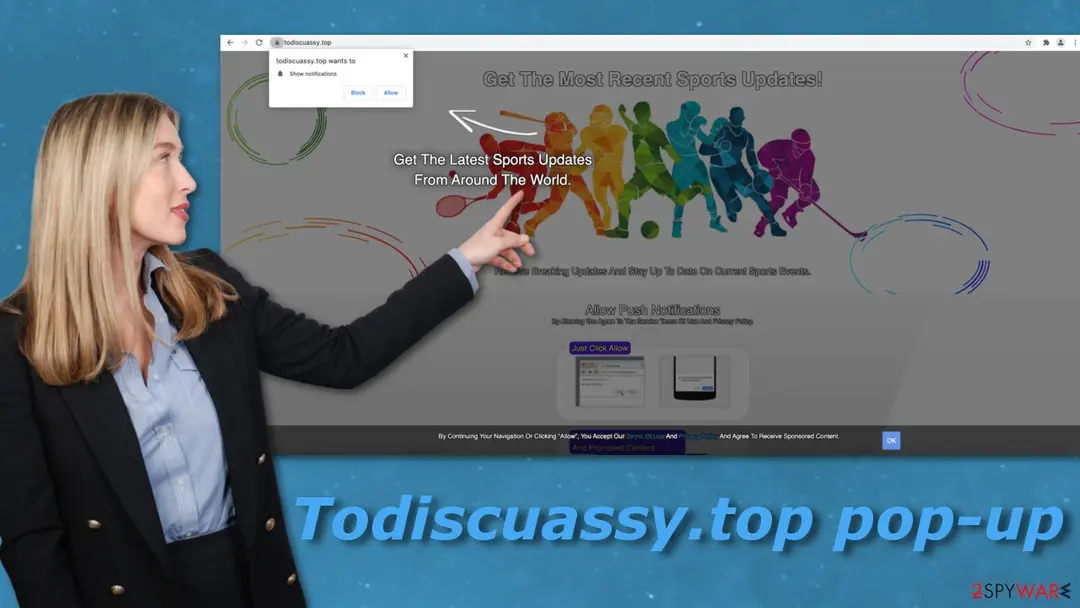
Websites like this can also disguise as legitimate news platforms and ask users' permissions to send them "the latest news," which actually is sponsored content.
This is what Todiscuassy.top also uses, although it chose to be more specialized and target sports fans. In this version of the website, it urges you to click the "Allow" button to "Get The Latest Sports Updates From Around The World."
Todiscuassy.top Privacy Policy, which seems to be copied and pasted off of another site, states:
In other words, after giving this website permission, it collects various data about your browsing behavior, interests, and so on. It can give that information to third parties and Todiscuassy.top shakes off any responsibility of how that data is going to be used. This can make people vulnerable to personal information breaches, so it is not recommended to keep this website even if you somehow find it useful.
If you allowed notifications on this website yourself and this was not caused by a PUP, the removal should be quite simple if you follow our step-by-step instructions. You will find explanations for the most widely used browsers.
Google Chrome (desktop):
Google Chrome (Android):
MS Edge (Chromium):
- Open Google Chrome browser and go to Menu > Settings.
- Locate the Privacy and security section and pick Site Settings > Notifications.
- Look at the Allow section and look for a suspicious URL.
- Click the three vertical dots next to it and pick Block. This should remove unwanted notifications from Google Chrome.
- Open Google Chrome and tap on Settings (three vertical dots).
- Select Notifications.
- Locate the unwanted URL and toggle the button to the left (Off setting).
- Open Mozilla Firefox and go to Menu > Options.
- Click on Privacy & Security section.
- Under Permissions, you should be able to see Notifications. Click Settings button next to it.
- In the Settings – Notification Permissions window, click on the drop-down menu by the URL in question.
- Select Block and then click on Save Changes. This should remove unwanted notifications from Mozilla Firefox.
- Click on Safari > Preferences...
- Go to Websites tab and, under General, select Notifications.
- Select the web address in question, click the drop-down menu and select Deny.
- Open Microsoft Edge, and click the Settings and more button (three horizontal dots) at the top-right of the window.
- Select Settings and then go to Advanced.
- Under Website permissions, pick Manage permissions and select the URL in question.
- Toggle the switch to the left to turn notifications off on Microsoft Edge.
- Open Microsoft Edge, and go to Settings.
- Select Site permissions.
- Go to Notifications on the right.
- Under Allow, you will find the unwanted entry.
- Click on More actions and select Block.
- Open Internet Explorer, and click on the Gear icon at the top-right on the window.
- Select Internet options and go to Privacy tab.
- In the Pop-up Blocker section, click on Settings.
- Locate web address in question under Allowed sites and pick Remove.
From our report of Aug 2021 · not reviewed since
More from our earlier report on Todiscuassy.top
- Removing website permissions is available via browser settings
Check your browser and PC
- Address:
todiscuassy.top
How to remove Todiscuassy.top ads
How to stop Todiscuassy.top notifications
Do this in every browser you use, and in every profile inside it: each keeps its own list of sites allowed to send notifications.
Nothing has to be uninstalled for the notifications themselves.
Which browser shows the ads?
Step 1: Remove todiscuassy.top from Chrome's notification list
Open More (the three dots) > Settings > Privacy and security > Site settings > Notifications, or paste
chrome://settings/content/notificationsinto the address bar.Under Allowed to send notifications, open the menu next to
todiscuassy.topand choose Remove or Block, and do the same for any other address you do not recognise.Next to Not allowed to send notifications, click Add and enter todiscuassy.top, so the site cannot ask again. The menus are the same in Chrome on Windows 11 and Windows 10, and each Chrome profile keeps its own list.
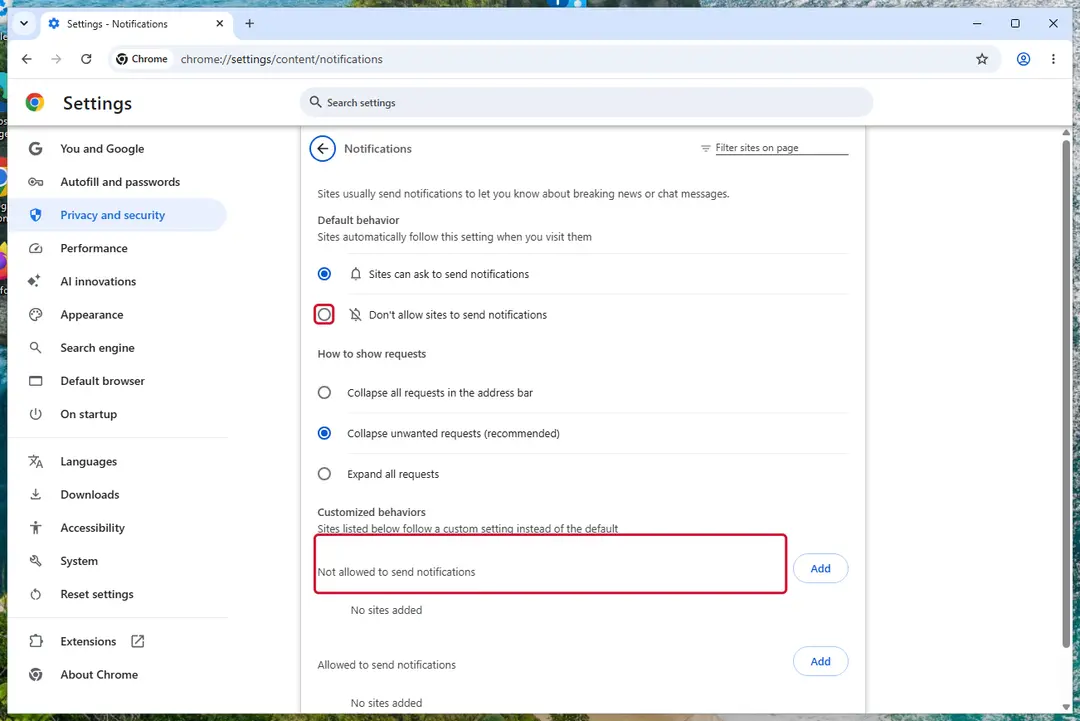
Chrome on Windows 11: Settings > Privacy and security > Site settings > Notifications. Full procedure with screenshots: Stop website notifications and pop-ups
Step 1: Remove todiscuassy.top from Edge's notification list
Edge stores its own permission list, separate from Chrome's, and it is often the browser behind these pop-ups on Windows 11 and Windows 10.
Go to Settings > Privacy, search, and services > Site permissions > All permissions > Notifications, or paste
edge://settings/content/notifications. Removetodiscuassy.topfrom Allowed, then add it under Not allowed to send notifications. Notifications that show the Edge logo come from this list.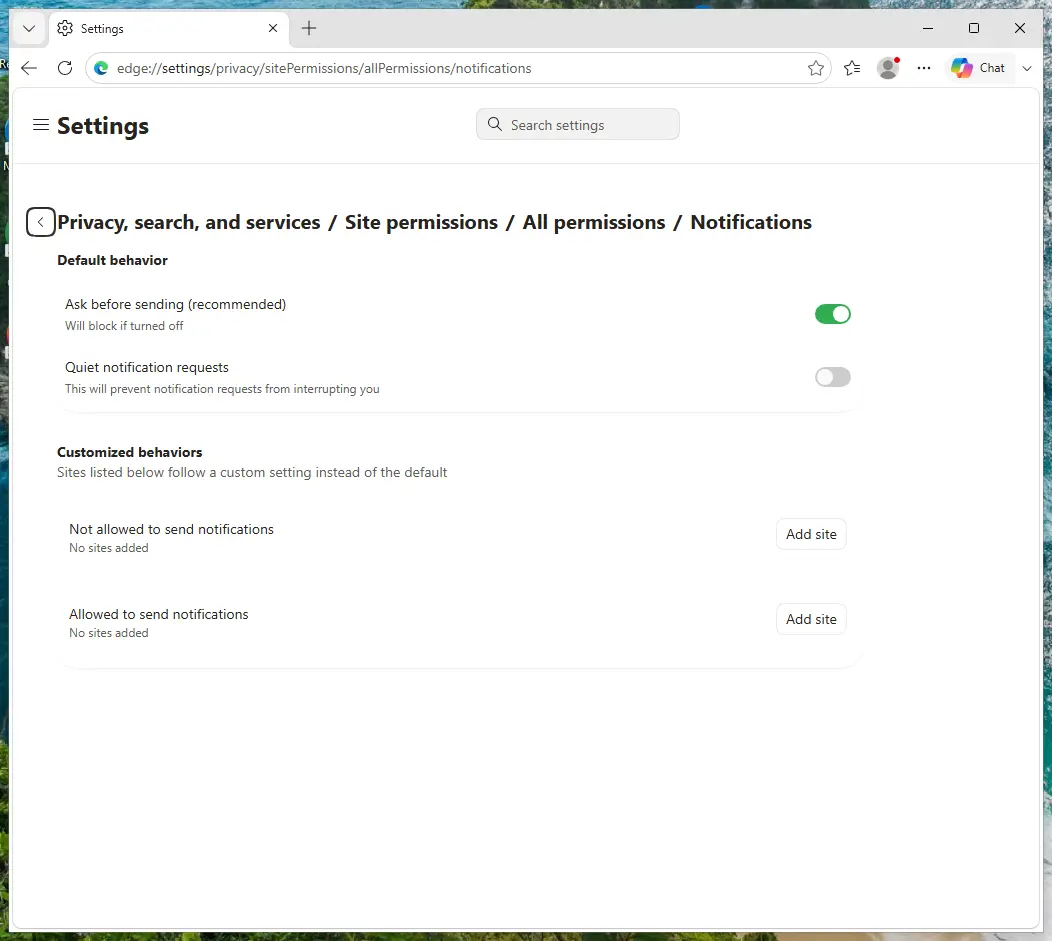
Edge on Windows 11: Site permissions > All permissions > Notifications. Full procedure with screenshots: Stop website notifications and pop-ups
Step 1: Remove todiscuassy.top from Firefox's notification permissions
In Firefox the permission sits in Settings > Permissions and data > Notifications (in older versions Privacy & Security > Notifications > Settings). Select
todiscuassy.topin the list, click Remove Website, and confirm with Save Changes.Firefox only shows these notifications while it is open, so if they stopped after closing Firefox, this is the browser to clean. The steps are the same on Windows 11 and Windows 10.
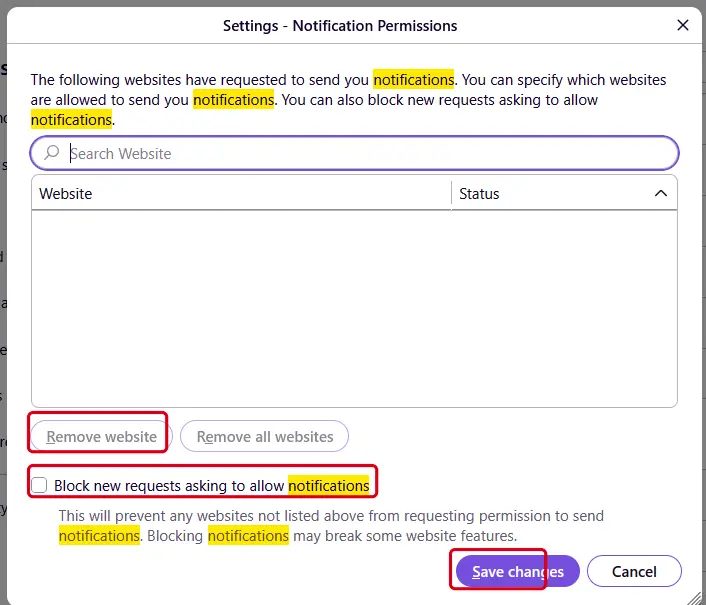
Firefox on Windows 11: the Notification Permissions window. Full procedure with screenshots: Stop website notifications and pop-ups
Our tested steps are for Windows 11 and 10. For Safari (Mac), use the instructions below.
Instructions for Safari (Mac)
Delete from macOS
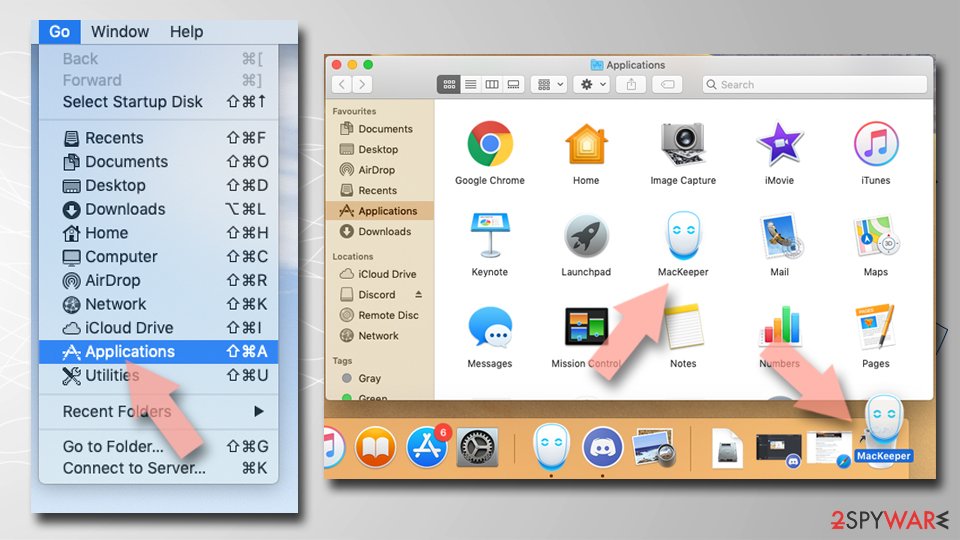
Remove the unwanted application:
- From the menu bar, select Go > Applications.
- In the Applications folder, look for any suspicious entries, then drag them to Trash (or right-click and pick Move to Trash).
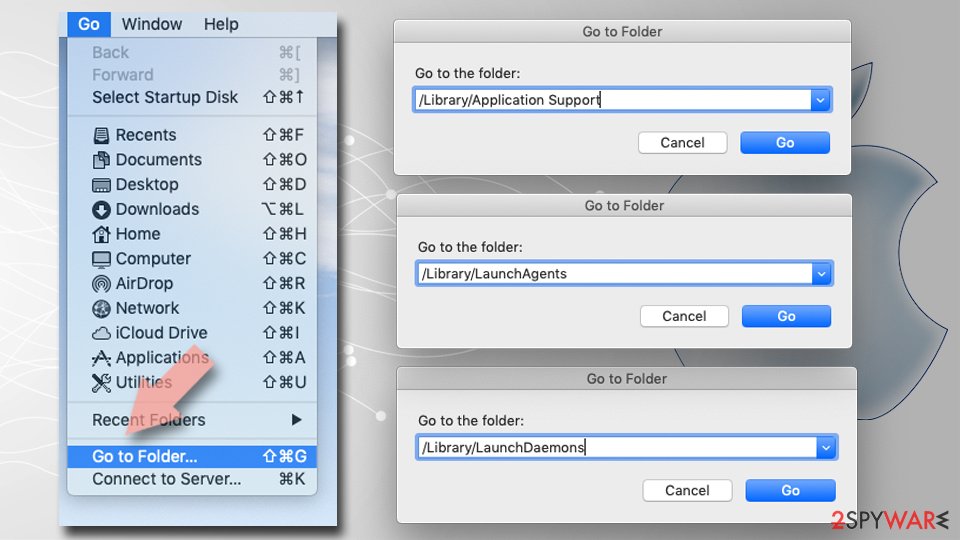
Delete leftover files and folders:
- Select Go > Go to Folder.
- Enter /Library/Application Support and remove any suspicious folders related to the unwanted program.
- Repeat the same check in the /Library/LaunchAgents and /Library/LaunchDaemons folders, deleting any suspicious entries.
- Finally, empty the Trash to permanently remove the leftovers.
Then, whichever browser you use
Step 2: Scan the PC if you downloaded anything from the ads
Most people who only saw the notifications can skip this step. If a notification or the page it opened made you download or run a file, delete the file and run a full scan, then a Microsoft Defender Offline scan.
In Windows 11 and Windows 10 open Windows Security > Virus & threat protection > Scan options, select Microsoft Defender Antivirus (offline scan) and click Scan now. The PC restarts and the scan takes about 15 minutes, so save your work first.

Windows 11: Windows Security > Virus & threat protection > Scan options. Full procedure with screenshots: Run a Microsoft Defender Offline scan
More removal instructions
For programs installed on the PC and older browsers. Open the one you need.
Manual removal via browser settings is not always an option
If you disabled the website permissions in your browser settings and it did not help, or you did not see this website in the list, there might be a more complicated explanation.
There are programs created that are usually disguised as handy tools, for example, antivirus software, but in reality, they are not functional and instead perform stealthy tasks without the users' knowledge. Sometimes people might not know about the existence of such a program in their system at all because of software bundling.
Bundled software are apps that come included as a package and are unrelated to the desired application. This usually happens during freeware installations when users' do not pay attention to the process and skip through all the steps. While downloading something that is provided for free, you most likely will have to give something in return that is not disclosed in capital letters.
Implement precautionary habits to avoid PUPs:
There are tools created for the automatic detection of such software.
- Always choose the "Advanced" or "Custom" installation method
- Read the Terms of Use and Privacy Policy to find out how your information will be used
- Check if the files have names related to the app you want
- If there are additional software included, make sure to uncheck the boxes next to them
Uninstall from Windows
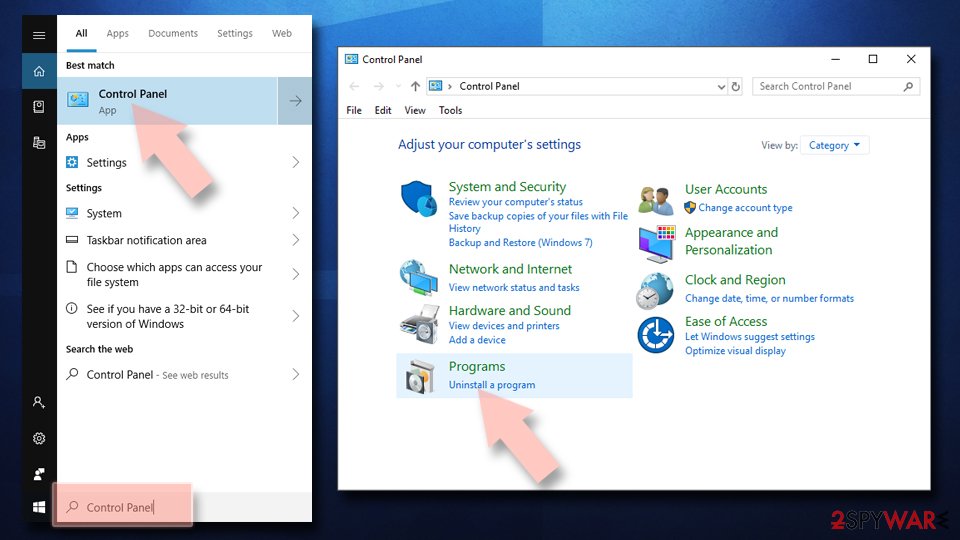
Uninstall from Windows 10/8:
- Type Control Panel into the Windows search box and open the result.
- Under Programs, select Uninstall a program.
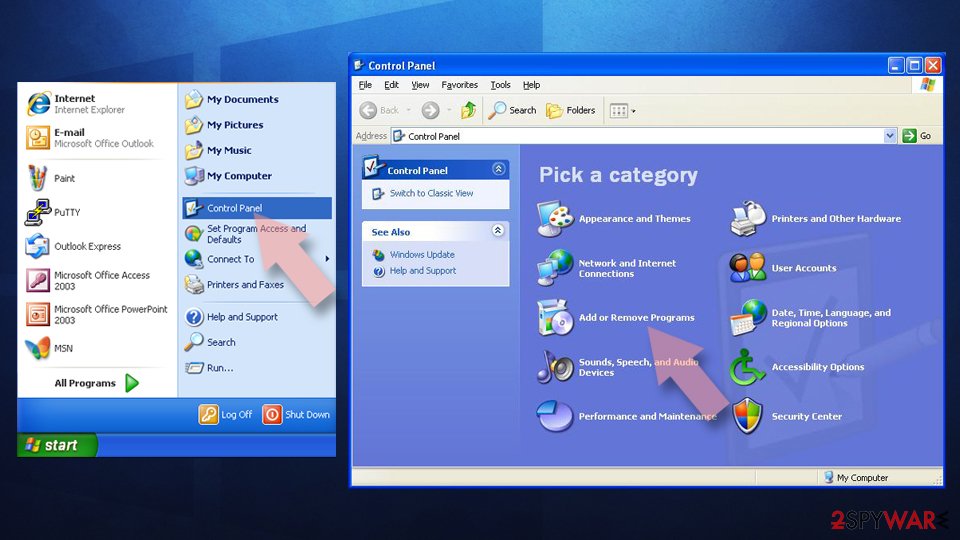
Uninstall from Windows 7/XP:
- Click on Windows Start > Control Panel (Windows XP users should click on Add/Remove Programs).
- In Control Panel, select Programs > Uninstall a program.
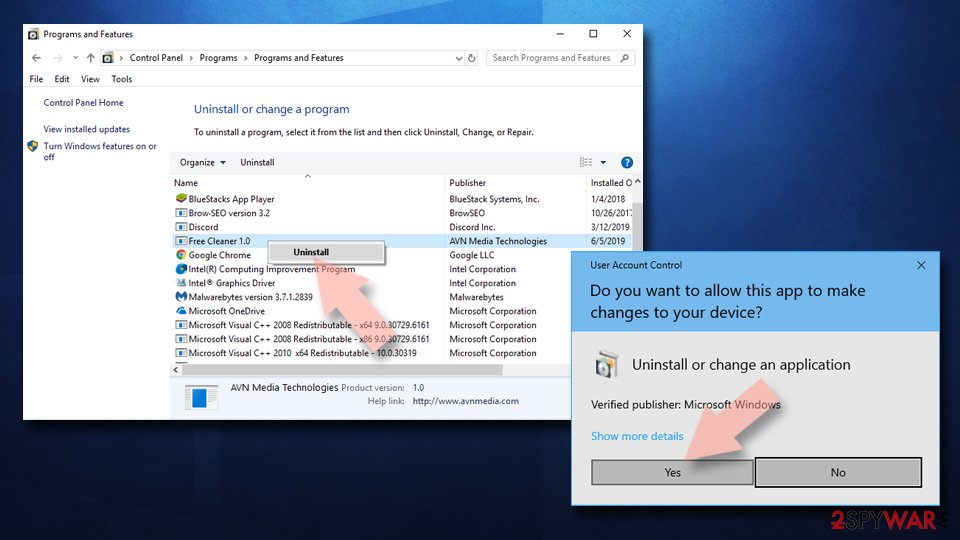
Remove the unwanted program:
- In the Programs and Features window, look for any recently installed suspicious entries, select them, and click Uninstall.
- If User Account Control appears, click Yes to confirm, then complete the removal.
Stream videos without limitations, no matter where you are
There are multiple parties that could find out almost anything about you by checking your online activity.
While this is highly unlikely, advertisers and tech companies are constantly tracking you online. The first step to privacy should be a secure browser that focuses on tracker reduction to a minimum.
Even if you employ a secure browser, you will not be able to access websites that are restricted due to local government laws or other reasons. In other words, you may not be able to stream Disney+ or US-based Netflix in some countries. To bypass these restrictions, you can employ a powerful VPN, which provides dedicated servers for torrenting and streaming, not slowing you down in the process.
Data backups are important - recover your lost files
Ransomware is one of the biggest threats to personal data.
Once it is executed on a machine, it launches a sophisticated encryption algorithm that locks all your files, although it does not destroy them. The most common misconception is that anti-malware software can return files to their previous states. This is not true, however, and data remains locked after the malicious payload is deleted.
While regular data backups are the only secure method to recover your files after a ransomware attack, tools such as can also be effective and restore at least some of your lost data.
Questions about Todiscuassy.top ads
How do I stop notifications from todiscuassy.top?
Remove its permission in the browser. The bottom line of each notification names the browser, so open that browser's notification settings and look under Allowed. Remove todiscuassy.top and any other site you do not recognise.
In Chrome and Edge this is under the site settings for notifications; in Firefox it is under Settings, Permissions and data, Notifications. Do this in every browser profile, because each one keeps its own list.
Restart the browser and wait a few minutes. If a message still arrives, read its bottom line again: the sending address can differ from the site you remember, and that is the entry still left in the list.
I clicked a notification from todiscuassy.top. What should I do?
If you only opened the page and closed it, nothing else is needed besides removing the permission from todiscuassy.top. If the page asked for card details, a phone number or a password and you entered them, act on that: call the bank to block the card, or change the password from another device.
If it offered a download, delete the file unopened, or uninstall it from Installed apps if you ran it, then run a full scan. If you called a number shown on the page, follow the steps for callers in this guide. Finally, remove the permission so that no more messages arrive.
What is Todiscuassy.top?
Todiscuassy.top is a push-notification spam site, a kind of adware. It earns money by showing desktop notifications, and each view, click or redirect pays whoever runs it. It is not something people usually choose; it arrives through a free download, a fake button or a misleading prompt.
Todiscuassy.top does not encrypt files or take control of Windows, but its ads are sold to anyone, including scam operators, so they can lead to fake virus warnings and unwanted downloads. The steps in this guide remove it from Windows and from each browser.
Why does todiscuassy.top keep showing up?
There are two possible reasons. If it appears as desktop notifications, a browser on this PC was given permission to receive them from todiscuassy.top, usually through a misleading prompt. That permission stays until you remove it in the browser's site settings.
If it appears as tabs or redirects, an ad on a site you visit is opening it, or an extension or program on the PC is. Test a private window: if todiscuassy.top never appears there, an extension is the likely cause. The plan above covers each case.
Do I have to change settings in every browser?
Only in the browsers that allowed todiscuassy.top, but checking all of them takes a minute and is worth it. We saw the notifications in Chrome, Edge and Firefox. Chrome and Edge keep their notification lists under site settings, and Firefox under Privacy & Security > Permissions.
Remove todiscuassy.top and any other unfamiliar site from each list, then turn off new notification requests if you do not need them. Remember that every browser profile has its own list, so a second profile can keep the messages coming after you clean the first.
Are the pop-ups I see really from Todiscuassy.top?
Compare them with the details in the table above. Todiscuassy.top produces desktop notifications, and the clearest sign of it is notifications from todiscuassy.top. Other adware looks similar, so check the name of the sending site at the bottom of a notification, the address in the tab that opened, or the newest entries on the extensions page.
If those match, this guide fits. If you see a different name, the same kind of steps apply, but remove the item you actually find rather than guessing.
Is it safe to click Block or Allow on a notification prompt?
Clicking Block is safe; it only tells the browser not to show notifications from that site. Clicking Allow is not dangerous to your files either, but it gives the site a channel to your desktop that spam sites abuse at once.
The prompt itself is part of the browser, so you can trust its buttons. What you cannot trust is the text on the page around it. If a page explains why you must click Allow, choose Block or close the tab.
My scan found nothing, but the ads continue. Why?
Because the source may not be a file a scanner looks for. Browser notifications are a permission stored in the browser, and many adware extensions are not flagged because they come from an official store.
Some ad-supported programs are only reported if you enable detection of potentially unwanted apps. So a clean scan does not mean the job is done. Check each browser's notification permissions and extension list by hand, and turn on Potentially unwanted app blocking in Windows Security before scanning again.
I let a "support technician" from an ad connect to my PC. What should I do?
Act quickly but calmly. Disconnect the PC from the internet first, so the connection ends. Uninstall the remote access tool they asked you to install and check Installed apps for anything else added during the call.
Run a Microsoft Defender full scan and offline scan. From another device, change your e-mail and banking passwords and sign out of all sessions.
If you paid by card, bank transfer or gift card, contact your bank or the card issuer immediately, and report the scam to the police. Do not answer if they call back.
Will Fortect remove Todiscuassy.top?
No program removes Todiscuassy.top itself, because there is nothing on the PC to remove: the notifications come through a permission saved in the browser, and only the browser's settings take it away, as the steps above show.
What Fortect can do is check the rest of Windows. Its free scan looks for malware, unwanted programs and damaged system files, which is useful if you clicked the ads, downloaded something from the pages they opened, or are not sure what else changed on the PC.
If the scan finds nothing and the notifications stopped after you removed the permission, this problem is solved. Use Microsoft Defender as a second opinion whenever you have downloaded files from pages like these.
Sources
- TechTarget: Social Engineering (read October 6, 2026)
- 2-Spyware: Get the best dedicated IP VPN to enjoy risk-free online reputation (read October 6, 2026)
- Hyperproof: What is Third-Party Risk? (read October 6, 2026)
- Google Chrome Help: Use notifications to get alerts (no longer online) (read October 6, 2026)
- FTC: How to recognize, remove and avoid malware (read October 6, 2026)