
Windows Police Pro: what it is and how to remove it
Windows Police Pro is a rogue antivirus application that displays fake scan results. It blocks legitimate security software and pressures users to purchase fake fixes.
Facts checked October 5, 2026. Removal steps tested on Windows 11 (26H2) and checked against Microsoft's and the browser makers' current documentation. Sections marked as our earlier report are the original text: they describe the threat as it was then and have not been reviewed since. The 2026 status, the removal steps and the questions are current.
Automatic
Get a free scan and check if your PC is infected.
Fortect finds malware, unwanted programs and the Windows damage they leave behind, and repairs it in one pass.
An automatic scan can look at svchast.exe and the other programs installed around the same time.
Do it yourself · free Remove Windows Police Pro yourself 5 steps, about 15 minutes, no software needed.
Start the steps
Windows Police Pro: summary
| Name | Windows Police Pro |
|---|---|
| Type | Rogue anti-spyware, malware |
| Infection means | Users might install the app deliberately (unlikely) or get tricked by freeware bundles, deceptive ads, scam sites, or fake updates |
| Symptoms | The installed security software stops working Intrusive pop-up messages show up regularly warning about fake threats Scan results return hundreds of entries of alleged malware Internet Explorer shows fake notifications about virus infections |
| Termination | Access Safe Mode and attempt to remove the app manually; if not successful, run a full system scan with anti-malware software (in Safe Mode) |
| Detection names | No Microsoft detection name is known |
| Removal | Scan the PC with security software to find and remove the malware and anything installed with it. Fortect scans Windows for malware and repairs the system files and settings it damaged. Remove it nowTo use the full-featured product, you have to purchase a license for Fortect. The scan is free. |
Show 6 more facts
| Distribution | Not recorded in the old report |
|---|---|
| Damage | Not recorded in the old report |
| Files and processes | svchast.exe |
| Evidence | 5 write-ups by security sites; details still limited |
| First seen | 17 March 2021 |
| Facts checked | 5 October 2026 |
Is Windows Police Pro a real security program?
- File:
svchast.exe
From our report of Mar 2021 · not reviewed since
Windows Police Pro - a misleading security application that seeks to make profits from scam alerts
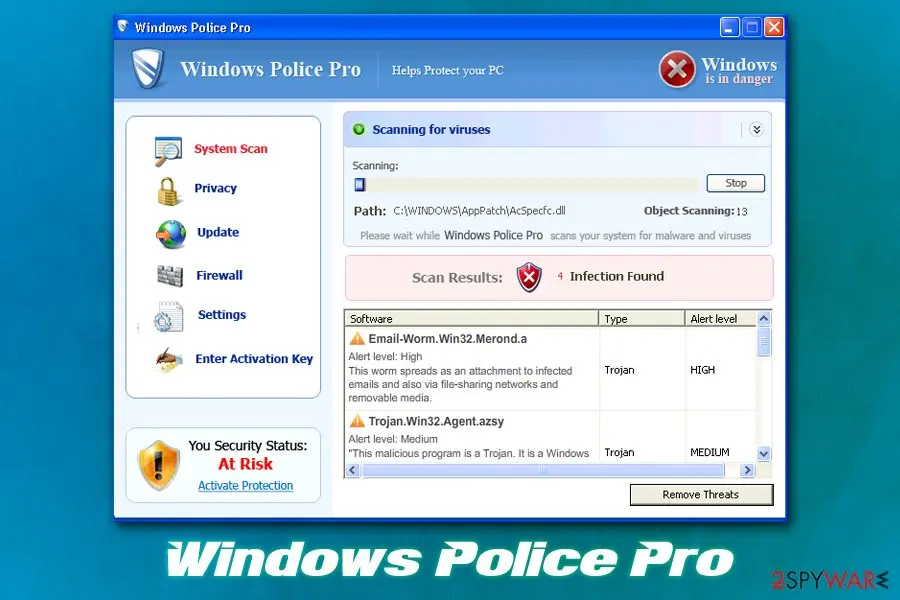
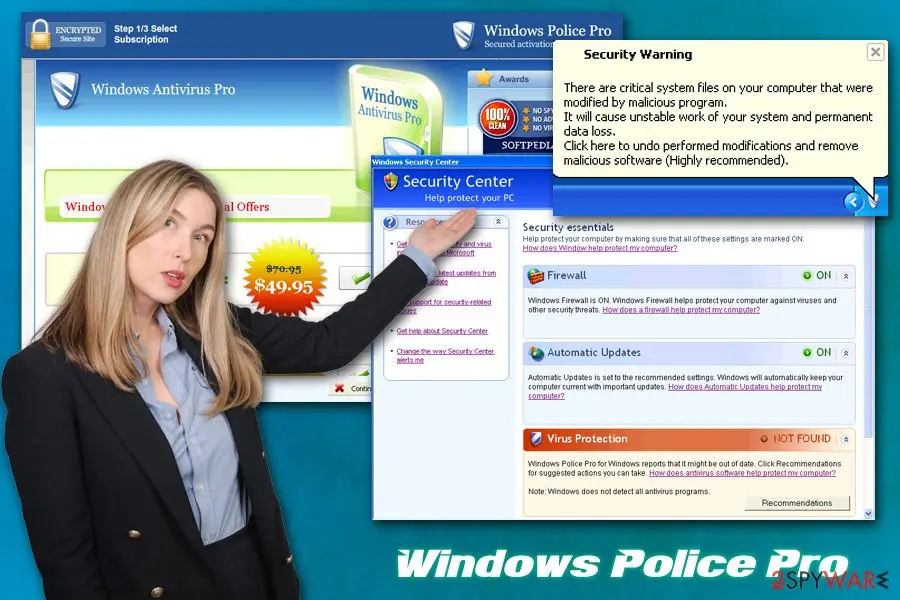
Windows Police Pro is a rogue anti-malware application that belongs to the same family of malicious programs like Windows Antivirus Pro - to be exact, it is a clone of the latter.
In most of the cases, these apps access users' computers during the installation of freeware (software bundling) or after they get tricked by a scam message, as well as a fake update. In rare cases, some might believe that this app is indeed a good solution for their computer security - they could not be more wrong than that.
As soon as the Windows Police Pro virus is installed, it performs an alleged system scan that returns hundreds of false-positives. Some of these "detections" are named after real malware samples, while others are completely bogus.
Once users try to get rid of the issues, they will be asked to purchase a full version of the program. In other words, this is a scam and is actually malicious, as it will also block users from running a real security program.
Besides showing fake scan results that claim that your computer is infected with spyware, adware, Trojans, or other malware, Windows Police Pro will continuously try to show false pop-up warnings. These messages work the same way: they will spam you with fake alerts about virus infections and ask you to purchase full versions of the app.
Buying it would be the worst possible solution, as you will not only pay for a malicious program but will also disclose your credit card details to unknown parties (likely, cybercriminals).
The obtained information can be sold on the underground forums for profit, resulting in money loss, targeted phishing attacks, or even identity fraud/theft. Therefore, please never purchase such tools, as you will be paying for malware that compromises your security and leaks your personal information to malicious actors. Instead, make sure you remove Windows Police Pro as soon as possible.
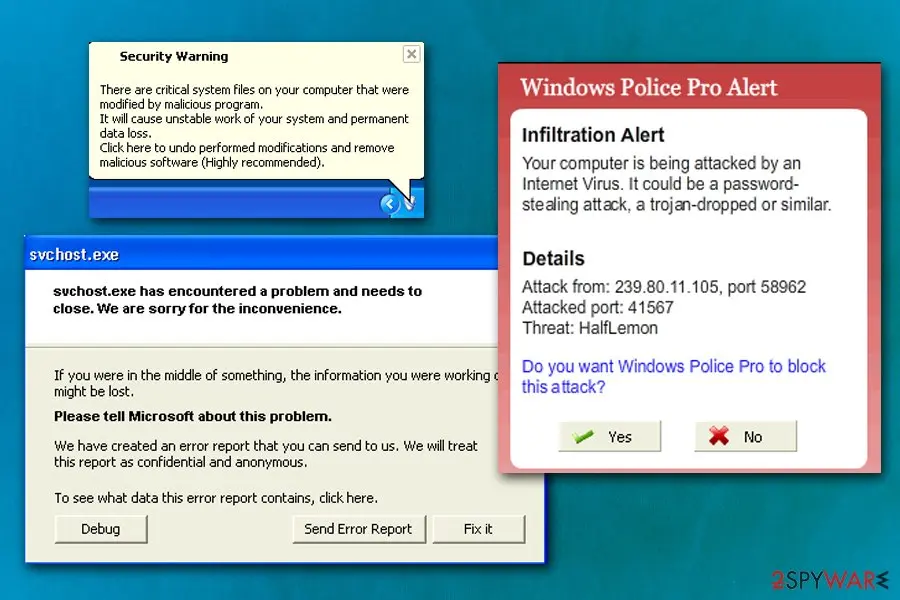
Here are some of quite ridiculously-sounding alerts from the scammers:
Another reason this program can be called Windows Police Pro malware is because it acts like it. It runs several background processes, including:
Some of these processes are placed into Windows and System32 directories. Also, note how the names of these processes try to mimic legitimate ones, such as svchost.exe - this a typical malware behavior. With the help of these background tasks, Windows Police Pro spams users with malicious messages in order to make them purchase the license.
Another reason for Windows Police Pro removal is the fact that it compromises your online security, as well as computer safety. As long as the malicious app is installed, it will not allow for a reputable and a working security tool to be installed on the system or will shut down the existing anti-malware apps, claiming that they are infected and need to be removed.
This rogue software cannot protect you - it will only damage your operating system and leave security holes that might lead to further malware infections.
To uninstall Windows Police Pro, you might have to access Safe Mode, as these types of apps are known to be persistent and hard to remove - follow our guide below.
- svchast.exe;
- svchasts.exe;
- svohost.exe;
- minix32.exe;
- pump.exe, etc.
From our report of Mar 2021 · outdated details corrected in October 2026
Select a correct anti-malware and avoid rogue programs
There are numerous anti-malware products available on the market, and sometimes it becomes difficult to determine which apps are the better ones and which are straight out useless.
Due to the rising online threats, the demand increases, and so does the supply. Unfortunately, the supply is filled with software that is actually malicious itself and would not protect users from malware whatsoever. Therefore, how do you pick a decent security tool for your computer?
Well, there are several factors to look for, for example, a company's reputation, online user reviews, as well as independent lab tests. We can guarantee that any application picked from AV-test or AV-comparatives will be sufficient and not a scam.
Please disregard any pop-ups or other messages coming from your browser that claim your machine is infected with malware, as these are all fake. Additionally, watch out for fake browser, codec, and Java updates - if you use this software, download the updates from official sites only.
Finally, during the installation of freeware acquired from third-party websites, always pick Advanced/Custom settings instead of Recommended/Quick one and remove all the optional components before they enter your machine.
From our report of Mar 2021 · not reviewed since
More from our earlier report on Windows Police Pro
- Windows Police Pro sets several new registries and tampers with other Windows settings.
- In some cases, this intrusion can lead to errors, system crashes, slowdowns on the computer, even after malware is eliminated.
- It could be password-stealing attack, a trojan-dropper or similar.
- In order to prevent permanent loss of your information and credit card data theft please activate your anti-virus software.
How to remove Windows Police Pro
Nothing it reports is real.
These steps remove it and undo a payment if you made one.
Step 1: Do not pay, and undo a payment if you made one
Windows Police Pro reports problems to sell a licence: the "threats" or "errors" it lists are invented or harmless leftovers. If you already paid, ask your card issuer to dispute the charge and cancel the subscription both in the seller's account and through your bank.
If you called a phone number it showed and let someone connect, treat the PC as remotely accessed and remove the remote tool. Uninstalling it from Windows 11 or Windows 10 does not cancel a subscription by itself.
Full procedure with screenshots: What to do after paying a scammer
Step 2: Uninstall programs you did not mean to install
Open Settings > Apps > Installed apps in Windows 11, or Settings > Apps > Apps & features in Windows 10, and sort the list by install date. Look at what appeared around the day the problem started and uninstall every program you do not recognise or did not choose.
Free converters, PDF and video tools, "system optimizers" and unknown browsers are the usual carriers of Windows Police Pro. If a name is unclear, search for it before you remove it, so you do not uninstall a driver or a Windows component.
Full procedure with screenshots: Uninstall a program or app in Windows On uGetFix
Step 3: Remove it from startup
Whatever Windows Police Pro installed usually starts with Windows.
Open Task Manager with Ctrl + Shift + Esc, go to Startup apps in Windows 11 or the Startup tab in Windows 10, and disable what you do not know, starting with entries that have an empty Publisher column.
Open file location on the right-click menu shows the file, which helps you decide and tells you what to delete later. Disabling is safe: if something you need stops working, switch it back on.
Full procedure with screenshots: Stop apps from opening at startup On uGetFix
Step 4: Delete the folders left behind
What the uninstaller leaves behind is usually in the user folders. Open File Explorer, switch on View > Show > Hidden items (in Windows 10 View > Hidden items), and go through
%LocalAppData%,%AppData%, %ProgramData% and the two Program Files folders.Sort by Date modified and delete folders that appeared together with the problem and belong to no program you use. Folders with random names that hold
.exe,.dll, .js or .ps1 files are the strongest sign.Full procedure with screenshots: Remove what malware leaves behind in Windows
Step 5: Scan the PC, then run the offline scan
Open Windows Security > Virus & threat protection > Scan options, run a Full scan and remove everything it finds. Then select Microsoft Defender Antivirus (offline scan) and click Scan now: the PC restarts and scans before Windows loads, which finds files that hide while Windows runs.
Save your work first, because the offline scan takes about 15 minutes. Both scans are built into Windows 11 and Windows 10, and a second scanner from another vendor is a useful extra opinion.

Windows 11: Windows Security > Virus & threat protection > Scan options. Full procedure with screenshots: Run a Microsoft Defender Offline scan
Instructions for each browser and system
The detailed steps for every browser and system this guide covers. Open the one you use.
Manual removal using Safe Mode
Important! →
Manual removal guide might be too complicated for regular computer users. It requires advanced IT knowledge to be performed correctly (if vital system files are removed or damaged, it might result in full Windows compromise), and it also might take hours to complete. Therefore, we highly advise using the automatic method provided above instead.
Step 1. Access Safe Mode with Networking
Manual malware removal should be best performed in the Safe Mode environment.
Windows 7 / Vista / XP
- Click Start > Shutdown > Restart > OK.
- When your computer becomes active, start pressing F8 button (if that does not work, try F2, F12, Del, etc. - it all depends on your motherboard model) multiple times until you see the Advanced Boot Options window.
- Select Safe Mode with Networking from the list.

Windows 10 / Windows 8
- Right-click on Start button and select Settings.

- Scroll down to pick Update & Security.

- On the left side of the window, pick Recovery.
- Now scroll down to find Advanced Startup section.
- Click Restart now.

- Select Troubleshoot.

- Go to Advanced options.

- Select Startup Settings.

- Press Restart.
- Now press 5 or click 5) Enable Safe Mode with Networking.

Step 2. Shut down suspicious processes
Windows Task Manager is a useful tool that shows all the processes running in the background. If malware is running a process, you need to shut it down:
- Press Ctrl + Shift + Esc on your keyboard to open Windows Task Manager.
- Click on More details.

- Scroll down to Background processes section, and look for anything suspicious.
- Right-click and select Open file location.

- Go back to the process, right-click and pick End Task.

- Delete the contents of the malicious folder.
Step 3. Check program Startup
- Press Ctrl + Shift + Esc on your keyboard to open Windows Task Manager.
- Go to Startup tab.
- Right-click on the suspicious program and pick Disable.

Step 4. Delete virus files
Malware-related files can be found in various places within your computer. Here are instructions that could help you find them:
- Type in Disk Cleanup in Windows search and press Enter.

- Select the drive you want to clean (C: is your main drive by default and is likely to be the one that has malicious files in).
- Scroll through the Files to delete list and select the following:
Temporary Internet Files
Downloads
Recycle Bin
Temporary files - Pick Clean up system files.

- You can also look for other malicious files hidden in the following folders (type these entries in Windows Search and press Enter):
%AppData%
%LocalAppData%
%ProgramData%
%WinDir%
After you are finished, reboot the PC in normal mode.
Stream videos without limitations, no matter where you are
There are multiple parties that could find out almost anything about you by checking your online activity.
While this is highly unlikely, advertisers and tech companies are constantly tracking you online. The first step to privacy should be a secure browser that focuses on tracker reduction to a minimum.
Even if you employ a secure browser, you will not be able to access websites that are restricted due to local government laws or other reasons. In other words, you may not be able to stream Disney+ or US-based Netflix in some countries. To bypass these restrictions, you can employ a powerful VPN, which provides dedicated servers for torrenting and streaming, not slowing you down in the process.
Data backups are important - recover your lost files
Ransomware is one of the biggest threats to personal data.
Once it is executed on a machine, it launches a sophisticated encryption algorithm that locks all your files, although it does not destroy them. The most common misconception is that anti-malware software can return files to their previous states. This is not true, however, and data remains locked after the malicious payload is deleted.
While regular data backups are the only secure method to recover your files after a ransomware attack, tools such as can also be effective and restore at least some of your lost data.
From our report of Mar 2021 · outdated details corrected in October 2026
Get rid of Windows Police Pro virus as soon as possible
As previously mentioned, Windows Police Pro removal might be hindered by its persistence techniques, such as background tasks or lack of entries within the Programs & Features section.
Besides, the malware also stops reputable security programs from working, so its intrusion level is very high.
To bypass this, you should access Safe Mode with Networking and perform a full system scan with security solutions like or . You can find the instructions on how to reach Safe Mode below.
Besides running a system scan, you should also reset your Microsoft Edge if you have it installed after you remove Windows Police Pro, as it inserts browser helper objects (BHO) into it in order to display fake notifications.
In the meantime, keep your machine secure with comprehensive security software that does not spam you with fake alerts and actually stops malware from entering. You can also clear issues with the performance using .
[GI=method-1]If Windows Police Pro is difficult to uninstall, you should go to Safe Mode with Networking and delete the virus from there:
Questions about Windows Police Pro
What is Windows Police Pro?
Windows Police Pro is a rogue antimalware application belonging to the same malicious family as Windows Antivirus Pro. It is essentially a clone of the latter with identical deceptive tactics. The virus is designed to make profits from scam alerts rather than provide genuine security.
It accesses computers during freeware installation through software bundling or after users are tricked by fake alerts and deceptive advertising. Once installed, it performs an alleged system scan returning hundreds of false-positives claiming infections that do not exist.
How does Windows Police Pro get installed?
In most cases, users install Windows Police Pro unintentionally during freeware installation through software bundling. Users rush through installation processes and accept default settings without reviewing optional components. The application can also be introduced through deceptive advertisements, scam websites, and fake software updates.
In rare cases, some users might believe the application is legitimate security software. However, legitimate antivirus companies do not distribute their software through these deceptive methods or aggressive pop-up tactics.
What does Windows Police Pro claim to find?
Windows Police Pro performs a fake system scan that returns hundreds of false-positive detections. Some of these "detections" are named after real malware samples, while others are completely bogus and made up.
The scan results display alarming notifications claiming your system is infected with spyware, adware, trojans, and other malware. All results are fabricated to frighten users into believing their computer is severely compromised. None of the claimed detections are real threats.
What happens when I try to remove the detected threats?
When users attempt to remove the fake threats, they are redirected to a payment page demanding purchase of Windows Police Pro's full version. The rogue software claims that only the paid version can remove all the detected threats.
After users enter credit card information, they have paid for malware that compromises their security. The obtained credit card details are likely sold to cybercriminals on underground forums or used for unauthorized charges and identity theft.
Why doesn't my real antivirus work?
Windows Police Pro actively blocks users from running legitimate security software. As soon as it installs, it disables or prevents execution of actual antivirus programs, claiming they are infected and need removal. This is typical malware behavior designed to prevent detection and removal.
The blocking mechanism tampers with Windows settings and registry entries, making it impossible for real security tools to function. Users must access Safe Mode and attempt removal there, where Windows Police Pro has less control.
Is buying the license a solution?
No. Buying the license is the worst possible decision. You would only pay for a malicious program that compromises your security and leaks your personal information to malicious actors. The software will not actually remove any threats because there are no real threats to remove.
After payment, you have funded cybercriminals and provided them your credit card details for potential fraud. The alerts and fake scan results continue even after payment because the program's purpose is generating revenue, not protecting your PC.
What example scam alerts does it show?
Windows Police Pro displays ridiculous-sounding alerts like "Infiltration Alert: Your computer is being attacked by an Internet Virus." It claims attacks could be password-stealing, trojan-droppers, or similar. The alert warns that the computer continues to be infected with harmful viruses and demands activation of antivirus software.
These absurd messages are designed to frighten non-technical users through exaggeration and fear tactics. The combination of threatening language and impressive-sounding technical jargon intimidates victims into purchasing the fake license.
How do I remove Windows Police Pro?
Access Safe Mode with Networking and attempt to uninstall Windows Police Pro through Programs and Features. If that fails, use reputable anti-malware software to scan and remove it in Safe Mode.
The application is persistent and hides background processes, making manual removal difficult. Search your system for these processes and related files, but be cautious not to delete legitimate Windows files.
After removal, reset Internet Explorer to remove browser helper objects it inserted. Run additional scans with different antivirus products to ensure complete elimination. Finally, repair system damage with optimization tools.
Will Fortect remove Windows Police Pro?
Fortect scans Windows for malware and unwanted programs and repairs the system files and settings they change, and its free scan shows what it finds on your PC before you decide anything.
For Windows Police Pro, follow the plan above as well: the browser steps take back permissions and settings that no scanner treats as a threat, and uninstalling the program that brought it removes the source.
Run Microsoft Defender's full scan and, if anything was found, its offline scan as a second opinion. If the symptoms are gone after the plan and both scans are clean, there is nothing more to do.
Sources
- Wikipedia: Rogue security software (read October 5, 2026)
- Sysnet: What do Cybercriminals do with the data they steal? (read October 5, 2026)
- AV-comparatives: Anti-malware test results (read October 5, 2026)
- FTC: How to recognize, remove and avoid malware (read October 5, 2026)
- Microsoft Learn: Microsoft Defender Offline (read October 5, 2026)