
Csrss.exe trojan: what it is and how to remove it
The Csrss.exe Trojan disguises itself as a legitimate Windows system file but steals data and damages your system. Check C:\Windows\System32 for suspicious copies and scan with antivirus immediately.
Facts checked October 6, 2026. Removal steps tested on Windows 11 (26H2) and checked against Microsoft's and the browser makers' current documentation. Sections marked as our earlier report are the original text: they describe the threat as it was then and have not been reviewed since. The 2026 status, the removal steps and the questions are current.
Automatic
Get a free scan and check if your PC is infected.
Fortect finds malware, unwanted programs and the Windows damage they leave behind, and repairs it in one pass.
Unsure whether Csrss.exe is safe? A free scan checks the file and what starts it.
Do it yourself · free Remove Csrss.exe trojan yourself 6 steps, about 18 minutes, no software needed.
Start the steps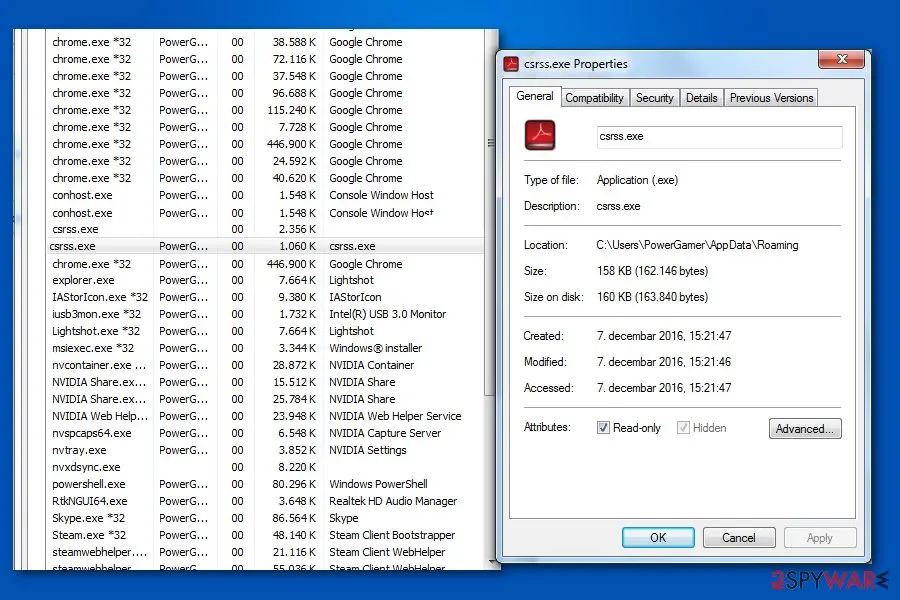
Csrss.exe trojan: summary
| Distribution | Malicious spam email attachments, fake updates, exploits, software cracks, etc. |
|---|---|
| Damage | The loss of personal information, banking data, credentials. Can log keystrokes and open a backdoor to other infections |
| Name | Csrss.exe trojan |
| Type | Trojan horse |
| Danger level | High |
| Possible relation | TrustedInstaller |
| Removal | Scan the PC with security software to find and remove the malware and anything installed with it. Fortect scans Windows for malware and repairs the system files and settings it damaged. Remove it nowTo use the full-featured product, you have to purchase a license for Fortect. The scan is free. |
Show 7 more facts
| Symptoms | Disrupted PC performance: system freezes and crashes; intrusive browser redirects; some of your programs taking longer to load or failing to open at all |
|---|---|
| Detection names | No Microsoft detection name is known |
| Evidence | 6 write-ups by security sites; no sample analysed yet |
| File names | Csrss.exe and C:\Windows\System32 |
| First seen | 5 March 2021 |
| Microsoft Defender name | Trojan:Win32/Fakecrss |
| Facts checked | 5 October 2026 |
What Csrss.exe trojan does on an infected PC
From our report of Mar 2021 · not reviewed since
Identifying the malicious Csrss.exe Trojan on the system
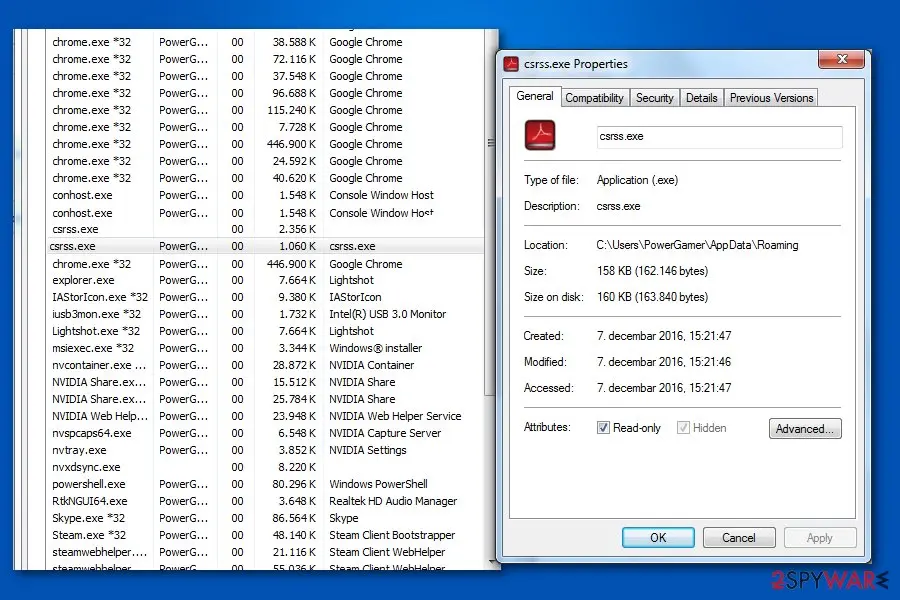
Experts have warned our users that the legitimate Microsoft file should be located in C:\Windows\System32/ directory.
In case you find a process running under the same name but in a different location, run a full system scan with reliable antivirus software to check for malware.
It is evident that if you fail to identify Csrss.exe Trojan virus, there is a substantial possibility that your credentials and other sensitive data might be leaked to malevolent people. Consequently, you may encounter enormous financial losses or even identity theft in the long run.
Furthermore, you might notice because of the presence of the Trojan that your computer is acting weird and sluggish. The reason for that - malware's capability to exploit computer resources to mine digital currency, including Bitcoin, Monero, ZCash, etc. In other terms, the system can be forced to function at high temperatures for excessive periods of time. This might result in system crashes, increased latency, and freezes.
Therefore, we strongly advise you to check your computer for this Trojan horse and perform the virus removal if necessary. Be aware that this type of malicious program is mainly programmed to hide deep inside the system and place their components all across the OS .
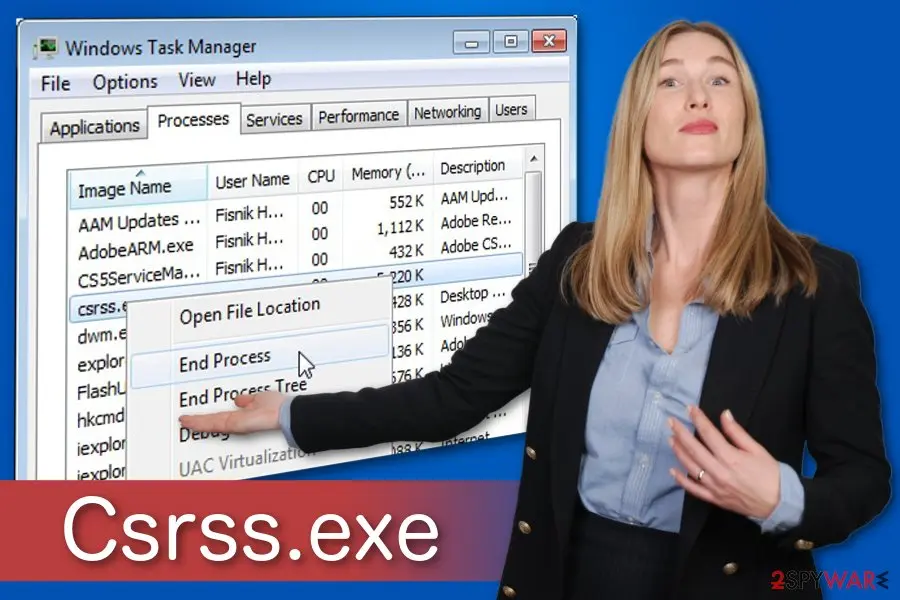
Likewise, you should not try to remove Csrss.exe Trojan manually. People who have already tried stopping this process in their Task Manager reported such error message:
To prevent such issues while trying to fix the system and protect your personal data, make sure you use automatic removal methods. In this case, we highly recommend using , which can delete the virus from the system for you.
From our report of Mar 2021 · not reviewed since
More from our earlier report on Csrss.exe trojan
- To eliminate the trojan, you should scan your machine with powerful anti-malware software.
- In case you notice crashes and other issues after you eliminate malware from your system, fix virus damage with tools such as
- You don't have the permission from TrustedInstaller to make changes in the file.
What Csrss.exe trojan can steal or download
From our report of Mar 2021 · not reviewed since
Csrss.exe Trojan is a type of malware designed to perform numerous malicious activities on a host computer.
Nonetheless, it is also important to note that that there is an entirely legitimate Microsoft process that is running on all normal operating systems under the same name - csrss.exe (Client Server Runtime Subsystem)- it is designed to manage graphical instruction sets under Windows. This legit version of the file is located in the C:\Windows\System32 folder.
Thus, users are advised to check this executable file by scanning the system with reputable security software just to make sure that it is not infected with the Trojan using the name of a legitimate system process. In case a Trojan is indeed located on your computer, it could cause serious security issues, including sensitive information disclosure, infiltration of other malware, and monetary losses.
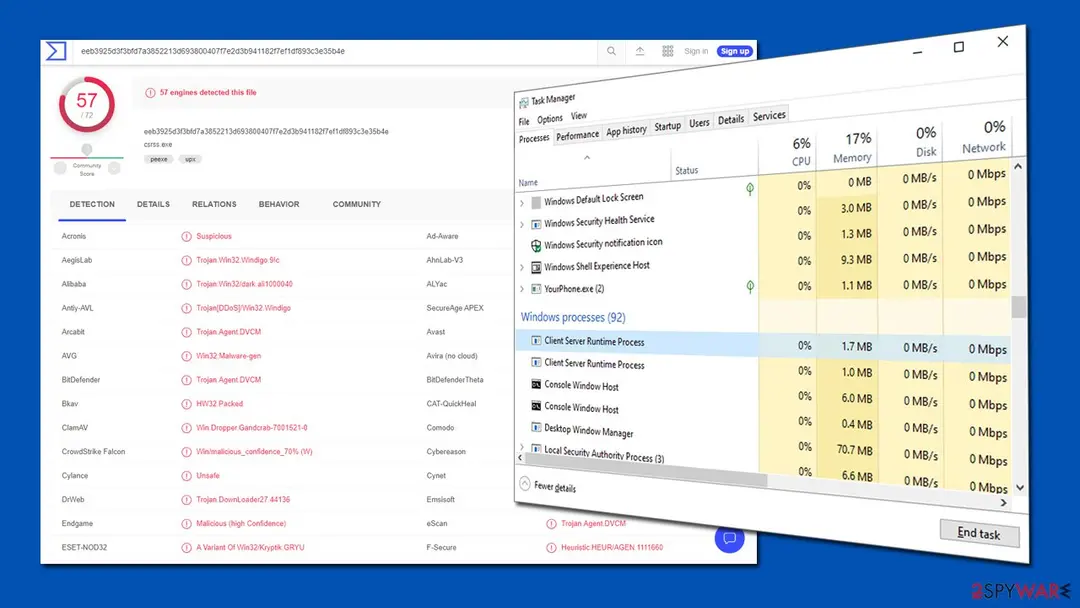
Nonetheless, cybersecurity solutions can detect the malicious version of the Csrss.exe virus as Mal/Generic-S, Trojan.Agent.DVCM, Win32:Malware-gen, Artemis!CDCB42F6700F, Trojan:Win32/Fakecrss, etc. These detection names can indicate that the trojan is not the only threat found on the system or that that infection happened due to the primary infiltration of another cyber virus.
The majority of users are not aware of the dangers that can be caused by Csrss.exe trojan. After infiltrating the system without any approval, it hides in its background and performs numerous activities that are extremely malicious. According to PC experts, the infection can put you and your computer's security at risk by performing the following actions:
As evident, the presence of the Csrss.exe trojan virus should not be tolerated, as the above-mentioned activities can cause serious consequences. Then again, it is also important to note that the process should not be terminated of it is a legitimate part of Windows, or otherwise serious system damage can occur.
- Mining cryptocurrency by using high amounts of CPU power;
- Recording keystrokes and mouse movements to obtain logins and passwords;
- Providing remote access to the infected system for hackers and allowing them to install other hazardous software.
How to check the PC for Csrss.exe trojan
Csrss.exe trojan detection names
If Windows Security shows Trojan:Win32/Fakecrss, it has found Csrss.exe trojan or a file that belongs to it.
Write the name down before you click Remove: it is the most useful search term later, and you will need it if you report the incident.
A family name in the label is more informative than a heuristic one. Our page on why one threat has many antivirus names lists the common formats and what each part means.
- Path:
C:\Windows\System32 - File:
Csrss.exe
How to remove Csrss.exe trojan
A loader's job is to install other malware, so treat the PC as infected with more than one program until the scans are clean.
Step 1: Check where Csrss.exe runs from and stop it
Csrss.exeis the part you can see, and its location tells you whether it belongs there. Right-click it on the Processes page of Task Manager and choose Open file location, then right-click the file > Properties > Digital Signatures to see who signed it.An unsigned file, or one in a user folder such as
%AppData%, is the one to remove: end the task, then delete the file.Note the folder name, because the same folder usually holds its other files. This is the same in Windows 11 and Windows 10.
Full procedure with screenshots: Close a frozen app (Task Manager, Force Quit) On uGetFix
Step 2: Delete scheduled tasks that bring it back
Open Task Scheduler from the Start menu and click Task Scheduler Library. Select each task you do not recognise and read the Actions tab:
- a task that starts a file in
%AppData%or%Temp% - runs
powershellwith a long encoded line - opens a web address belongs to Csrss.exe trojan or a similar program
Right-click such a task and choose Delete, and check the subfolders too. Leave tasks from Microsoft, your PC's maker and programs you use. Task Scheduler is the same in Windows 11 and Windows 10.
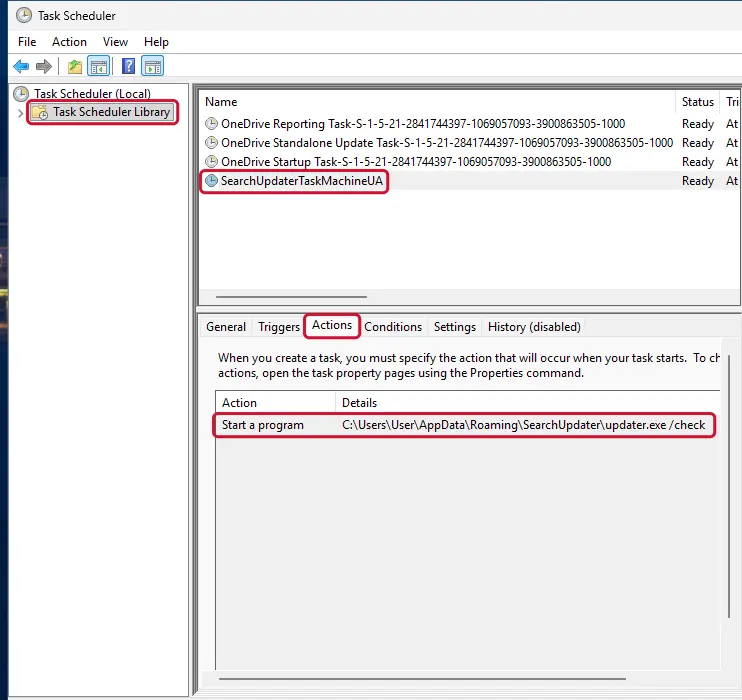
Windows 11: Task Scheduler Library, the task selected, the Actions tab shows the file it runs. Full procedure with screenshots: Remove what malware leaves behind in Windows
- a task that starts a file in
Step 3: Remove it from startup
Whatever Csrss.exe trojan installed usually starts with Windows. Open Task Manager with Ctrl + Shift + Esc, go to Startup apps in Windows 11 or the Startup tab in Windows 10, and disable what you do not know, starting with entries that have an empty Publisher column.
Open file location on the right-click menu shows the file, which helps you decide and tells you what to delete later. Disabling is safe: if something you need stops working, switch it back on.
Full procedure with screenshots: Stop apps from opening at startup On uGetFix
Step 4: Delete the folders left behind
What the uninstaller leaves behind is usually in the user folders. Open File Explorer, switch on View > Show > Hidden items (in Windows 10 View > Hidden items), and go through
%LocalAppData%,%AppData%, %ProgramData% and the two Program Files folders.Sort by Date modified and delete folders that appeared together with the problem and belong to no program you use. Folders with random names that hold
.exe,.dll, .js or .ps1 files are the strongest sign.Full procedure with screenshots: Remove what malware leaves behind in Windows
Step 5: Scan the PC, then run the offline scan
Open Windows Security > Virus & threat protection > Scan options, run a Full scan and remove everything it finds. Then select Microsoft Defender Antivirus (offline scan) and click Scan now: the PC restarts and scans before Windows loads, which finds files that hide while Windows runs.
Save your work first, because the offline scan takes about 15 minutes. Both scans are built into Windows 11 and Windows 10, and a second scanner from another vendor is a useful extra opinion.

Windows 11: Windows Security > Virus & threat protection > Scan options. Full procedure with screenshots: Run a Microsoft Defender Offline scan
Step 6: Change passwords from another device and sign out other sessions
Assume that the passwords saved in this PC's browsers, and the accounts that were open in them, are known to the attacker. From a phone or a clean computer, change the e-mail password first, then banking, shopping, social and gaming accounts.
Use each service's option to sign out of all other sessions, because stolen cookies keep a session open even after a password change. Turn on two-step verification on each account. Wait with the infected Windows 11 or Windows 10 PC until the scans are clean.
Full procedure with screenshots: Turn on two-step verification / secure a hacked account
Instructions for each browser and system
The detailed steps for every browser and system this guide covers. Open the one you use.
Manual removal using Safe Mode
Important! →
Manual removal guide might be too complicated for regular computer users. It requires advanced IT knowledge to be performed correctly (if vital system files are removed or damaged, it might result in full Windows compromise), and it also might take hours to complete. Therefore, we highly advise using the automatic method provided above instead.
Step 1. Access Safe Mode with Networking
Manual malware removal should be best performed in the Safe Mode environment.
Windows 7 / Vista / XP
- Click Start > Shutdown > Restart > OK.
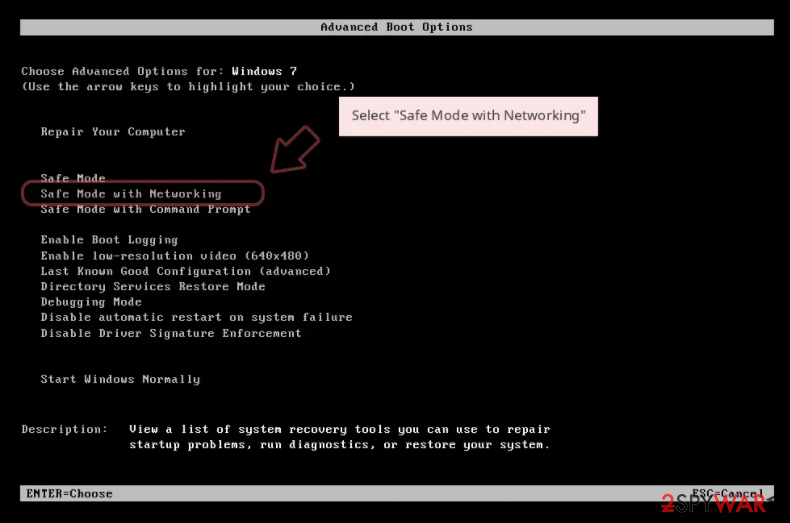
- When your computer becomes active, start pressing F8 button (if that does not work, try F2, F12, Del, etc. - it all depends on your motherboard model) multiple times until you see the Advanced Boot Options window.
- Select Safe Mode with Networking from the list.
Windows 10 / Windows 8
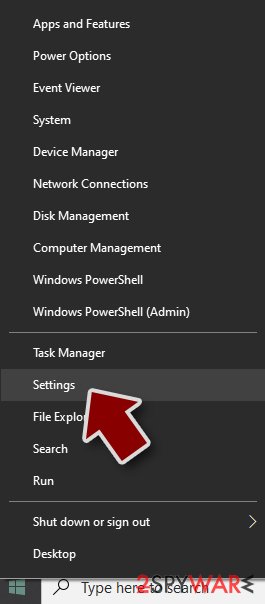
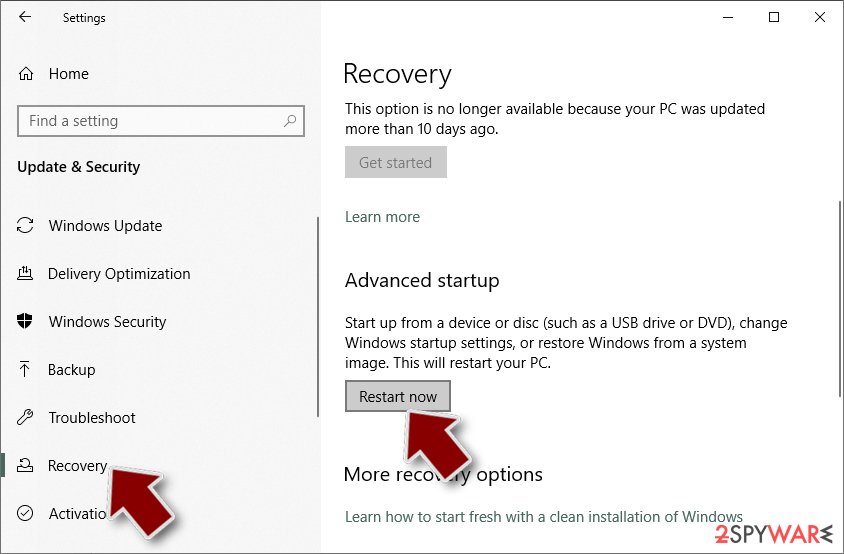
- Right-click on Start button and select Settings.
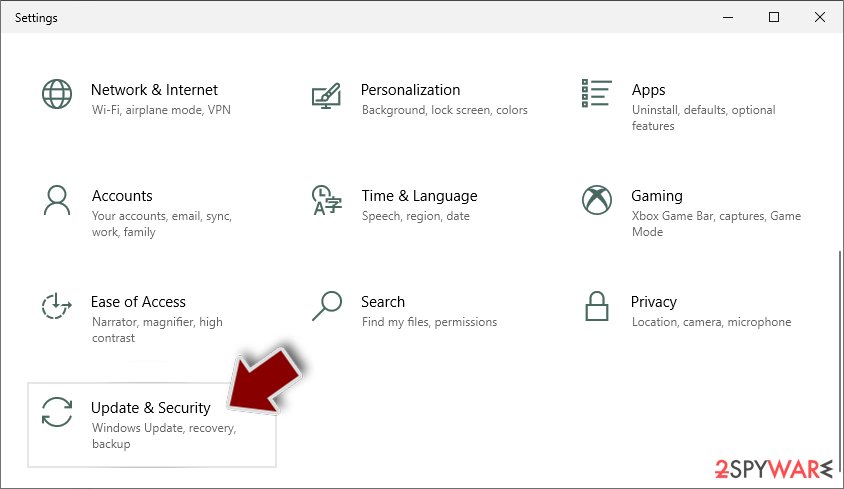
- Scroll down to pick Update & Security.
- On the left side of the window, pick Recovery.
- Now scroll down to find Advanced Startup section.
- Click Restart now.
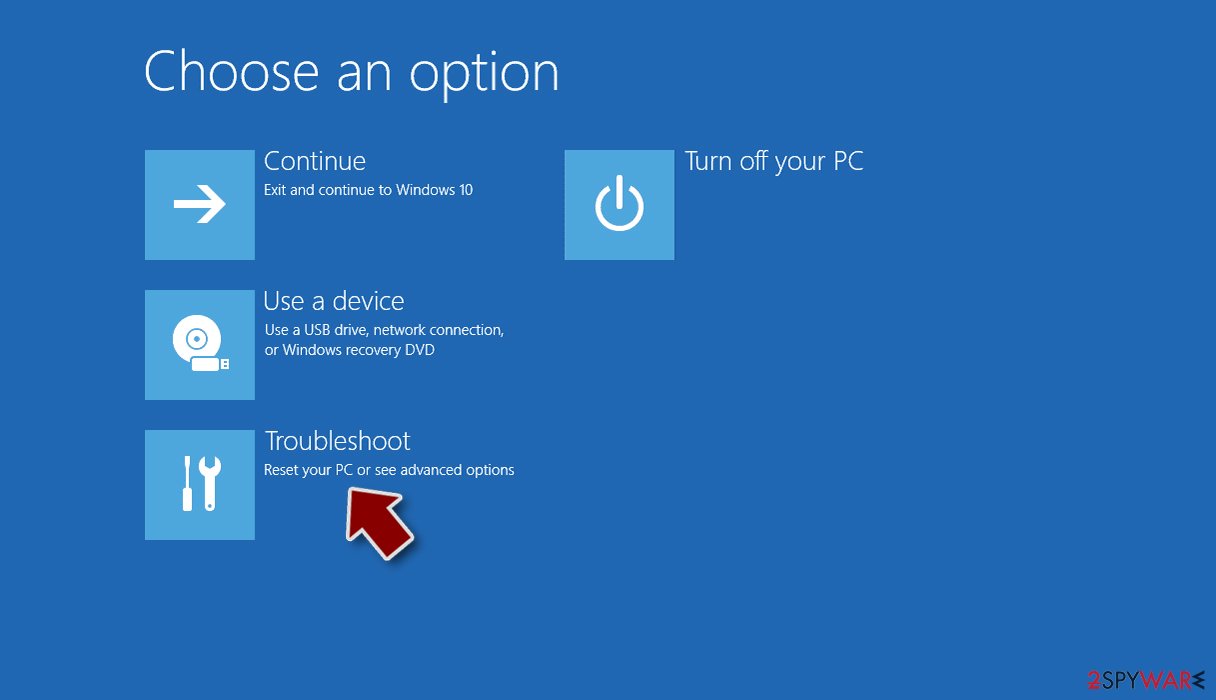
- Select Troubleshoot.
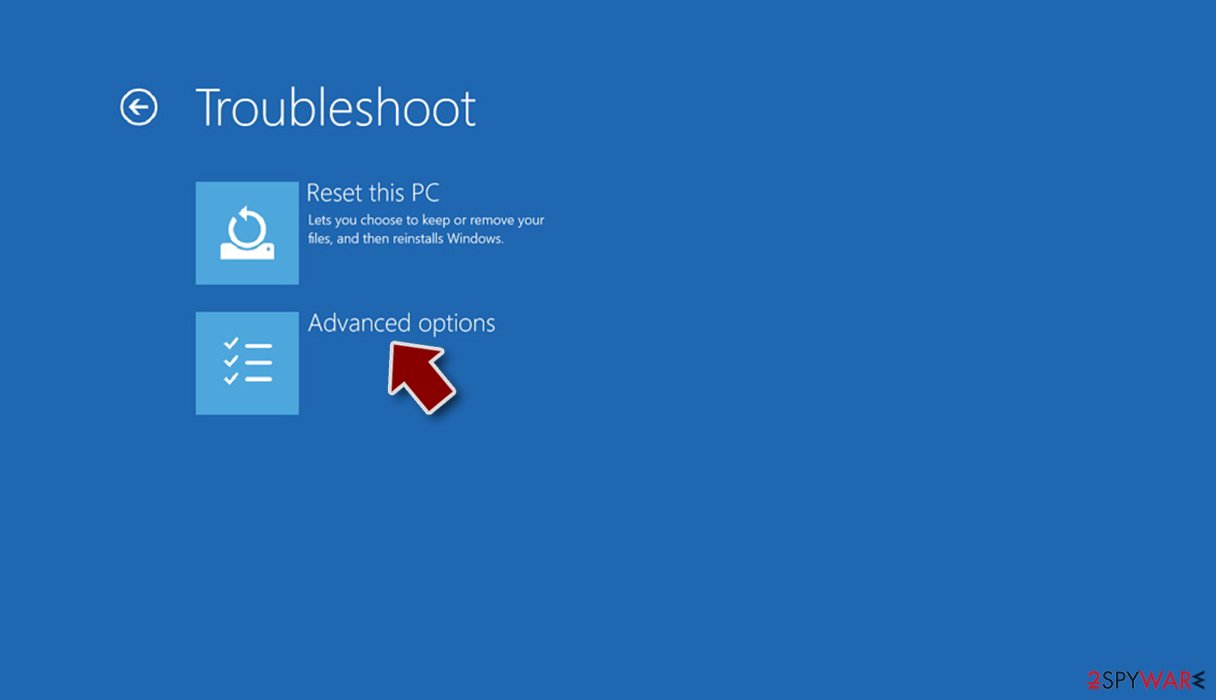
- Go to Advanced options.
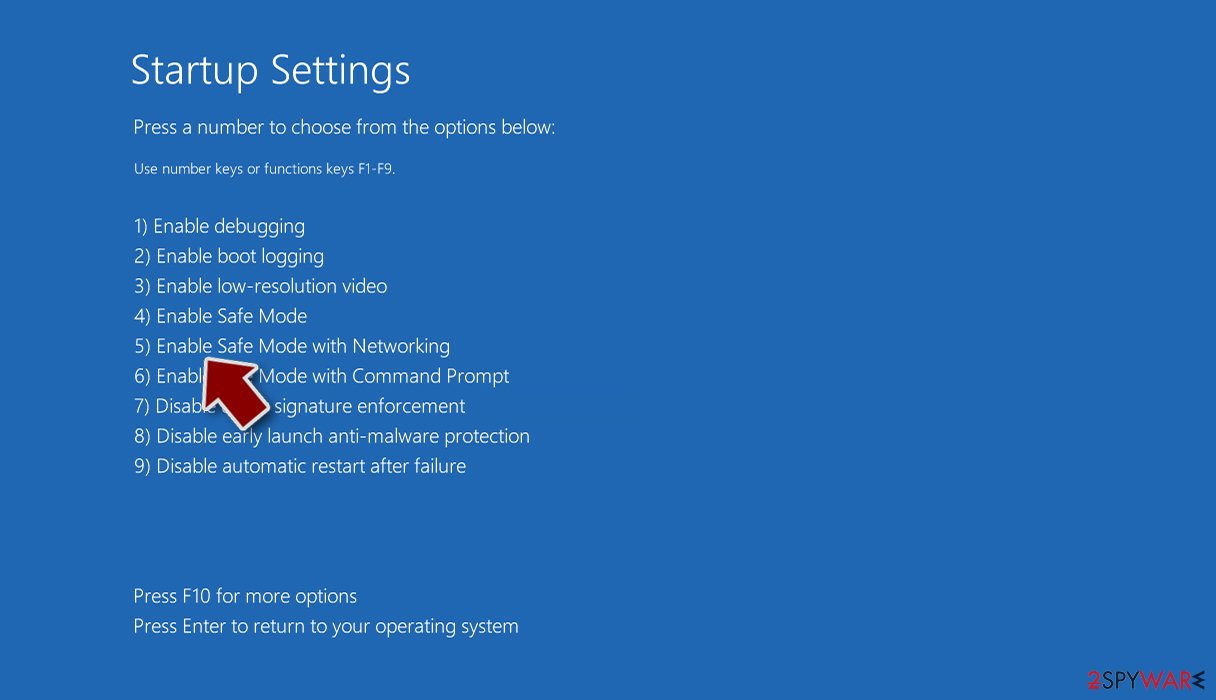
- Select Startup Settings.
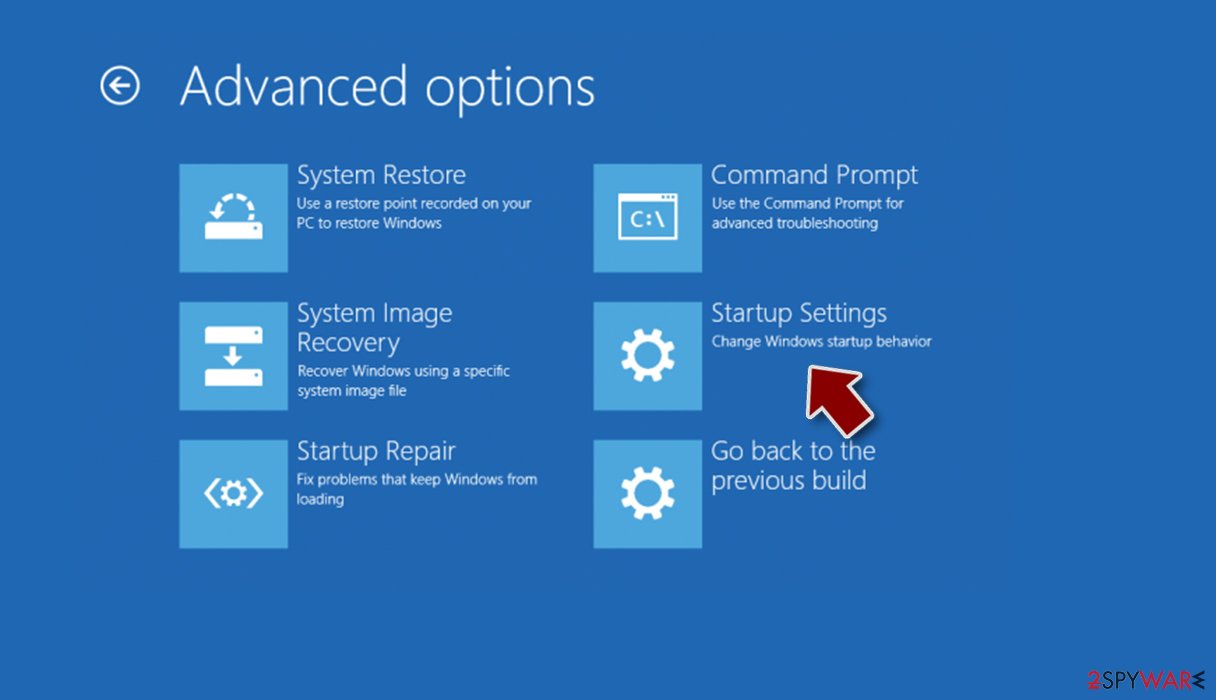
- Press Restart.
- Now press 5 or click 5) Enable Safe Mode with Networking.
Step 2. Shut down suspicious processes
Windows Task Manager is a useful tool that shows all the processes running in the background. If malware is running a process, you need to shut it down:
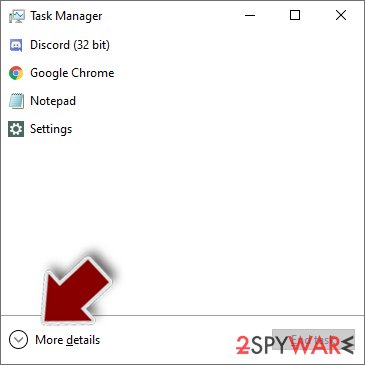
- Press Ctrl + Shift + Esc on your keyboard to open Windows Task Manager.
- Click on More details.
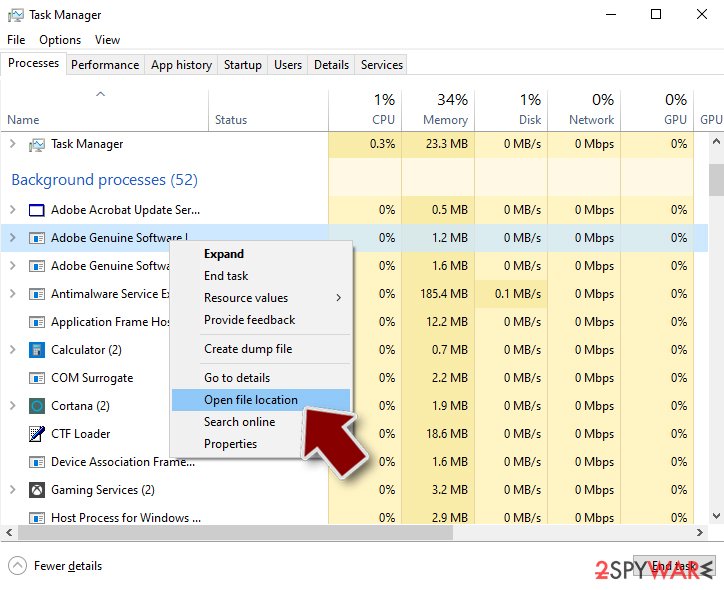
- Scroll down to Background processes section, and look for anything suspicious.
- Right-click and select Open file location.
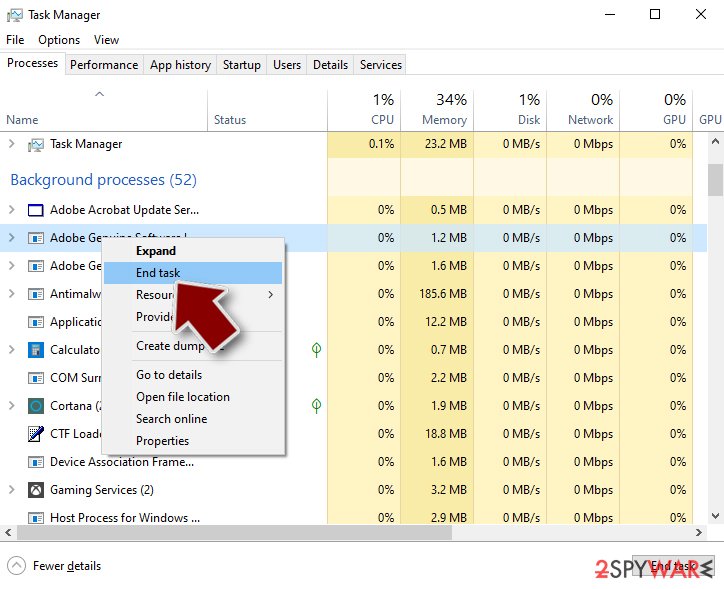
- Go back to the process, right-click and pick End Task.
- Delete the contents of the malicious folder.
Step 3. Check program Startup
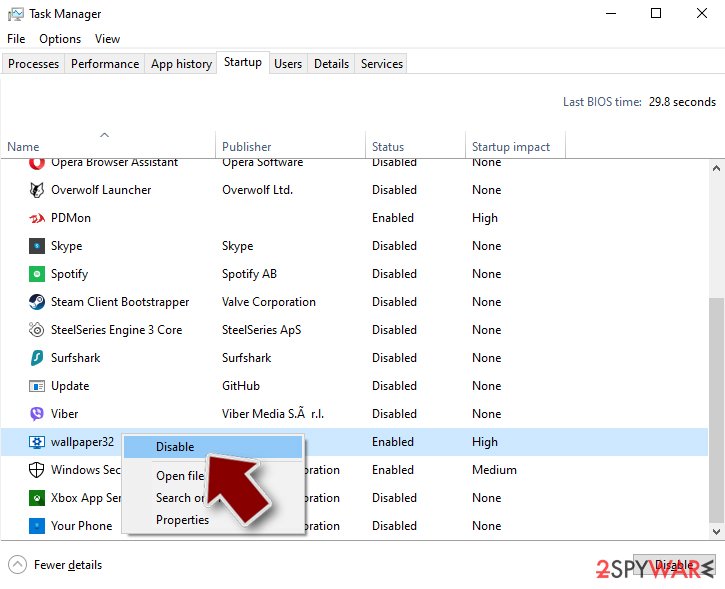
- Press Ctrl + Shift + Esc on your keyboard to open Windows Task Manager.
- Go to Startup tab.
- Right-click on the suspicious program and pick Disable.
Step 4. Delete virus files
Malware-related files can be found in various places within your computer. Here are instructions that could help you find them:
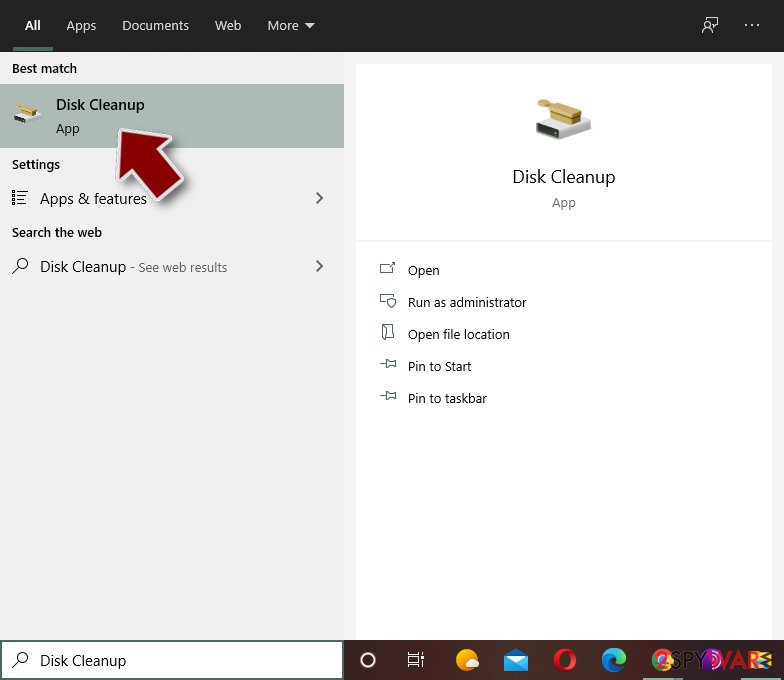
- Type in Disk Cleanup in Windows search and press Enter.
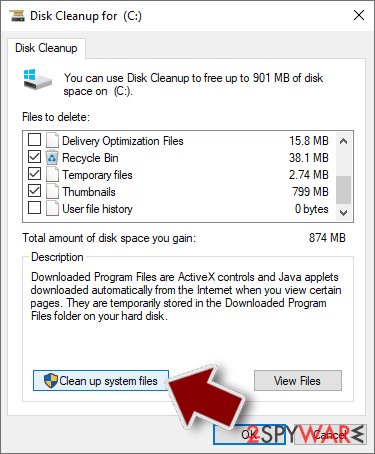
- Select the drive you want to clean (C: is your main drive by default and is likely to be the one that has malicious files in).
- Scroll through the Files to delete list and select the following:
Temporary Internet Files
Downloads
Recycle Bin
Temporary files - Pick Clean up system files.
- You can also look for other malicious files hidden in the following folders (type these entries in Windows Search and press Enter):
%AppData%
%LocalAppData%
%ProgramData%
%WinDir%
After you are finished, reboot the PC in normal mode.
From our report of Mar 2021 · not reviewed since
Ways to prevent Trojans on the system
The primary way how malicious programs enter your system is unreliable websites that offer to install suspicious software.
Usually, it is hard to determine whether the application is legitimate and people install unnecessary programs without close inspection.
Criminals upload Trojan horses disguised as innocent software on peer-to-peer (P2P) file-sharing sites and benefit from novice computer users who fall into their trap. Likewise, it is essential to download and install applications only from authorized websites.
Additionally, some online ads and hyperlinks are designed to execute bogus scripts which automatically install malicious programs. Thus, never click on any commercial content online and always use professional security software for protection against malware.
From our report of Mar 2021 · not reviewed since
To delete Csrss.exe Trojan immediately after detection, use special software
If you noticed a suspicious process running on your system, be aware that it might be the Trojan which should be eliminated right away.
You can check the location of the executable file to make sure that it is not potentially dangerous — a safe file must be located in C:\Windows\System32/ directory.
Otherwise, you can remove Csrss.exe trojan by scanning your computer with a robust antivirus. It is crucial to pick the best one as Trojan horses have numerous additional components that must be eliminated entirely. This procedure requires professional security tools only.
Our top recommendations for Csrss.exe trojan removal are the following security applications: , and . Our experts have collaborated with BedyNet.ru team to pick only the best options for our readers. Additionally, check the system with to fix corrupted system files.
After removal: passwords, accounts and prevention
Your passwords after Csrss.exe trojan
Removing Csrss.exe trojan does not undo what it may already have sent out while the PC showed an unfamiliar process called Csrss.exe in Task Manager.
Treat saved browser passwords and logged-in sessions on this PC as known to the attacker.
From another device, change the e-mail password first and end all its sessions. Then do the same for the bank, PayPal, Microsoft, Google and Apple accounts. Stolen session cookies keep working after a password change until you sign out everywhere.
Move crypto to a new wallet created on a clean device. A step-by-step order for every kind of account is in our guide to account security after an infection.
Choose a proper web browser and improve your safety with a VPN tool
Online spying has got momentum in recent years and people are getting more and more interested in how to protect their privacy online.
One of the basic means to add a layer of security - choose the most private and secure web browser. Although web browsers can't grant full privacy protection and security, some of them are much better at sandboxing, HTTPS upgrading, active content blocking, tracking blocking, phishing protection, and similar privacy-oriented features.
However, if you want true anonymity, we suggest you employ a powerful VPN - it can encrypt all the traffic that comes and goes out of your computer, preventing tracking completely.
Lost your files? Use data recovery software
While some files located on any computer are replaceable or useless, others can be extremely valuable.
Family photos, work documents, school projects - these are types of files that we don't want to lose. Unfortunately, there are many ways how unexpected data loss can occur:
- power cuts
- Blue Screen of Death errors
- hardware failures
- crypto-malware attack
- even accidental deletion
To ensure that all the files remain intact, you should prepare regular data backups. You can choose cloud-based or physical copies you could restore from later in case of a disaster. If your backups were lost as well or you never bothered to prepare any, can be your only hope to retrieve your invaluable files.
Questions about Csrss.exe trojan
What is the Csrss.exe Trojan?
The Csrss.exe Trojan is a file-masking infection that hides under the name of a legitimate Windows system process. Windows has a genuine csrss.exe file located in C:\Windows\System32 that manages graphical instructions on all normal operating systems. Malware developers exploit this by creating trojans with the same name to evade detection while stealing information and damaging your computer.
What damage can this Trojan cause?
The malicious Csrss.exe Trojan performs numerous damaging activities including recording keystrokes to steal passwords and banking data, opening backdoors for other malware infections, and mining cryptocurrency using your computer's processing power. It can also cause system freezes, crashes, program failures, and drastically reduced performance. Sensitive information stored on your machine is at serious risk of theft and unauthorized access.
How does this Trojan get on my computer?
The Csrss.exe Trojan typically enters through unreliable websites offering suspicious software, peer-to-peer file-sharing sites, and malicious email attachments. Criminals upload trojan horses disguised as legitimate software on P2P networks to deceive novice users. Online ads and hyperlinks designed to execute bogus scripts can also automatically install this malware without your knowledge.
How can I identify if I have this Trojan?
If you find a csrss.exe file running from anywhere other than C:\Windows\System32, your system may be infected. You can verify the location by checking Task Manager.
The malicious version often causes severe system slowdowns, freezing, or crashing. Cryptomining infections typically cause high temperatures and excessive CPU usage. However, only a full system scan with reliable antivirus software can definitively confirm infection.
Can I remove it manually?
Manual removal is not recommended because the Trojan is complex and may have components spread throughout your system. Many users have reported permission errors when attempting to delete it themselves.
Additionally, incomplete removal can leave malicious pieces active. The safest approach is to use robust antivirus software that can scan, detect, and completely eliminate all components automatically and safely.
What detection names does this Trojan use?
Cybersecurity solutions detect the malicious Csrss.exe under various names including Mal/Generic-S, Trojan.Agent.DVCM, Win32:Malware-gen, Artemis!CDCB42F6700F, and Trojan:Win32/Fakecrss. Multiple detection names may indicate that your infection is more severe than just this Trojan—other malware may have infiltrated your system as well. This suggests compromise through multiple vectors or from an initial vulnerability.
What should I do after removing it?
After antivirus software eliminates the Trojan, repair any damage caused by running system repair tools to fix corrupted files and registry entries. If your computer continues experiencing crashes, freezes, or stability issues after removal, use additional repair utilities to restore proper functionality. You may also want to change all your passwords since the Trojan could have logged your keystrokes.
How can I prevent this infection?
Download and install applications only from authorized websites and official sources. Never click on suspicious online ads or unknown hyperlinks. Use reliable antivirus software with active real-time protection to block threats before they install.
Be especially cautious with email attachments and suspicious links from unknown senders. Keep your antivirus definitions updated to detect the latest malware variants.
Will Fortect remove Csrss.exe trojan?
Fortect scans Windows for malware and unwanted programs and repairs the system files and settings they change, and its free scan shows what it finds on your PC before you decide anything.
For Csrss.exe trojan, follow the plan above as well: the browser steps take back permissions and settings that no scanner treats as a threat, and uninstalling the program that brought it removes the source.
Run Microsoft Defender's full scan and, if anything was found, its offline scan as a second opinion. If the symptoms are gone after the plan and both scans are clean, there is nothing more to do.
Sources
- Virus Total: csrss.exe (read October 5, 2026)
- Wikipedia: Operating System (read October 5, 2026)
- Microsoft security forum: Is csrss.exe a malware (read October 5, 2026)
- FTC: How to recognize, remove and avoid malware (read October 5, 2026)
- Microsoft Learn: Microsoft Defender Offline (read October 5, 2026)