
Mac File Opener: what it is and how to remove it
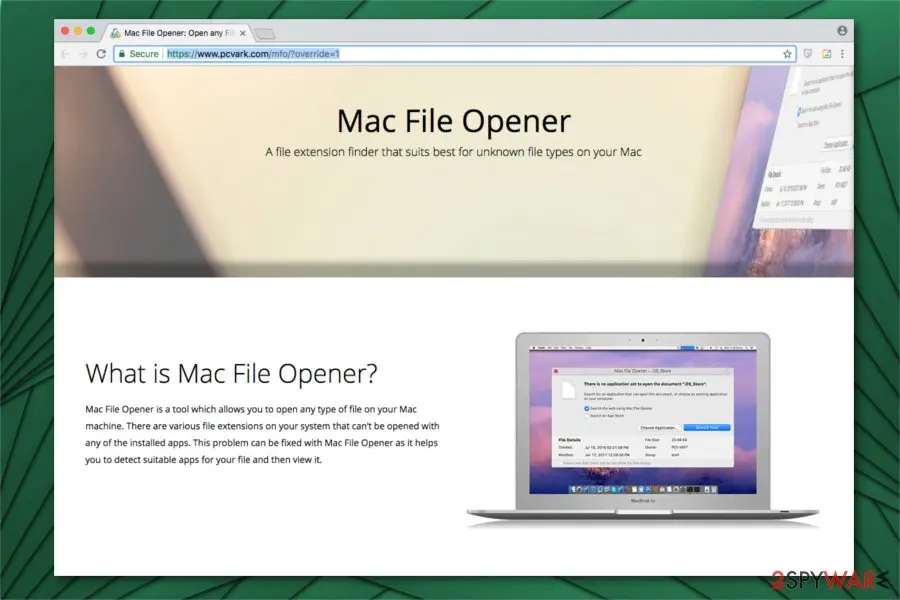
Mac File Opener is an unreliable application which supposedly helps users open files that are not supported by any regular MacOS programs. Unfortunately, this tool is not only ineffective but also promotes another questionable app, known as Advanced Mac Cleaner.
Facts checked October 7, 2026. Removal steps checked against Apple's current documentation and the security vendors' reports. We have not run the malware on a Mac. Sections marked as our earlier report are the original text: they describe the threat as it was then and have not been reviewed since. The 2026 status, the removal steps and the questions are current.
Automatic
Get a free scan and check if your Mac is infected.
Fortect for Mac scans for malware and unwanted programs, and its free scan shows what it finds before you decide anything.
If Mac File Opener keeps coming back after uninstalling, a scan can find what reinstalls it.
Do it yourself · free Remove Mac File Opener yourself 4 steps, about 12 minutes, no software needed.
Start the steps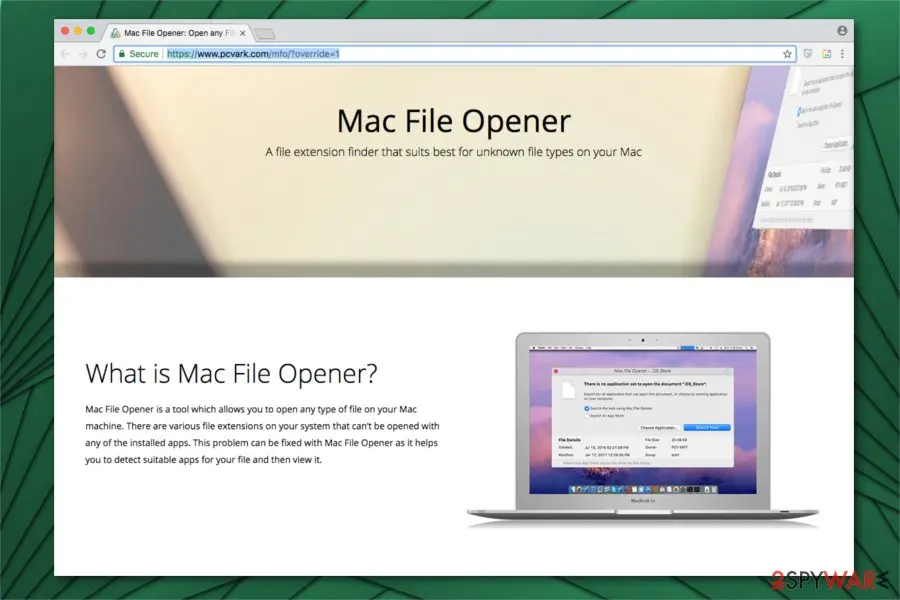
Mac File Opener: summary
| Distribution | Spreads via well-known marketing tactic, called bundling |
|---|---|
| Name | Mac File Opener |
| Type | System tools |
| Danger level | Medium. It cannot perform system changes. Although, might infiltrate other PUPs on the computer |
| Related to | Advanced Mac Cleaner |
| Symptoms | Displays false virus alerts, redirects to the sites of fraudulent system optimization tools and suggests installing questionable applications |
| Removal | Scan the Mac with security software to find the malware and anything installed with it. Fortect for Mac scans for malware and unwanted programs. Remove it nowTo use the full-featured product, you have to purchase a license for Fortect. The scan is free. |
Show 6 more facts
| Detection names | No Microsoft detection name is known |
|---|---|
| Damage | Not recorded in the old report |
| Evidence | 4 write-ups by security sites; details still limited |
| Program | Mac File Opener |
| First seen | 31 July 2018 |
| Facts checked | 7 October 2026 |
Is Mac File Opener safe? Why it is flagged
From our report of Jul 2018 · not reviewed since
Mac File Opener is a questionable tool which also promotes Advanced Mac Cleaner
Mac File Opener is an unreliable application which supposedly helps users open files that are not supported by any regular MacOS programs.
Unfortunately, this tool is not only ineffective but also promotes another questionable app, known as Advanced Mac Cleaner. Users report that these potentially unwanted programs (PUPs) often are installed via software-bundles and display fake virus alerts or redirect to their official sites. People indicate that Mac File Opener neither help accessing files nor improve their computer's performance.
According to the experts, Mac File Opener can enter the system as an optional component of the third-party application. This distribution method does not require the user's consent. Thus, people might not even notice when and how Mac File Opener was installed on their computers.
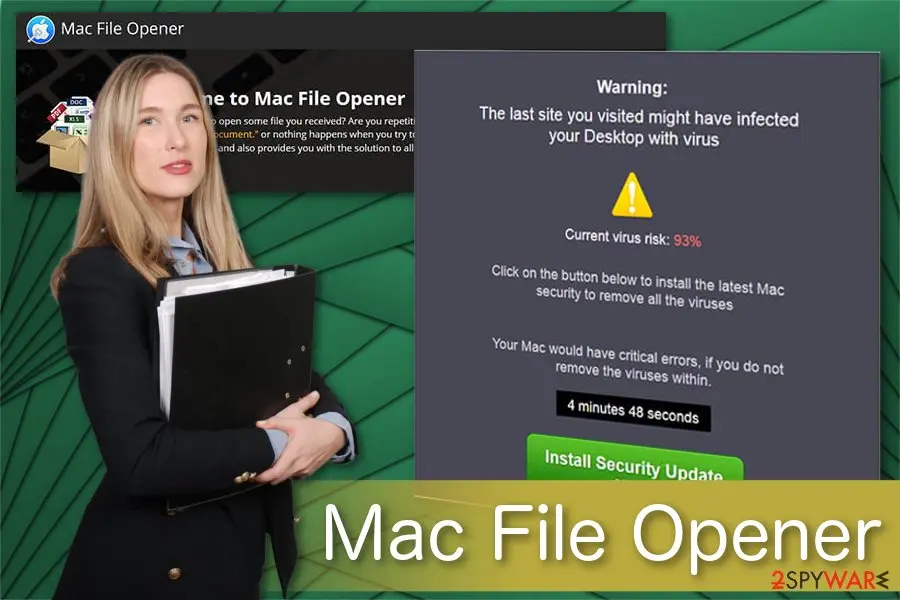
Furthermore, once Mac File Opener is running on the system, it can display false malware alerts. In other terms, people encounter deceptive messages stating that their computers are infected by a virus. As a result, they must install security update now. However, this Mac File Opener pop-up is nothing more than a trick to promote affiliated programs, like Advanced Mac Cleaner.
In return, that questionable system optimization tool also promotes Mac File Opener once the person running the so-called antivirus cannot open files with regular MacOS apps. Such actions are performed in order to generate pay-per-install revenue for the developers of both potentially unwanted programs (PUPs) .
Keep in mind that Mac File Opener might also redirect users to less than reliable sites where other questionable applications are promoted as useful tools. Thus, if you keep Mac File Opener on your system, there is a substantial risk that you can notice more potentially dangerous programs installed without your consent.
As Mac File Opener does not carry out the promised features and instead puts your computer's security at risk, we strongly recommend you to remove Mac File Opener right away. There are manual elimination guidelines presented at the end of this article.
However, some people report that after Mac File Opener removal this software still appears on the spotlight search. In case you are unable to get rid of all components which are related to this fraudulent tool, run a full system scan with . It will uninstall Mac File Opener and other PUPs from your system completely.
From our report of Jul 2018 · not reviewed since
More from our earlier report on Mac File Opener
- People report that even after they uninstall Mac File Opener it still appears on the spotlight search.
- You can get rid of this PUP completely by using
How to uninstall Mac File Opener
How to remove Mac File Opener from a Mac
Remove the app and what starts it, then check the browsers.
Step 1: Delete apps and downloads you did not intend to install
Open the Applications folder and your Downloads folder. Drag any app you did not install, and any disk image (
.dmg), installer (.pkg) or archive (.zip) that came from Mac File Opener or a site you do not trust, to the Bin, then empty the Bin.Also check
~/Library/Application Supportfor a folder with the same name as the app you removed.Step 2: Remove unknown login items and background items
Open System Settings > General > Login Items & Extensions. Under Open at Login and Allow in the Background, switch off or remove anything you do not recognize, especially items whose developer is shown as an unknown name or that appeared on the day you ran the command.
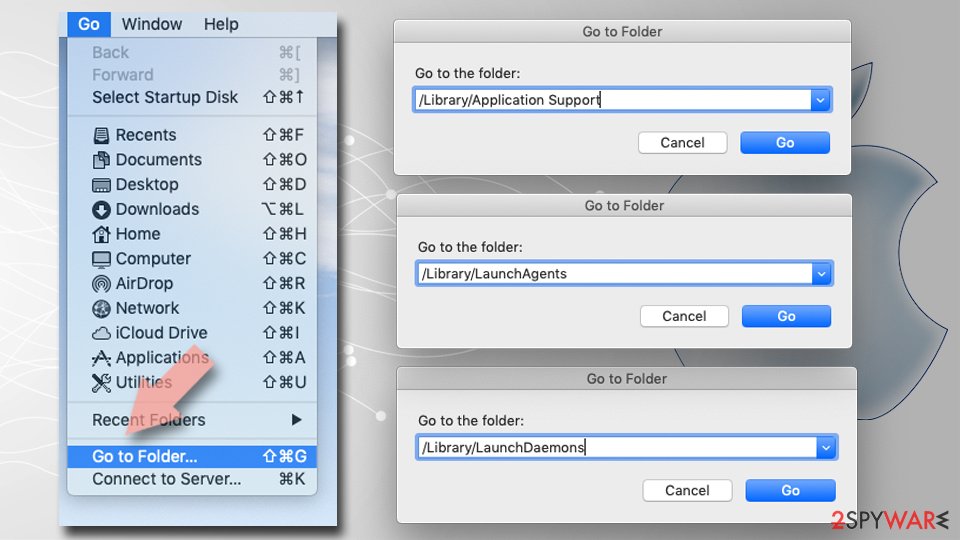
Then open Finder, choose Go > Go to Folder and check
~/Library/LaunchAgents,/Library/LaunchAgentsand /Library/LaunchDaemons for property list (.plist) files you did not add. Drag suspicious ones to the Bin, then restart the Mac.Step 3: Check the browsers for extensions and changed settings
In Safari open Settings > Extensions and General (homepage). In Chrome open
chrome://extensions, in Firefoxabout:addons.Remove any extension you did not add, and reset the homepage and search engine if they changed. Browsers hold saved passwords and cookies, which is why the password step comes first.
Step 4: Quit what is running that you do not recognize
Open Activity Monitor (in Applications > Utilities, or search for it with Command + Space).
In the CPU or Network tab, look for a process you did not install or whose name is random, select it, click the stop button (the octagon with an X) and choose Quit or Force Quit.
Note the name first: you will look for the same name in the next steps. Malware that comes back after a restart is handled in the next two steps.
Instructions for each browser and system
The detailed steps for every browser and system this guide covers. Open the one you use.
Delete from macOS
These guidelines are designed to help users uninstall Mac File Opener from their systems and ensure that the potentially unwanted program wouldn't reappear in the future.
Remove the unwanted application:
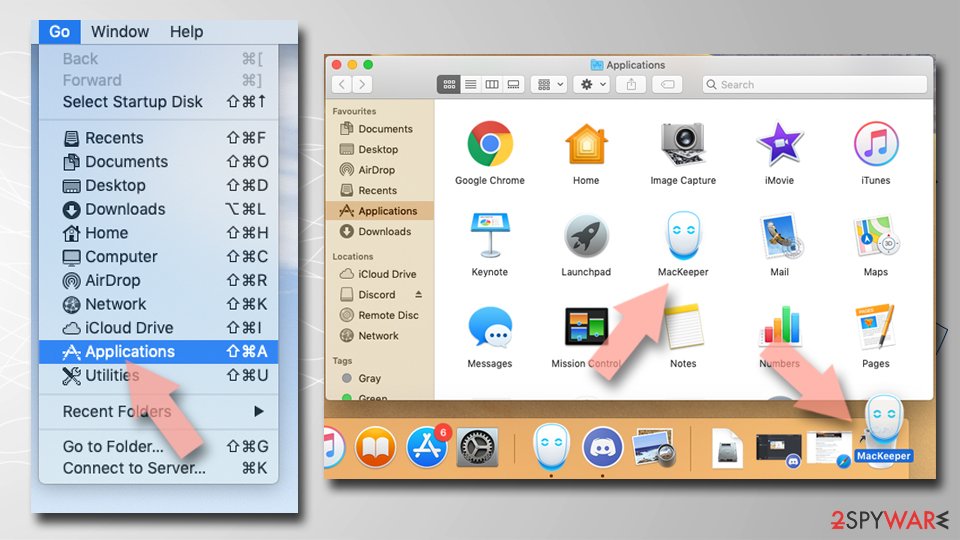
- From the menu bar, select Go > Applications.
- In the Applications folder, look for any suspicious entries, then drag them to Trash (or right-click and pick Move to Trash).
Delete leftover files and folders:
- Select Go > Go to Folder.
- Enter /Library/Application Support and remove any suspicious folders related to the unwanted program.
- Repeat the same check in the /Library/LaunchAgents and /Library/LaunchDaemons folders, deleting any suspicious entries.
- Finally, empty the Trash to permanently remove the leftovers.
Do not let government spy on you
The government has many issues in regards to tracking users' data and spying on citizens, so you should take this into consideration and learn more about shady information gathering practices.
Avoid any unwanted government tracking or spying by going totally anonymous on the internet.
You can choose a different location when you go online and access any material you want without particular content restrictions. You can easily enjoy internet connection without any risks of being hacked by using VPN.
Control the information that can be accessed by government any other unwanted party and surf online without being spied on. Even if you are not involved in illegal activities or trust your selection of services, platforms, be suspicious for your own security and take precautionary measures by using the VPN service.
Backup files for the later use, in case of the malware attack
Computer users can suffer from data losses due to cyber infections or their own faulty doings.
Ransomware can encrypt and hold files hostage, while unforeseen power cuts might cause a loss of important documents. If you have proper up-to-date backups, you can easily recover after such an incident and get back to work. It is also equally important to update backups on a regular basis so that the newest information remains intact - you can set this process to be performed automatically.
When you have the previous version of every important document or project you can avoid frustration and breakdowns. It comes in handy when malware strikes out of nowhere. Use for the data restoration process.
From our report of Jul 2018 · not reviewed since
Installing freeware attentively can prevent the infiltration of PUPs
As it was mentioned before, potentially unwanted programs can enter the system without the user's consent.
It happens when they are bundled with third-party software and comes as optional components. If the person does not pay attention to the installation procedure, the questionable tool is installed alongside the primary app.
For this reason, you should attentively follow the installation procedure. More precisely, choose Advanced or Custom mode instead of Quick or Recommended one. This way, you will be able to monitor each step of the process and find pre-selected additional components. You must de-select them to protect your Mac from PUPs.
Furthermore, stay away from sites promoting questionable programs. Usually, they are designed to push useless tools which open paths for more potentially dangerous applications. Instead, use only reliable websites for software downloads. Additionally, it is wise to read reviews online posted by IT professionals.
From our report of Jul 2018 · not reviewed since
Uninstall Mac File Opener entirely
Even though you can remove Mac File Opener manually, researchers note that some related components might persist on the system.
As a result, the so-called infection could reappear operating on your Mac after some time. Thus, the wisest decision would be to get help from certified antivirus tools.
Usually, it takes several minutes before the check-up is completed and you are prompted to the elimination procedure.
Questions about Mac File Opener
Can I safely uninstall Mac File Opener?
If you did not install Mac File Opener yourself and it is not part of your hardware or a program you rely on, yes. Uninstalling an unwanted program does not harm Windows.
Before you do, search the exact name and publisher to be sure it is not a driver tool, a printer utility or a game launcher with an odd name. Then remove it from Settings, Apps, Installed apps.
Ignore any offers or warnings in its uninstaller about losing protection or performance. Afterwards check Startup apps and your browsers for leftovers, and restart once to confirm that it does not reinstall itself.
Mac File Opener will not uninstall. What can I do?
First restart the PC and try again, because the program may have been running and locked its own files. If the uninstaller is missing or fails, start Windows in Safe Mode, where most third-party programs do not start, and remove Mac File Opener from Installed apps there.
If it still refuses, delete its startup entry and its scheduled task, restart, and try once more. A program that actively prevents removal is behaving like malware, so finish with a Microsoft Defender offline scan. Avoid third-party uninstallers offered on search ads; several of them are unwanted programs themselves.
Can I use Mac File Opener safely?
Yes, if you installed it on purpose and control its settings. Download it only from the publisher's own site, never through a bundle or a portal. After installing, disable automatic start, offers and telemetry, and check that it did not change your search engine or add extensions.
Watch for renewals if you bought a licence, and turn on PUA blocking in Windows Security so that anything it tries to add during updates is stopped. If Mac File Opener keeps pushing payments or offers, it is not worth the trouble.
Could Mac File Opener be a legitimate program?
Possibly. Some programs that cause mac File Opener in the list of installed apps are real products from real companies that simply use aggressive distribution. Check the publisher in Installed apps and the digital signature in the file's Properties.
A known publisher and a program you actually use mean you can keep it and only adjust its settings. An unknown publisher, a program you never opened and no clear purpose mean it should go.
If it came bundled with something else, the decision is easy: you did not choose it, so remove it and keep the program you actually wanted.
Why does my antivirus call Mac File Opener a PUA or PUP?
These labels mean potentially unwanted application or program. They are used for software that is legal but uses deceptive distribution, aggressive ads, misleading claims or a hard removal. Microsoft's PUA categories include advertising software, bundlers, download managers, torrent clients, marketing software and miners.
A PUA detection is a warning, not proof of infection, and you decide whether to keep Mac File Opener. Other vendors use their own labels for the same idea, such as PUP.Optional or not-a-virus. Read more in our guide to potentially unwanted programs.
Do I need special software to remove Mac File Opener?
No. Windows has everything needed:
- Installed apps for the uninstall
- the Startup list and Task Scheduler for what restarts it
- Windows Security for a scan afterwards
The steps in this guide take about fifteen minutes. A dedicated tool is a convenience when you would rather not check each place yourself or when the program keeps coming back.
Whatever you use, finish by confirming that mac File Opener in the list of installed apps is gone after a restart, and avoid downloading removal tools from pages that promote them through scary warnings.
Is my privacy at risk because of Mac File Opener?
A little, not dramatically. Unwanted programs tend to report what you install, which sites you visit or how you use the program back to their publisher. That data is sold or used for ads.
The sign people noticed, mac File Opener in the list of installed apps, is consistent with such a program, and nothing reported suggests access to your files, camera or passwords.
Remove it, delete its leftovers and clear the browser data if it touched the browser. From then on, keep Potentially unwanted app blocking switched on in Windows Security, which stops many of these programs before they install.
Is Mac File Opener harmful?
It is unwelcome rather than destructive, based on what has been reported: mac File Opener in the list of installed apps. Unwanted programs like this slow Windows down, use your connection, show offers or change settings, and they make money for their publisher at your expense. The bigger concern is what arrived with them.
Bundled installers often add two or three programs at once, and some of those change the browser or install updaters that fetch more software later. Remove Mac File Opener, then sort Installed apps by date and remove anything else from the same day. A full scan in Windows Security afterwards confirms that nothing more serious came along.
Mac File Opener came back after I removed it. Why?
Something reinstalls it:
- another program from the same bundle
- a scheduled task that downloads it again
- a browser extension restored by sync
Look in Installed apps for anything from the same publisher or installed on the same date, and in Task Scheduler for tasks with the program's name or random names. Remove extensions while signed in to the browser so sync deletes them on every device.
Remove everything in one session and restart. If Mac File Opener still returns, a full scan and a Microsoft Defender offline scan usually find the part that brings it back.
Will Fortect remove Mac File Opener?
Fortect for Mac scans for malware and unwanted programs, and its free scan shows what it finds on your Mac before you decide anything.
For Mac File Opener, follow the plan on this page as well: removing a launch item or an app is done in macOS itself, and a scanner cannot undo what was typed or entered on the infected Mac, such as saved passwords that were copied.
Change your passwords from another device first, and if the page tells you to erase the Mac, a scan is not a substitute. The free scan costs nothing and the full-featured product needs a license.
Sources
- How-To Geek: PUPs Explained: What is a "Potentially Unwanted Program"? (read October 7, 2026)
- LosVirus: LosVirus (read October 7, 2026)
- FTC: How to recognize, remove and avoid malware (read October 7, 2026)
- Microsoft Learn: Microsoft Defender Offline (read October 7, 2026)
- Microsoft Learn: How Microsoft names malware (read October 7, 2026)