
OneSafe PC Cleaner: what it is and how to remove it
OneSafe PC Cleaner operates as a tool that supposedly helps users fix and correct Windows errors with one click. However, such promises are far from reality.
Facts checked October 6, 2026. Removal steps tested on Windows 11 (26H2) and checked against Microsoft's and the browser makers' current documentation. Sections marked as our earlier report are the original text: they describe the threat as it was then and have not been reviewed since. The 2026 status, the removal steps and the questions are current.
Automatic
Get a free scan and check if your PC is infected.
Fortect finds malware, unwanted programs and the Windows damage they leave behind, and repairs it in one pass.
Programs like OneSafe PC Cleaner usually arrive in groups; a free scan lists the companions that are easy to miss.
Do it yourself · free Remove OneSafe PC Cleaner yourself 4 steps, about 12 minutes, no software needed.
Start the steps
OneSafe PC Cleaner: summary
| Name | OneSafe PC Cleaner |
|---|---|
| Category | System tool |
| Sub-category | Potentially unwanted application |
| OS | Windows |
| Purpose | To convince naive people to purchase the licensed version of the fake cleaning program |
| Symptoms | Automated scan results show hundreds of issues that need to be fixed; pop-ups urge to purchase full version of the app |
| Removal | Scan the PC with security software to find and remove the malware and anything installed with it. Fortect scans Windows for malware and repairs the system files and settings it damaged. Remove it nowTo use the full-featured product, you have to purchase a license for Fortect. The scan is free. |
Show 8 more facts
| Distribution sources | Official downloading website, bundled freeware/shareware |
|---|---|
| Detection & removal | You can check our manual guide below, or opt for more automatic removal with anti-malware software; no Microsoft detection name is known for this name |
| Damage | Not recorded in the old report |
| Type | System optimizer |
| Evidence | 7 write-ups by security sites; details still limited |
| Program | OneSafe PC Cleaner |
| First seen | 6 February 2020 |
| Facts checked | 6 October 2026 |
Is OneSafe PC Cleaner safe? Why it is flagged
From our report of Feb 2020 · not reviewed since
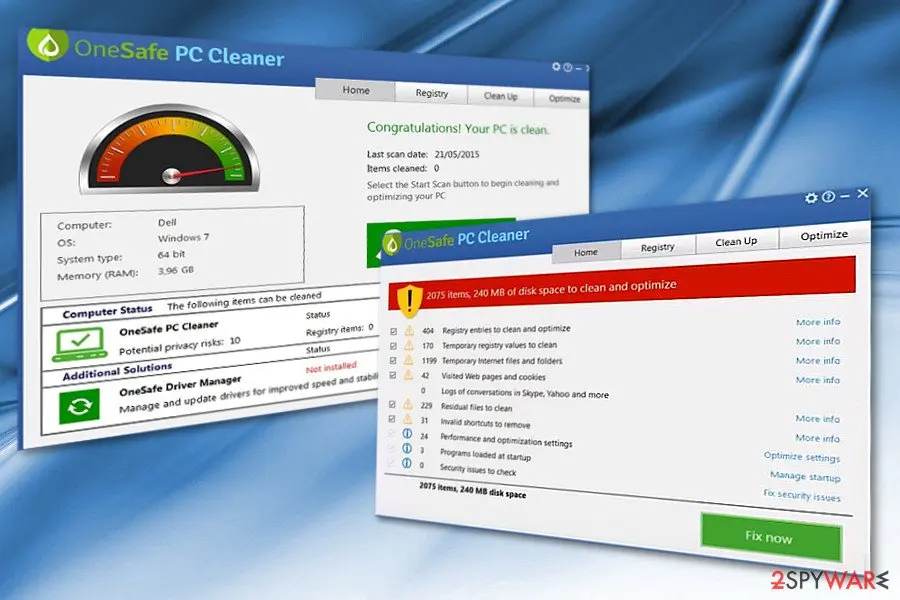
OneSafe PC Cleaner is the application that claims to find issues with the system and improve the performance significantly
OneSafe PC Cleaner operates as a tool that supposedly helps users fix and correct Windows errors with one click.
However, such promises are far from reality. In other words, this system optimization tool can cause more new problems with your computer than help you get rid of the existing issues.
It is wise to mention that there is more similar and unreliable software like this that can lead to more serious issues with your device and result in various infiltrations of PUPs or even malware. You shouldn't trust random pop-ups and download pages that promote these tools.
Be aware that their appearance and description might deceive many users, including you. Developers of such programs aim to trick naive people into believing that their software is useful.
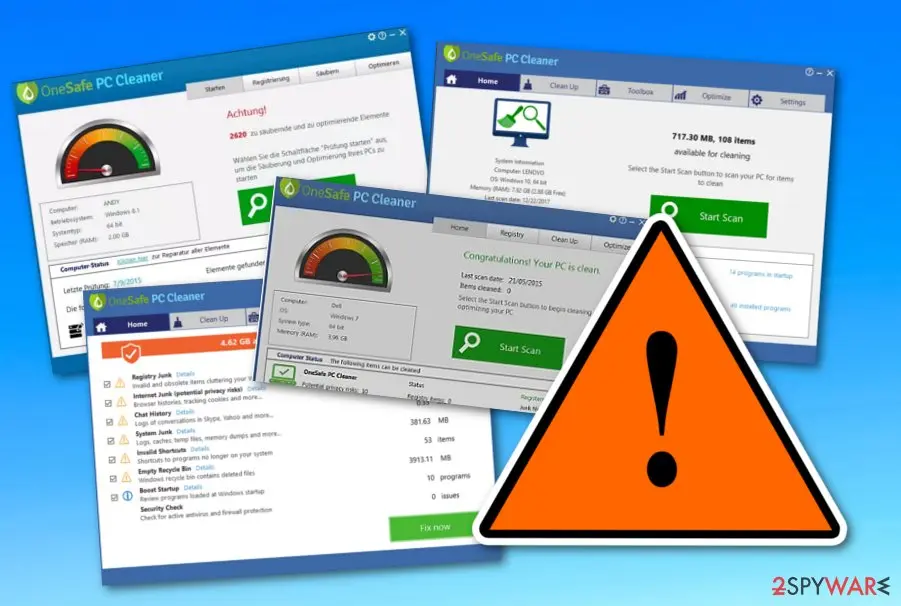
Unfortunately, the real answer to the question of what is OneSafe PC Cleaner and similar applications can disappoint you; In reality, the absolute majority of system optimization tools are programmed to alarm victims about dozens if not hundreds of fake computer-related issues.
As for the solution, such fraudulent software offers to purchase its full version to solve the detected issues. When a user buys the licensed version, the program magically solves them.
However, if you would have checked the system earlier with reputable antivirus, you would have noticed that there were no issues similar to the ones provided by One Safe PC Cleaner. Such phishing technique has led hundreds of users to get caught in a marketing trick and suffer from money loss.
While the majority of optimizers such as this and other similar ones happen to be just useless programs created for an extortion purpose, some samples might even cause cyber issues. Some of the latter might make the operating system more vulnerable to virtual threats, while others, such as Windows Antivirus Helper, might even interfere with legitimate system apps and anti-virus programs and diminish their operation.
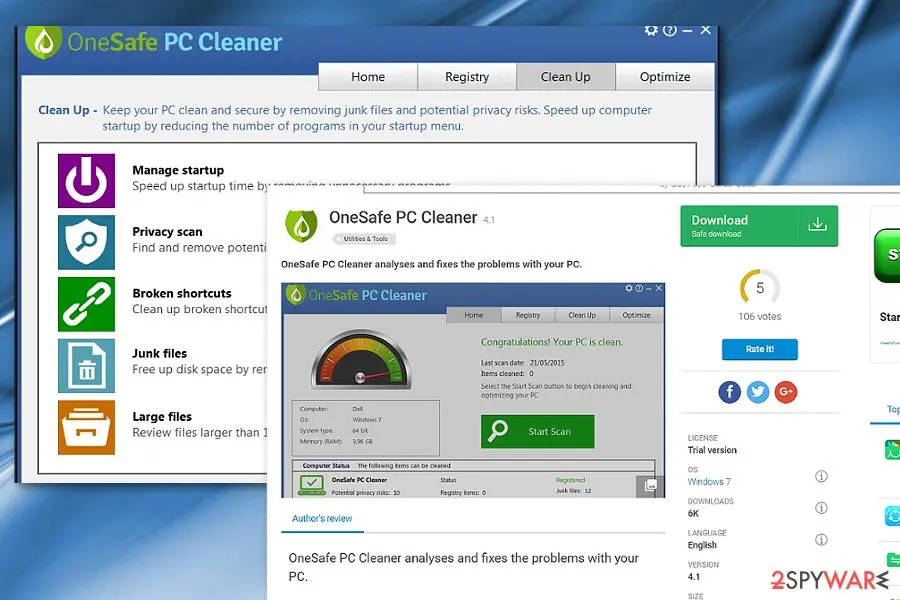
While such programs have been online already for several years, recently, Microsoft and other cybersecurity institutions have been paying more attention to this rooted cyber phenomenon. Likewise, OneSafe PC Cleaner tool happens to be one of such fake tools. It does not have its own website but instead is promoted at the notorious Softonic domain, which has a low reputation due to the insecure content it promotes.
Even though such an honest OneSafe PC Cleaner review might make the developers of this program dissatisfied, we want to raise awareness that not every software online which has a well-constructed description is worth users' trust. It is important to make good research about the program you attempt to download and choose only reputable distribution sources.
For all the reasons mentioned above, we strongly advise you to stay away from the so-called OneSafe PC Cleaner virus. However, despite whether you have manually installed this program or it has sneaked into your system via software bundles, you should immediately uninstall it if you notice its presence.
If you keep the rogue app for a long time, it may start bombarding your desktop with various pop-ups that might cause system slowdowns and intrude on your computing work.
Be aware that after the installation, the scan only takes a couple of minutes until it immediately displays over a thousand issues. Instead of paying $19.99 for this fake tool, proceed to perform the proper virus removal.
Once you get rid of the fake system optimization program, make sure that you consider downloading and installing a truly reliable computer security tool that will prevent the installation of various dubious applications and even dangerous malware.
However, if you are not experienced enough, we suggest you remove OneSafe PC Cleaner virus with a malware removal tool. You can do that by scanning the system with tools like , . Automatic elimination of this program will save your time as well as ensure that all its components will be deleted from your system.
From our report of Feb 2020 · not reviewed since
You can install fake PC optimizers manually or they can stealthily sneak into your computer
Similar to other unreliable system optimization tools, this one is available at the official Softonic's website for free.
However, developers try to infiltrate this potentially dangerous software secretly by using deceptive distribution techniques. One of them is bundling it with other free third-party applications and offering it as one.
Likewise, people who tend to rush through the installation procedure are most likely to end up with fake PC optimizers on their systems. However, there is an easy way how you can avoid downloading additional software during the installation of freeware. The secret is to choose Custom or Advanced settings of the installer.
Later on, unmark all add-ons. Rarely useful apps are promoted likewise. Note that some developers even promote their products via online tech support scam sites. If you got redirected to a site that claims that your computer is heavily infected with Zeus virus or another malware and asks to call a specific phone number or purchase a tool, exit it.
How to uninstall OneSafe PC Cleaner
How to remove OneSafe PC Cleaner
Uninstall it, then remove what keeps it starting with Windows.
Nothing it flagged needs fixing.
Step 1: Uninstall OneSafe PC Cleaner
Open Settings > Apps > Installed apps in Windows 11, or Settings > Apps > Apps & features in Windows 10.
Sort the list by install date and find OneSafe PC Cleaner, then choose Uninstall from the three-dot menu next to it (in Windows 10, click the entry and then Uninstall).
Remove anything else installed on the same day that you do not recognise, because such programs usually arrive together in one installer. If the uninstaller opens a browser page with an offer or a survey, close it: the program is removed either way.
Full procedure with screenshots: Uninstall a program or app in Windows On uGetFix
Step 2: Remove it from startup
Whatever OneSafe PC Cleaner installed usually starts with Windows.
Open Task Manager with Ctrl + Shift + Esc, go to Startup apps in Windows 11 or the Startup tab in Windows 10, and disable what you do not know, starting with entries that have an empty Publisher column.
Open file location on the right-click menu shows the file, which helps you decide and tells you what to delete later. Disabling is safe: if something you need stops working, switch it back on.
Full procedure with screenshots: Stop apps from opening at startup On uGetFix
Step 3: Delete the folders left behind
What the uninstaller leaves behind is usually in the user folders. Open File Explorer, switch on View > Show > Hidden items (in Windows 10 View > Hidden items), and go through
%LocalAppData%,%AppData%, %ProgramData% and the two Program Files folders.Sort by Date modified and delete folders that appeared together with the problem and belong to no program you use. Folders with random names that hold
.exe,.dll, .js or .ps1 files are the strongest sign.Full procedure with screenshots: Remove what malware leaves behind in Windows
Step 4: Scan the PC, then run the offline scan
Open Windows Security > Virus & threat protection > Scan options, run a Full scan and remove everything it finds. Then select Microsoft Defender Antivirus (offline scan) and click Scan now: the PC restarts and scans before Windows loads, which finds files that hide while Windows runs.
Save your work first, because the offline scan takes about 15 minutes. Both scans are built into Windows 11 and Windows 10, and a second scanner from another vendor is a useful extra opinion.

Windows 11: Windows Security > Virus & threat protection > Scan options. Full procedure with screenshots: Run a Microsoft Defender Offline scan
Instructions for each browser and system
The detailed steps for every browser and system this guide covers. Open the one you use.
Uninstall from Windows
Uninstall from Windows 10/8:
- Type Control Panel into the Windows search box and open the result.
- Under Programs, select Uninstall a program.

Uninstall from Windows 7/XP:
- Click on Windows Start > Control Panel (Windows XP users should click on Add/Remove Programs).
- In Control Panel, select Programs > Uninstall a program.

Remove the unwanted program:
- In the Programs and Features window, look for any recently installed suspicious entries, select them, and click Uninstall.
- If User Account Control appears, click Yes to confirm, then complete the removal.

Protect your privacy - employ a VPN
There are several ways how to make your online time more private - you can access an incognito tab.
However, there is no secret that even in this mode, you are tracked for advertising purposes. There is a way to add an extra layer of protection and create a completely anonymous web browsing practice with the help of VPN. This software reroutes traffic through different servers, thus leaving your IP address and geolocation in disguise.
Besides, it is based on a strict no-log policy, meaning that no data will be recorded, leaked, and available for both first and third parties. The combination of a secure web browser and VPN will let you browse the Internet without a feeling of being spied or targeted by criminals.
No backups? No problem. Use a data recovery tool
If you wonder how data loss can occur, you should not look any further for answers - human errors, malware attacks, hardware failures, power cuts, natural disasters, or even simple negligence.
In some cases, lost files are extremely important, and many straight out panic when such an unfortunate course of events happen. Due to this, you should always ensure that you prepare proper data backups on a regular basis.
If you were caught by surprise and did not have any backups to restore your files from, not everything is lost. is one of the leading file recovery solutions you can find on the market - it is likely to restore even lost emails or data located on an external device.
From our report of Feb 2020 · not reviewed since
Easy ways to uninstall OneSafe PC Cleaner virus
We can offer you two ways to remove the virus from your system.
The first one is to follow manual elimination guidelines at the end of this article and try to get rid of this PC optimizer by yourself. However, it is wise to know that this method will require your time and attention but if you complete it correctly, it should bring you expected results.
Therefore, we suggest an easier way to get rid of OneSafe PC Cleaner — download professional malware removal software. You can either pick one from the list below or get one of your choices. According to ZonderVirus.nl team, it is only important to choose a reliable program that will not be used to swindle money from you by offering useless services.
Start OneSafe PC Cleaner removal by downloading the antivirus from a reputable source. Use a direct link if possible and install it on your system.
Later, run an entire computer scan and let it eliminate this shady software from your system. Automatic termination should not cause any trouble. However, if you have any questions, feel free to contact us.
Questions about OneSafe PC Cleaner
What is OneSafe PC Cleaner and why is it on my PC?
OneSafe PC Cleaner is a program that was installed on the PC, most likely together with something else you downloaded. Free software sites and many installers add extra programs on setup pages with pre-ticked boxes, so the extra install looks like your choice even though nobody read the page.
Check the install date in Settings, Apps, Installed apps: the program you installed that day is the probable carrier. If you do not need OneSafe PC Cleaner, uninstall it. If it belongs to your hardware or to a program you use, search its exact name and publisher first, because drivers and their tools can have unfamiliar names.
OneSafe PC Cleaner will not uninstall. What can I do?
First restart the PC and try again, because the program may have been running and locked its own files. If the uninstaller is missing or fails, start Windows in Safe Mode, where most third-party programs do not start, and remove OneSafe PC Cleaner from Installed apps there.
If it still refuses, delete its startup entry and its scheduled task, restart, and try once more. A program that actively prevents removal is behaving like malware, so finish with a Microsoft Defender offline scan. Avoid third-party uninstallers offered on search ads; several of them are unwanted programs themselves.
Do I need special software to remove OneSafe PC Cleaner?
No. Windows has everything needed:
- Installed apps for the uninstall
- the Startup list and Task Scheduler for what restarts it
- Windows Security for a scan afterwards
The steps in this guide take about fifteen minutes. A dedicated tool is a convenience when you would rather not check each place yourself or when the program keeps coming back.
Whatever you use, finish by confirming that oneSafe PC Cleaner in the list of installed apps is gone after a restart, and avoid downloading removal tools from pages that promote them through scary warnings.
Is it safe to remove OneSafe PC Cleaner?
Yes. Removing an unwanted program does not damage Windows, because programs like this are not part of the system. Before uninstalling, make sure it is not something you rely on: if the publisher is a company you know and you use the program, keep it.
If not, uninstall it from Installed apps, restart and check that oneSafe PC Cleaner in the list of installed apps is gone. If something you need stops working afterwards, reinstall that program from its official website, choosing the custom installation so that the unwanted extra is not added again.
Can I use OneSafe PC Cleaner safely?
Yes, if you installed it on purpose and control its settings. Download it only from the publisher's own site, never through a bundle or a portal. After installing, disable automatic start, offers and telemetry, and check that it did not change your search engine or add extensions.
Watch for renewals if you bought a licence, and turn on PUA blocking in Windows Security so that anything it tries to add during updates is stopped. If OneSafe PC Cleaner keeps pushing payments or offers, it is not worth the trouble.
Why does my antivirus call OneSafe PC Cleaner a PUA or PUP?
These labels mean potentially unwanted application or program. They are used for software that is legal but uses deceptive distribution, aggressive ads, misleading claims or a hard removal. Microsoft's PUA categories include advertising software, bundlers, download managers, torrent clients, marketing software and miners.
A PUA detection is a warning, not proof of infection, and you decide whether to keep OneSafe PC Cleaner. Other vendors use their own labels for the same idea, such as PUP.Optional or not-a-virus. Read more in our guide to potentially unwanted programs.
OneSafe PC Cleaner came back after I removed it. Why?
Something reinstalls it:
- another program from the same bundle
- a scheduled task that downloads it again
- a browser extension restored by sync
Look in Installed apps for anything from the same publisher or installed on the same date, and in Task Scheduler for tasks with the program's name or random names. Remove extensions while signed in to the browser so sync deletes them on every device.
Remove everything in one session and restart. If OneSafe PC Cleaner still returns, a full scan and a Microsoft Defender offline scan usually find the part that brings it back.
Can Windows block unwanted programs automatically?
Yes, with one setting. Windows Security has Potentially unwanted app blocking under App & browser control > Reputation-based protection settings. Block apps stops flagged programs from installing, and Block downloads works in Microsoft Edge.
On some PCs this was not switched on, which is how programs like OneSafe PC Cleaner got through. It does not catch everything, so read installer screens, choose Custom setup and decline offers. Removing free tools you no longer use also helps, because their updates are a common route for new bundles.
Does OneSafe PC Cleaner use a lot of resources?
It depends on the program, and no measurements have been published for OneSafe PC Cleaner. The sign reported is oneSafe PC Cleaner in the list of installed apps. Check for yourself: open Task Manager, find its process and watch the CPU, memory and network columns for a minute while the PC is otherwise idle.
Steady use with nothing open is a strong reason to remove it. Even if it seems light, it may run more processes under other names, so sort Installed apps by date and remove anything else from the same day. Then restart and compare.
Will Fortect remove OneSafe PC Cleaner?
Fortect scans Windows for malware and unwanted programs and repairs the system files and settings they change, and its free scan shows what it finds on your PC before you decide anything.
For OneSafe PC Cleaner, follow the plan above as well: the browser steps take back permissions and settings that no scanner treats as a threat, and uninstalling the program that brought it removes the source.
Run Microsoft Defender's full scan and, if anything was found, its offline scan as a second opinion. If the symptoms are gone after the plan and both scans are clean, there is nothing more to do.
Sources
- Microsoft Support site: Microsoft support policy for the use of registry cleaning utilities (read October 6, 2026)
- Gigaom: FTC shuts down massive "PC cleaner" scam (read October 6, 2026)
- Zondevirus: Eliminate computer threats (read October 6, 2026)
- FTC: How to recognize, remove and avoid malware (read October 6, 2026)
- Microsoft Learn: Microsoft Defender Offline (read October 6, 2026)