

OriginalSearchManager – a browser hijacker that prevents itself from removal by changing particular preferences
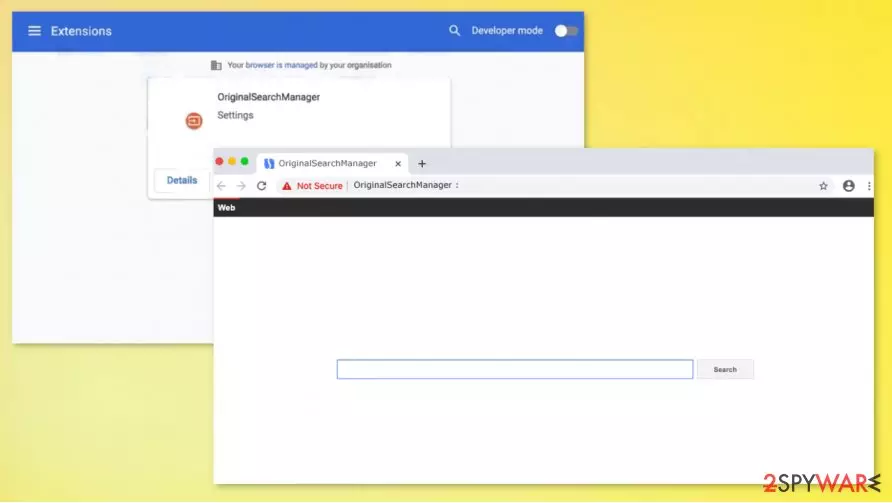
OriginalSearchManager is a browser hijacker that changes the computer's default search engine, new tab preferences, collects browsing data, and adds the “Managed by your organization” attribute to Google Chrome browsers. Usually, this kind of potentially unwanted programs (PUPs) is installed unknowingly with freeware bundles. StreamBee is one of the PUPs that act the same as Original Search Manager.
When the OriginalSearchManager virus gets installed the browser settings are changed immediately. Now, the default search engine and the new tab become search.locatorunit.com, which is a fake site, because the search results that it provides is based on search.yahoo.com. Furthermore, each time the user types a search query in the search or the URL bar, the first provided results are from sponsored websites that have nothing to do with the inquiry. That's how these kinds of PUP gain revenue.
| name | OriginalSearchManager |
|---|---|
| type | Browser hijacker |
| Symptoms | Default search engine and new tab changed to search.locatorunit.com, search results displayed with ads |
| Issues | PUPs can lead to other malware installation. Users could also become victims of various scams due to browsing and other data disclosure |
| Distribution | Although sometimes browser hijackers can be found in official app stores, most of them are installed unknowingly when installing freeware bundles |
| removal | If you're unhappy with the service that this PUP provides, or it got on your computer unwillingly, then remove OriginalSearchManager with a proper anti-malware software |
| System repair | PUP can modify the system registry and other settings, to undo all changes and get your computer back on track, perform a full system scan with the FortectIntego app |
Although browser hijackers, like the OriginalSearchManager, aren't deemed as hazardous malware[1] like ransomware (such as Lisp) or trojan horses,[2] it could still cause a lot of problems to the users. When being redirected, the users might end up on a malicious site where some malware payload files could be downloaded.
Furthermore, browser hijackers are known to collect browsing data, such as visited sites, search queries, geolocations, IP addresses, etc., this data can be sold to third parties and god knows what they could do with it. OriginalSearchManager in most cases is not responsible for these additional activities.
When everyday computer users are fed up with OriginalSearchManager and try to remove it from the Google Chrome browsers they get an error message saying that their browser is managed. This is due to the “Managed by your company” setting that the PUP ads right after it's installed.
If this PUP was installed on your computer unknowingly, or you're not satisfied with it, don't doubt for a second to uninstall it. We recommend using SpyHunterCombo Cleaner or MalwarebytesMalwarebytes apps to automatically remove OriginalSearchManager and all its allocated files from designated devices.

After OriginalSearchManager removal the original browser settings might be restored, that depends on your computer system. But nonetheless, a system repair is in order. Experts[3] advise using the FortectIntego system tune-up tool to revert any changes the browser hijacker might have caused to the computer registry and other core settings.
Prevent potentially unwanted programs from gaining access to your devices
Potentially unwanted programs are spread via freeware bundles and misleading ads. Creators of such PUPs tend to hide their creations in freeware bundles because unaware users rarely choose the Custom or Advanced installation mode over the Quick or Express installation. Along with the desired app user are tricked into installing one or two extra apps. And that's how browser hijackers and PUPs alike get into devices unknowingly.

These PUP installations could be easily avoided if the user doesn't rush with the Express installation option and picks the Custom one instead. Then you'll see and be able to choose what's being installed on your system. Usually, all the boxes agreeing to install some PUPs are pre-ticked, so the user has to just remove the ticks and that's it. Only the desired software that was originally meant to be acquired will be installed. Please remember, don't rush, stay attentive on the internet because it is full of various threats,
Getting rid of OriginalSearchManager PUP from your device
As we've mentioned in the first paragraph of this article, users are encountering problems while trying to remove OriginalSearchManager. This PUP ads a “Managed by your company” feature to Google Chrome browser settings preventing itself from removal.
We're here to help you, so below this paragraph, you can find detailed instructions on how to easily perform the OriginalSearchManager removal. The browser hijacker should be deleted from your browser and your computer. Whether it's Mac or Windows OS, doesn't matter, we got you covered.
Delete from macOS
Remove the unwanted application:
- From the menu bar, select Go > Applications.
- In the Applications folder, look for any suspicious entries, then drag them to Trash (or right-click and pick Move to Trash).


Delete leftover files and folders:
- Select Go > Go to Folder.
- Enter /Library/Application Support and remove any suspicious folders related to the unwanted program.
- Repeat the same check in the /Library/LaunchAgents and /Library/LaunchDaemons folders, deleting any suspicious entries.

- Finally, empty the Trash to permanently remove the leftovers.

Remove from Mozilla Firefox (FF)
Remove dangerous extensions:
- Open Mozilla Firefox browser and click on the Menu (three horizontal lines at the top-right of the window).
- Select Add-ons.
- In here, select the unwanted extension and click Remove.


Reset the homepage:
- Click three horizontal lines at the top right corner to open the menu.
- Choose Settings.
- Under Home, set your preferred homepage and new tab settings.
Clear cookies and site data:
- Click Menu and pick Settings.
- Go to Privacy & Security section.
- Scroll down to locate Cookies and Site Data.
- Click on Clear Data...
- Select Cookies and Site Data and Temporary cached files and pages, then click Clear.


Reset Mozilla Firefox
If clearing the browser as explained above did not help, reset Mozilla Firefox:
- Open Mozilla Firefox browser and click the Menu.
- Go to Help and then choose Troubleshooting Information.

- Under Give Firefox a tune up section, click on Refresh Firefox...
- Once the pop-up shows up, confirm the action by pressing on Refresh Firefox.



Remove from Google Chrome
Delete malicious extensions from Google Chrome:
- Open Google Chrome, click on the Menu (three vertical dots at the top-right corner) and select More tools > Extensions.
- In the newly opened window, you will see all the installed extensions. Uninstall all suspicious extensions related to the unwanted program by clicking Remove.


Clear cache and web data from Chrome:
- Click on Menu and pick Settings.
- Under Privacy and security, select Clear browsing data.
- Select Browsing history, Cookies and other site data, as well as Cached images and files.
- Click Clear data.


Change your homepage:
- Click menu and choose Settings.
- Look for a suspicious site in the On startup section.
- Click on Open a specific or set of pages and click on three dots to find the Remove option.
Reset Google Chrome:
If the previous methods did not help you, reset Google Chrome to eliminate all the unwanted components:
- Click on Menu and select Settings.
- In the Settings, scroll down and click Advanced.
- Scroll down and locate Reset and clean up section.
- Now click Restore settings to their original defaults.
- Confirm with Reset settings.


Delete from Safari
Remove dangerous extensions:
- Open Safari, click Safari in the menu at the top-left of the screen, and select Preferences.
- Go to the Extensions tab, look for any suspicious entries, and click Uninstall to remove them.


Clear history and website data:
- Click Safari in the menu and pick Clear History.
- Set Clear to all history and confirm with Clear History.


Reset Safari:
- Click Safari in the menu and select Preferences > Advanced.
- Enable Show Develop menu in menu bar.
- From the menu bar, click Develop and select Empty Caches.


Did this guide help?
Be the first to comment