
SystemCarePro: what it is and how to remove it
SystemCarePro (or System Care Pro) is yet another highly questionable system optimization tool that has been already classified as a rogue tool or scareware .
Although its developers promote it as a perfect Windows registry cleaner that prevents the system from crashes, freezes, startup/shutdown, and privacy issues, it has been found displaying false system health status to make people purchase its paid standard or premium version for $99.99 or $149.99 yearly fee.
Facts checked October 7, 2026. Removal steps tested on Windows 11 (26H2) and checked against Microsoft's and the browser makers' current documentation. Sections marked as our earlier report are the original text: they describe the threat as it was then and have not been reviewed since. The 2026 status, the removal steps and the questions are current.
Automatic
Get a free scan and check if your PC is infected.
Fortect finds malware, unwanted programs and the Windows damage they leave behind, and repairs it in one pass.
If Splash.exe returns after removal, a full scan can find the entry that brings it back.
Do it yourself · free Remove SystemCarePro yourself 4 steps, about 12 minutes, no software needed.
Start the steps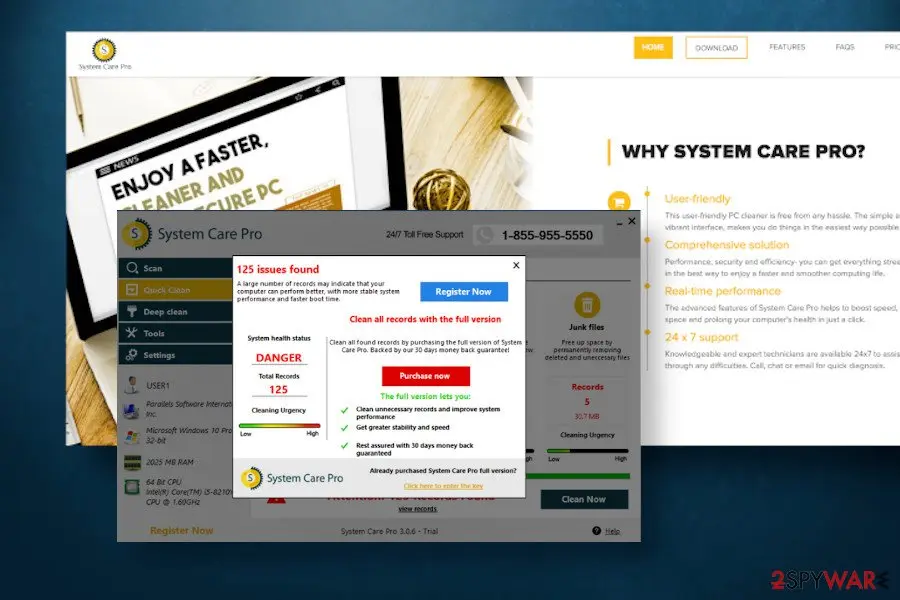
SystemCarePro: summary
| Name | SystemCarePro |
|---|---|
| Classification | Potentially Unwanted Program (PUP), scareware |
| Related files | Splash.exe, SystemCarePro.exe, SystemCareProSetup |
| Installation | The app has an official download website. However, most of the downloads are initiated via bundled freeware installers |
| Operations | The app relies on less experienced PC users and shows them preselected scan results that are mainly false positives. By displaying exaggerated scan results, this application tries to create a feeling of urgency and trick people into purchasing its paid version |
| Capabilities | The developers (not specified) claim that this tool can clean and optimize Windows registries, prevent Windows from running into errors, maintaining hardware and software status, defragment hard disk to ensure maximum free space, and more. However, these are false claims because the app can hardly perform any of its task |
| Removal | Scan the PC with security software to find and remove the malware and anything installed with it. Fortect scans Windows for malware and repairs the system files and settings it damaged. Remove it nowTo use the full-featured product, you have to purchase a license for Fortect. The scan is free. |
Show 9 more facts
| Detection names | No Microsoft detection name is known |
|---|---|
| Distribution | Not recorded in the old report |
| Damage | Not recorded in the old report |
| Type | System optimizer |
| Symptoms | An unknown process in Task Manager |
| Files and processes | Splash.exe |
| Evidence | 4 write-ups by security sites; details still limited |
| First seen | 15 June 2020 |
| Facts checked | 7 October 2026 |
Is SystemCarePro safe? Why it is flagged
From our report of Jun 2020 · not reviewed since
SystemCarePro - a fictitious system tool that displays false-positives to misled its users
SystemCarePro (or System Care Pro) is yet another highly questionable system optimization tool that has been already classified as a rogue tool or scareware .
Although its developers promote it as a perfect Windows registry cleaner that prevents the system from crashes, freezes, startup/shutdown, and privacy issues, it has been found displaying false system health status to make people purchase its paid standard or premium version for $99.99 or $149.99 yearly fee.
In most of the cases, people are conscious enough not to install tools like SystemCarePro virus intentionally. However, this dubious application is actively promoted with the help of affiliates who bundle it with freeware apps as a pre-selected component.
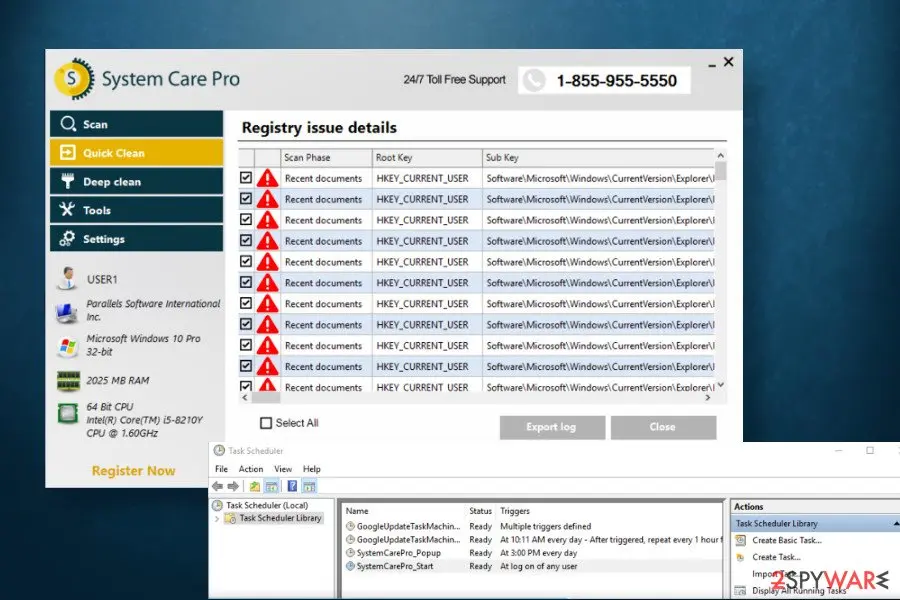
Consequently, people install it unintentionally by recklessly performing the freeware installation process. Upon the infiltration of the free trial version, the tool creates an undisclosed scheduled task, which regularly loads the unwanted system scan, which may suck up CPU and diminish PC's performance.
Please note that the scheduled SystemCarePro scanner cannot be disabled manually from the app's interface. Instead, the user has to navigate to the Task Scheduler and disable the unwanted scanners manually, which may be difficult for less tech-savvy users.
Anyway, experts do not recommend paying the money for this dubious application as it's not very likely to fix any Windows problems. Instead, perform a thorough SystemCarePro removal and rely on a reliable optimization utility.
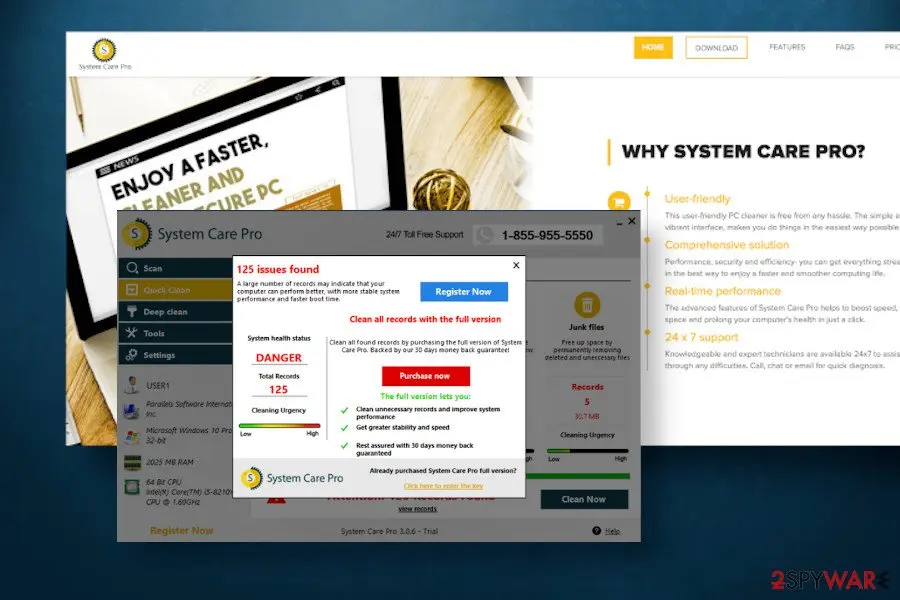
SystemCarePro belongs to the group of scareware or rogue system optimization tools because its main task is to make people purchase its license. For this purpose, it creates undisclosed scheduled tasks to perform automatic system scans and generates false-positive scan results, which include regular system files and entries that, in fact, have no negative impact on system's performance.
However, SystemCarePro virus shows its scan results in a convincing manner. It's scan logs contain red colors, flags, and words like "Attention" or "Danger." It lists hundreds of system errors and provides users with a single solution - to purchase a full license to fix the issues.
SystemCarePro malware is one of the fake system optimizing tools similar to Super System Optimizer, Speedy SystemCare, Xtron System Care, Advance-System-Care, etc. It has no real value to the users, so keep it on the system, or even more paying for its license, is not recommended unless you approve of supporting scammers.
Luckily, this tool has already been included in the virus database and is currently recognized by 25 AV engines as dangerous. According to VirusTotal analysis, the SystemCarePro optimizer is typically detected as:
The scan results are based on many factors. As we have already pointed out, the SystemCarePro is spread via freeware bundles, infiltrates without being noticed, creates schedules system scans without requiring permission, displays pre-selected scan results to misled gullible PC users.
In addition, experts from NoVirus.uk claim, that developers of this tool do not provide EULA, Terms of Service, Returns and Cancellation Policy, as well as Privacy Policy on the official website, as well as on the installation setup. That's one of the signs that there's something wrong with the SystemCarePro optimizer.
Keep in mind that potentially unwanted system optimizers can eliminate wrong registry entries, system files, startup programs, slow down system performance, and otherwise trigger negative effects on the machine. Therefore, we strongly recommend you to remove SystemCarePro and all files related to it.
However, SystemCarePro removal is not sufficient to restore the system to the previous state when the machine was not malware affected.
- PUA/SystemCarePro.CZ
- Application.Deceptor.AQC (B)
- A Variant Of MSIL/UwS.PCCleaningUtility.A
- Artemis!0BB0D77721C4
- Misleading:Win32/Lodi
- Mal/Generic-S
- Application.Deceptor.AQC
- PotentialRisk.PUA/SystemCarePro.CZ
- Malware.Undefined!8.C (CLOUD), etc.

From our report of Jun 2020 · not reviewed since
Freeware bundles often trick people into installing unwanted applications unconsciously
The so-called bundling software distribution method is not illicit.
It is widely used by third parties to increase the number of downloads. The problem is that developers of potentially unwanted programs (PUPs) are not disclosing the presence of PUPs inside the freeware installer.
In other words, unwanted applications are hidden under the Quick or Express installation technique. They spread as pre-selected options, which are installed by default if the user fails to unmark the additional options. Therefore, every time you decide to install a free tool, install it with extreme carefulness, and take the following precautionary measures:
- Download freeware from official sources if possible;
- When it comes to third-party websites, keep in mind that most of them promote software bundles;
- Always opt for the Advanced or Custom installation option and monitor every installation setup window;
- Look for pre-selected boxes saying that you agree with the installation of add-ons or plug-ins;
- Opt-out of the offers to replace the start page, search provider or other web browser's settings;
- Use a robust anti-malware suite, which would be powerful enough to detect potentially unwanted programs.
From our report of Jun 2020 · not reviewed since
More from our earlier report on SystemCarePro
- If your machine has been infected by a PUP, it may initiate a multiplicity of Windows problems, such as errors, slowdowns, software crashes, etc.
- To fix suchlike problems, scan the machine with tool
Check your PC and browser
- File:
Splash.exe
How to uninstall SystemCarePro
How to remove SystemCarePro
Uninstall it, then remove what keeps it starting with Windows.
Nothing it flagged needs fixing.
Step 1: Uninstall programs you did not mean to install
SystemCarePro rarely comes alone: it is usually installed by, or together with, a free program. In Windows 11 open Settings > Apps > Installed apps, in Windows 10 Settings > Apps > Apps & features, and sort by install date.
Uninstall every entry from the day the trouble began that you did not install on purpose, for example a download manager, a converter or a browser you never chose.
Keep drivers and entries from Microsoft, Intel, AMD, NVIDIA or your PC's maker unless you are sure.
Full procedure with screenshots: Uninstall a program or app in Windows On uGetFix
Step 2: Remove it from startup
Press Ctrl + Shift + Esc to open Task Manager and select Startup apps (Windows 11) or the Startup tab (Windows 10). Disable entries you do not recognise, especially ones with no publisher or with a name that copies a Windows component.
Right-click an entry and choose Open file location to see where it runs from: programs in
%AppData%or%Temp%deserve a closer look. Some entries are not listed there but in the registry Run keys, which the procedure below shows how to check.Full procedure with screenshots: Stop apps from opening at startup On uGetFix
Step 3: Delete the folders left behind
Uninstalling often leaves the program's folders, and some threats reinstall themselves from them.
Press Windows + R, type
%LocalAppData%and press Enter, then do the same for%AppData%and %ProgramData%, and look for folders named after SystemCarePro, its publisher or created on the day the problem started. Delete those folders, and check C:\Program Files and C:\Program Files (x86) too.If Windows says a file is in use, end it in Task Manager or delete the folder after a restart in Safe Mode. The folders are the same in Windows 11 and Windows 10.
Full procedure with screenshots: Remove what malware leaves behind in Windows
Step 4: Scan the PC, then run the offline scan
A scan finds the parts of SystemCarePro that the manual steps cannot see. In Windows Security > Virus & threat protection > Scan options, start a Full scan and quarantine what it reports.
Follow it with Microsoft Defender Antivirus (offline scan) > Scan now, which restarts the PC and checks the disk while Windows and the malware are not running.
It takes about 15 minutes and works the same in Windows 11 and Windows 10. If either scan finds something, run the full scan again after removal until it comes back clean.

Windows 11: Windows Security > Virus & threat protection > Scan options. Full procedure with screenshots: Run a Microsoft Defender Offline scan
Instructions for each browser and system
The detailed steps for every browser and system this guide covers. Open the one you use.
Uninstall from Windows
To remove SystemCarePro from Windows OS, you should check the installed program list via the Control Panel as explained below:
Uninstall from Windows 10/8:
- Type Control Panel into the Windows search box and open the result.
- Under Programs, select Uninstall a program.

Uninstall from Windows 7/XP:
- Click on Windows Start > Control Panel (Windows XP users should click on Add/Remove Programs).
- In Control Panel, select Programs > Uninstall a program.

Remove the unwanted program:
- In the Programs and Features window, look for any recently installed suspicious entries, select them, and click Uninstall.
- If User Account Control appears, click Yes to confirm, then complete the removal.

Delete from macOS
Remove the unwanted application:
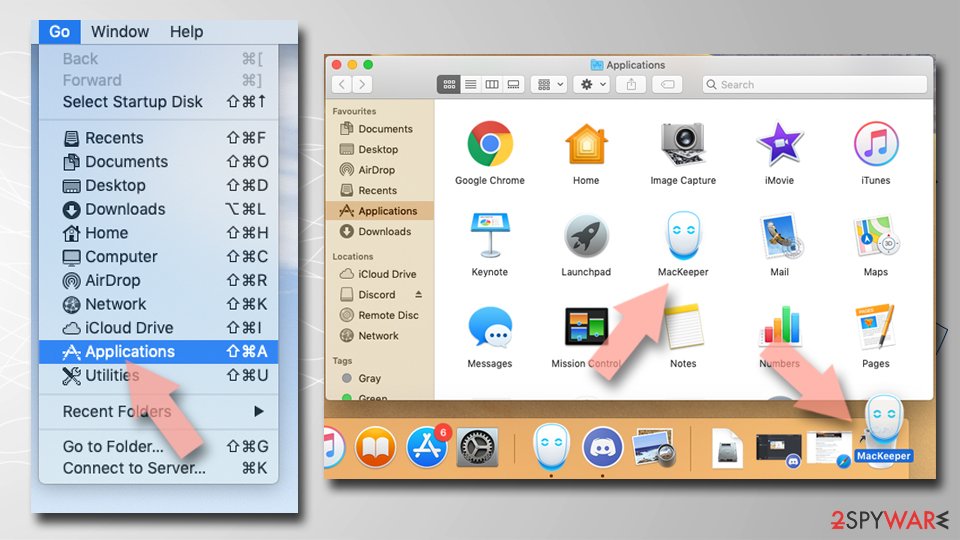
- From the menu bar, select Go > Applications.
- In the Applications folder, look for any suspicious entries, then drag them to Trash (or right-click and pick Move to Trash).
Delete leftover files and folders:
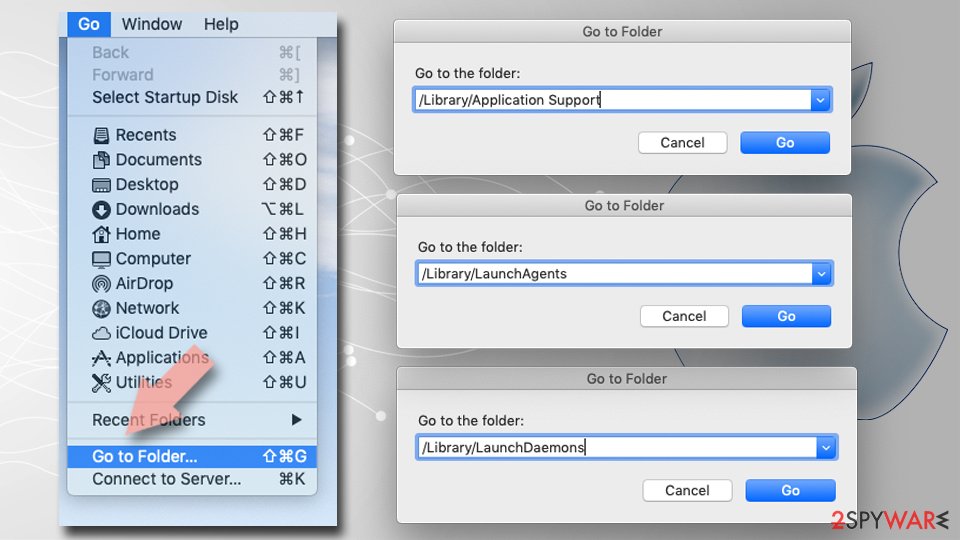
- Select Go > Go to Folder.
- Enter /Library/Application Support and remove any suspicious folders related to the unwanted program.
- Repeat the same check in the /Library/LaunchAgents and /Library/LaunchDaemons folders, deleting any suspicious entries.
- Finally, empty the Trash to permanently remove the leftovers.
Choose a proper web browser and improve your safety with a VPN tool
Online spying has got momentum in recent years and people are getting more and more interested in how to protect their privacy online.
One of the basic means to add a layer of security - choose the most private and secure web browser. Although web browsers can't grant full privacy protection and security, some of them are much better at sandboxing, HTTPS upgrading, active content blocking, tracking blocking, phishing protection, and similar privacy-oriented features.
However, if you want true anonymity, we suggest you employ a powerful VPN - it can encrypt all the traffic that comes and goes out of your computer, preventing tracking completely.
Lost your files? Use data recovery software
While some files located on any computer are replaceable or useless, others can be extremely valuable.
Family photos, work documents, school projects - these are types of files that we don't want to lose. Unfortunately, there are many ways how unexpected data loss can occur:
- power cuts
- Blue Screen of Death errors
- hardware failures
- crypto-malware attack
- even accidental deletion
To ensure that all the files remain intact, you should prepare regular data backups. You can choose cloud-based or physical copies you could restore from later in case of a disaster. If your backups were lost as well or you never bothered to prepare any, can be your only hope to retrieve your invaluable files.
From our report of Jun 2020 · not reviewed since
Eliminate SystemCarePro virus and rely on powerful optimization tool for the system's maintenance
Those who are interested in cybersecurity news must have noticed that system optimizers, in general, are condemned as being dangerous.
There's a reason for the suchlike reputation since there are tens or even hundreds of rogue optimization utilities that have a sole purpose - earn the money for nothing. The same reason applies to the SystemCarePro virus.
This dubious tool is taking advantage of less experienced PC users who fall for believing that the system needs immediate maintenance and spend their money on an unpopular third-party app, which, in fact, has no positive effect on Windows OS performance. Therefore, those who have noticed the unexpected scanner, should launch or anti-malware solution and remove SystemCarePro without hesitation.
The easiest way to remove SystemCarePro virus from the system is to employ a robust anti-malware or anti-virus tool. If, however, you are not using one, you can try to delete the unwanted application manually. The guide submitted below will help you to do so.
Questions about SystemCarePro
Is Splash.exe a virus?
The name Splash.exe is not enough to say. Malware often uses technical-sounding names, and harmless updaters often use odd ones. Check three things:
- the folder the file runs from
- the Digital Signatures tab in its properties
- the program that starts it (Startup apps, Task Scheduler or services)
A signed file from a company whose product you use is almost certainly fine. An unsigned file in a user folder that no installed program explains should be removed, and the PC scanned with Microsoft Defender in offline mode.
Can I delete the Splash.exe file?
Only after you know what it belongs to. If Splash.exe is part of a program, uninstall that program through Settings instead, so its services and tasks go too. If it belongs to nothing and is unsigned, end the process, disable whatever starts it and then delete its folder.
Do not delete files from the Windows folder or files signed by Microsoft: those are part of the system, and removing them can stop Windows from starting. When in doubt, run a Microsoft Defender scan first and let it decide.
SystemCarePro has no uninstall option. What now?
Some unwanted programs leave no entry in Installed apps on purpose. Find the program's files instead:
- open Task Manager while an unfamiliar process called
Splash.exein Task Manager is visible - right-click the process
- choose Open file location
End the process, then look in that folder for an uninstall file. If there is none, delete the folder after checking that it holds nothing you need.
Before deleting, remove the startup entry and any scheduled task that points to it, otherwise it may be recreated. A restart and a full scan in Windows Security finish the job and catch files stored elsewhere.
Is SystemCarePro a virus?
Not in the strict sense. Nothing reported so far shows SystemCarePro copying itself, encrypting files or stealing passwords, which is what security companies mean by a virus.
What people see is an unfamiliar process called Splash.exe in Task Manager, which fits an unwanted program: software that arrives bundled with something else and keeps running without being asked for. Many antivirus programs label such software PUP or PUA rather than malware.
That label does not make it harmless. It still uses your PC and connection, may collect data and is often bundled with other programs, so removing it is the right call. Uninstall it from Installed apps, then check startup items and browser settings for its companions.
How do I know if I need SystemCarePro?
Ask three questions. Did you install it on purpose? Have you ever opened it?
Does anything you use depend on it? If the answers are no, you do not need it. The sign that brought you here, an unfamiliar process called Splash.exe in Task Manager, suggests it arrived without a clear choice.
Programs bundled with free software rarely do anything their host program needs. Uninstall it, restart, and see whether anything you rely on stops working. If nothing does, which is the usual outcome, you can forget about it.
How do I stop programs like SystemCarePro from installing?
Turn on Potentially unwanted app blocking in Windows Security > App & browser control > Reputation-based protection settings, with both Block apps and Block downloads checked. Download programs from the developer's own site or the Microsoft Store, choose Custom in installers and untick extra offers, and treat large download buttons on file sites as ads.
Apps from the Microsoft Store are checked by Microsoft and uninstall cleanly. Keep real-time protection on, so that bundled offers flagged as unwanted are stopped before they install.
Can SystemCarePro see my passwords?
There is no report of that. Unwanted programs make money from ads, offers, data about your browsing or the use of your connection, not from stealing passwords, and the sign reported here is an unfamiliar process called Splash.exe in Task Manager.
That said, a bundle can contain more than one program, and you cannot be sure what else ran on the day it arrived. After removing SystemCarePro, run a full scan in Windows Security.
If it finds a password stealer or a trojan, change your passwords from another device. If the scan is clean and you see no unknown sign-ins, there is no need to change them.
Do I need special software to remove SystemCarePro?
No. Windows has everything needed:
- Installed apps for the uninstall
- the Startup list and Task Scheduler for what restarts it
- Windows Security for a scan afterwards
The steps in this guide take about fifteen minutes. A dedicated tool is a convenience when you would rather not check each place yourself or when the program keeps coming back.
Whatever you use, finish by confirming that an unfamiliar process called Splash.exe in Task Manager is gone after a restart, and avoid downloading removal tools from pages that promote them through scary warnings.
Is SystemCarePro why my PC is slow?
It can be one reason. Programs of this kind often start with Windows, run updaters in the background and keep a process open all the time.
The sign reported, an unfamiliar process called Splash.exe in Task Manager, means at least one such program is active. Open Task Manager, sort by CPU, memory and network, and see whether SystemCarePro or a related process is near the top.
If it is, removing it will help. If not, the slowdown has another cause, but removing a program you never chose is still worth doing. A restart after removal shows the difference best.
Will Fortect remove SystemCarePro?
Fortect scans Windows for malware and unwanted programs and repairs the system files and settings they change, and its free scan shows what it finds on your PC before you decide anything.
For SystemCarePro, follow the plan above as well: the browser steps take back permissions and settings that no scanner treats as a threat, and uninstalling the program that brought it removes the source.
Run Microsoft Defender's full scan and, if anything was found, its offline scan as a second opinion. If the symptoms are gone after the plan and both scans are clean, there is nothing more to do.
Sources
- Norton: What is scareware? And how to spot online scareware scams (read October 7, 2026)
- VirusTotal: SystemCareProSetup (read October 7, 2026)
- FTC: How to recognize, remove and avoid malware (read October 7, 2026)
- Microsoft Learn: Microsoft Defender Offline (read October 7, 2026)
- Microsoft Learn: How Microsoft names malware (read October 7, 2026)