
Vzwpix email virus: how to spot it and what to do
Vzwpix email virus spoofs Verizon's legitimate messaging service using phone numbers in sender addresses and malicious file attachments. It tricks users into executing .exe files that deploy ransomware, trojans, or spyware.
Facts checked October 11, 2026. Removal steps tested on Windows 11 (26H2) and checked against Microsoft's and the browser makers' current documentation. Sections marked as our earlier report are the original text: they describe the threat as it was then and have not been reviewed since. The 2026 status, the removal steps and the questions are current.
Automatic
Get a free scan and check if your PC is infected.
Fortect finds malware, unwanted programs and the Windows damage they leave behind, and repairs it in one pass.
Do it yourself · free Remove Vzwpix email virus yourself 4 steps, about 12 minutes, no software needed.
Start the steps
Vzwpix email virus: summary
| Name | Vzwpix email virus |
|---|---|
| Type | Phishing email/malware |
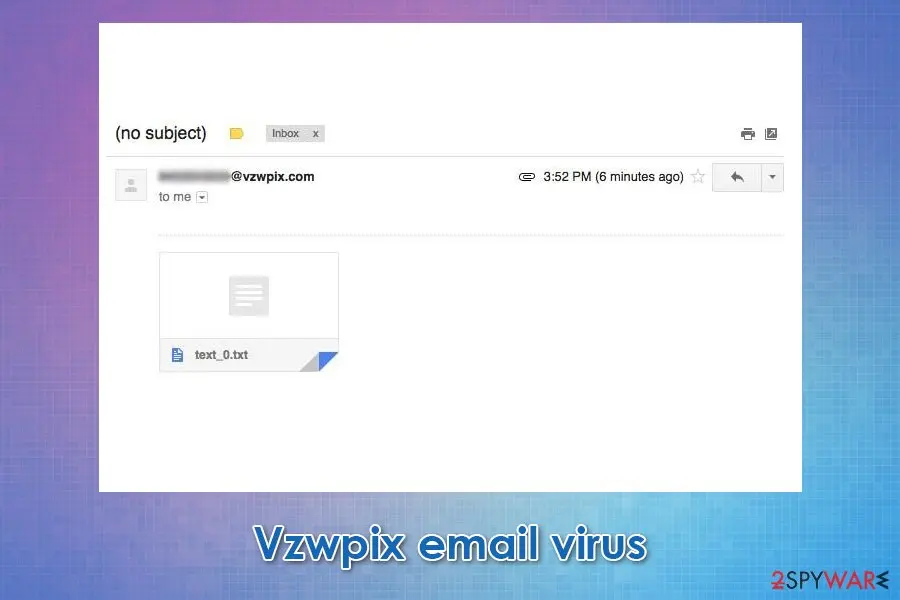
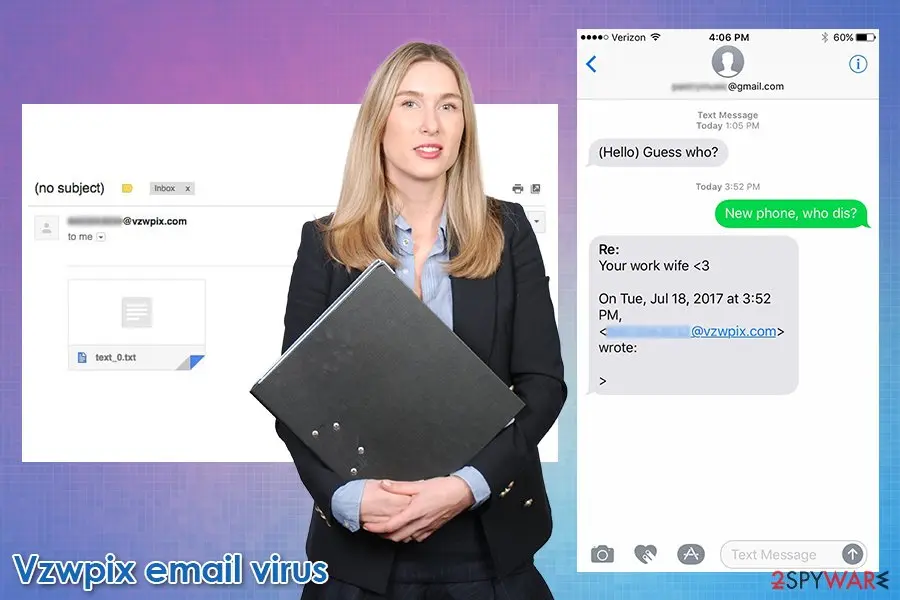
| Operation | Users receive an email from an address that contains a phone number and @vzwpix. Inside, they can find an attachment that is presented as a picture but is actually an obfuscated .exe file that would infect the host with malware |
| Attachment name | 8400587498Img_Picture.jpeg.exe, MG_20180604_124758075.jpg (may vary) |
| Operating system | Windows |
| Associated malware | The malware that is extracted from the malicious .exe file can vary in type and can be one of the following: Remote Access Trojan (RAT), ransomware, backdoor, rootkit, spyware, etc. |
| Removal | Scan the PC with security software to find and remove the malware and anything installed with it. Fortect scans Windows for malware and repairs the system files and settings it damaged. Remove it nowTo use the full-featured product, you have to purchase a license for Fortect. The scan is free. |
Show 8 more facts
| Symptoms | A phishing e-mail asking you to sign in |
|---|---|
| Evidence | 4 write-ups by security sites; details still limited |
| Arrives as | |
| Pretends to be | A well-known company |
| Claim | Your account needs urgent attention |
| Asks for | Your password |
| First seen | 1 June 2020 |
| Facts checked | 5 October 2026 |
How to tell the Vzwpix email virus e-mail is fake
Vzwpix meaning: what the vzwpix.com address really is
Vzwpix is short for Verizon Wireless pictures.
The domain vzwpix.com belongs to Verizon and carries its email to text gateway for picture and multimedia messages. A real address looks like a ten digit phone number followed by @vzwpix.com. It appears when a Verizon phone sends a picture message to an email address, or when someone emails a picture to a Verizon number. The plain text version of the same gateway uses vtext.com.
So the name itself is not a virus. Scammers copy the format because a phone number at a Verizon domain looks like a friend sharing a photo.
Verizon says it is shutting down email to text on vzwpix.com and vtext.com, with the process expected to finish by March 31, 2027. After that date, no one can send texts through those addresses, so a vzwpix message arriving later is a strong sign of spoofing.
To check a vzwpix email yourself, look at the attachment name first. A real picture message carries an image, never a file ending in .exe, .scr, .js or a double ending such as .jpeg.exe. Ask the person behind the number through a separate channel whether they sent it. If you do not know the number, delete the message without opening anything.
From our report of Jun 2020 · not reviewed since
Learn to recognize phishing emails to avoid malware infections
Spam email attachments are one of the leading causes for consumer and corporate infections of malware.
The method is relatively old and yet remains one of the main attack vectors for cybercriminals. According to calculations, almost 90% of all malware is delivered precisely via spam emails, whether it would be malicious attachments or hyperlinks. The payload may vary, although most commonly, banking trojans like Emotet, Trickbot, and Zeus are delivered to unsuspecting victims.
Therefore, it is important to be vigilant when dealing with emails on a daily basis, especially if you are a corporate employee. Opening an attachment will not be visible for the victim, although malware can get into the host machine and then into other computers connected to the same networks, harvesting valuable credentials and breaking in the company's systems.
Note that email spoofing is a very common technique used in these phishing emails. In most cases, users will see an original email address, despite it being fake, and they might also see a commonly used company name or the name of the CEO/company managers.
Thus, even if the email looks legitimate but includes an attachment, it is best to check it with anti-malware software or online tools like Virus Total. Additionally, before clicking on links, hover your mouse over it to see the actual destination URL in the bottom-left corner of the window (or on top of it, depending on the app).
From our report of Jun 2020 · not reviewed since
More from our earlier report on Vzwpix email virus
- Perform a full system scan with reputable anti-malware software
Is Vzwpix email virus dangerous? What the senders want
From our report of Jun 2020 · not reviewed since
Vzwpix email virus is malware that can infect the host after clicking on a fake Varizon message
Vzwpix email virus is a trick used by malicious actors to make users install malware on their device.
In most cases, users receive a message from an email address, which consists of a spoofed ten-digit phone number followed up by @vztext.com. Initially, users might believe that the email consists of a picture attachment due to its name (for example, 8400587498Img_Picture), although in reality, it is a Zip file, with an obfuscated executable (exe) format.
Once clicked, the Vzwpix email virus can infect the machine immediately, as executables run a set of commands on the computer immediately. There are countless of various malware that could be extracted, depending on what the attackers compiled in the background. For this reason, it is important to familiarize yourself with email scam not to infect your machine with malicious programs.
Malicious actors are creative and are always looking for new ways to infect users with malware. Most of the infections occur after users are tricked by a convincing phishing attempt - be it a carefully crafted email or message on a random malicious website.
They are also keen on imitating or abusing legitimate services in order to fulfill their goal and, since users are generally familiar with those, they download and install malware without giving it a second thought (for example, Calendar virus is still popular, where hackers inject events into users' calendars and prompt them to visit malicious websites).
On the other hand, some scam schemes are extremely well crafted and difficult to differentiate - such is Vzwpix.com email scam.
The site is a legitimate multimedia messaging service (picture and video messaging) provided by tech giant Verizon, which based in the U.S. The service allows users to send emails via their phones, so it includes sender's number. Since the service is very widespread, bad actors are also abusing it - they imitate the original email address by using a well-known technique called email spoofing.
The email can include a variety of different themes, such as somebody pretending to send you information about the delivery item, or a receipt, or something similar. In many cases, threat actors behind the Vzwpix email virus use social engineering in order to make users think that the message is real.
Since users believe that the attachment is a picture, they double-click the file, which results in malicious code execution - it contacts a remote server to download the final payload, and it can be anything. As a result, users may suffer from the following damaging activities:
Thus, to check whether this suspicious email is not a scam, you should verify the provided phone number - it should be from somebody you know, and the body of the email should also make sense. If you have any doubts, you should not open the attachments clipped to the email - or at least scan them with reputable anti-malware software/online service like Virus Total.
If you were unlucky and got yourself infected with malware, Vzwpix email virus removal should be performed without any delays, as the aforementioned consequences of malware infection could be devastating to any computer user.
To remove the email virus safely, download and install powerful anti-malware software and perform a full system scan. For that, you might also need to access Safe Mode with Networking, as we explain below. Finally, if you experience any side effects after the virus elimination, we suggest fixing the machine with the help of repair tools such as .
- Financial losses due to banking malware;
- Permanent loss of pictures, videos, documents, and other data on the machine due to ransomware infection;
- Personal details compromise (credit card information, social security number, etc.);
- Identity theft;
- Inclusion into a botnet (the infected machine begins to send spam automatically);
- Infiltration of other malware, etc.
What to do after the Vzwpix email virus e-mail
If you only received the message and clicked nothing, step 3 is all you need.
If you clicked the link or typed anything on the page it opened, do every step, starting with the password.
Step 1: Change the password you typed on the fake page
If you entered a password after clicking the link in the Vzwpix email virus message, treat that account as known to the sender.
Open the provider's real site by typing its address yourself, not through any link in the e-mail, and change the password there. Choose a new one you have never used before, and change it on every other account that shared the old one.
Then use the option to sign out of all other sessions or devices, if the provider has one. This works the same in any browser on Windows 11 and Windows 10.
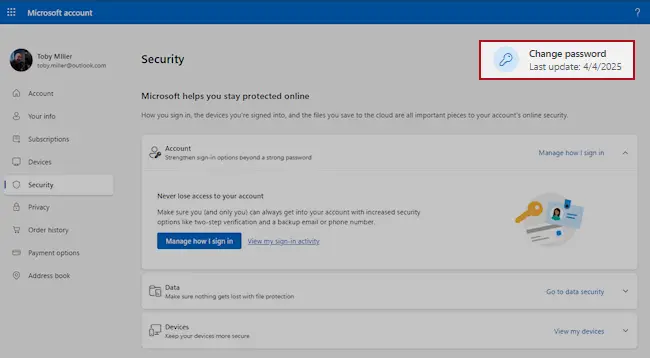
Microsoft account, Security page (account.microsoft.com/security): Change password. Full procedure with screenshots: Turn on two-step verification / secure a hacked account
Step 2: Turn on two-step verification
Two-step verification asks for a code from your phone or an authenticator app whenever someone signs in from a new device. A stolen password alone is then not enough to open the mailbox.
Turn it on in the security settings of the e-mail account first, then for the bank, shop and social accounts that send their reset links to that address.
While you are there, check the recovery e-mail and phone number and the forwarding rules, which attackers sometimes change to keep access. The settings pages look the same on Windows 11 and Windows 10.
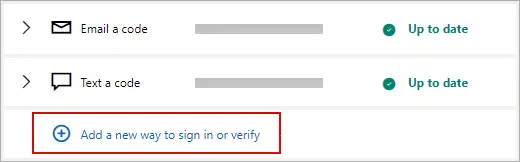
Microsoft account: Manage how I sign in, where two-step verification and the sign-in methods are. Full procedure with screenshots: Turn on two-step verification / secure a hacked account
Step 3: Report the e-mail and delete it
Report the message instead of only deleting it. In Outlook choose Report > Report phishing, in Gmail the three-dot menu > Report phishing; the provider then blocks the same message for other people.
Do not reply and do not click anything else in it. On a work account, forward it to your IT team as an attachment first. Web mail and the mail apps on Windows 11 and Windows 10 offer the same options.
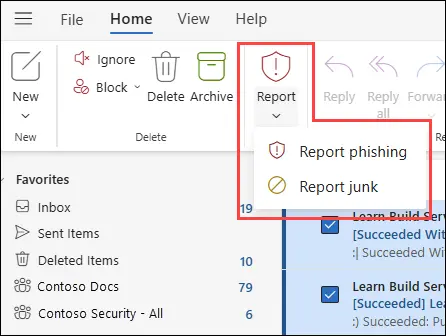
New Outlook for Windows and Outlook on the web: Report > Report phishing. Full procedure with screenshots: Report a phishing e-mail
Step 4: Scan the PC if you opened a file from the message
A page that only asked for a password installs nothing, so most readers can skip this step.
If the Vzwpix email virus e-mail or the page it opened made you download or open a file, delete it and run a full scan, then a Microsoft Defender Offline scan.
In Windows 11 and Windows 10 open Windows Security > Virus & threat protection > Scan options, select Microsoft Defender Antivirus (offline scan) and click Scan now. The PC restarts and the scan takes about 15 minutes, so save your work first.

Windows 11: Windows Security > Virus & threat protection > Scan options. Full procedure with screenshots: Run a Microsoft Defender Offline scan
Instructions for each browser and system
The detailed steps for every browser and system this guide covers. Open the one you use.
Manual removal using Safe Mode
Important! →
Manual removal guide might be too complicated for regular computer users. It requires advanced IT knowledge to be performed correctly (if vital system files are removed or damaged, it might result in full Windows compromise), and it also might take hours to complete. Therefore, we highly advise using the automatic method provided above instead.
Step 1. Access Safe Mode with Networking
Manual malware removal should be best performed in the Safe Mode environment.
Windows 7 / Vista / XP
- Click Start > Shutdown > Restart > OK.
- When your computer becomes active, start pressing F8 button (if that does not work, try F2, F12, Del, etc. - it all depends on your motherboard model) multiple times until you see the Advanced Boot Options window.
- Select Safe Mode with Networking from the list.

Windows 10 / Windows 8
- Right-click on Start button and select Settings.

- Scroll down to pick Update & Security.

- On the left side of the window, pick Recovery.
- Now scroll down to find Advanced Startup section.
- Click Restart now.

- Select Troubleshoot.

- Go to Advanced options.

- Select Startup Settings.

- Press Restart.
- Now press 5 or click 5) Enable Safe Mode with Networking.

Step 2. Shut down suspicious processes
Windows Task Manager is a useful tool that shows all the processes running in the background. If malware is running a process, you need to shut it down:
- Press Ctrl + Shift + Esc on your keyboard to open Windows Task Manager.
- Click on More details.

- Scroll down to Background processes section, and look for anything suspicious.
- Right-click and select Open file location.

- Go back to the process, right-click and pick End Task.

- Delete the contents of the malicious folder.
Step 3. Check program Startup
- Press Ctrl + Shift + Esc on your keyboard to open Windows Task Manager.
- Go to Startup tab.
- Right-click on the suspicious program and pick Disable.

Step 4. Delete virus files
Malware-related files can be found in various places within your computer. Here are instructions that could help you find them:
- Type in Disk Cleanup in Windows search and press Enter.

- Select the drive you want to clean (C: is your main drive by default and is likely to be the one that has malicious files in).
- Scroll through the Files to delete list and select the following:
Temporary Internet Files
Downloads
Recycle Bin
Temporary files - Pick Clean up system files.

- You can also look for other malicious files hidden in the following folders (type these entries in Windows Search and press Enter):
%AppData%
%LocalAppData%
%ProgramData%
%WinDir%
After you are finished, reboot the PC in normal mode.
Stream videos without limitations, no matter where you are
There are multiple parties that could find out almost anything about you by checking your online activity.
While this is highly unlikely, advertisers and tech companies are constantly tracking you online. The first step to privacy should be a secure browser that focuses on tracker reduction to a minimum.
Even if you employ a secure browser, you will not be able to access websites that are restricted due to local government laws or other reasons. In other words, you may not be able to stream Disney+ or US-based Netflix in some countries. To bypass these restrictions, you can employ a powerful VPN, which provides dedicated servers for torrenting and streaming, not slowing you down in the process.
Data backups are important - recover your lost files
Ransomware is one of the biggest threats to personal data.
Once it is executed on a machine, it launches a sophisticated encryption algorithm that locks all your files, although it does not destroy them. The most common misconception is that anti-malware software can return files to their previous states. This is not true, however, and data remains locked after the malicious payload is deleted.
While regular data backups are the only secure method to recover your files after a ransomware attack, tools such as can also be effective and restore at least some of your lost data.
From our report of Jun 2020 · not reviewed since
Get rid of the email virus in a simple way
As mentioned above, malware distributed to users may vary, so Vzwpix email virus removal can also depend on that.
First of all, it is important to note that if you did not double-click the suspicious file attached to the email, your machine did not get infected (this also applies to embedded hyperlinks). However, once the executable is launched, it is highly likely to succeed with malware infiltration via a remote server.
Most importantly, you should ensure that your anti-malware is fully updated, since new versions on malware are released every day, and definitions are also updated accordingly by AV developers.
Some malware might attempt to turn off your security software or even try to corrupt it. Thus, if your security software is struggling to get rid of the Vzwpix com email virus, you should access Safe Mode with Networking to ensure prompt elimination. Once there, initiate a full system scan, so all the malicious components can be terminated for good.
[GI=method-1]You can access Safe Mode in case the malware is tampering with your security software:
[GI=method-2]System Restore can also work sometimes when trying to eliminate the infection:
Questions about Vzwpix email virus
What is the Vzwpix email virus?
Vzwpix email virus is a malware delivery method using spoofed Verizon multimedia messaging addresses to trick users into installing malicious executables. Users receive emails from addresses containing a phone number followed by @vztext.com or @vzwpix.com. Attachments appear to be pictures with names like "8400587498Img_Picture" but are actually Zip files containing obfuscated .exe executables.
Verizon's legitimate Vzwpix service allows sending emails via phones including the sender's number, which attackers abuse through email spoofing techniques. Clicking these malicious attachments immediately infects the machine as executables run commands automatically, potentially deploying ransomware, trojans, backdoors, rootkits, or spyware.
How does the Vzwpix scam work?
Threat actors use email spoofing to imitate legitimate Verizon Vzwpix addresses by using phone numbers in sender addresses, making emails appear official. The email body contains various social engineering themes, such as fake delivery notifications, receipts, or similar-looking messages designed to appear legitimate.
The malicious attachment masquerades as a picture or document attachment, exploiting user familiarity with Verizon's popular messaging service. When users receive messages from what appears to be a trusted source mentioning familiar company names or situations, they're more likely to open attachments without caution.
Double-clicking the obfuscated .exe file triggers malware installation as the executable contacts remote servers downloading the final payload. Users never realize infection occurred until significant damage happens.
What malware comes from Vzwpix email attachments?
Various malware types deploy through Vzwpix emails depending on what attackers compiled in the background. Common payloads include Remote Access Trojans (RAT) allowing criminals full control of your computer, ransomware encrypting files and demanding payment, backdoors providing persistent unauthorized access, rootkits hiding deep in system architecture, and spyware stealing personal information. The specific threat varies by campaign and attacker intent.
Some emails deliver banking trojans like Emotet or Trickbot designed to steal financial credentials. Phishing emails employing this technique are responsible for nearly 90 percent of all malware infections according to calculations. The diversity of possible payloads makes Vzwpix emails particularly dangerous as victims cannot predict what infection they'll receive.
How can I identify Vzwpix phishing emails?
Verify the phone number in the sender address belongs to someone you actually know. Legitimate Verizon emails come from official Verizon addresses, not phone numbers. Examine the email body content carefully: if it doesn't make sense or discusses something you didn't expect, it's likely phishing.
Messages about deliveries, refunds, or account updates from unknown senders should raise suspicion. Hover your mouse over links without clicking to see the actual destination URL in the status bar; legitimate links go to trusted domains.
Never open attachments from unknown senders without scanning them through reputable antivirus software or online tools like VirusTotal first. Be suspicious of emails creating urgency, demanding immediate action, or containing threats about account suspension or legal issues.
What should I do if I clicked a Vzwpix email attachment?
If you didn't double-click the suspicious file, your machine did not get infected, as merely downloading does not trigger malware installation. However, if you did execute the .exe file, immediately disconnect your computer from the internet to prevent malware from contacting command servers and downloading additional payloads.
Run a full system scan using reputable antivirus software like Windows Defender or Malwarebytes. You may need to access Safe Mode with Networking if malware interferes with security software operation.
Ensure your antivirus is fully updated with latest definitions since new malware variants release daily. If security software struggles eliminating the threat, use alternative antivirus tools for secondary scanning. Monitor your banking accounts and credit for suspicious activity after infection.
Can antivirus software remove malware from Vzwpix infections?
Yes, reputable antivirus software can detect and remove most malware delivered through Vzwpix emails if your antivirus definitions are current. Windows Defender, Malwarebytes, and other established security tools excel at identifying and eliminating email-delivered malware.
However, some sophisticated malware attempts to disable security software or prevent proper operation. If your antivirus struggles removing the threat, access Safe Mode with Networking to operate with reduced malware interference. Initiate a full system scan from Safe Mode for more reliable elimination.
Secondary scanning with alternative antivirus programs helps ensure complete removal of stubborn infections. After removal, system repair utilities can address any damage malware caused to system functions and files. Professional antivirus intervention is far safer than attempting manual malware removal.
How can I protect myself from Vzwpix email virus?
Never open email attachments from unknown senders without scanning them first with antivirus software or online services like VirusTotal. Be highly skeptical of unexpected emails mentioning delivery notifications, account alerts, or financial transactions.
Verify sender authenticity by checking email addresses carefully and looking for signs of spoofing. Use strong, unique passwords for email accounts and enable two-factor authentication when available. Keep your operating system and all software updated with latest security patches to close vulnerabilities.
Install and maintain updated antivirus software with real-time protection and email scanning capabilities. Pay special attention to emails from services like Verizon, Amazon, or PayPal as these are commonly spoofed in phishing attempts.
What if my email was spoofed to send Vzwpix virus emails?
If your email account appears in spam reports or recipients claim receiving malicious emails from your address, your account may have been compromised or spoofed by attackers. Immediately change your email password to a strong, unique combination. Enable two-factor authentication on your email account to prevent unauthorized access.
Review your email forwarding settings and authorized applications to remove any suspicious entries. Check sent mail folders for messages you didn't send. Notify important contacts that your address may be compromised so they're cautious about emails appearing to come from you.
Malware on your computer could be sending emails through your account, requiring full antivirus scanning and system cleanup. Contact your email provider's support team to report the compromised account and request additional security measures.
Will Fortect remove Vzwpix email virus?
Fortect scans Windows for malware and unwanted programs and repairs the system files and settings they change, and its free scan shows what it finds on your PC before you decide anything.
For Vzwpix email virus, follow the plan above as well: the browser steps take back permissions and settings that no scanner treats as a threat, and uninstalling the program that brought it removes the source.
Run Microsoft Defender's full scan and, if anything was found, its offline scan as a second opinion. If the symptoms are gone after the plan and both scans are clean, there is nothing more to do.
Sources
- Richpasco: Every trick in the book: how hackers take over your computer (or your bank account) (read October 5, 2026)
- Wikipedia: Email spoofing (read October 5, 2026)
- FTC: How to recognize and avoid phishing scams (read October 5, 2026)
- CISA: Recognize and report phishing (read October 5, 2026)
- Microsoft Support: Protect yourself from phishing (read October 5, 2026)
- Verizon: Notice to customers, shutdown of email to Vtext and VZWPix (read October 11, 2026)