

Apple.com-monitor.live is a fraudulent website that claims Mac computer compromise by e.tre456_worm_osx or another virus
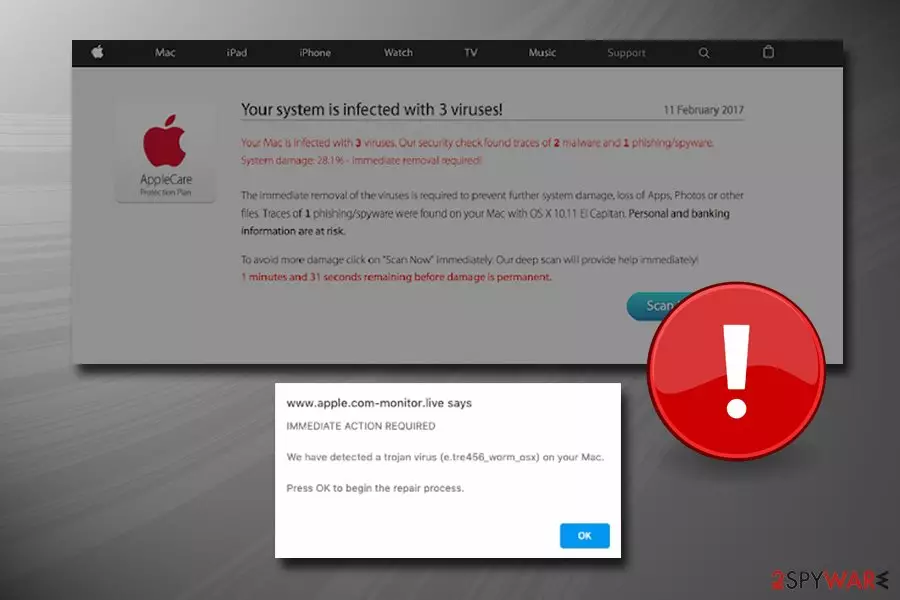
Apple.com-monitor.live is a scam that was compiled by threat actors. It usually begins with adware infection – ad-supported software gets into machines with the help of software bundling or is installed intentionally when users do not spot the deception. Soon after the infiltration, the potentially unwanted program displays a significant amount of pop-ups, banners, deals, offers, in-text links, and other forms of ads.
The infected Google Chrome, Safari, Mozilla Firefox, or another browser starts linking users to insecure domains, and Apple.com-monitor.live is one of those. As soon as the visitor enters the site, a pop-up shows up which suggests that Mac is infected with the e.tre456_worm_osx trojan and that immediate action is required to fix the issue.
Allegedly, the only way to address the problem is by performing a fake scan within the browser, which later asks users to download bogus software, such as Cleanup My Mac, Advanced Mac Cleaner, or similar scareware.[1] As evident, these tools are useless, and the claims are fake – no trojan is affecting the device.
Nevertheless, to remove Apple.com-monitor.live redirects from the web browsers, adware must be terminated either with the help of security software or our manual removal guide below.
| Name | Apple.com-monitor.live |
| Type | Scam |
| Category | Adware, potentially unwanted program |
| Scheme | Claims system compromise by e.tre456_worm_osx ir another fake virus infection to make users download useless software that they need to pay for |
| Related | Your system is infected with 3 viruses, e.tre456_worm_osx |
| Infiltration methods | Software bundling, ads, third-party websites |
| Symptoms | Redirects to suspicious websites, including Apple.com-monitor.live, pop-up ads, changed web browser settings, etc. |
| Risk factors | Money loss, malware infections, sensitive data leak to unknown parties |
| Termination | To stop the unwanted activity, you need to delete adware with anti-virus software or by following our manual guide below |
| Recovery | To ensure the best results after the infection, scan your device with FortectIntego |
Adware, such as the one that redirects to Apple.com-monitor.live, is by far not the most devastating computer infection, although security experts already warned about its dangers, and some even suggest called it malware due to its deceptive techniques that are used by the latter.[2]
In the recent years, many scandals emerged, such as Lenovo Superfish adware campaign,[3] suggesting that adware can be just as dangerous as malware, compromising users' online safety by exposing them to potential cyber attacks. Regardless of the controversy, adware is here to stay (at least for now), and users should take care of their computers if they value their online security and computer safety, avoiding such scams as Apple.com-monitor.live.
Those who get redirected to Apple.com-monitor.live site would see a pop-up which claims:
IMMEDIATE ACTION IS REQUIRED
We have detected a trojan virus (e.tre456_worm_osx) on your Mac.
Press OK to begin the repair process
This is a very common scare tactic that is used to frighten inexperienced users by claiming virus infections. However, more computer-savvy individuals would know straight away that browser-based scanners cannot determine whether or not your system is infected. Therefore, it becomes apparent that Apple.com-monitor.live virus is fake, and there is no need to proceed with fake scans.
Nevertheless, those who get tricked will be prompted to download and install fake system optimization tools that work similarly to tech support scams, claiming multiple computer threats. Later, users are asked to pay for the full license of the application, resulting in money loss, as there is no proof that the app was installed on the system with the help of phishing.
Therefore, if you see persistent ads and redirects to scam sites, you need to proceed with Apple.com-monitor.live removal, which would involve terminating adware from macOS. You can employ security software that specializes in PUPs or terminate the infection by following our guide below. Experts also recommend scanning the device with FortectIntego for best results.

Do not trust software bundles – expand the installation list of optional components by opting for Advanced settings
While there is a chance that you installed adware intentionally (and do not know about it yet), the vast majority of PUP infections from software bundles. If the former is the case, it might sometimes be difficult to determine which application is ad-supported, especially if you use many of them.
In most cases, users rush the installation process, and do not pay close attention to instructions, skipping vital steps. And that is precisely what freeware and PUP developers are looking for, as they can hide optional components within the installers in a way most rushing users would never notice. For example, they use a misleading placement of buttons, grayed out options, pre-ticked boxes, and other tricks.
To avoid the deception, never rush the installation process and always read through the instructions. Make sure you select Advanced/Custom mode and terminate all the optional installs before proceeding. Additionally, check if vital documents like Privacy Policy and Terms of Service are provided, lack of which might indicate that you are installing an unsafe program.
Stop Apple.com-monitor.live redirects by removing adware from your Mac
Despite the popular belief, Mac viruses are real, and adware is especially prominent on this platform. Therefore, if you are consistently redirected to dubious sites, your browsers are flooded by ads and your search results are filled with sponsored links, it is time to check for adware, which would also result in Apple.com-monitor.live removal.
To remove, Apple.com-monitor.live virus, you can scan your device with security software that is known for reasonable PUP detection rates, such as SpyHunterCombo Cleaner. Nevertheless, you can also employ another anti-virus that detects and terminate unwanted apps automatically.
If you recently installed a questionable application or precisely know which apps you installed, you can also terminate adware manually. Please follow the guide below, but do not forget to check /Library/LaunchAgents, /Library/Application Support and /Library/LaunchDaemons folders for suspicious entries.
Delete from macOS
Remove the unwanted application:
- From the menu bar, select Go > Applications.
- In the Applications folder, look for any suspicious entries, then drag them to Trash (or right-click and pick Move to Trash).


Delete leftover files and folders:
- Select Go > Go to Folder.
- Enter /Library/Application Support and remove any suspicious folders related to the unwanted program.
- Repeat the same check in the /Library/LaunchAgents and /Library/LaunchDaemons folders, deleting any suspicious entries.

- Finally, empty the Trash to permanently remove the leftovers.

Reset Internet Explorer
Remove dangerous add-ons:
- Open Internet Explorer, click on the Gear icon (IE menu) on the top-right corner of the browser
- Pick Manage Add-ons.
- You will see a Manage Add-ons window. Here, look for suspicious plugins. Click on these entries and select Disable.


Change your homepage if it was altered:
- Open IE and click on the Gear icon.
- Select Internet Options.
- In the General tab, delete the Home page address and replace it by your preferred one (for example, Google.com).
- Click Apply and then select OK.


Delete temporary files:
- Press on the Gear icon and select Internet Options.
- Under Browsing history, click Delete...
- Select relevant fields and press Delete.


Reset Internet Explorer:
- Click on Gear icon > Internet options and select Advanced tab.
- Select Reset.
- In the new window, check Delete personal settings and select Reset.


Remove from Microsoft Edge
Delete unwanted extensions from MS Edge:
- Select Menu (three horizontal dots at the top-right of the browser window) and pick Extensions.
- From the list, pick the extension and click on the Gear icon.
- Click Remove.


Clear cookies and other browser data:
- Click on the Menu (three horizontal dots at the top-right of the browser window) and select Settings > Privacy, search, and services..
- Under Clear browsing data, pick Choose what to clear.
- Select Cookies and other site data and Cached images and files. (apart from passwords, although you might want to include Media licenses as well, if applicable) and click on Clear.


Restore new tab and homepage settings:
- Click the menu icon and choose Settings.
- Then find On startup section.
- Click Remove next to any suspicious startup page.
Reset MS Edge if the above steps did not work:
- Press on Ctrl + Shift + Esc to open Task Manager.
- Click on More details arrow at the bottom of the window.
- Select Details tab.
- Now scroll down and locate every entry with Microsoft Edge name in it. Right-click on each of them and select End Task to stop MS Edge from running.


Instructions for Chromium-based Edge
Delete extensions from MS Edge (Chromium):
- Open Edge and click select Settings > Extensions.
- Delete unwanted extensions by clicking Remove.


Clear cache and site data:
- Click on Menu and go to Settings.
- Select Privacy, search and services.
- Under Clear browsing data, pick Choose what to clear.
- Under Time range, pick All time.
- Select Clear now.


Reset Chromium-based MS Edge:
- Click on Menu and select Settings.
- On the left side, pick Reset settings.
- Select Restore settings to their default values.
- Confirm with Reset.
- This will disable extensions and reset startup pages but will not delete bookmarks, saved passwords, or browsing history.


Remove from Mozilla Firefox (FF)
Remove dangerous extensions:
- Open Mozilla Firefox browser and click on the Menu (three horizontal lines at the top-right of the window).
- Select Add-ons.
- In here, select the unwanted extension and click Remove.


Reset the homepage:
- Click three horizontal lines at the top right corner to open the menu.
- Choose Settings.
- Under Home, set your preferred homepage and new tab settings.
Clear cookies and site data:
- Click Menu and pick Settings.
- Go to Privacy & Security section.
- Scroll down to locate Cookies and Site Data.
- Click on Clear Data...
- Select Cookies and Site Data and Temporary cached files and pages, then click Clear.


Reset Mozilla Firefox
If clearing the browser as explained above did not help, reset Mozilla Firefox:
- Open Mozilla Firefox browser and click the Menu.
- Go to Help and then choose Troubleshooting Information.

- Under Give Firefox a tune up section, click on Refresh Firefox...
- Once the pop-up shows up, confirm the action by pressing on Refresh Firefox.



Remove from Google Chrome
Delete malicious extensions from Google Chrome:
- Open Google Chrome, click on the Menu (three vertical dots at the top-right corner) and select More tools > Extensions.
- In the newly opened window, you will see all the installed extensions. Uninstall all suspicious extensions related to the unwanted program by clicking Remove.


Clear cache and web data from Chrome:
- Click on Menu and pick Settings.
- Under Privacy and security, select Clear browsing data.
- Select Browsing history, Cookies and other site data, as well as Cached images and files.
- Click Clear data.


Change your homepage:
- Click menu and choose Settings.
- Look for a suspicious site in the On startup section.
- Click on Open a specific or set of pages and click on three dots to find the Remove option.
Reset Google Chrome:
If the previous methods did not help you, reset Google Chrome to eliminate all the unwanted components:
- Click on Menu and select Settings.
- In the Settings, scroll down and click Advanced.
- Scroll down and locate Reset and clean up section.
- Now click Restore settings to their original defaults.
- Confirm with Reset settings.


Delete from Safari
Remove dangerous extensions:
- Open Safari, click Safari in the menu at the top-left of the screen, and select Preferences.
- Go to the Extensions tab, look for any suspicious entries, and click Uninstall to remove them.


Clear history and website data:
- Click Safari in the menu and pick Clear History.
- Set Clear to all history and confirm with Clear History.


Reset Safari:
- Click Safari in the menu and select Preferences > Advanced.
- Enable Show Develop menu in menu bar.
- From the menu bar, click Develop and select Empty Caches.


Did this guide help?
Be the first to comment