
AV Defender Professional: what it is and how to remove it
AV Defender Professional is a totally malicious application, which has been added to rogue anti-spyware category. It is closely related to System Defender, Spyware Defender and other malwares.
Facts checked October 7, 2026. Removal steps tested on Windows 11 (26H2) and checked against Microsoft's and the browser makers' current documentation. Sections marked as our earlier report are the original text: they describe the threat as it was then and have not been reviewed since. The 2026 status, the removal steps and the questions are current.
Automatic
Get a free scan and check if your PC is infected.
Fortect finds malware, unwanted programs and the Windows damage they leave behind, and repairs it in one pass.
An automatic scan can look at hunter.exe and the other programs installed around the same time.
Do it yourself · free Remove AV Defender Professional yourself 5 steps, about 15 minutes, no software needed.
Start the steps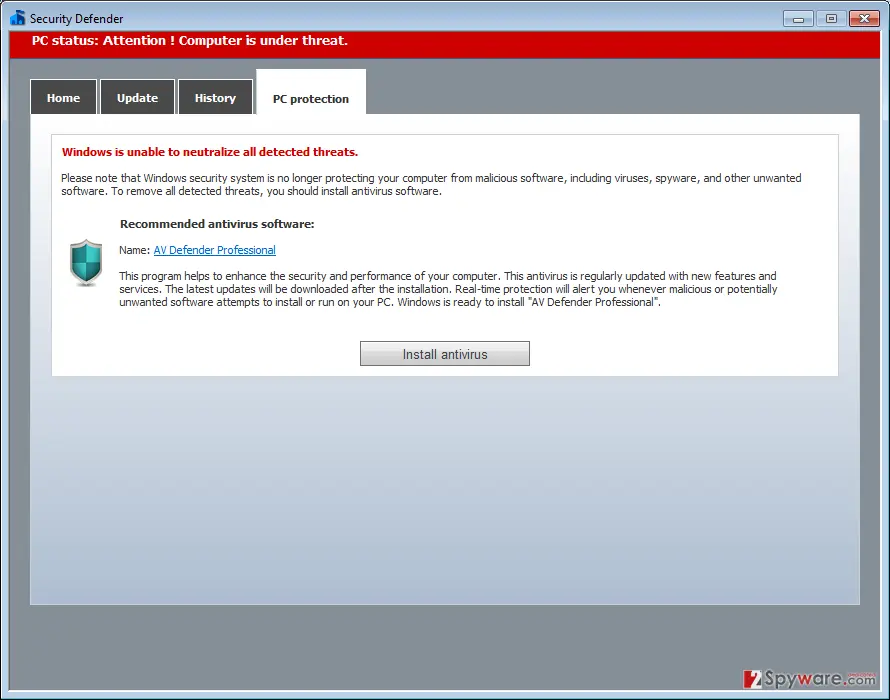
AV Defender Professional: summary
| Detection names | No Microsoft detection name is known |
|---|---|
| Distribution | Not recorded in the old report |
| Damage | Not recorded in the old report |
| Name | AV Defender Professional |
| Type | Rogue antivirus |
| Symptoms | An unknown process in Task Manager |
| Removal | Scan the PC with security software to find and remove the malware and anything installed with it. Fortect scans Windows for malware and repairs the system files and settings it damaged. Remove it nowTo use the full-featured product, you have to purchase a license for Fortect. The scan is free. |
Show 4 more facts
| Files and processes | hunter.exe |
|---|---|
| Evidence | One write-up by a security site; details still limited |
| First seen | 1 September 2015 |
| Facts checked | 7 October 2026 |
Is AV Defender Professional a real security program?
- File:
hunter.exe
From our report of Sep 2015 · not reviewed since
What is AV Defender Professional?
AV Defender Professional is a totally malicious application, which has been added to rogue anti-spyware category.
It is closely related to System Defender, Spyware Defender and other malwares. Remember that this program has nothing to do with computer's security and the only thing that it seeks is the money. It's a virus that reports about hundreds of different viruses and then offers to remove them from the system with the help of its licensed version.
Of course, this licensed version is a useless thing that is used just for swindling people's money. If you don't want to be scared into thinking that your computer is seriously infected and that you need to buy AV Defender Professional malware, you should stay away from it as far as you can.
Beware that it can try to infect your computer with the help of various tricky techniques. Such threats are typically hidden in illegal websites, misleading pop-up notifications and spam.
If this rogue infiltrates the system, it drops its files and then starts some of its process in computer's background. In addition, this threat starts showing misleading system "scanners" that are set to report about different viruses. In most of the cases, these are either legitimate or nonexistent files, so we don't recommend trying to remove them.
Otherwise, you can get rid of useful applications that you use for browsing the web or protecting your computer. If you think that this malware is hiding in your PC system, you should waste no time and scan it with updated anti-spyware.
We highly recommend avoiding manual removal of AV Defender Professional because you can leave malicious files that are related to this malware. If they are left on the system, they can be used for downloading another virus to your computer.

From our report of Sep 2015 · not reviewed since
How can AV Defender Professional infect my computer?
Av Defender Professional starts showing such fake notifications right after infecting the system:
If you have just started seeing such alerts, it means that you have been tricked by fake alert telling you that you need to check your computer for free. In addition, such fake notifications can inform you that your computer is seriously infected and that you need to install a free malware remover. Of course, nothing is for free these days and such offers are totally misleading.
Besides, you can be tricked into downloading AV Defender Professional virus to your computer after downloading a malicious email attachment, so please stay away from suspicious mails and always double check them in order to make sure that they are not trying to infect your computer. The easiest way to avoid such threats is to install a reputable anti-spyware.
From our report of Sep 2015 · not reviewed since
More from our earlier report on AV Defender Professional
- This app is unable to delete all found threats!
- A suitable antivirus software is not installed on your computer.
- Please press Search Antivirus button to find and install suitable software to clean your system from threats.
- You need to immediately install antivirus software and clean up your computer.
- Your personal data is at risk!
How to remove AV Defender Professional
Nothing it reports is real.
These steps remove it and undo a payment if you made one.
Step 1: Do not pay, and undo a payment if you made one
Nothing that AV Defender Professional says it found needs fixing by it. Close its windows and do not enter card details.
If you bought it, contact your bank or card issuer about a dispute and cancel any renewal, keeping the receipt e-mail as evidence. Uninstalling it from Windows 11 or Windows 10 removes the program but leaves the subscription running.
Full procedure with screenshots: What to do after paying a scammer
Step 2: Uninstall programs you did not mean to install
AV Defender Professional rarely comes alone: it is usually installed by, or together with, a free program. In Windows 11 open Settings > Apps > Installed apps, in Windows 10 Settings > Apps > Apps & features, and sort by install date.
Uninstall every entry from the day the trouble began that you did not install on purpose, for example a download manager, a converter or a browser you never chose.
Keep drivers and entries from Microsoft, Intel, AMD, NVIDIA or your PC's maker unless you are sure.
Full procedure with screenshots: Uninstall a program or app in Windows On uGetFix
Step 3: Remove it from startup
Press Ctrl + Shift + Esc to open Task Manager and select Startup apps (Windows 11) or the Startup tab (Windows 10). Disable entries you do not recognise, especially ones with no publisher or with a name that copies a Windows component.
Right-click an entry and choose Open file location to see where it runs from: programs in
%AppData%or%Temp%deserve a closer look. Some entries are not listed there but in the registry Run keys, which the procedure below shows how to check.Full procedure with screenshots: Stop apps from opening at startup On uGetFix
Step 4: Delete the folders left behind
Uninstalling often leaves the program's folders, and some threats reinstall themselves from them.
Press Windows + R, type
%LocalAppData%and press Enter, then do the same for%AppData%and %ProgramData%, and look for folders named after AV Defender Professional, its publisher or created on the day the problem started.Delete those folders, and check
C:\Program FilesandC:\Program Files (x86)too.If Windows says a file is in use, end it in Task Manager or delete the folder after a restart in Safe Mode. The folders are the same in Windows 11 and Windows 10.
Full procedure with screenshots: Remove what malware leaves behind in Windows
Step 5: Scan the PC, then run the offline scan
A scan finds the parts of AV Defender Professional that the manual steps cannot see. In Windows Security > Virus & threat protection > Scan options, start a Full scan and quarantine what it reports.
Follow it with Microsoft Defender Antivirus (offline scan) > Scan now, which restarts the PC and checks the disk while Windows and the malware are not running.
It takes about 15 minutes and works the same in Windows 11 and Windows 10. If either scan finds something, run the full scan again after removal until it comes back clean.
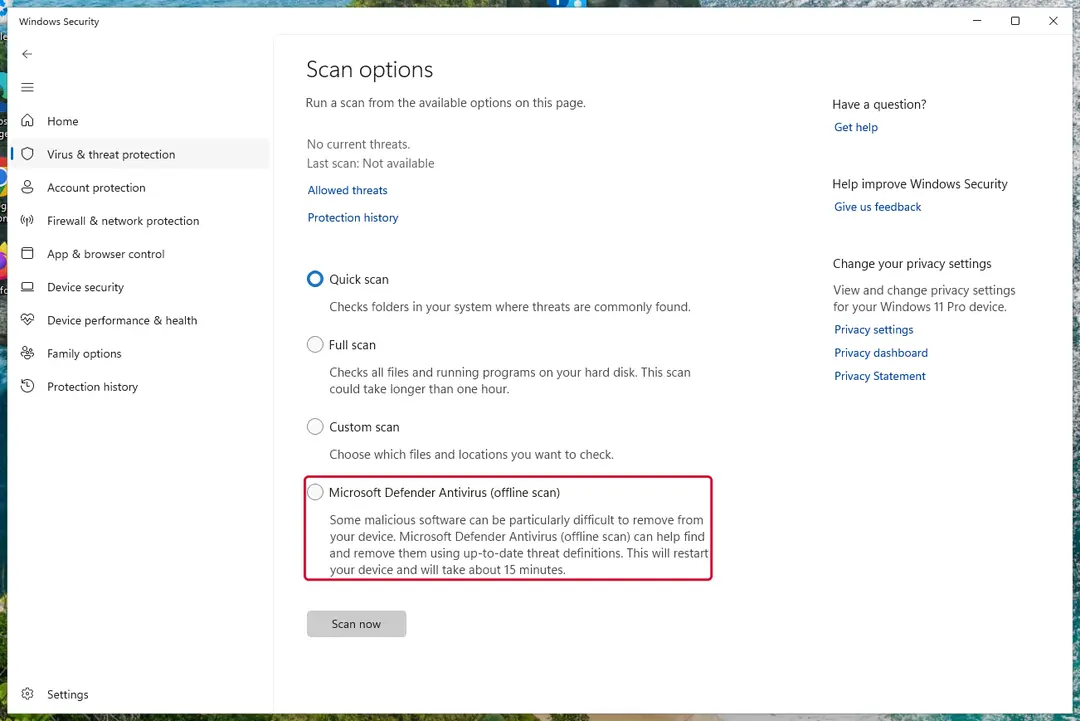
Windows 11: Windows Security > Virus & threat protection > Scan options. Full procedure with screenshots: Run a Microsoft Defender Offline scan
Access your website securely from any location
When you work on the domain, site, blog, or different project that requires constant management, content creation, or coding, you may need to connect to the server and content management service more often. The best solution for creating a tighter network could be a dedicated/fixed IP address.
If you make your IP address static and set to your device, you can connect to the CMS from any location and do not create any additional issues for the server or network manager that needs to monitor connections and activities. VPN software providers like can help you with such settings and offer the option to control the online reputation and manage projects easily from any part of the world.
Recover files after data-affecting malware attacks
While much of the data can be accidentally deleted due to various reasons, malware is one of the main culprits that can cause loss of pictures, documents, videos, and other important files.
More serious malware infections lead to significant data loss when your documents, system files, and images get encrypted. In particular, ransomware is is a type of malware that focuses on such functions, so your files become useless without an ability to access them.
Even though there is little to no possibility to recover after file-locking threats, some applications have features for data recovery in the system. In some cases, can also help to recover at least some portion of your data after data-locking virus infection or general cyber infection.
From our report of Sep 2015 · not reviewed since
How to remove AV Defender Professional virus?
If fake System Defender or AV Defender Professional alerts are bothering you, it means that your PC is infected.
In this case, you should download a reputable anti-spyware program and update it to its latest version. Now it's time to run a full system scan (here is a detailed guide explaining how to do that: guide).
For the removal of AV Defender Professional malware, we highly recommend or , because they can easily detect every hidden component that belongs to this and other cyber threats.
ATTENTION! If you can't download or launch any them, try these options:
1. USING SYSTEM RESTORE TO DISABLE VIRUS:
2. REBOOTING TO SAFE MODE WITH NETWORKING:
3. USING ANOTHER PC FOR DOWNLOADING ANTI-SPYWARE:
- Go to the Windows 8 Start Screen and type restore point in the Search section.
- Now click on Settings -> Create a restore point.
- When in System Protection tab, select System Restore.
- Click Next button to see your restore points and left click on the entry you need.
- Now select Scan for affected programs -> Close -> Next -> Finish.
- Once your PC reboots, download and run a full system scan after updating it.
- Click on Windows key and go to the bottom-right corner.
- Select Settings -> Change PC Settings -> General.
- Click theRestart Now buttonunder Advanced Startup.
- Now selectTroubleshoot -> Advanced Options -> Startup Settings.
- Now choose Restart and press F5.
- Launch IE or other browser and enter this link to your address bar: http://www.2-spyware.com/download/hunter.exe
- Download a program on your desktop and launch it to remove malicious files.
- Take another computer that is not infected by this virus and download .
- After completing the procedure, transfer this anti-malware to the CD/DVD, external drive, or USB flash drive.
- In the meanwhile, kill malicious processes on your infected computer. For that you can use this tutorial.
- Stick the device you used for transferring anti-spyware program to your infected PC and launch it.
Questions about AV Defender Professional
What is hunter.exe and why is it running?
Every process is started by something:
- a program you installed
- a Windows service
- a scheduled task
- a startup entry
To learn why hunter.exe runs, find its file with Open file location in Task Manager, then look for an entry pointing to that file in Settings > Apps > Startup and in Task Scheduler.
Sort Installed apps by date to see what arrived when the process first appeared. Once you know the owner, you can decide whether to keep it, switch it off at startup or uninstall it completely.
Can I delete the hunter.exe file?
Only after you know what it belongs to. If hunter.exe is part of a program, uninstall that program through Settings instead, so its services and tasks go too. If it belongs to nothing and is unsigned, end the process, disable whatever starts it and then delete its folder.
Do not delete files from the Windows folder or files signed by Microsoft: those are part of the system, and removing them can stop Windows from starting. When in doubt, run a Microsoft Defender scan first and let it decide.
Someone called offering a refund for AV Defender Professional. Is it genuine?
Almost certainly not. Refund calls are a well-known second stage of scareware and tech support scams. The caller says you are owed money, asks you to install a remote access program to "process" it, then opens your online banking, makes it look as if too much was refunded and asks you to send the difference back.
Hang up. Real refunds go back to the card or PayPal account you paid with, through your bank or the payment provider, and never need remote access or a gift card.
Is my card safe after buying AV Defender Professional?
Treat it as exposed. The order page belongs to the seller of AV Defender Professional, and you cannot know how the number is stored or shared. Ask your bank for a replacement card, which is usually free, and dispute the original charge as a misrepresented product.
Until the new card arrives, check your account daily for small or foreign transactions. If the bank offers alerts for every card payment, turn them on. Keep the receipt and screenshots, because they support the dispute.
What could the caller do while connected to my PC?
Anything you could do. Callers working with fake alerts like AV Defender Professional typically show you Windows logs as "proof", install their own remote tool for later, and steer you to online banking or a gift card purchase. Some add a password to Windows or lock the PC if you refuse to pay.
Remove every remote access program you did not install yourself, check Settings > Accounts > Other users for new accounts, and change important passwords from a clean device. If you cannot be sure what was changed, a reset of Windows is the safe choice.
What if I paid AV Defender Professional?
Contact your bank or card issuer the same day, explain that the payment went to a fake security program and ask for a chargeback. Keep screenshots of an unfamiliar process called hunter.exe in Task Manager, the payment receipt and any e-mails.
If you gave card details in the program, ask the bank to block and replace the card. Then uninstall the program and run a full scan in Windows Security. If you also called a number and let someone connect to your PC, uninstall the remote-access tool they used and change your passwords from another device.
How do I know AV Defender Professional is fake?
Three things give it away. It appears as an unfamiliar process called hunter.exe in Task Manager, a window from a program rather than from Windows Security. It pushes you to act quickly by calling, paying or downloading.
And the threats it reports never show up when you run a scan in the real Windows Security app. Microsoft does not put phone numbers in warnings or charge for removing threats through pop-ups. Close the window, do not call, and follow the steps to find and uninstall the program behind it.
Do I need to reinstall Windows to get rid of AV Defender Professional?
Usually not. A thorough clean-up is enough when the offline scan finds nothing afterwards and you do not see an unfamiliar process called hunter.exe in Task Manager again. A reset is the safer choice if an attacker had remote control, if security tools were switched off, or if detections come back after every clean-up.
Windows 11 can reset itself without a USB stick under Settings > System > Recovery > Reset this PC. Copy documents and photos out first and scan the copies. A reset does not change passwords or undo stolen data, so the account steps still apply.
Will Fortect remove AV Defender Professional?
Fortect scans Windows for malware and unwanted programs and repairs the system files and settings they change, and its free scan shows what it finds on your PC before you decide anything.
For AV Defender Professional, follow the plan above as well: the browser steps take back permissions and settings that no scanner treats as a threat, and uninstalling the program that brought it removes the source.
Run Microsoft Defender's full scan and, if anything was found, its offline scan as a second opinion. If the symptoms are gone after the plan and both scans are clean, there is nothing more to do.
Sources
- FTC: How to recognize, remove and avoid malware (read October 7, 2026)
- Microsoft Learn: Microsoft Defender Offline (read October 7, 2026)
- Microsoft Learn: How Microsoft names malware (read October 7, 2026)