
SearchConverterHD: what it is and how to remove it
SearchConverterHD is the name of an extension, which alters the start page and search engine on the default web browser. According to cybersecurity researchers, it is being actively disseminated on third-party download sites bundled with popular Windows and Mac apps .
Facts checked October 6, 2026. Removal steps tested on Windows 11 (26H2) and checked against Microsoft's and the browser makers' current documentation. Sections marked as our earlier report are the original text: they describe the threat as it was then and have not been reviewed since. The 2026 status, the removal steps and the questions are current.
Automatic
Get a free scan and check if your PC is infected.
Fortect finds malware, unwanted programs and the Windows damage they leave behind, and repairs it in one pass.
A quick scan confirms nothing else was installed alongside the portal.search-converterhd.com search hijacker.
Do it yourself · free Remove SearchConverterHD yourself 5 steps, about 15 minutes, no software needed.
Start the steps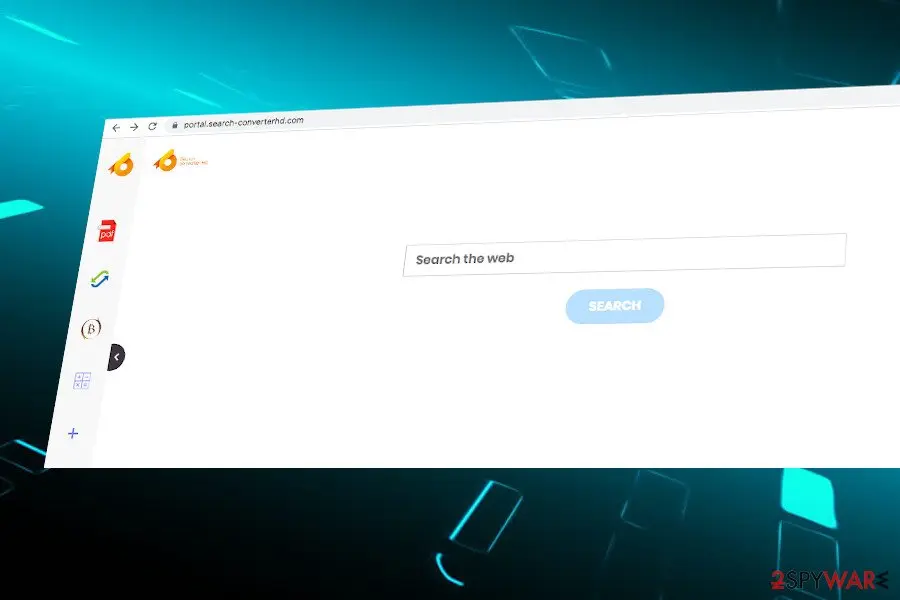
SearchConverterHD: summary
| Name | SearchConverterHD |
|---|---|
| Type | Browser hijacker |
| Sub-Type | Potentially Unwanted Program (PUP) |
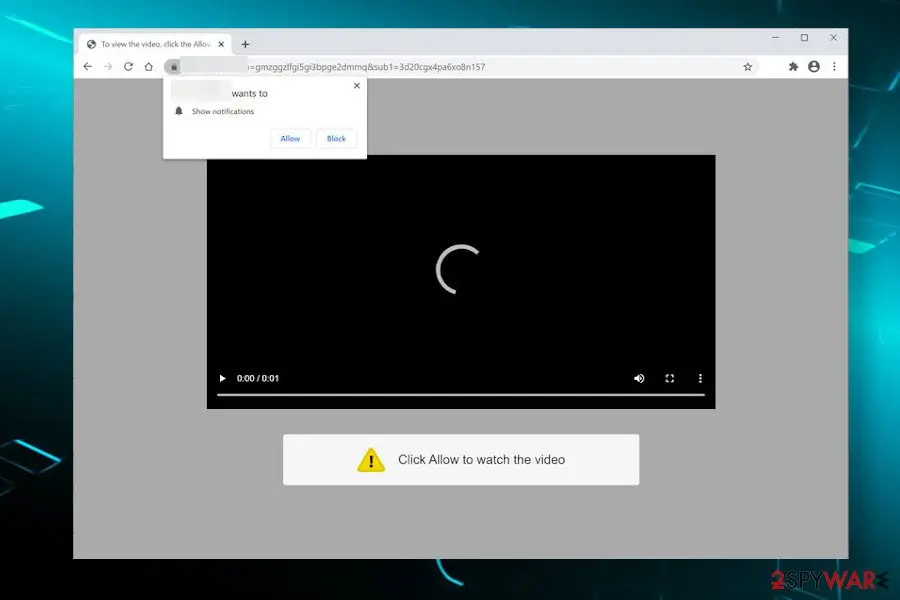
| Symptoms | The symptoms are usually seen within a web browser: – start page URL replaced by portal.search-converterhd.com or feed.search-converterhd.com – search engine set to Yahoo (sponsored version) without permission – some unfamiliar URLs may be included into the list of notification permissions – unwanted toolbars may be installed – web search results may contain suspicious links and redirect random sites to irrelevant third-party sites – Search results contain featured banner ads on the right side of the window |
| Main dangers | Clicking on the content brought by SearchConverterHD virus poses a risk of being exposed to suspicious or even dangerous websites managed by third parties. The app may also use tracking cookies to record user's browsing history |
| Should I remove it? | Cybersecurity experts[2] recommend removing browser hijackers instantly as they disrupt browsing activities, generate intrusive content, and can trigger malware download. The easiest way to eliminate it is to scan the machine with anti-malware and then manually reset the web browser's settings |
| Removal | Scan the PC with security software to find and remove the malware and anything installed with it. Fortect scans Windows for malware and repairs the system files and settings it damaged. Remove it nowTo use the full-featured product, you have to purchase a license for Fortect. The scan is free. |
Show 8 more facts
| Detection names | No Microsoft detection name is known |
|---|---|
| Distribution | Not recorded in the old report |
| Damage | Not recorded in the old report |
| Evidence | 4 write-ups by security sites; details still limited |
| Search page | portal.search-converterhd.com |
| Browsers | Chrome, Edge and Firefox |
| First seen | 3 July 2020 |
| Facts checked | 6 October 2026 |
What SearchConverterHD changes in your browser
You acknowledge that we have no control over and assume no responsibility for Third Party Content. You assume all responsibility and risk in connection with your use of Third Party Content and we hereby disclaim any and all liability to you or any third party in connection thereto. We have no obligation to examine, review or monitor Third Party Content and are not responsible for the accuracy, completeness, appropriateness or legality of Third Party Content.
Is SearchConverterHD dangerous? What it collects
From our report of Jul 2020 · not reviewed since
More from our earlier report on SearchConverterHD
- Potentially unwanted apps usually spread in bundles and initiate a multiplicity of changes within the registries.
- To recover the system, try a scan with tool
From our report of Jul 2020 · not reviewed since
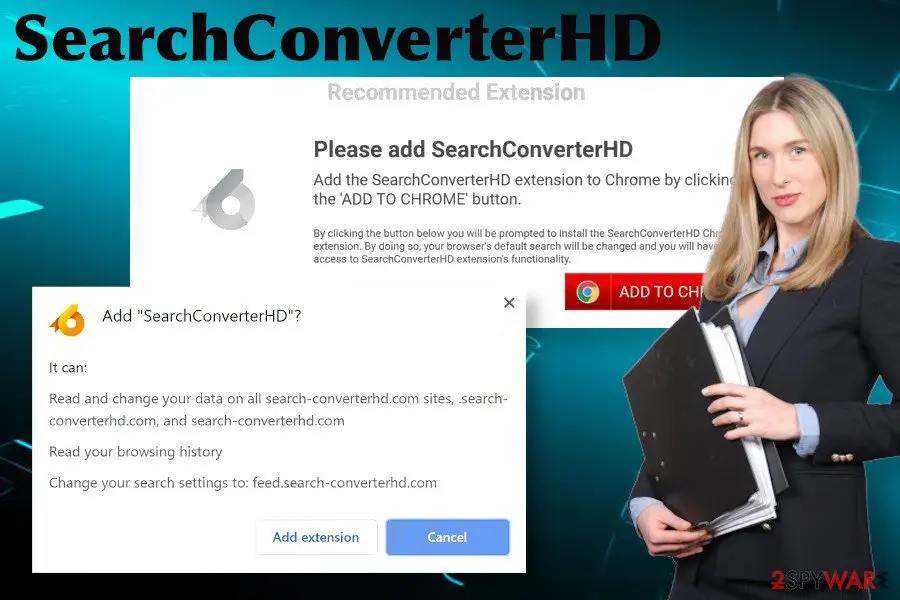
SearchConverterHD is labeled as a browser hijacker and PUP due to stealthy installation with freeware and intrusive browser-based behavior
SearchConverterHD is the name of an extension, which alters the start page and search engine on the default web browser.
According to cybersecurity researchers, it is being actively disseminated on third-party download sites bundled with popular Windows and Mac apps .
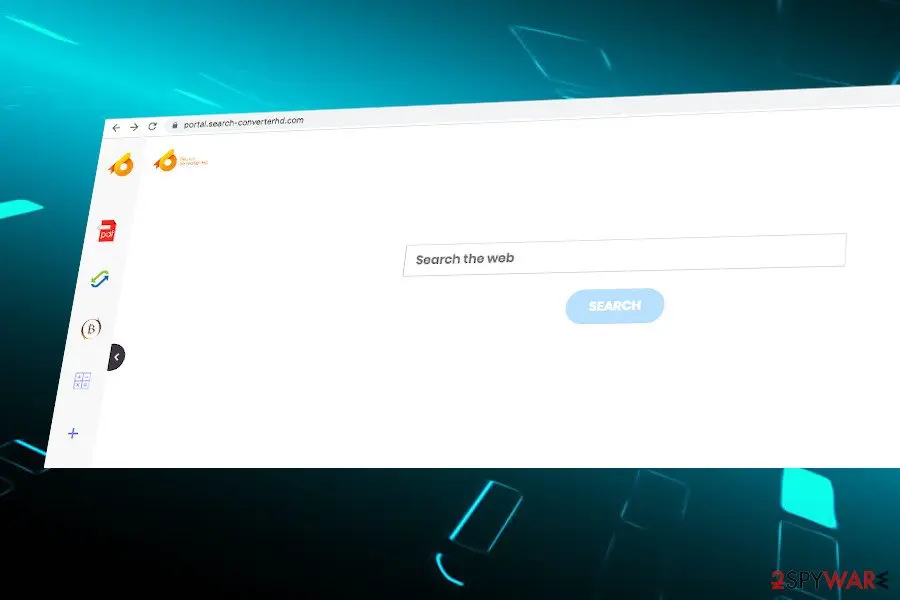
The main symptom that this PUP has been installed on your machine is the portal.search-converterhd.com or feed.search-converterhd.com start page on Chrome, Firefox, Safari, Opera, and other web browsers. Such replacement is not the only capability of the so-called SearchConverterHD virus.
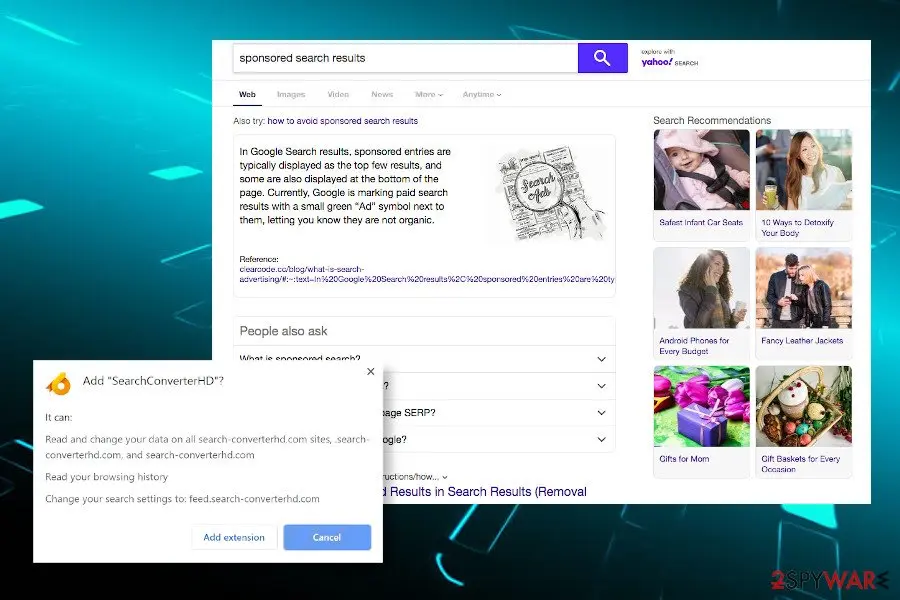
It can also set a sponsored search engine (typically Yahoo) and inject cookies/beacons into web browser's settings to inform third-party advertisers about your web browser preferences and, subsequently, display pre-selected search results.
SearchConverterHD PUP belongs to the group of browser hijackers that promote an identical search site known as Portal or Feed. There's a rather long list of identical applications, including UpdateSearch, PDFSearches, SearchConverterz, SearchZone, and SportStreamSearch. Each of these extensions is spread via software bundles and used for promoting a sponsored search engine.
SearchConverterHD malware is usually promoted as a great extension for improving the web browsing experience. However, users are not informed about its functionality explicitly. All actual information is typically disclosed on the freeware installation checkboxes that are shown to the users only if they opt for Advanced or Custom installation setup. That's the main reason why this questionable extension usually gets installed without the user's knowledge.
Right after the install of the malware, the extension is dropped onto the default web browser. For this reason, the start page, search engine, new tab URL, and other settings are automatically altered.
Both portal.search-converterhd.com and feed.search-converterhd.com searchers look rather neat and reliable. There is a couple of in-built additional features (PDF converter, Calculator, Bitcoin Converter, quick access links, etc.) and a simple search bar on the start page, so there's actually nothing suspicious.
Then one may ask so what makes people want to remove SearchConverterHD extension? The answer is simple - sponsored content that it is set to display. The changes that it performs are initiated for monetization purposes.
In fact, developers of this search gain earn a commission fee for displaying sponsored links and ads. However, please note that the company is not liable for any content that belongs to third parties, but is promoted via SearchConverterHD server.
To put it simply, the web browser can continuously trigger SearchConverterHD redirects, which are potentially dangerous due to the potentially dangerous content on the end sites.
Privacy concerns are yet another reason why experts recommend immediate SearchConverterHD removal. This extension contains cookies and web beacons under the main installer. Thus, it can access people's browsing history and record non-personal information and some pieces of personal (email address, IP address, geolocation, name, address, if you enter such info during the search process).
To prevent privacy and security related issues, it's advisable to keep browser hijackers away from the machine. If, however, you have accidentally installed one, eliminate it properly. SearchConverterHD virus removal can be completed in two ways - manually or with a robust anti-malware tool.
If you have downloaded unwanted applications alongside freeware , we strongly recommend initiating a full system scan with application upon malware removal. That's because PUPs can leave registry entries or running processes even after being removed, so a full optimization might prevent the machine from slowdowns and errors.
Check your browser and PC
- Address:
portal.search-converterhd.com
How to remove SearchConverterHD
How to remove SearchConverterHD and get your search engine back
Remove the extension first.
The search settings only stay fixed once nothing on the PC can change them again.
Step 1: Remove extensions you did not add
SearchConverterHD often works through an extension, so go through the extension list of each browser:
chrome://extensionsedge://extensions- Extensions and themes in Firefox
Switch suspicious extensions off one at a time and reload the page where the problem shows, then remove the one that stops it, and any other you did not add.
Remember the other browsers and profiles on the PC. If Remove is missing or greyed out, a policy forces the extension, which the policy step deals with. Windows 11 and Windows 10 show the same pages.
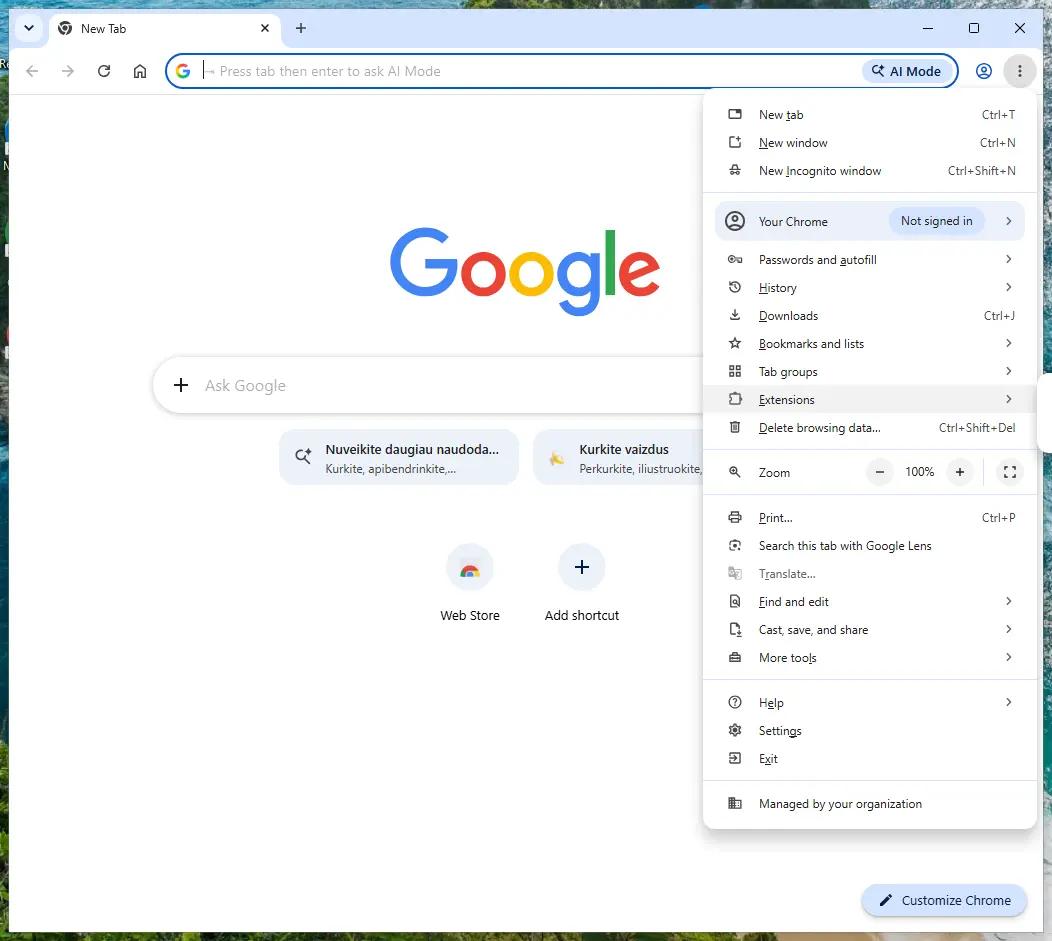
Chrome on Windows 11: More > Extensions > Manage extensions. Full procedure with screenshots: Remove a browser extension
Step 2: Put the search engine back and delete portal.search-converterhd.com
Searches that pass through
portal.search-converterhd.commean the browser's default search engine was replaced. Chrome: Settings > Search engine > Manage search engines and site search, then Make default on Google, Bing or another engine you chose, and Delete on portal.search-converterhd.com.Edge has the same list under Manage search engines (search the Settings page for it), and Firefox under Settings > Search.
Look at On startup and the homepage settings too and remove the hijacker's address there. Nothing in this step differs between Windows 11 and Windows 10.
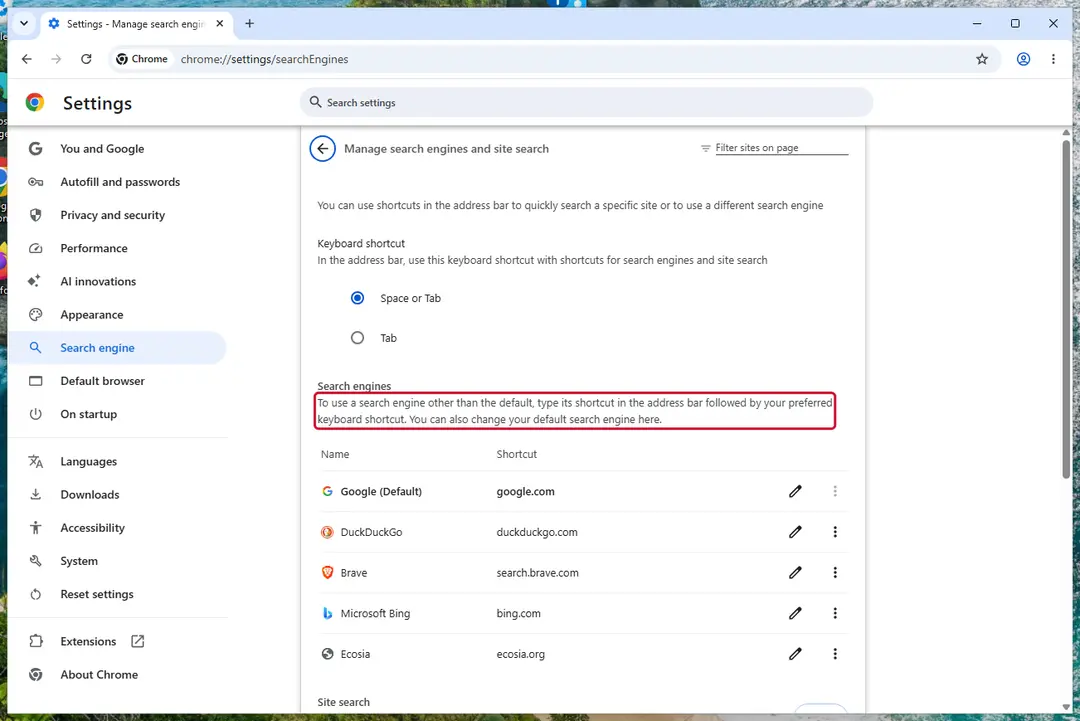
Chrome on Windows 11: check Search engine and On startup. Full procedure with screenshots: Reset a browser and fix a hijacked search engine
Step 3: Uninstall programs you did not mean to install
Open Settings > Apps > Installed apps in Windows 11, or Settings > Apps > Apps & features in Windows 10, and sort the list by install date. Look at what appeared around the day the problem started and uninstall every program you do not recognise or did not choose.
Free converters, PDF and video tools, "system optimizers" and unknown browsers are the usual carriers of SearchConverterHD. If a name is unclear, search for it before you remove it, so you do not uninstall a driver or a Windows component.
Full procedure with screenshots: Uninstall a program or app in Windows On uGetFix
Step 4: Reset the browser
Finish the browser part with a reset, which puts the search engine, start page, new tab page and site permissions back to their defaults and switches extensions off. Chrome: Settings > Reset settings > Restore settings to their original defaults.
Edge: Settings > Reset settings. Firefox: Help > More troubleshooting information > Refresh Firefox, which also removes its extensions. Your bookmarks and saved passwords are kept, and the menus are the same on Windows 11 and Windows 10.
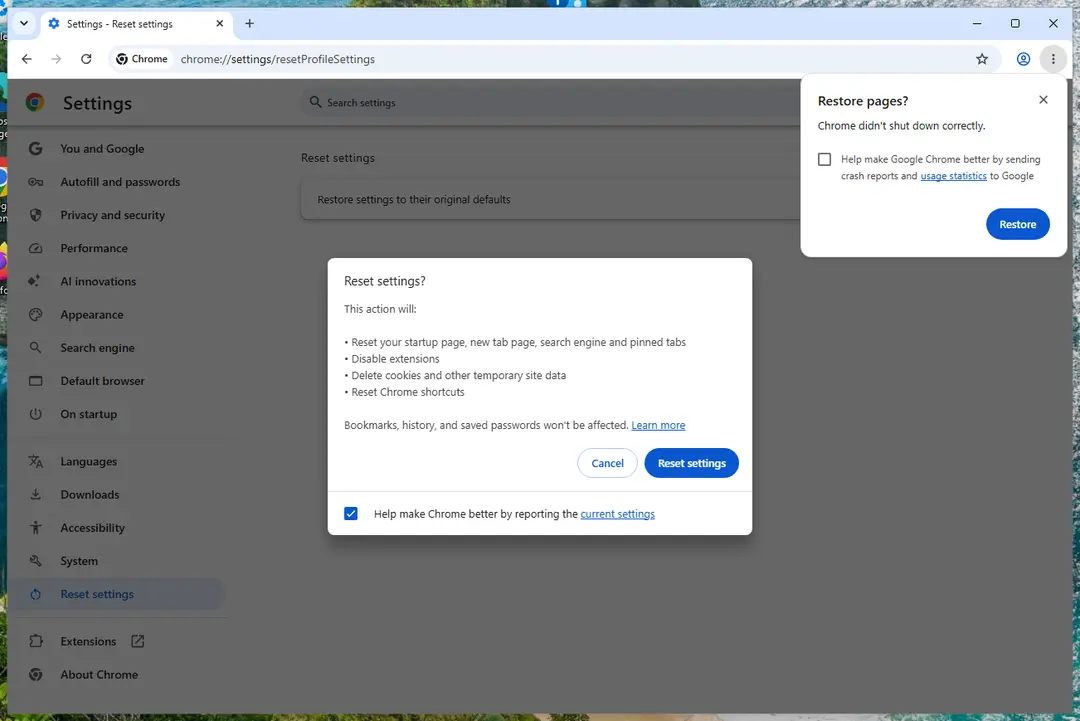
Chrome on Windows 11: Settings > Reset settings. Full procedure with screenshots: Reset a browser and fix a hijacked search engine
Step 5: Scan the PC, then run the offline scan
Open Windows Security > Virus & threat protection > Scan options, run a Full scan and remove everything it finds. Then select Microsoft Defender Antivirus (offline scan) and click Scan now: the PC restarts and scans before Windows loads, which finds files that hide while Windows runs.
Save your work first, because the offline scan takes about 15 minutes. Both scans are built into Windows 11 and Windows 10, and a second scanner from another vendor is a useful extra opinion.
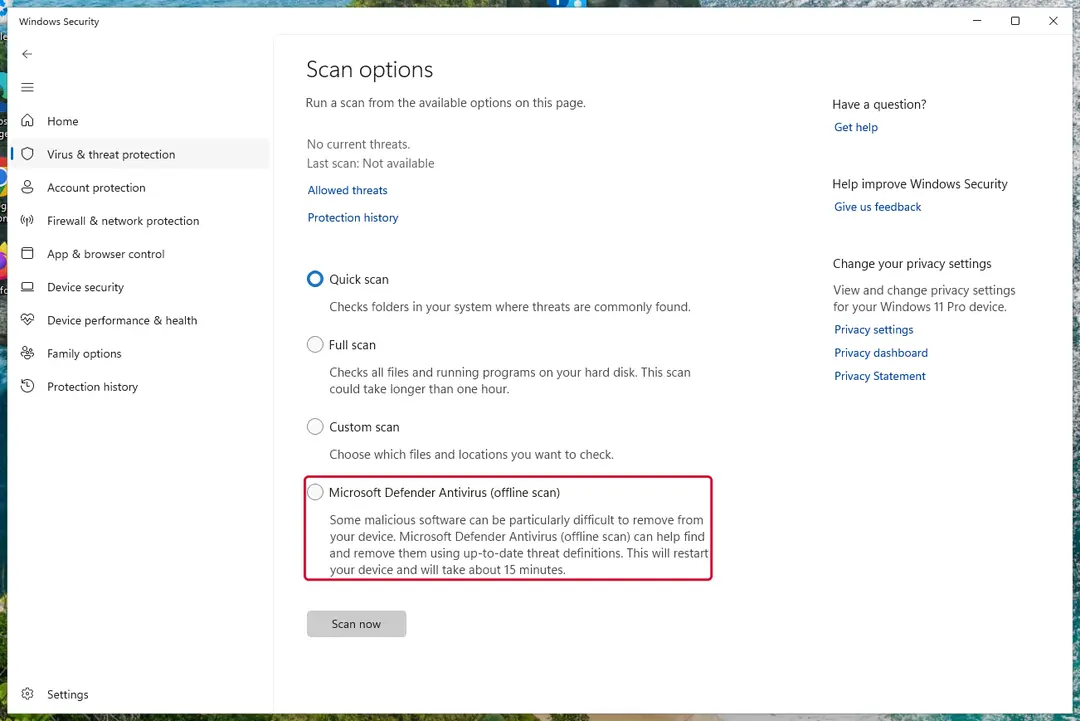
Windows 11: Windows Security > Virus & threat protection > Scan options. Full procedure with screenshots: Run a Microsoft Defender Offline scan
Instructions for each browser and system
The detailed steps for every browser and system this guide covers. Open the one you use.
Uninstall from Windows
Windows OS users should rely on the below-given instructions when trying to deal with the SearchConverterHD-related malware.
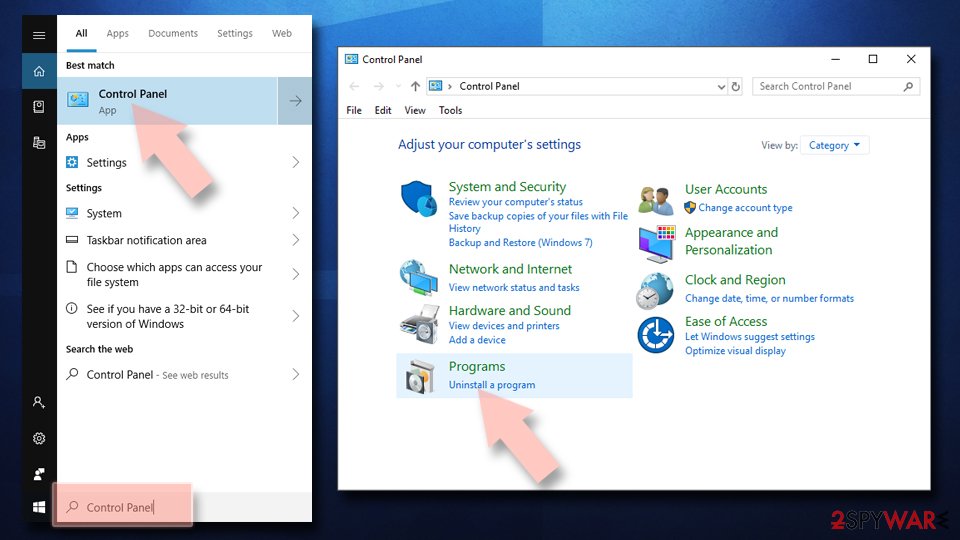
Uninstall from Windows 10/8:
- Type Control Panel into the Windows search box and open the result.
- Under Programs, select Uninstall a program.
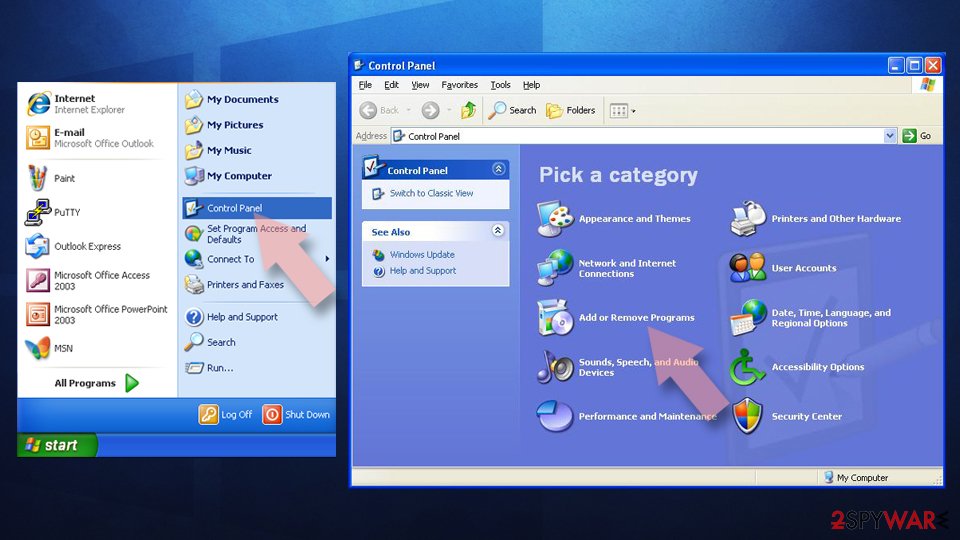
Uninstall from Windows 7/XP:
- Click on Windows Start > Control Panel (Windows XP users should click on Add/Remove Programs).
- In Control Panel, select Programs > Uninstall a program.
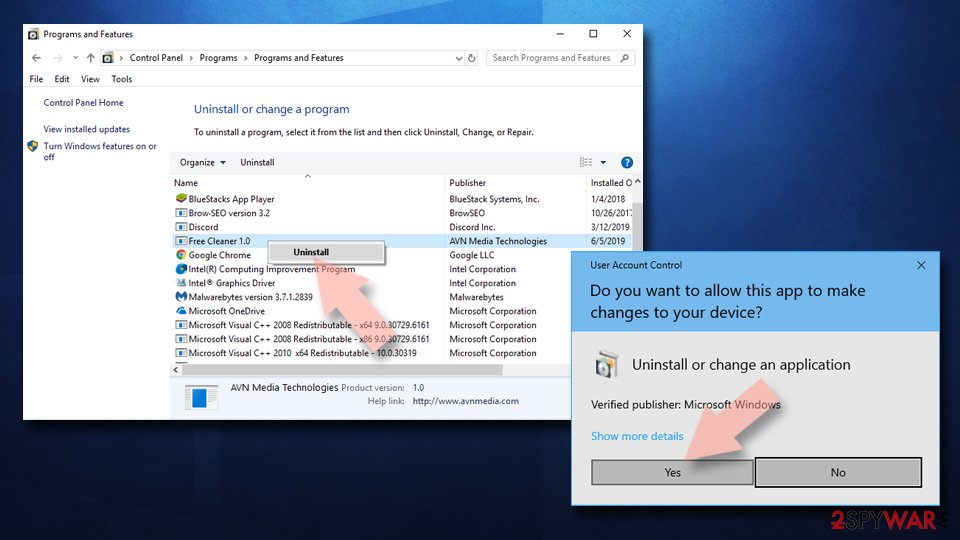
Remove the unwanted program:
- In the Programs and Features window, look for any recently installed suspicious entries, select them, and click Uninstall.
- If User Account Control appears, click Yes to confirm, then complete the removal.
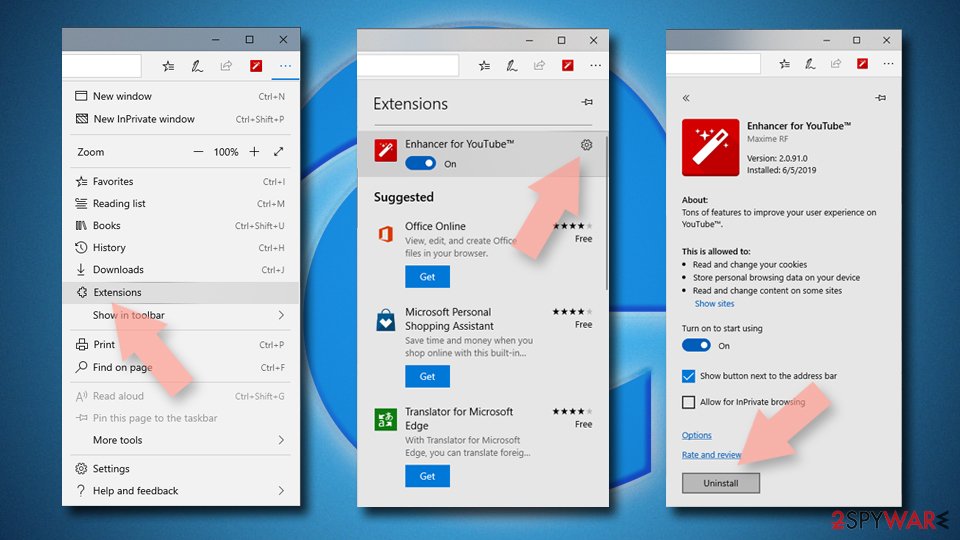
Remove from Microsoft Edge
To stop intrusive activities on a web browser, eliminate SearchConverterHD extension or completely reset browser's settings as explained below.
Delete unwanted extensions from MS Edge:
- Select Menu (three horizontal dots at the top-right of the browser window) and pick Extensions.
- From the list, pick the extension and click on the Gear icon.
- Click Remove.
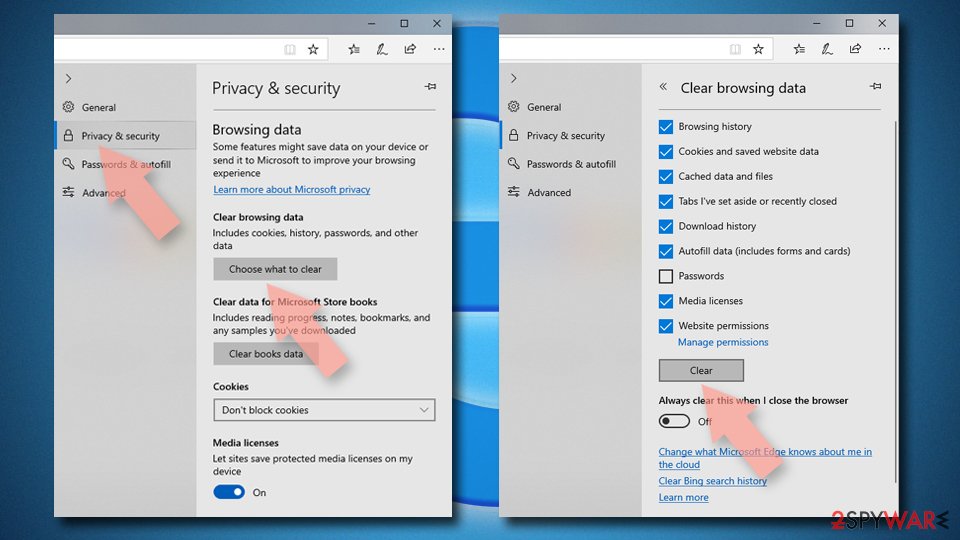
Clear cookies and other browser data:
- Click on the Menu (three horizontal dots at the top-right of the browser window) and select Settings > Privacy, search, and services..
- Under Clear browsing data, pick Choose what to clear.
- Select Cookies and other site data and Cached images and files. (apart from passwords, although you might want to include Media licenses as well, if applicable) and click on Clear.
Restore new tab and homepage settings:
- Click the menu icon and choose Settings.
- Then find On startup section.
- Click Remove next to any suspicious startup page.
Reset MS Edge if the above steps did not work:
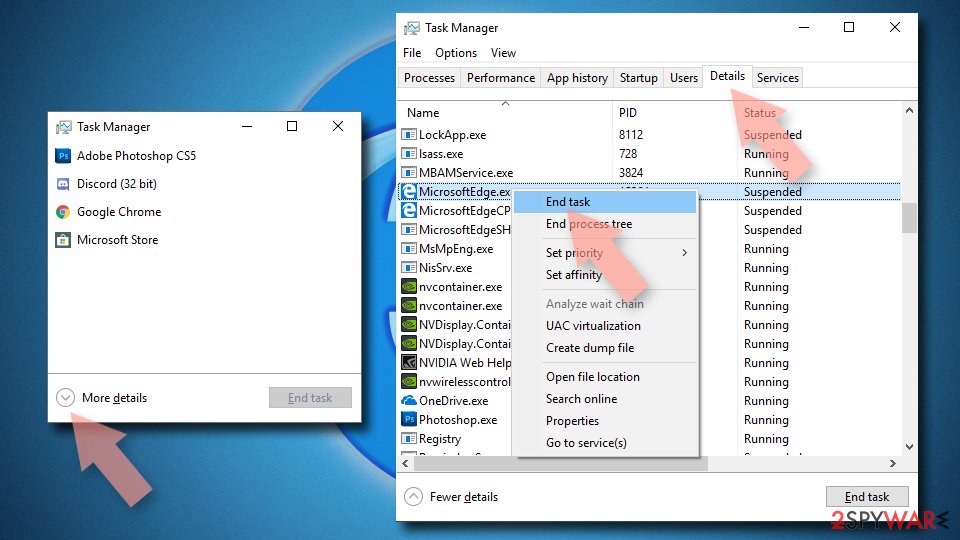
- Press on Ctrl + Shift + Esc to open Task Manager.
- Click on More details arrow at the bottom of the window.
- Select Details tab.
- Now scroll down and locate every entry with Microsoft Edge name in it. Right-click on each of them and select End Task to stop MS Edge from running.
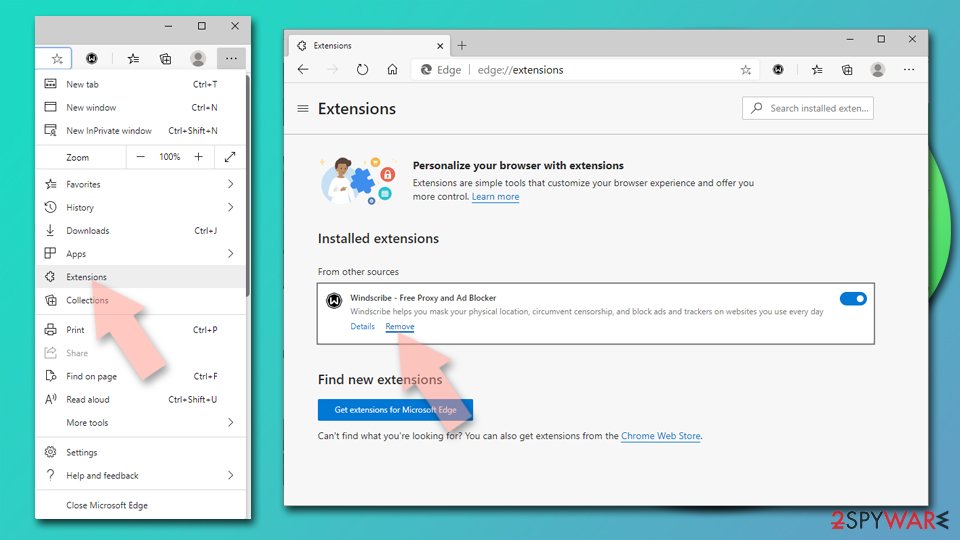
Delete extensions from MS Edge (Chromium):
- Open Edge and click select Settings > Extensions.
- Delete unwanted extensions by clicking Remove.
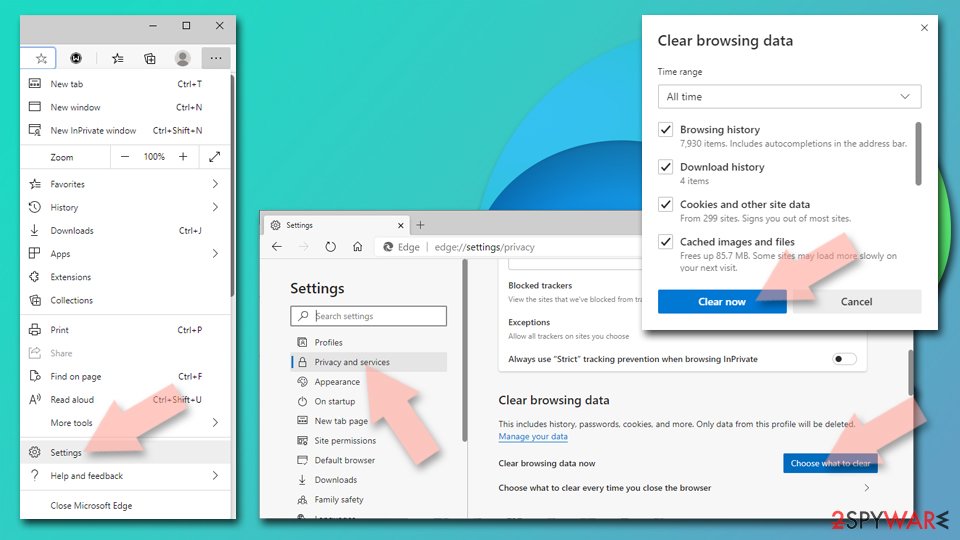
Clear cache and site data:
- Click on Menu and go to Settings.
- Select Privacy, search and services.
- Under Clear browsing data, pick Choose what to clear.
- Under Time range, pick All time.
- Select Clear now.
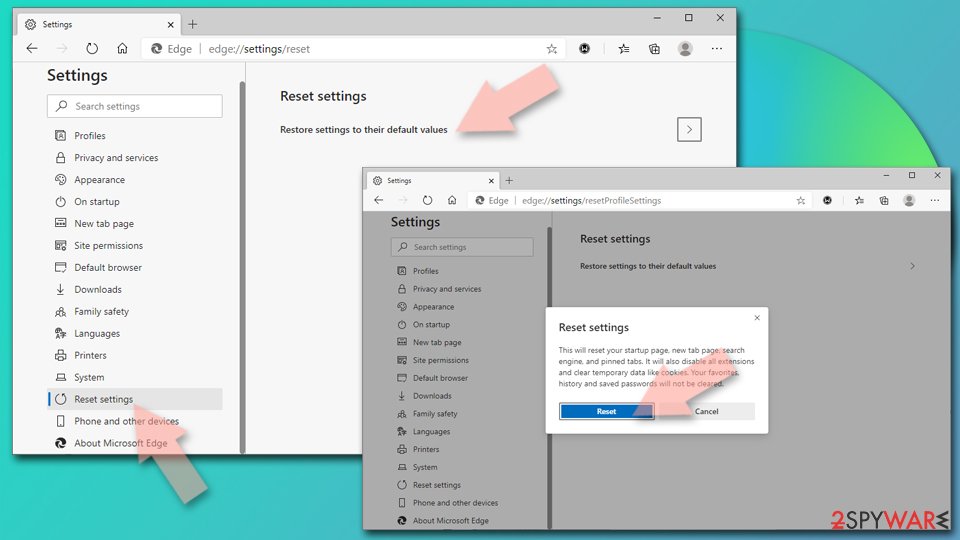
Reset Chromium-based MS Edge:
- Click on Menu and select Settings.
- On the left side, pick Reset settings.
- Select Restore settings to their default values.
- Confirm with Reset.
- This will disable extensions and reset startup pages but will not delete bookmarks, saved passwords, or browsing history.
Remove from Mozilla Firefox (FF)
Remove dangerous extensions:
- Open Mozilla Firefox browser and click on the Menu (three horizontal lines at the top-right of the window).
- Select Add-ons.
- In here, select the unwanted extension and click Remove.
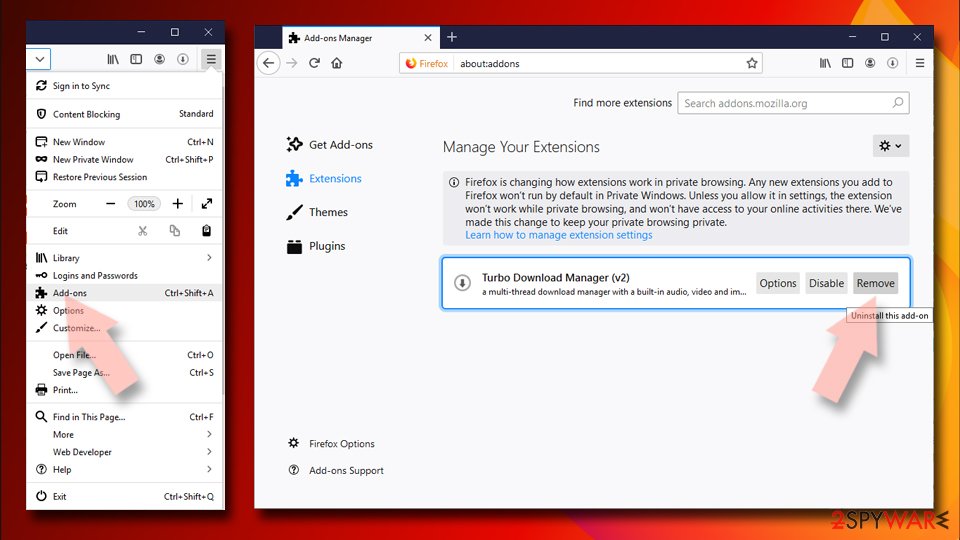
Reset the homepage:
- Click three horizontal lines at the top right corner to open the menu.
- Choose Settings.
- Under Home, set your preferred homepage and new tab settings.
Clear cookies and site data:
- Click Menu and pick Settings.
- Go to Privacy & Security section.
- Scroll down to locate Cookies and Site Data.
- Click on Clear Data...
- Select Cookies and Site Data and Temporary cached files and pages, then click Clear.
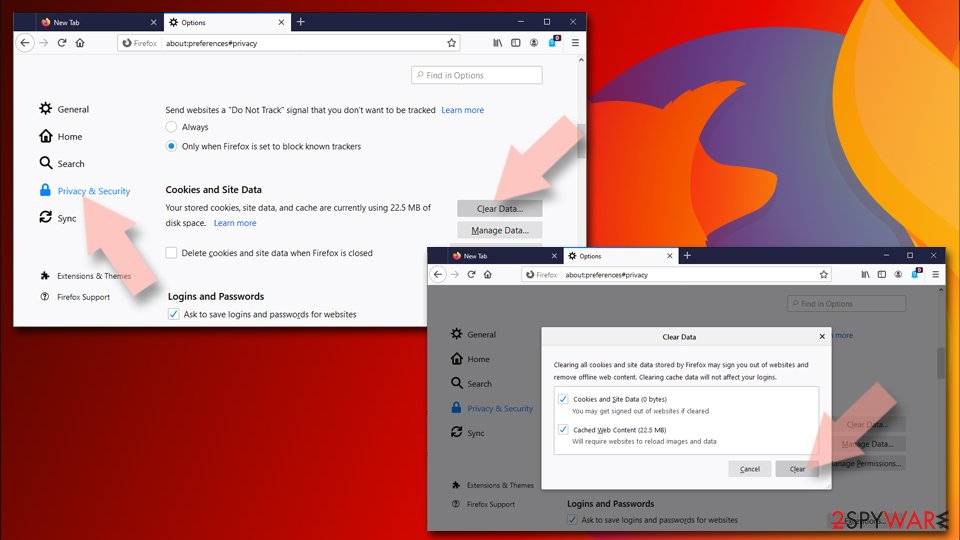
Reset Mozilla Firefox
If clearing the browser as explained above did not help, reset Mozilla Firefox:
- Open Mozilla Firefox browser and click the Menu.
- Go to Help and then choose Troubleshooting Information.
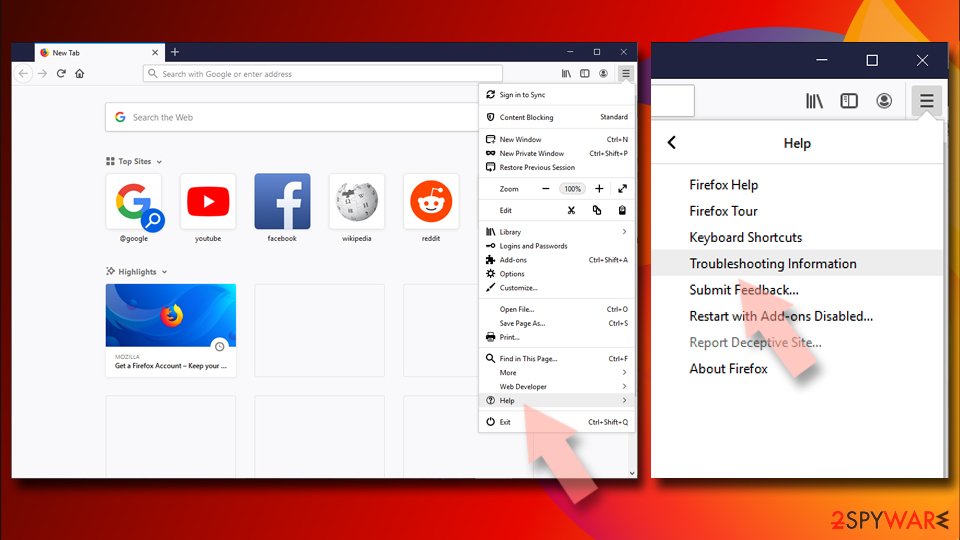
- Under Give Firefox a tune up section, click on Refresh Firefox...
- Once the pop-up shows up, confirm the action by pressing on Refresh Firefox.
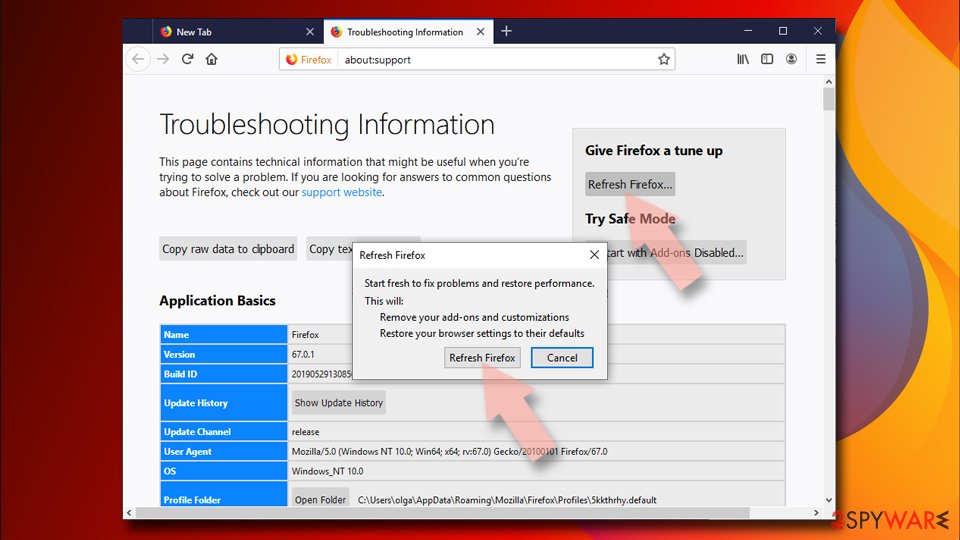
Delete from macOS
SearchConverterHD redirects on Mac web browsers can also happen if the system runs malware. In order to get rid of it, please scan the machine with a Mac-compatible anti-malware tool or follow this tutorial.
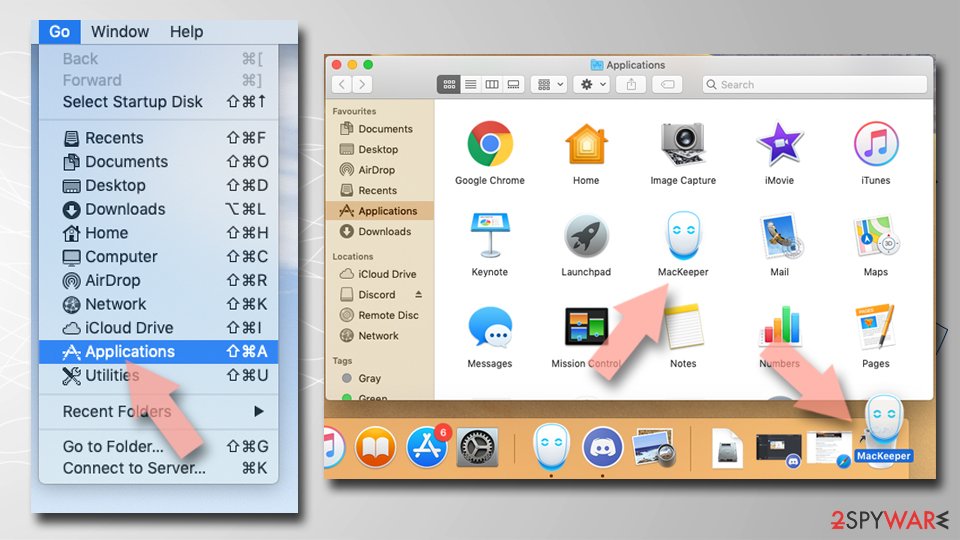
Remove the unwanted application:
- From the menu bar, select Go > Applications.
- In the Applications folder, look for any suspicious entries, then drag them to Trash (or right-click and pick Move to Trash).
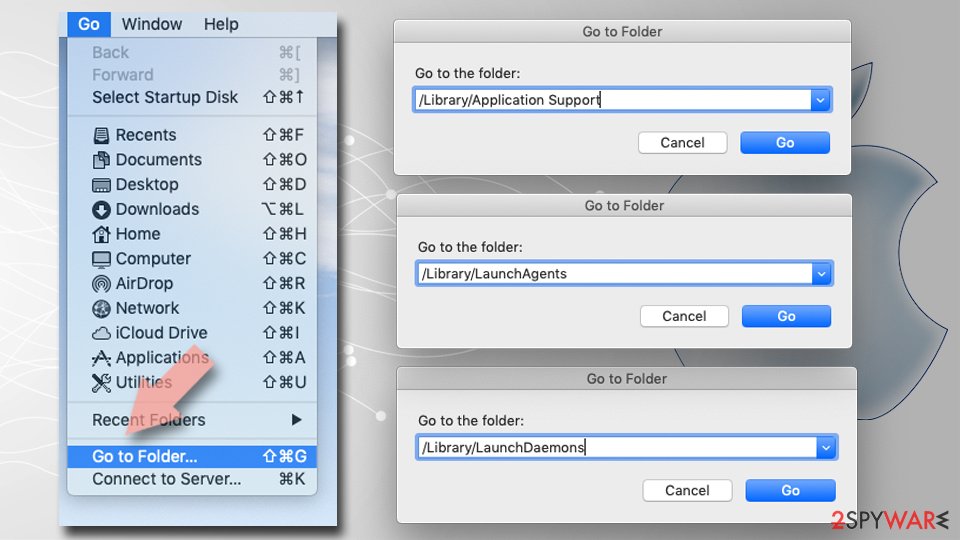
Delete leftover files and folders:
- Select Go > Go to Folder.
- Enter /Library/Application Support and remove any suspicious folders related to the unwanted program.
- Repeat the same check in the /Library/LaunchAgents and /Library/LaunchDaemons folders, deleting any suspicious entries.
- Finally, empty the Trash to permanently remove the leftovers.
Reset Internet Explorer
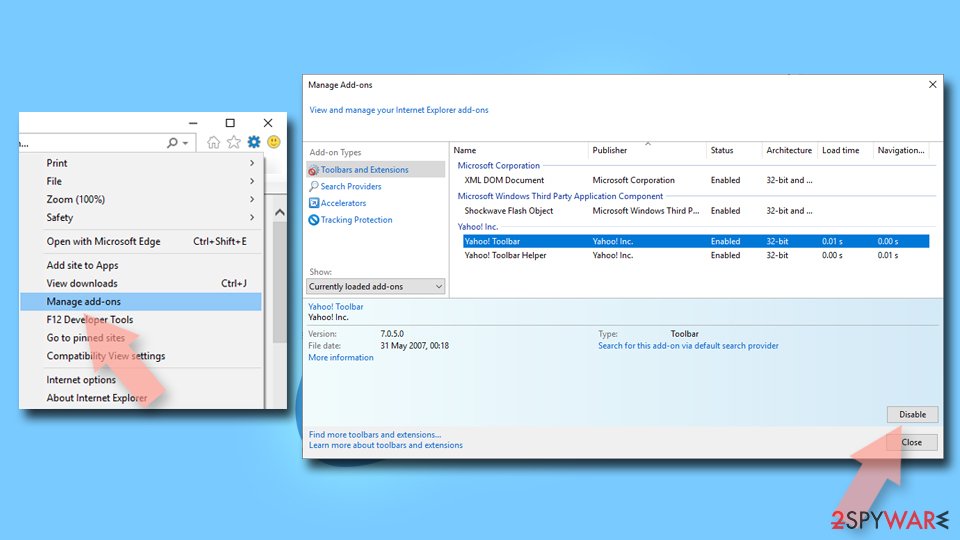
Remove dangerous add-ons:
- Open Internet Explorer, click on the Gear icon (IE menu) on the top-right corner of the browser
- Pick Manage Add-ons.
- You will see a Manage Add-ons window. Here, look for suspicious plugins. Click on these entries and select Disable.
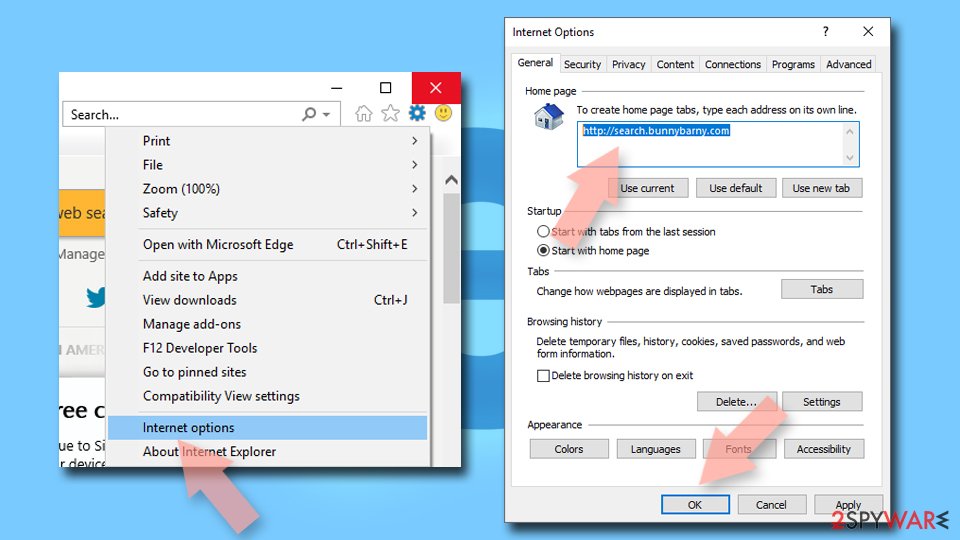
Change your homepage if it was altered:
- Open IE and click on the Gear icon.
- Select Internet Options.
- In the General tab, delete the Home page address and replace it by your preferred one (for example, Google.com).
- Click Apply and then select OK.
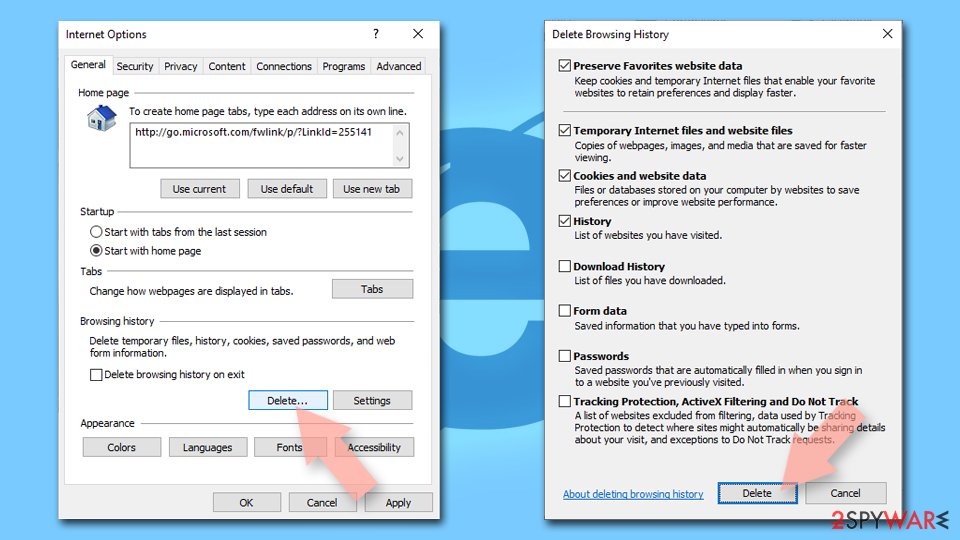
Delete temporary files:
- Press on the Gear icon and select Internet Options.
- Under Browsing history, click Delete...
- Select relevant fields and press Delete.
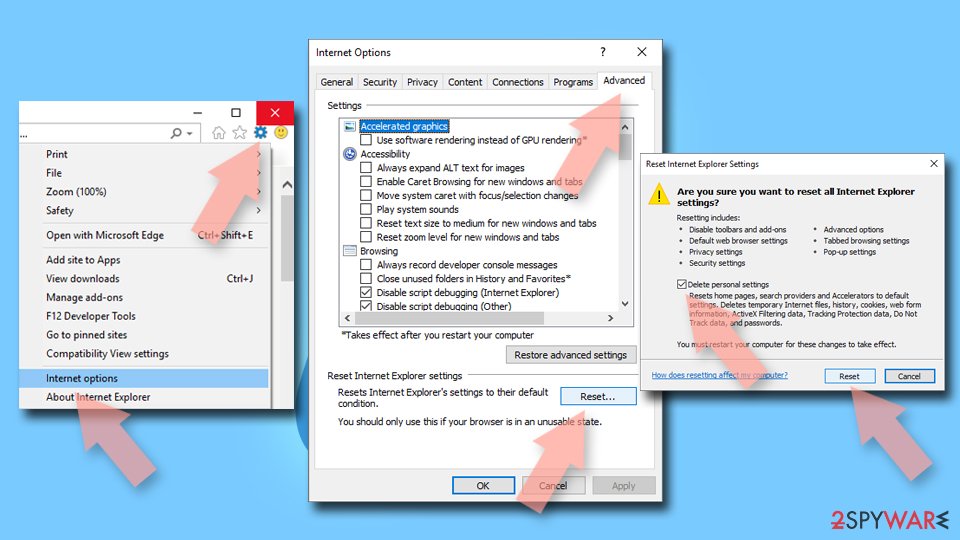
Reset Internet Explorer:
- Click on Gear icon > Internet options and select Advanced tab.
- Select Reset.
- In the new window, check Delete personal settings and select Reset.
Stream videos without limitations, no matter where you are
There are multiple parties that could find out almost anything about you by checking your online activity.
While this is highly unlikely, advertisers and tech companies are constantly tracking you online. The first step to privacy should be a secure browser that focuses on tracker reduction to a minimum.
Even if you employ a secure browser, you will not be able to access websites that are restricted due to local government laws or other reasons. In other words, you may not be able to stream Disney+ or US-based Netflix in some countries. To bypass these restrictions, you can employ a powerful VPN, which provides dedicated servers for torrenting and streaming, not slowing you down in the process.
Data backups are important - recover your lost files
Ransomware is one of the biggest threats to personal data.
Once it is executed on a machine, it launches a sophisticated encryption algorithm that locks all your files, although it does not destroy them. The most common misconception is that anti-malware software can return files to their previous states. This is not true, however, and data remains locked after the malicious payload is deleted.
While regular data backups are the only secure method to recover your files after a ransomware attack, tools such as can also be effective and restore at least some of your lost data.
From our report of Jul 2020 · not reviewed since
The tips on how to prevent browser-hijacking applications
The fact that the potentially unwanted application has an official website does not mean that it's not spread bundled with freeware at the same time.
Therefore, if you want to avoid browser hijacker and intrusive browser-based activities, you should change the thinking that the freeware installation procedure can be initiated by counting up to two.
Proper software installation habits can help you to block the installation of intrusive potentially unwanted apps, such as adware or browser hijacker. First of all, do not install freeware for the purpose and functionality of which is difficult to understand. If it is included in a virus or malware database by any security researchers, it must perform some inadequate behavior, so you'd better not install it.
Second of all, opt for the Advanced/Custom installation technique. Quick of Recommended installation disguises so-called "additional features" or "optional downloads" and allow their installation without a direct user's permission.
The advanced installation allows monitoring of the entire process, so you will most likely notice pre-selected statements saying that you agree to make portal.search-converterhd.com or feed.search-converterhd.com your default homepage and search site. It goes without saying that such offers have to be rejected.
From our report of Jul 2020 · not reviewed since
Suggestions for the SearchConverterHD uninstall methods
SearchConverterHD is a typical web browser's hijacker.
It infiltrates machines via freeware bundles, alters web browser's settings without authorization, and then promoted sponsored content to earn easy money. Such applications are not difficult to remove. However, stealthy replacement of browser's settings means that you have been tricked to download a bundle and, since its not clear what apps might have been installed, a full system scan with a professional anti-malware is recommended.
Nevertheless, it's possible to remove the SearchConverterHD virus from the system manually. It means that you have to take your time analyzing the apps that have recently been downloaded and uninstall each raising suspicions. Besides, scan the machine with afterward to recover the machine to the state prior to malware installation.
[GI=google-chromeThere are thousands of Google Chrome extensions, though not all of them are trustworthy. As in the case of SearchConverterHD hijack, people may be pushed into the risk of being exposed to unsafe domains. Therefore, restore your web browser's settings to minimize security risks.
Questions about SearchConverterHD
Is it safe to keep portal.search-converterhd.com as my search engine?
It is not recommended. Searches through portal.search-converterhd.com usually still return results, but the operator sees every query, often stores it with an identifier for your browser and shows extra ads or paid links. Some hijacked results lead to fake downloads or scam pages.
You also did not choose it, which means something changed your settings without asking and may still be installed. Set your own search engine back, remove the extension or program that set portal.search-converterhd.com, and check the browser's other settings, such as the start page and notification permissions, for further changes made at the same time.
Can portal.search-converterhd.com see my searches?
Yes. Every search typed into the address bar goes to portal.search-converterhd.com first, which is how it earns money. It can log the query, the time and an identifier for your browser, and some hijackers also collect the pages you visit through their extension.
The privacy policy of such sites usually allows sharing that data with partners. Once the hijacker is removed and your own search engine is set again, new searches no longer reach it. Searches already sent cannot be taken back, so avoid entering sensitive information until the clean-up is finished, and clear cookies afterwards.
Why do my searches go to portal.search-converterhd.com?
Because the browser's default search engine was changed to it. SearchConverterHD did that through an extension, a program or a browser policy, and as long as that source remains, the setting points to portal.search-converterhd.com.
The page then passes your query to a real search provider, so the results look almost normal, with extra sponsored links on top. Changing the search engine back on its own does not last, because the source resets it. Remove the extension or program first, then the policies if any, then set your own search engine.
Is it safe to keep searching with portal.search-converterhd.com?
We would not. Every query you type is logged by its operators and shared with their advertising partners, and the sponsored links at the top are chosen for payment, not relevance. Results that look like a download page or a support site may lead to scams.
The page will not damage Windows by itself, but there is no benefit in keeping it: the results come from another search engine anyway. Remove SearchConverterHD and use that search engine directly, by typing its address or choosing it in the browser settings.
Which browsers does SearchConverterHD affect?
We saw it in Chrome, Edge and Firefox. That does not mean the other browsers on your PC are safe: hijacker installers usually change every browser they find, and browser sync can carry an extension to other computers signed in to the same account.
Check the search engine, home page, new tab, extensions and policies in each browser you have, including ones you rarely open. Chrome and Edge profiles count separately, so switch to each profile and check it as well before you call the job done.
What does portal.search-converterhd.com know about me?
It knows what you searched for while it was your search engine, when, from which IP address and with which browser, and usually which results you opened. Tracking cookies let it connect those searches into a profile. It does not see your saved passwords or files.
After removing SearchConverterHD, delete the cookies and site data for portal.search-converterhd.com so the profile cannot be continued, and remove it from the browser's list of saved search engines. Signing out of important sites and back in also replaces session cookies.
I changed the search engine, but it switched back. Why?
The hijacker is still installed, and it rewrites the setting whenever the browser starts or the extension updates. Changing the setting is the last step, not the first. Find what controls it: the search settings page usually names the extension, and a greyed-out field means a policy.
Remove that source, restart the browser, then pick your search engine and delete the hijacker's entry from the list of saved search engines so it cannot be chosen by accident. Check again after a day, when extensions have had a chance to update.
The results look like Google or Bing. Is that real?
Partly. Many hijacker search pages pass your query to a real search engine and show its results, so the list looks familiar. What changes is the frame around it:
- extra sponsored links at the top
- the hijacker's own tracking
- sometimes a design that copies a known search engine
You can tell by the address bar. If it shows portal.search-converterhd.com or another unfamiliar domain instead of the search engine you know, the results come through a middleman. Remove SearchConverterHD and search directly.
Should I just switch to another browser?
It may not help. Installers that add hijackers usually target every browser on the PC, and system-level changes such as the hosts file, DNS or proxy affect all browsers at once. A new browser also leaves the hijacker's program and extension in place, collecting data in the old one.
Remove SearchConverterHD properly first. After that, use whichever browser you prefer; Chrome, Edge and Firefox all let you set and protect your own search engine. Import your bookmarks only after the old browser is clean.
Will Fortect remove SearchConverterHD?
Fortect scans Windows for malware and unwanted programs and repairs the system files and settings they change, and its free scan shows what it finds on your PC before you decide anything.
For SearchConverterHD, follow the plan above as well: the browser steps take back permissions and settings that no scanner treats as a threat, and uninstalling the program that brought it removes the source.
Run Microsoft Defender's full scan and, if anything was found, its offline scan as a second opinion. If the symptoms are gone after the plan and both scans are clean, there is nothing more to do.
Sources
- Arstechnica: Malicious Chrome extensions infect 100,000-plus users, again (read October 6, 2026)
- Virusai: SAUGUMO IR VIRUSŲ NAUJIENOS (read October 6, 2026)
- FTC: How to recognize, remove and avoid malware (read October 6, 2026)
- Microsoft Learn: Microsoft Defender Offline (read October 6, 2026)
- Microsoft Learn: How Microsoft names malware (read October 6, 2026)